


The cost of a merchant processing statement fee audit in the UAE depends on the scope of the review, transaction volume and the records available. Reviewing one provider’s statements differs from analysing multiple acquirers, settlement reports and fee categories. Any quote should reflect the payment setup and work involved, rather than a fixed tariff.
Before engaging a specialist, clarify what the review covers and how reporting complexity, transaction volume and engagement terms affect the work. This article outlines the main factors to consider so you can assess the scope and expected value of a merchant processing statement fee audit in the UAE.
Key Takeaways
• Understand how an auditor reviews financial statements and presents findings, so you can assess what a quoted engagement covers.
• Expect transaction volume, company size, account complexity and document quality to influence the work required.
• Compare quotes by scope, deliverables and engagement terms, and check which payment-related services are included.
• Use PaySelect’s payment cost review to assess payment fees and reports, whether or not you plan to change providers.
Understanding the Payment Fee Assessment and Report
A statement fee review examines provider statements and pricing terms, checks fee calculations, and compares the totals with sales records. It reconciles gross transactions against refunds and bank settlements, accounts for adjustments, and documents discrepancies with supporting evidence.
How a Professional Reviews a Merchant Processing Statement
A payment statement review checks whether processing charges match the merchant’s agreed pricing and transaction activity. It is different from a financial statement audit, which examines a company’s financial position. This review focuses on payment costs and settlement records.
The reviewer gathers statements, pricing schedules, transaction exports, settlement reports and relevant correspondence. Each fee description is matched to its pricing basis, then checked against the applicable terms. A charge listed under an unfamiliar label, for example, may need to be matched to the contract’s fee category before its treatment can be assessed.
The review also considers sales channels, transaction types and revenue patterns. A UAE business that accepts payments in stores and online may have separate records for each channel. For businesses with multiple entities, the reviewer identifies which entity owns each account and statement, keeping the findings tied to the right business rather than combining unrelated activity.
Reconciling Sales and Settlements
Reconciliation compares provider records with sales, refunds and deposits in the merchant’s bank accounts. This helps distinguish pricing discrepancies from differences caused by settlement timing or recordkeeping.
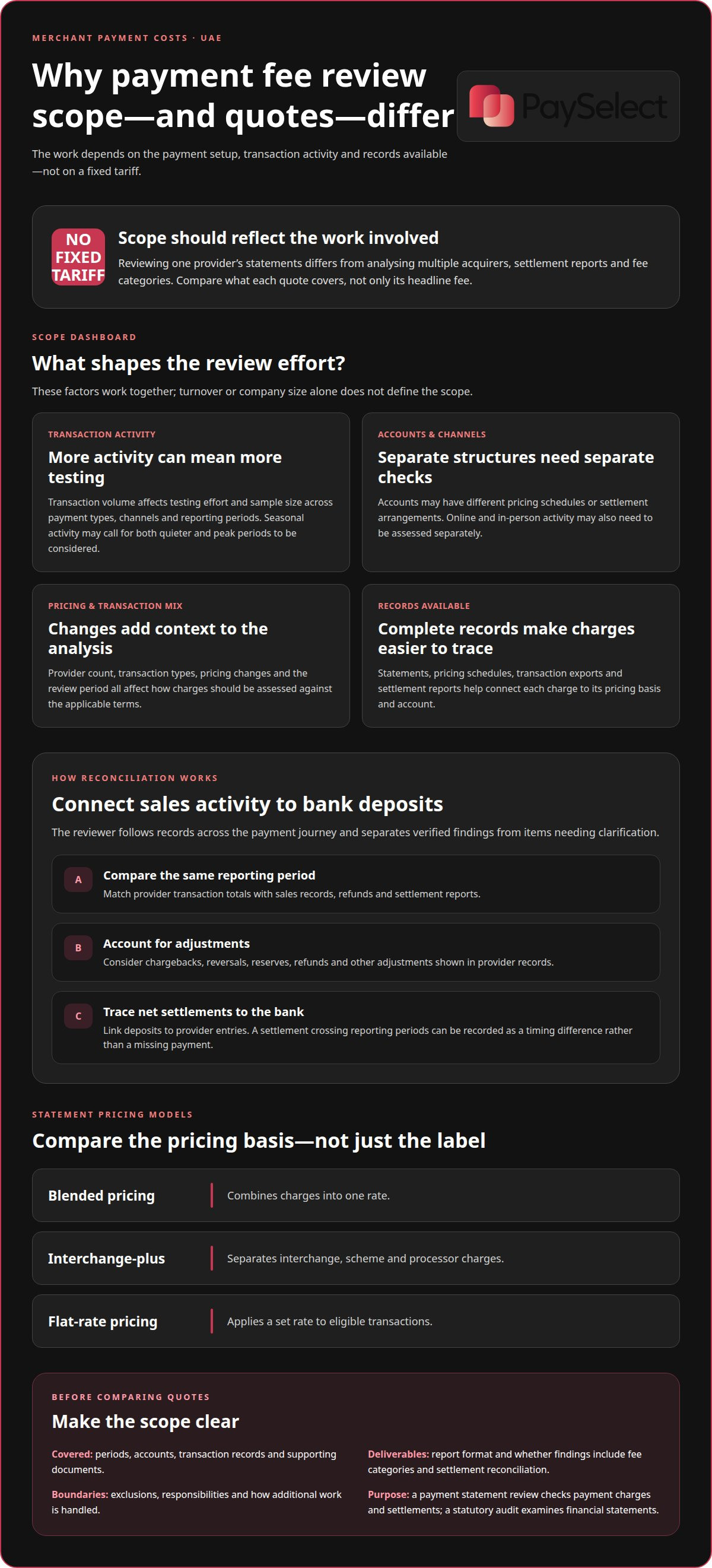
The reviewer compares transaction totals for the same reporting period, then accounts for refunds, chargebacks, reversals, reserves and adjustments in provider records. They trace net settlements to bank entries and identify deposits that combine multiple processing batches. If a settlement crosses reporting periods, they record it as a timing difference rather than treating it as a missing payment.
For example, a sales system may record a transaction in one period while the provider settles it later. The reviewer links the sale, provider entry and bank deposit using dates, batch references and amounts. They then investigate unmatched items, such as duplicate charges, unexplained deductions or refunds missing from the sales record.
The report separates verified findings from items needing clarification. It can show the fee category, affected statement period, supporting evidence, and the reason for each exception.
What Affects Audit Effort and Fees?
For a merchant processing statement fee audit in the UAE, transaction volume helps determine the testing effort and sample size. Higher activity can mean more transactions to assess across payment types, channels and reporting periods. A seasonal merchant, for example, may need a review covering both quieter and peak trading periods to show how costs change with volume.
The number of accounts also affects how the work is organised. Separate merchant accounts may have different pricing schedules or settlement arrangements, so each needs to be assessed against its own terms. Keeping online and in-person accounts separate, for example, can reveal differences in their cost patterns that an overall total might obscure.
Company size may indicate a wider payment operation, but it does not determine the review effort by itself. A small business with several channels and complex pricing may require more analysis than a larger merchant with consistent terms. Relevant factors include transaction mix, provider count, account structure, reporting periods and pricing changes during the review.
The available documents affect how directly a reviewer can assess these factors. Complete pricing schedules and statements help link each charge to its contractual basis. Transaction exports with consistent dates and account references make comparisons across periods easier. If provider terms changed during the review, the effective dates and revised schedule help assess each charge against the correct pricing.
For example, a merchant expanding from one sales channel to several may encounter a different mix of transaction types, accounts or provider charges. The review then needs to account for both the larger set of activity and the new structure. A clear scope identifies the channels, accounts and periods covered before work begins.
These factors explain why businesses with similar turnover can require different review efforts. One may have consistent records and a single pricing structure; another may have multiple accounts, changing terms and several transaction types. A merchant processing statement fee audit in the UAE should be scoped around the payment operation, not company size or transaction volume alone.
Comparing Audit Quotes and Engagement Scope
Compare proposals by scope, records reviewed, deliverables and exclusions, not just the headline fee. A merchant statement review examines payment charges and settlements, while a statutory audit examines financial statements. Identify which engagement you need before comparing terms.
These are market ranges for statutory audits, not quotes for payment statement reviews. Under Article 27(1) of the UAE Commercial Companies Law, every joint stock company and limited liability company must appoint at least one auditor annually. Free zones may also set audit requirements for licence renewal, where licensed UAE auditing firms such as Bin Hamad Mathew Joseph and Associates Chartered Accountants help businesses meet statutory filing standards.
Ask each audit firm to define the periods, accounts, transaction records, and supporting documents covered. The engagement terms should state the report format, exclusions, responsibilities, and how additional work is handled. For a statutory audit, confirm the signing firm and partner are registered under the applicable rules. For a payment review, clarify whether findings include transaction-level exceptions, fee categories, and settlement reconciliation.
Acquirer pricing models also affect how statements should be read. Blended pricing combines charges into one rate; interchange-plus separates interchange, scheme and processor charges; and flat-rate pricing applies a set rate to eligible transactions. Compare the pricing basis and included services, not just the labels.
Statements may show processing, payment gateway charges, refunds, chargebacks, monthly, or other contract-based charges. Card type and payment method can affect the applicable pricing, so compare statement lines with the signed schedule. Possible review points include repeated entries, unexplained adjustments, or charges that do not match agreed terms. Interchange and card-scheme charges follow their applicable schedules, rather than being set solely by the merchant.
For VAT, the UAE Federal Tax Authority states registration is mandatory when taxable turnover exceeds AED 375,000 in 12 months. Review VAT treatment against the provider’s invoice and the nature of each charge. Before applying card surcharges, assess the merchant agreement and applicable card rules; display customer prices clearly. A quote comparison should keep these compliance questions separate from the payment-cost review.
How PaySelect Can Help Review Payment Costs
PaySelect’s Payment Cost Optimization Audit helps merchants examine processing charges and settlement records without treating a provider switch as the default next step. A merchant processing statement fee audit in the UAE can help a business understand its current costs, interpret statement line items or prepare for a discussion with its provider.
The review brings transaction and settlement reports together with provider pricing information. PaySelect assesses how charges relate to the merchant’s payment activity and agreed terms, then identifies items that may need explanation, further analysis or negotiation. The findings give decision-makers a structured view of payment costs, rather than a list of statement entries without context.
The scope can reflect the merchant’s setup. A business using one provider may focus on existing processing costs and settlement patterns. A larger organisation with multiple acquirers, business units or international card acceptance may need a broader review across providers and payment flows. For enterprises handling cross-border commercial transfers or multi-currency settlements through platforms like keybs.io, auditing international fees is an essential step toward full cost visibility. In either case, the review connects reported costs with the operating model and highlights areas for closer analysis.
Relevant materials can include:
• Merchant statements and transaction reports
• Settlement reports and records that help explain payment flows
• Provider pricing schedules and relevant commercial terms
If a business sees a charge it cannot match to its pricing schedule, for example, the review can examine the fee category and supporting records. Comparing settlement reports with internal transaction data may also help explain differences between them. This gives the merchant a structured basis for discussing the issue with its provider, without assuming every discrepancy is an error or that switching is necessary.
A merchant processing statement fee audit in the UAE can help businesses decide whether to clarify a charge, benchmark existing terms or discuss pricing. PaySelect’s payment pricing comparison can help merchants assess alternatives against their requirements, while an audit can also support businesses that choose to retain their current provider.
Already have a payment provider? Speak with a PaySelect payments expert to review your fees and payment setup.
Frequently Asked Questions
So what will it cost?
There is no single standard price for a merchant statement review. The quote depends on the case and its scope, including statement periods, transaction volume, provider count, account structure and available records. Reviewing one payment setup differs from analysing multiple entities or acquirers. Compare quotes by coverage and deliverables, not just the headline amount.
What information is required to begin and complete an audit?
To define a review, provide the period, payment providers and accounts involved, and the questions you want answered. Useful materials include merchant statements, pricing schedules, transaction and settlement exports, refund and chargeback records, and relevant provider correspondence. Explain how internal sales reports are organised if they use different dates or reference formats. This context helps set a workable scope and interpret the records accurately.
How much time does it need to carry out an audit?
The time required depends on the review period, transaction volume, number of accounts and how consistently the records can be matched. Reviewing one provider with organised exports differs from analysing several providers and entities with separate reporting formats. The work plan should identify the records needed, review stages and any outstanding information, giving everyone a clear view of what may affect completion.
Which documents and data should a merchant provide to support a dispute over incorrect processing fees in the UAE?
Provide the provider agreement and pricing schedule, along with the statement showing the disputed charge. Add transaction-level records, settlement reports, bank entries, and relevant refund or chargeback evidence for the same period. A concise reconciliation identifying the fee, affected transactions and calculation difference can make the issue easier to assess. Keep related provider messages and earlier explanations together as supporting evidence.
Which UAE merchant statement fees are commonly hidden, duplicated, or negotiable?
Check for repeated entries, unexplained adjustments and charges that do not match the signed pricing schedule. The findings can support a commercial discussion with the current provider.
Disclaimer
This content is for informational purposes only and should not be considered financial, legal, or regulatory advice. Payment provider availability, pricing, and approval processes vary depending on individual business circumstances. PaySelect does not guarantee provider acceptance or specific outcomes. Businesses should conduct their own due diligence before entering into any agreements.
Empowering businesses to achieve greater growth
