
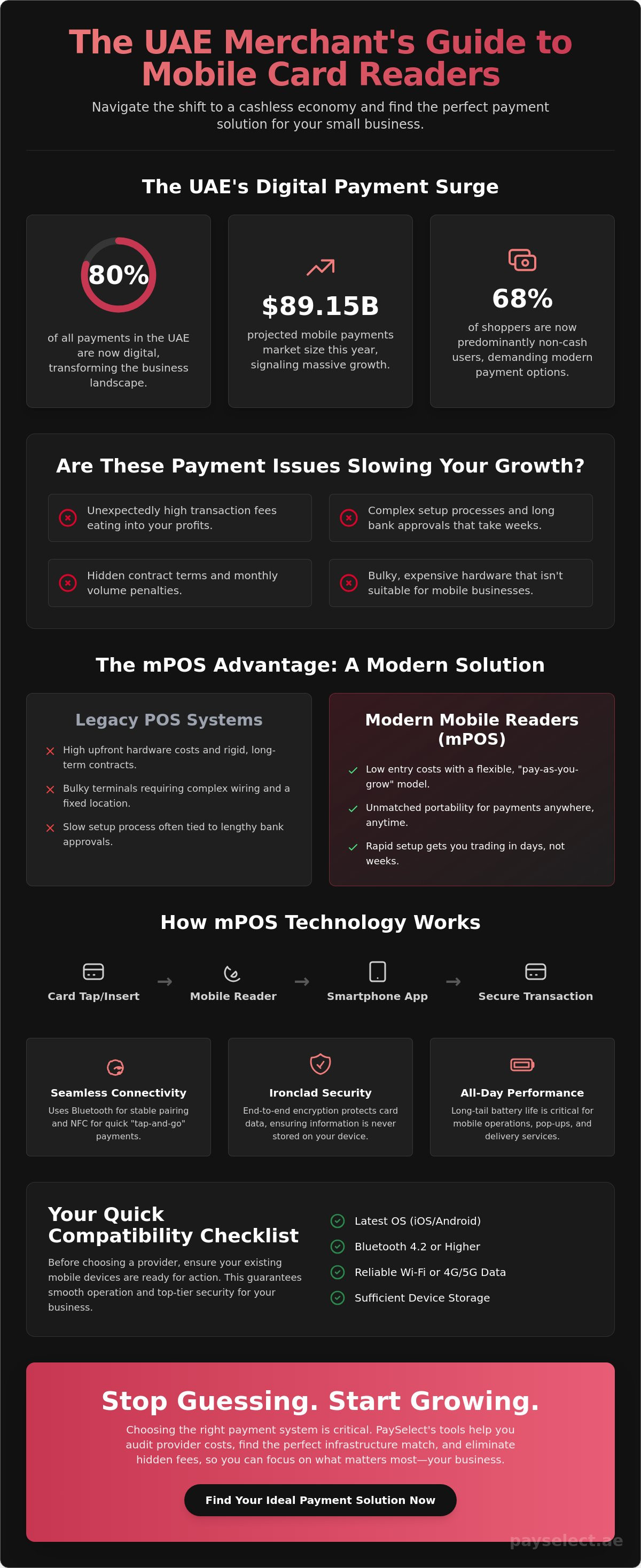
80% of all payments in the UAE are now digital. With the mobile payments market projected to hit USD 89.15 billion this year, securing a reliable mobile card reader for small business dubai is no longer optional. You likely recognize the shift toward a cashless economy, yet you're probably tired of high transaction fees and complex setup processes that stall your momentum. It's difficult to find a portable solution when contract terms feel hidden and bank approvals take weeks.
This 2026 merchant guide clarifies the path forward. You'll learn to select a mobile reader that balances low fees with fast settlement, ensuring your funds move as quickly as your sales. We'll explore the current fee landscape, the impact of the Digital Dirham, and the essential regulatory steps for UAE merchants. PaySelect helps you cut through the noise by using our payment gateway and POS system selection tools to find the most efficient infrastructure for your expansion. You'll gain a clear understanding of total ownership costs so you can focus on growth instead of hidden overhead.
Key Takeaways
• Identify why a mobile card reader for small business dubai is essential for modern operations and how it integrates with your existing mobile devices.
• Demystify the technical side of secure payments, focusing on how Bluetooth and NFC connectivity keep your transactions fluid and safe.
• Expose the components of the Merchant Discount Rate to understand your total cost of ownership and avoid unexpected monthly volume penalties.
• Develop a selection strategy based on your unique sales volume and feature requirements to ensure your payment solution scales with your growth.
• Leverage PaySelect’s POS system selection tool to audit provider costs and find the perfect infrastructure match for your business expansion.
The Rise of Mobile Card Readers for Small Business in the UAE
The UAE is rapidly becoming a cashless society. With 80% of all payments now made digitally, the demand for a reliable mobile card reader for small business dubai has surged. Mobile Point of Sale (mPOS) technology transforms a standard smartphone or tablet into a secure payment terminal. This innovation has empowered the local gig economy, freelancers, and SMEs—including premium event entertainers like Thomas McElroy - Magician & Mentalist—to accept payments anywhere, from bustling souks to high-end pop-up events. It's a shift driven by national digital initiatives aiming for a 90% digital transaction rate by 2026. This transition allows entrepreneurs to capture every sale, optimize their cash flow, and project a professional image instantly.
By integrating point-of-sale (POS) technology directly with mobile apps, businesses eliminate the need for bulky hardware. You can now manage transactions, track sales, and process refunds through a single interface. The primary advantages include:
• Unmatched portability for on-the-go services and deliveries.
• Significantly lower entry costs compared to legacy systems.
• Rapid setup processes that get you trading in days, not weeks.
Why Traditional POS is Not Always the Best Fit
Legacy terminals often come with high fixed costs and rigid contracts that drain small margins. For a growing enterprise, these overheads are often unsustainable. Mobile readers offer a "pay-as-you-grow" model, allowing you to scale your payment infrastructure alongside your revenue. By choosing a mobile-first approach, you reduce physical infrastructure requirements and bypass the complex wiring needed for older systems. If you're struggling with high fees or complex bank setups, PaySelect provides a POS system selection tool to help you find a more efficient, cost-optimized solution that removes operational barriers.
Meeting Modern Customer Expectations
Consumer behavior in the UAE has shifted permanently. 68% of shoppers are now predominantly non-cash users, an increase of 7% from last year. They expect contactless "tap-and-go" options and NFC-enabled payments at every touchpoint. Mobile readers excel here, providing a seamless experience during home deliveries or outdoor markets. Beyond the transaction, these devices allow you to issue digital receipts via SMS or email instantly. This builds trust, captures customer data for loyalty programs, and ensures your business reflects the cutting-edge standards of the Dubai digital economy.
Understanding mPOS Technology: How Mobile Readers Work
The technical foundation of a mobile card reader for small business dubai lies in the seamless synergy between compact hardware and sophisticated software. These devices act as a secure bridge, capturing encrypted card data and transmitting it to a dedicated mobile application on your smartphone or tablet. This process relies on industry-standard encryption protocols, ensuring that sensitive financial information is never stored directly on your phone. By utilizing end-to-end encryption, you protect your enterprise from liability while offering customers absolute peace of mind during every transaction.
Connectivity is the lifeblood of these systems. Most modern readers use Bluetooth to pair with your mobile device, while Near Field Communication (NFC) facilitates the "tap-and-go" payments that have become the norm across the UAE eCommerce market. For businesses operating in the field, such as delivery services or outdoor pop-ups, long-tail battery life is a critical specification. You need hardware that can withstand a full day of high-volume sales without requiring a recharge, ensuring your operations remain fluid and uninterrupted.
Connectivity and Compatibility Requirements
Before investing in hardware, you must verify technical compatibility with your existing mobile fleet. Many business owners consult tech comparison platforms like SuggestMeTech to understand how specific devices perform under real-world conditions. Most payment applications require recent versions of iOS or Android to maintain security compliance and operational speed. A stable internet connection is non-negotiable. While 4G or 5G is typically sufficient for mobile processing, a dedicated Wi-Fi network provides the lowest latency for high-traffic environments. Use this checklist to confirm your device is ready:
• Bluetooth 4.2 or higher for stable, low-energy reader pairing.
• Latest OS updates installed to support mandatory security patches.
• Sufficient local storage for the provider's payment application and updates.
• Active data plan or reliable Wi-Fi access in your primary sales locations.
Hardware Features to Look For
Choosing the right interface depends on your specific business environment. A physical keypad offers tactile reliability, which is often preferred for PIN entry in traditional retail settings. Conversely, a sleek touchscreen interface provides a modern aesthetic and is often more intuitive for staff already familiar with smartphones. Durability is also vital in the UAE's unique climate. Look for devices with reinforced casings and dust-resistant screens to ensure longevity. To see how different models stack up, explore PaySelect's POS machine comparison to find hardware that matches your operational needs. If you're unsure which technical specs matter most for your volume, our POS system selection tool can audit your requirements and suggest the ideal infrastructure match.
Evaluating the Real Costs: Transaction Fees and Hidden Charges
Hardware costs are only the tip of the iceberg. When you deploy a mobile card reader for small business dubai, the most significant expense is the Merchant Discount Rate (MDR). This fee is rarely a flat number; it's a composite of several layers. You pay the interchange fee to the card-issuing bank, a scheme fee to Visa or Mastercard, and a processor markup. Market data from 2026 shows that the general MDR for Visa and Mastercard in the UAE typically ranges between 1.8% and 3.5%. Understanding these layers is vital because it determines how much of each sale actually reaches your business account.
Hidden charges often erode small margins. Many merchants overlook minimum monthly volume requirements, which penalize you if your sales dip below a specific threshold. You might also encounter statement fees, payout fees, or PCI compliance charges that aren't immediately obvious. The UAE Fintech Regulations provide the framework for these operations, yet fee transparency remains a challenge for many entrepreneurs. As your transaction volume increases, your bargaining power grows. High-volume merchants can often move from standard flat-rate pricing to a more transparent interchange-plus model, significantly reducing the total cost of ownership.
Common Fee Structures in the UAE Market
Providers generally offer two paths. The "no monthly fee" model is attractive for new businesses because it eliminates fixed overhead. However, it often carries higher transaction costs, sometimes reaching 2.85% plus a fixed AED 1.00 fee per sale. Once your business scales, a monthly subscription model usually becomes more cost-effective. You pay a set monthly fee in exchange for a lower Merchant Discount Rate. It's also important to distinguish between domestic and international card fees. International cards often carry foreign exchange margins and higher processing rates, which can push your total cost per transaction above 3.5%.
Protecting Your Margins
To truly understand your expenses, you must calculate your "Effective Rate." This isn't the headline rate your provider quoted you. Use this simple formula: divide your total monthly fees by your total monthly sales, then multiply by 100. If your headline rate is 2.2% but your Effective Rate is 3.1%, hidden fees are eating your profits. Transparent reporting is your best defense against billing errors and unexpected surcharges. If you're managing both physical and digital sales, use PaySelect's payment gateway fee comparisons to audit your entire infrastructure. Our tools allow you to perform a payment cost optimization audit, ensuring you don't overpay for the convenience of mobile processing.
How to Choose the Right Mobile Card Reader for Your Business
Selecting the right mobile card reader for small business dubai is a strategic decision that directly impacts your daily cash flow and operational agility. You shouldn't choose hardware based on aesthetics alone. Instead, follow a structured framework to ensure your payment infrastructure supports your growth objectives. Start by analyzing your average transaction value and monthly sales volume. As established in our cost analysis, your volume dictates whether a flat-rate or an interchange-plus model is more sustainable for your margins.
Execution requires a five-step evaluation process to avoid common pitfalls:
Step 1: Volume Analysis.
Match your fee structure to your transaction frequency to prevent overpaying on small tickets.
Step 2: Feature Mapping.
Identify if you need advanced capabilities like real-time inventory tracking or multi-staff accounts.
Step 3: Settlement Velocity.
Evaluate the provider's payout schedule. While T+1 or T+2 is standard, the retail launch of the Digital Dirham in March 2026 has introduced options for instant merchant settlement.
Step 4: Support Reliability.
Assess the hardware replacement policy. Every hour of downtime is a lost opportunity for revenue.
Step 5: Contract Transparency.
Review the fine print for exit clauses and hidden termination fees before committing to a long-term partnership.
Industry-Specific Considerations
Different sectors require different hardware strengths. Retailers should focus on inventory synchronization and barcode scanning to maintain accuracy across sales channels. Service providers, such as consultants or technicians, often prioritize ease of tipping and a robust mobile app interface. For those operating at events or pop-up markets, battery longevity and an "offline mode" are non-negotiable. These features ensure you can process payments even when connectivity is intermittent in high-traffic areas.
Integration with Business Ecosystems
Your mobile reader shouldn't operate in a vacuum. It must communicate with your accounting software and CRM to automate reconciliation and customer data collection. A unified dashboard that combines your online and offline sales provides a holistic view of your performance. If your business serves the high volume of international tourists in the city, consider your cross-border payment needs to handle multiple currencies efficiently. Using a centralized system reduces manual entry errors and frees up your time for strategic expansion. To find the perfect fit for your specific requirements, use PaySelect's POS system selection tool to compare the market's leading infrastructure options.
Optimizing Your Payment Setup with PaySelect
The fintech landscape in the UAE moves fast. Selecting a mobile card reader for small business dubai is only one piece of the puzzle. To truly scale, you need a payment setup that remains fluid and cost-effective. PaySelect serves as an independent advisor, bridging the gap between complex global infrastructures and your intuitive business needs. We don't process payments. Instead, we provide the tools you need to audit, compare, and optimize your entire financial stack. Our role is to act as an elite facilitator, ensuring you move toward a more efficient operational model without hesitation.
Our platform simplifies the selection process through targeted tools like our POS system selection tool. By answering a few specific questions about your operations, you can identify the most efficient infrastructure match for your specific volume. This data-driven approach removes the guesswork from your decision-making. It ensures that every technical utility you implement acts as a strategic tool for transformation rather than a hidden cost center. We focus on your ultimate business outcome, providing the structural clarity required to lead your enterprise forward.
The Power of Transparency
Many entrepreneurs find themselves locked into contracts with hidden operational barriers. PaySelect provides unbiased data to empower you. We allow you to compare multiple providers in a single view, highlighting the differences in fee structures and settlement speeds. This transparency is essential for identifying hidden costs in merchant statements that often go unnoticed. By using our payment cost optimization audit, you can pinpoint exactly where your margins are being eroded. We're committed to helping SMEs reduce these barriers, fostering a sense of calm assurance as you expand into new markets.
Next Steps for Your Business
Efficiency is a competitive advantage. Your next move should be a thorough audit of your current payment expenses. If you haven't reviewed your merchant statements lately, you're likely overpaying for basic services. Use our comparison tools to see how your current rates stack up against the broader market. This proactive approach ensures your business remains lean and ready for the implementation of new technologies. Don't let complex technical solutions stall your momentum. Take the first step toward a more portable and reliable payment solution today. Find the perfect mobile reader for your business with PaySelect and secure a long-term partner for your payment infrastructure growth.
Secure Your Competitive Edge in the UAE Digital Economy
The UAE payment landscape is evolving at a rapid pace. Success depends on moving beyond basic hardware and mastering your backend fee structures. You've learned that the right mobile card reader for small business dubai is defined by its ability to integrate with your existing systems while protecting your margins from hidden transaction costs. By prioritizing settlement speed and contract transparency, you position your business for sustainable expansion in a cashless market. Technical utility should always serve as a strategic tool for transformation rather than an operational burden.
PaySelect specializes in the UAE payment landscape, offering an independent and unbiased comparison for both SMEs and enterprise organizations. Our tools help you remove operational barriers and optimize your financial infrastructure with absolute precision. We act as a bridge between complex global infrastructures and your strategic growth needs, ensuring you have the data required to make confident decisions. Your business deserves a payment setup that is as ambitious as your vision. Take the PaySelect Test to find your ideal payment provider and gain the clarity required for your next phase of growth. The future of commerce is digital, and your business is ready to lead it.
Frequently Asked Questions
Is it legal to use a mobile card reader for a home-based business in the UAE?
Yes, it's legal provided you hold a valid UAE trade license. This document is a mandatory legal prerequisite for opening any merchant account. The UAE Central Bank's "Retail Payment Services and Card Schemes Regulation" mandates that all payment activities are tied to a licensed entity. Home-based entrepreneurs must ensure their license permits commercial activity to remain compliant with local anti-money laundering frameworks.
How long does it take to get a mobile card reader approved and delivered?
Approval times depend heavily on the provider's onboarding infrastructure. Modern fintech providers often approve accounts within 48 to 72 hours. Traditional institutional banks may take several weeks due to rigorous manual verification processes. Once approved, hardware delivery typically occurs within 2 to 5 business days. Using PaySelect's comparison tools helps you identify providers known for rapid deployment to minimize your operational downtime.
Can I use a mobile card reader without a corporate bank account?
You cannot use a mobile card reader without a corporate bank account. UAE regulations require that funds from commercial transactions are settled into an account held in the business's legal name. This structure facilitates transparent financial tracking and regulatory compliance. If you're setting up a mobile card reader for small business dubai, ensure your corporate banking is active before applying for a merchant terminal.
What happens if my mobile card reader loses internet connection during a sale?
Most mobile readers require an active 4G, 5G, or Wi-Fi connection to authorize transactions in real-time. If the connection drops, the payment will likely fail. While some advanced hardware offers an "offline mode" for store-and-forward processing, this is less common due to the risk of subsequent card declines. Maintaining a stable mobile data plan is essential for ensuring fluid customer experiences at the point of sale.
Are there any specific security standards a mobile reader must meet in the UAE?
Mobile readers must comply with global PCI-DSS standards and local UAE Central Bank regulations. These frameworks ensure that every transaction uses end-to-end encryption to protect sensitive cardholder data. Hardware must also support EMV chip and NFC contactless protocols. These security layers prevent data breaches and inspire absolute confidence in your customers while they utilize modern digital payment methods.
Do mobile card readers support digital wallets like Apple Pay and Samsung Pay?
Yes, modern mobile readers fully support digital wallets through NFC technology. This includes Apple Pay, Google Pay, and Samsung Pay, which are used by a significant portion of the UAE's 80% digital payment user base. Offering these options is a strategic advantage, as 68% of consumers now prefer non-cash methods. Digital wallet support ensures your business remains compatible with the fast-moving digital landscape.
What is the average transaction fee for small businesses using mobile readers?
Small businesses typically see transaction fees ranging from 2.2% to 2.9% plus a fixed AED 1.00 fee. However, the total cost of ownership for a mobile card reader for small business dubai can climb to 3.55% after accounting for foreign exchange margins and settlement fees. PaySelect's pricing comparison tool allows you to audit these rates across different providers to find the most cost-effective solution for your specific volume.
Can I accept international credit cards with a local mobile card reader?
You can accept international credit cards, though they often carry higher processing costs. Providers typically charge an additional margin for cross-border transactions and currency conversion. If your business serves international tourists, it's vital to compare how different providers handle these fees. PaySelect's cross-border payment solution matching can help you identify which infrastructure minimizes these specific expenses to protect your overall profit margins.
Disclaimer
This content is for informational purposes only and should not be considered financial, legal, or regulatory advice. Payment provider availability, pricing, and approval processes vary depending on individual business circumstances. PaySelect does not guarantee provider acceptance or specific outcomes. Businesses should conduct their own due diligence before entering into any agreements.
Empowering businesses to achieve greater growth