
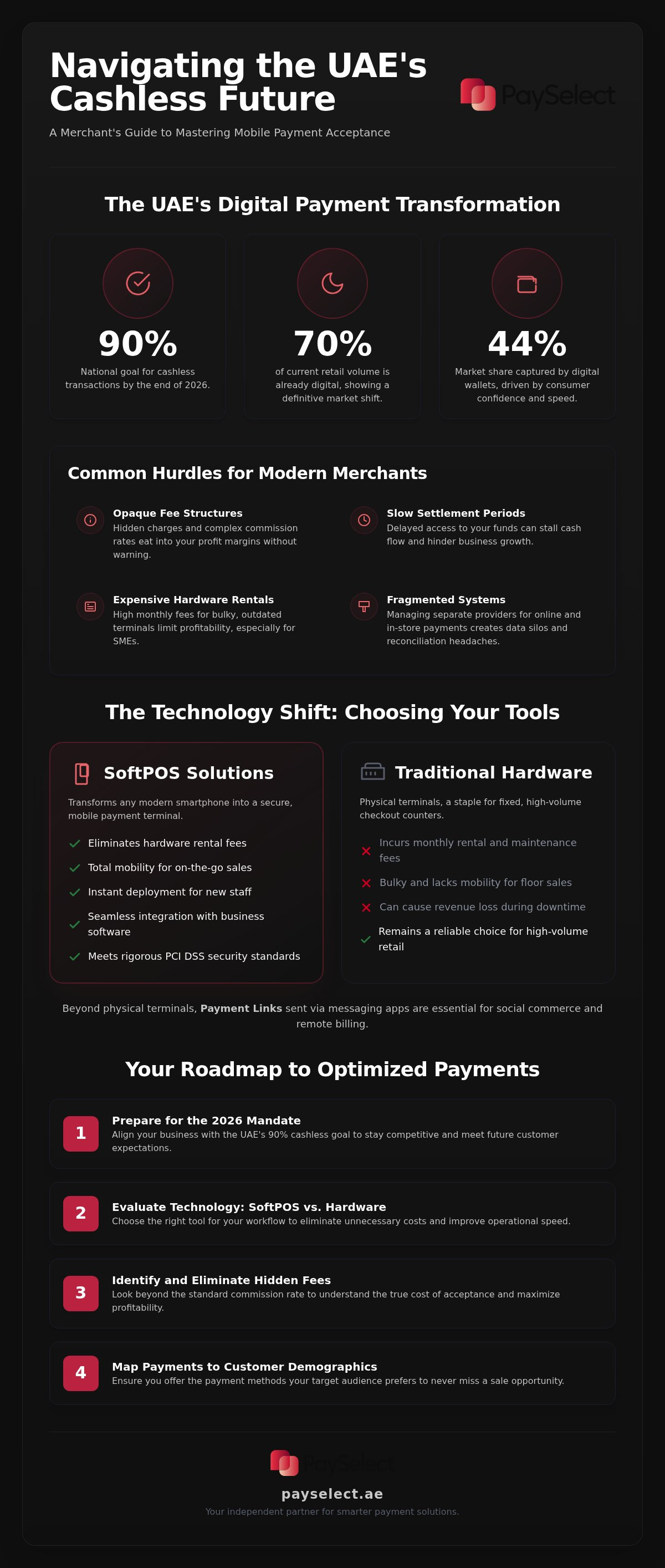
Did you know the UAE government aims for 90% of all transactions to be cashless by the end of 2026? This rapid shift means that mastering mobile payment acceptance uae is now a critical strategic priority for every merchant. Digital wallets already command nearly 44% of the market, signaling a clear move toward a more fluid, digital-first economy.
You're likely tired of dealing with opaque fee structures and hidden charges that eat into your margins. It's frustrating when slow settlement periods stall your cash flow or when you're tied down by expensive hardware rentals that don't fit your modern workflow. These operational barriers shouldn't hold your business back from expanding in a fast-moving landscape.
This guide will show you how to take control of your payment strategy. You'll learn to master the complexities of the local landscape and discover how to optimize your infrastructure for maximum efficiency and minimum cost. We'll examine the latest regulatory changes and compare the different paths to achieving lower merchant discount rates. By the end, you'll have a clear roadmap for seamless integration and faster access to your funds.
Key Takeaways
• Understand why 70% of retail volume in the Emirates is now digital and how to prepare for the 2026 cashless mandate.
• Evaluate the benefits of SoftPOS technology versus traditional hardware to eliminate bulky rentals and improve operational speed.
• Identify hidden fees beyond the standard commission rate to optimize your mobile payment acceptance uae for maximum profitability.
• Use a strategic framework to map payment methods against customer demographics, ensuring you never miss a sale.
• Leverage independent comparison tools to find the most cost-effective payment partners without biased provider influence.
The State of Mobile Payment Acceptance in the UAE
The Emirates has reached a definitive tipping point in its financial evolution. As of July 2026, digital payments represent nearly 70% of retail volume, proving that the era of cash dominance has ended. Business owners are no longer just looking for a way to process cards; they're building fluid digital ecosystems. Modern mobile payment acceptance uae requires a strategic blend of NFC technology, digital wallets, and remote payment links to stay competitive. The market is projected to hit $79.6 billion by the end of the year, fueled by a clear national vision for a 90% cashless society.
For a foundational overview of mobile payments, one can see how the global shift toward proximity-based transactions has mirrored the UAE's own rapid adoption. In the context of the UAE’s 2026 digital standards, mobile payment acceptance is the seamless integration of NFC, QR code, and link-based technologies into a unified merchant infrastructure that prioritizes speed and security. Optimizing your mobile payment acceptance uae isn't just about saving on fees; it's about removing the friction that stops a customer from completing a purchase.
Drivers of Digital Adoption
Government-led initiatives are the backbone of this transformation. The Central Bank of the UAE has implemented strict standards to ensure every transaction is secure, moving the industry toward biometric and app-based verification by March 2026. This regulatory clarity gives consumers the confidence to use digital wallets, which now capture 44% of the market. These tools don't just provide security; they offer the speed that modern shoppers expect. When a customer can pay with a thumbprint or a watch, your checkout line moves faster and operational efficiency climbs.
Merchant Pain Points in the Current Market
Operating a business in this fast-paced environment reveals specific friction points. Many merchants feel trapped by legacy hardware. High monthly rental fees for bulky terminals eat into profits, especially for SMEs. Maintenance delays can halt sales for hours, causing immediate revenue loss. There's also the challenge of fragmented systems. Managing different providers for online gateways and physical stores creates a data nightmare that complicates reconciliation.
Legacy systems often fail to support the newest local payment rails, leaving a gap between what customers want and what merchants can provide. Transitioning to software-defined infrastructure is the logical next step for growth. If you're currently dealing with expensive hardware, utilizing a POS machine selection tool can help you identify more agile, cost-effective options that match your specific transaction volume and customer demographics.
Mobile Acceptance Technologies: SoftPOS vs. Hardware
The choice between physical terminals and software-based solutions defines your operational agility. While traditional hardware remains a staple for high-volume retail, SoftPOS is rapidly gaining ground. This technology transforms a standard smartphone into a secure payment terminal, eliminating the need for bulky, expensive hardware rentals. According to recent UAE mobile payments market analysis, the shift toward these agile solutions is a key driver in the region's expansion. Merchants can now accept payments anywhere on the shop floor or at the customer's doorstep without carrying extra equipment, which is essential as the market approaches a projected US$79.6 billion value by the end of 2026.
The Mechanics of SoftPOS
SoftPOS relies on Near Field Communication (NFC) to facilitate secure, encrypted transactions directly on a mobile device. These systems meet rigorous PCI DSS security standards, ensuring that sensitive card data is never stored on the phone itself. Instead, the data is tokenized and encrypted during transit, providing a level of security that matches traditional chip-and-pin terminals. For merchants, the benefits are immediate. You gain total mobility, lower entry costs, and the ability to deploy new terminals instantly across your sales team. Most modern software solutions integrate directly with your existing inventory and accounting platforms, creating a unified data stream that simplifies end-of-day reconciliation. This connectivity removes the manual errors often associated with legacy systems.
Alternative Mobile Acceptance Channels
Effective mobile payment acceptance uae isn't limited to physical proximity. Payment links have become essential for social commerce and remote billing. You can send a link via WhatsApp or email, allowing customers to pay securely from their own devices. This is particularly useful for service-based businesses or B2B vendors who require deposit payments before fulfillment. For micro-merchants or temporary pop-ups, QR codes offer a low-cost implementation path. Customers simply scan a code to trigger a mobile wallet payment, streamlining the customer journey by removing the need for physical card handling. Digital wallets currently capture nearly 44% of the market share, making QR and link-based acceptance a strategic necessity rather than an optional add-on.
The evolution of modern POS machines into mobile-first tools means businesses can now mix and match technologies based on specific use cases. Some providers focus on high-speed hardware for heavy footfall, while others prioritize software-only solutions for maximum flexibility. If you're unsure which hardware or software configuration fits your budget, using a POS machine selection tool can provide the clarity needed to make an informed decision without being pushed toward a specific brand's proprietary hardware.
Evaluating the Real Cost of Mobile Payments
Achieving efficient mobile payment acceptance uae requires looking past the headline transaction rate. Most merchants focus solely on the Merchant Discount Rate (MDR), yet the real impact on your bottom line often comes from less obvious sources. Setup fees, monthly service charges, and per-transaction processing fees can quickly accumulate, especially for businesses with high transaction volumes. These costs aren't always transparent during the initial signup, making it essential to conduct regular audits of your payment infrastructure to identify and eliminate financial leakage.
Cash flow remains the ultimate metric for business health. When a provider holds your funds for three to five days, they're essentially using your capital interest-free while you wait for liquidity. For high-growth businesses, slow settlement speed acts as a hidden cost that restricts your ability to restock inventory, pay staff, or invest in expansion. Selecting a partner that offers faster access to funds is often more valuable than a slightly lower commission rate. This fluidity ensures your operations keep pace with the rapid growth of digital commerce in the UAE.
Currency conversion markups present another significant overhead, particularly in the UAE's tourist-heavy economy. If your provider applies a high spread on international cards, you're losing a percentage of every dirham spent by global visitors. Cross-border transactions require a specific strategy to minimize these markups. By optimizing your mobile payment acceptance uae to handle international wallets and cards more efficiently, you can protect your margins from being eroded by unfavorable exchange rates and hidden banking fees.
Understanding Fee Structures
Interchange fees are set by card networks and paid to the issuing bank, while markup fees represent the payment provider's profit. Distinguishing between the two is vital for effective negotiation and cost control. Mobile-first security features, such as biometric authentication and tokenization, significantly reduce the risk of fraudulent chargebacks. These secure protocols don't just protect your reputation; they prevent the administrative costs and lost revenue associated with disputed transactions. Implementing robust authentication is a strategic move to lower your overall cost of acceptance.
Compliance and Regulatory Costs
The Central Bank of the UAE maintains rigorous standards for retail payment services to ensure market stability and consumer protection. Maintaining PCI DSS Level 1 compliance is non-negotiable in mobile environments to safeguard data and avoid substantial penalties. Reviewing payment gateway options allows you to identify partners who include these compliance costs within their standard service rather than adding them as separate line items. This approach ensures you meet 2026 regulatory deadlines without incurring unexpected operational overhead or technical debt.
A Strategic Framework for Choosing a Provider
Selecting a partner for mobile payment acceptance uae shouldn't be a matter of convenience; it's a data-driven decision that impacts your long-term scalability. The market is crowded with providers offering similar-sounding features, but the differences in their underlying infrastructure can create significant operational gaps. To find the right fit, you need a structured approach that prioritizes your specific business metrics over generic marketing promises. Use the following five-step framework to evaluate potential partners and ensure your choice supports your 2026 growth targets.
Step 1: Analyze transaction volume and ticket size.
High-volume merchants need low per-transaction fees, while those with high average ticket sizes should focus on percentage-based commission caps.
Step 2: Map payment methods against demographics.
Ensure your provider supports the specific wallets and local payment rails your customers actually use.
Step 3: Evaluate integration capabilities.
Determine if you need the deep customization of a REST API or the speed of a pre-built SDK for mobile apps.
Step 4: Assess settlement terms.
Liquidity is the lifeblood of retail; prioritize providers that offer T+1 or T+2 settlement to keep your cash flow fluid.
Step 5: Review scalability.
Look for partners that can handle regional expansion and cross-border transactions without requiring a complete system overhaul.
Matching Technology to Business Scale
Solopreneurs and micro-merchants often thrive with SoftPOS solutions that turn a phone into a terminal with zero upfront capital. However, enterprise-grade organizations require unified dashboards that consolidate reporting across multiple physical and digital sales channels. This structural clarity is essential for managing complex reconciliation and inventory tracking. For businesses looking to expand their footprint beyond the Emirates, evaluating cross-border payment solutions early in the selection process prevents the technical debt of a future migration. Your technology must grow with your ambition, not restrict it.
Technical Integration and Support
The choice between a no-code solution and a custom API integration depends on your internal technical resources. No-code payment links allow for immediate deployment in social commerce, while custom APIs enable a frictionless, branded checkout experience. In the local market, having access to responsive technical support is a non-negotiable requirement. When a system goes down during a peak shopping period, you need a partner with a local presence who understands the regional regulatory landscape. Future-proofing your mobile payment acceptance uae means choosing a provider that is already compatible with 2026 mandates, such as advanced biometric verification and instant account-to-account transfers.
To find the provider that matches your specific business profile, compare payment gateway options using our independent tool to filter by cost, features, and settlement speed.
Optimizing Your Infrastructure with PaySelect
The Emirates’ financial market is crowded, fast-paced, and often opaque. Finding the right configuration for mobile payment acceptance uae shouldn't involve trial and error or expensive mistakes. PaySelect operates as an independent digital platform based in the UAE, providing the transparency needed to make informed strategic decisions. By remaining neutral, we ensure that your selection is based on performance data and cost-efficiency rather than biased sales incentives. Our platform removes operational barriers, allowing you to focus on expansion while we handle the technical complexities of infrastructure matching.
The Independent Advantage
Neutral guidance is essential for optimizing merchant discount rates and protecting your profit margins. Traditional providers often lead with their own proprietary systems, which might not be the most cost-effective choice for your specific transaction volume or average ticket size. PaySelect’s data-driven approach replaces guesswork with structural clarity. Through a Payment Cost Optimization Audit, we identify hidden fees, analyze settlement speeds, and pinpoint areas where you're overpaying for compliance. This independent perspective ensures your payment stack is lean, fast, and fully integrated. Our infrastructure audits lead to significant savings by identifying inefficient routing and redundant service charges that often go unnoticed in monthly statements. We empower businesses to:
• Identify and eliminate redundant monthly hardware rental fees.
• Negotiate better terms based on independent, real-time market data.
• Accelerate access to capital through partners offering faster settlement.
Next Steps for UAE Merchants
Taking the first step toward a more efficient payment stack is straightforward. You can utilize our proprietary 'Take the Test' matching tool to instantly align your business needs with the ideal payment partner. This tool acts as the starting point for any robust payment strategy, whether you're a boutique retailer or a large-scale hotel group. For enterprises with more complex requirements, our specialized advisory services provide bespoke audits to refine your entire digital ecosystem. We offer a Payment Gateway Comparison Tool and a POS System Selection Tool to ensure every piece of your infrastructure is optimized for performance.
Preparing for a consultation involves gathering your current transaction data and identifying your primary pain points, such as high commission rates or delayed funds. Using our tools provides the objective data needed to benchmark your current setup against the rest of the market. This process ensures you aren't just following trends, but making choices that directly improve your bottom line. PaySelect bridges the gap between complex global infrastructure and the intuitive needs of modern entrepreneurs by delivering simple, manageable, and ready-to-implement solutions.
Future-Proofing Your Payment Strategy
The 2026 landscape demands more than just a terminal; it requires a strategic approach to liquidity and cost control. By transitioning to software-defined infrastructure and identifying hidden fees, you can protect your margins while meeting the high expectations of UAE consumers. Mastering mobile payment acceptance uae is about building a foundation that scales with your ambition and removes friction from every transaction. The shift toward a digital-first economy is an opportunity to streamline your operations and improve cash flow fluidity.
PaySelect provides the independent and unbiased advisory you need to navigate this complex market with absolute confidence. Our expert-led infrastructure audits and tailored matching tools ensure you aren't just choosing a provider, but optimizing your entire financial operation for maximum performance. Don't let operational barriers or opaque pricing structures stall your progress in the region's fast-moving digital economy. You have the tools to turn technical utility into a strategic competitive advantage.
Take control of your growth today. Find your ideal payment partner with PaySelect's comparison tool and build a more efficient, cost-effective checkout experience. The UAE's digital future is here, and your business is ready to lead it.
Frequently Asked Questions
What is the average transaction fee for mobile payment acceptance in the UAE?
Transaction fees for mobile payment acceptance uae generally range from 1.5% to 2.9% for contactless transactions; however, some providers may also include a fixed fee of approximately AED 1 per tap. Gateway commission rates can vary more widely, often between 1.5% and 4.5% depending on your industry and volume. These rates aren't static, so comparing different provider structures is the only way to ensure you aren't overpaying for your specific transaction profile.
Can I accept mobile payments in the UAE without a physical POS machine?
You can definitely accept payments without a traditional terminal by using SoftPOS technology, which turns any NFC-enabled smartphone into a secure payment point. Remote payment links and QR codes also allow you to facilitate transactions without any physical contact or expensive hardware. These software-based solutions are ideal for delivery services and social commerce businesses that prioritize mobility and want to avoid monthly hardware rental costs.
How long does it take to settle funds from mobile payments into a UAE bank account?
Standard settlement periods typically fall between one and five business days, though many modern providers now offer T+1 settlement for improved liquidity. Fast access to funds is a major differentiator between payment partners. If your current setup involves long delays, it can create a significant bottleneck in your cash flow, making it harder to manage inventory or cover immediate operational expenses.
Is SoftPOS technology secure for high-volume retail businesses?
SoftPOS is built on rigorous PCI DSS security standards and uses advanced tokenization to ensure that sensitive card data is never stored on the merchant's phone. The system encrypts every transaction at the point of contact, providing the same level of security as a traditional chip-and-pin machine. With the CBUAE mandating app-based and biometric authentication by March 2026, these software-driven mobile payment acceptance uae tools are becoming the benchmark for secure retail commerce.
Do I need a separate license to accept international mobile payments?
Merchants don't require a separate license, but you must ensure your payment provider is fully licensed by the Central Bank of the UAE to handle international card schemes and wallets. Your infrastructure should be optimized to recognize and process global digital wallets and international cards efficiently. Be sure to check for currency conversion markups, as these can act as a hidden cost when dealing with the UAE's high volume of international tourists.
What are the hidden costs associated with mobile payment gateways?
Hidden costs often include setup fees, monthly maintenance charges, and per-transaction processing fees that aren't always highlighted in the headline commission rate. You might also encounter fees for chargebacks, refunds, or PCI compliance penalties if your system isn't managed correctly. Conducting a regular audit of your payment infrastructure helps you identify these extra charges and switch to a more transparent provider that aligns with your actual sales volume.
How does the Central Bank of the UAE regulate mobile payment providers?
The Central Bank of the UAE regulates the industry through the UAE Banking Law, specifically Federal Decree-Law 6 of 2025. This law mandates that all retail payment service providers meet specific security and operational standards, with a key licensing deadline set for September 16, 2026. These regulations focus on protecting consumer data and ensuring that all providers move toward more secure, biometric-based authentication methods to maintain market stability.
Which mobile payment methods are most popular among UAE consumers in 2026?
Global digital wallets are the most used method, currently representing nearly 44% of the market share. Local digital wallets and Buy Now, Pay Later (BNPL) services are also essential for merchants who want to cater to regional consumer preferences. Additionally, real-time account-to-account payment systems are gaining rapid traction as the country moves toward its national objective of 90% cashless transactions by the end of 2026.
Disclaimer
This content is for informational purposes only and should not be considered financial, legal, or regulatory advice. Payment provider availability, pricing, and approval processes vary depending on individual business circumstances. PaySelect does not guarantee provider acceptance or specific outcomes. Businesses should conduct their own due diligence before entering into any agreements.
Empowering businesses to achieve greater growth