


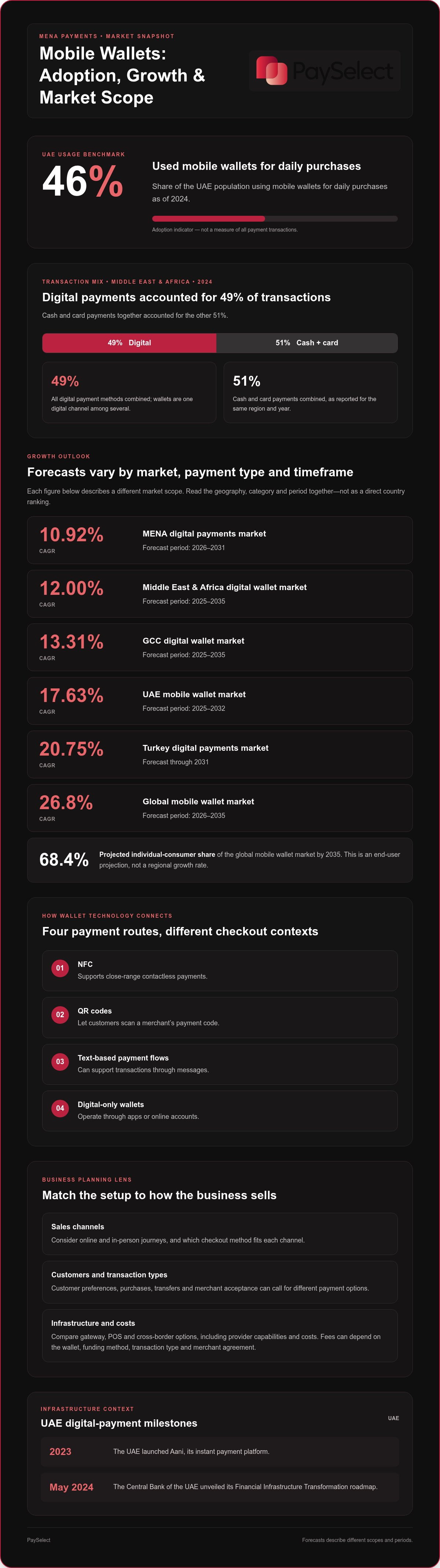
The UAE launched its Aani instant payment platform in 2023, adding real-time transfers to the digital payment options reshaping the region. The mobile wallet payments growth in the Middle East is driven by this expanding payment infrastructure, wider digital access and changing consumer habits. Across the Middle East and North Africa, the digital payments market is forecast to grow at a 10.92% CAGR from 2026 to 2031.
Growth in mobile wallet payments in the Middle East is about more than tapping a phone to pay. Consumers use digital options for everyday purchases and transfers, while businesses need payment journeys that work across online and in-person channels. In the UAE, mobile wallets and financial super apps are part of this shift, but the right setup depends on how a business sells, who it serves and which payment methods its customers prefer.
This article explains what is driving digital payment growth, how the market is segmented by payment type, technology and end user, and how UAE residents use mobile wallets and financial super apps. It also covers practical considerations for choosing payment infrastructure, from connecting sales channels to comparing provider capabilities and costs.
Key Takeaways
• See how digital wallets and payment services are grouped by transaction type, technology and user.
• Understand the everyday ways UAE residents use mobile wallets, including for in-person and online purchases.
• Compare the roles of telecom wallets and financial super apps in bringing payment features together.
• Identify how business needs, sales channels and customer preferences shape payment setup decisions.
• Learn how comparing gateway, POS and cross-border options can help streamline payment planning.
What's behind the Middle East's boom in digital payments?
Digital payment growth reflects more than consumer preference. In the UAE, instant transfers, government services and expanding cashless infrastructure are reshaping how people pay and move money.
Regional Wallet Market Outlook
The Middle East and Africa digital wallet market is forecast to grow at a 12.00% CAGR from 2025 to 2035. The GCC is forecast to grow faster, at a 13.31% CAGR over the same period. These forecasts show why market size should be considered alongside regional differences. For UAE businesses, customer needs, transaction channels and international payment activity all shape the opportunity.
Wallet Payment Technologies
Payment technology determines how a wallet connects customers, merchants and transactions. NFC supports close-range contactless payments, while QR codes let customers scan a merchant’s payment code. Text-based payment flows can support transactions through messages, and digital-only wallets operate through apps or online accounts. Businesses should consider where customers pay and which checkout method suits each channel.
Government services and digital identity can also connect wallets to everyday activities. A resident might use a digital identity to access an online service, then choose a wallet to pay. The customer journey depends on how service providers connect identity checks, account access and payment steps. Integration can reduce separate steps, while clear payment choices help users complete government transactions efficiently.
GCC wage-protection mandates can contribute to the shift from cash to digital payments by directing salary payments through formal channels. When workers receive wages electronically, they can use account-linked wallets for transfers and purchases. The transition also depends on practical access: users need ways to receive funds, make payments and move money between services. For employers, digital salary processes connect payroll with broader transaction infrastructure.
Across the UAE, national cashless initiatives continue to drive high levels of digital transaction adoption. The UAE launched Aani, its instant payment platform, in 2023, adding another layer to domestic payment infrastructure. The Central Bank of the UAE unveiled its Financial Infrastructure Transformation roadmap in May 2024. Together, these developments support faster digital transactions, while customer habits and merchant acceptance influence how widely each option is used.
International payments add another consideration for UAE businesses serving customers or partners across borders. Payment flows can involve different markets, channels and settlement needs, so the right setup depends on how a business operates. For a closer look at cross-border payment solutions, consider how international requirements fit alongside local wallet acceptance and domestic transfers.
Market segmentation by payment type, technology, and end user
Mobile wallet markets are measured by transaction type, technology, user group and geographic scope. These distinctions matter: forecasts for all digital payments do not describe wallet adoption alone, and consumer transactions differ from merchant payments. Check each estimate’s scope, region and period before using it to assess business opportunities.
Which Middle Eastern countries have the highest mobile wallet adoption and usage? The UAE offers a clear usage benchmark: 46% of its population used mobile wallets for daily purchases as of 2024. Saudi Arabia’s market has a different indicator, with digital wallets projected to surpass debit and prepaid cards in 2025. These measures describe separate aspects of adoption, not a like-for-like country ranking.
How do mobile wallet payments compare with cash, cards, and bank transfers in the region? Digital payments accounted for 49% of total transactions in the Middle East and Africa in 2024, while cash and card payments together accounted for 51%. Wallets are one digital channel alongside other electronic methods. Bank transfers serve different purposes, such as moving money between accounts, rather than paying at every merchant checkout.
What fees do consumers and merchants pay for mobile wallet transactions in the Middle East? Charges depend on the wallet, funding method, transaction type and merchant agreement. Consumers and merchants may face different fees. Compare the terms for purchases, transfers and business acceptance to understand how each payment method affects the total transaction cost.
Compare market forecasts by geography
Forecasts show different growth rates across markets. The UAE mobile wallet market is projected to grow at a 17.63% CAGR from 2025 to 2032, while Turkey’s digital payments market is forecast to grow at a 20.75% CAGR through 2031. These figures cover different markets and periods, so they don’t create a direct country-by-country wallet adoption ranking. The forecast for mobile wallet payments growth in the Middle East should likewise be read in the context of its market definition and timeframe.
Read global and end-user projections carefully
Globally, the mobile wallet market is forecast to grow at a 26.8% CAGR from 2026 to 2035. That projection differs in scope from regional digital-payment forecasts. End-user segmentation adds another lens: individual consumers are projected to account for 68.4% of the global mobile wallet market by 2035. For businesses, distinguish consumer use from merchant acceptance, then match payment options to the transactions and customer groups they serve.
Payment type also shapes comparisons. Proximity payments held the largest share of the Middle East and Africa mobile wallet and payment market in 2023. Online and remote payments, by contrast, describe transactions completed away from a physical checkout. Separating in-person wallet use, online purchases and account-to-account transfers makes mobile wallet payments growth in the Middle East easier to interpret and more useful for business planning.
Mobile wallet adoption among UAE residents
Mobile wallet adoption in the UAE reflects smartphone access, contactless habits and online commerce. Residents use wallets for in-person purchases and online checkout, while merchants accept them through compatible payment terminals and ecommerce flows. UAE adoption contributes to mobile wallet payments growth in the Middle East, but customer habits and preferred payment methods vary across markets.
UAE Wallet Adoption Drivers
Adoption is shaped by access and everyday usefulness. GCC smartphone penetration was projected to rise from 76% in 2022 to 92% by 2030, expanding the potential audience for app-based payments. In the UAE, 64% of nationals expected the country to become fully cashless by 2030. That expectation signals a shift in how residents want to handle routine purchases and transactions.
Digital commerce strengthens the case for wallet access. In the UAE, 71% of ecommerce transactions are made using cards or mobile wallets. Wallets can support checkout across digital and physical settings, while customers retain a choice of payment methods. For merchants, useful analysis starts with identifying where customers pay, which methods they already use and whether checkout supports those journeys.
Fintech innovation is expanding how people access payment services. App-based wallets bring payment functions to smartphones, and online retailers can offer them alongside card options. Adoption depends on straightforward payment steps and acceptance where customers shop. A wallet’s value comes from how well it fits customer routines, not simply from its availability as a technology.
Contactless and Online Wallet Use
Contactless payments account for 84% of all transactions in the UAE, while 30% of consumers use mobile devices for contactless payments. These figures describe different measures: overall contactless use and phone-based contactless use. At a store, a consumer can tap a compatible mobile device at checkout. The merchant needs an acceptance setup that can process that payment method.
Online, a customer may select a wallet during checkout instead of entering card details manually. In the UAE, 71% of ecommerce transactions use cards or mobile wallets, making checkout design relevant to payment planning. Merchants can assess how payment choices appear on mobile screens, whether each step is clear, and how accepted methods match customer preferences.
Contactless preferences aren’t uniform. Although mobile devices enable tap payments, 75% of consumers prefer debit or credit cards for contactless payments. Merchants should treat wallets as one part of a broader acceptance mix. Keeping card and wallet options available can serve different preferences across in-store and online purchases.
For a business, map each payment journey separately. Compare the in-person checkout with the online flow, then identify which methods each supports. This links local customer adoption with mobile wallet payments growth in the Middle East and helps guide decisions about terminals, ecommerce checkout design and payment experiences across channels.
Mobile wallet providers and recent developments
Wallet competition in the UAE reflects growing demand for convenient digital payments, online commerce and international transfers. Providers differ in how wallets are funded, accepted and connected to other services. Understanding those differences helps residents and businesses assess which payment journeys suit their needs.
Wallet provisioning means setting up a payment credential for use in a digital wallet. A user adds an eligible card or account, completes the required setup, then selects the wallet at checkout. For a business, the customer experience depends on whether its checkout and acceptance arrangements support that payment method. Simple steps matter: users need to recognise the option and complete the transaction smoothly.
Regulation is another part of the provider landscape. The Central Bank of the UAE issued a regulation for stored-value digital payments in 2017, requiring licensing and other compliance measures for payment service providers. In 2024, the Central Bank of the UAE released a comprehensive Open Finance Framework. These developments give providers a regulatory context for stored-value services and data-connected financial services.
Open finance can enable financial services to connect through customer-authorised data sharing. For wallets, this may support more connected account experiences, depending on how a service is designed and integrated. It is different from simply provisioning a card for payment. Businesses assessing wallet compatibility should consider how each payment method fits their checkout, settlement processes and customer journey.
The competitive landscape includes different types of providers, such as banks, telecom operators and fintech businesses. Their wallet propositions can differ in funding options, service integration and where customers can use them. A bank-linked wallet may connect closely with an existing account, while a telecom-led service may build on a mobile customer relationship. These are broad models, not a ranking of providers.
Across the UAE and Gulf, consumers encounter wallets through financial institutions, mobile services and digital platforms. Each provider competes on practical value: payment access, ease of use and relevance to everyday transactions. In Saudi Arabia, digital wallets were projected to surpass debit and prepaid cards in 2025, reflecting a notable shift in payment preferences. Regional trends still vary by country and customer needs.
Remittance is another important use case in the UAE. 57% of remittance users in the UAE send money abroad using digital platforms. For cross-border transactions, customers and businesses should consider supported destinations, funding methods and the full payment journey. These factors can differ from local merchant payments, so a wallet’s usefulness for purchases doesn’t automatically make it the right choice for international transfers.
For businesses, compare providers by the payment methods they support, how well they fit existing sales channels and the steps customers must take. Then assess how each option handles in-store payments, online commerce or cross-border needs. This grounds decisions in actual transaction patterns rather than provider labels or broad market trends.
Telecom wallets and financial super apps
Telecom wallets use mobile networks and phone-based accounts to support digital payments. Financial super apps take a broader approach, combining payment features with other services in one app. For example, a user might access transfers, bill payments and shopping services from a single smartphone interface. These models bring payment activity into familiar digital channels, but their features and reach vary by market.
The distinction matters for financial inclusion. A telecom wallet can give users a way to store value or send money through a mobile service, while a super app can connect payments with services people already use. Access still depends on practical factors, including smartphone ownership, account setup, connectivity and merchant acceptance. A national digital strategy can support wider participation, but each service must fit users’ routines.
Mobile money also supports person-to-person transfers. In the Middle East and Africa digital wallet market, P2P transfers accounted for 34.0% of use-case revenue in 2025. This shows the importance of wallet functions beyond checkout. A resident might send money to family, pay a service provider or move funds between accounts, with the available options shaped by the wallet and transaction purpose.
Merchant payments are another growth area. In the Middle East and Africa, merchant payments in the digital wallet market are forecast to grow at a 17.13% CAGR from 2025 to 2035. For a business, that trend makes acceptance decisions relevant: customers may want to pay in person, online or through an app-based journey. The right setup depends on customer preferences, sales channels and how the business processes transactions.
Financial super apps can make payments part of a wider digital experience. A customer could use one app to view services, make a purchase and access a transfer function. That convenience can simplify repeat tasks, but it also makes the payment journey dependent on the app’s available services and integrations. Businesses should consider whether customers can move smoothly from discovery to payment.
For UAE businesses, assess a wallet by its actual role in the customer journey rather than its label. Check whether it supports the intended transaction, fits the sales channel and serves the customer group. A telecom wallet may centre on mobile access and money movement; a financial super app may connect payments with broader digital services. These differences shape how each option fits commerce.
As the sector evolves, forecasts describe market direction, not a universal customer preference. A business can map its own payment needs by listing transaction types, customer channels and required payment methods. That simple analysis helps distinguish a digital wallet used for P2P transfers from one used for merchant checkout, and keeps technology choices tied to operational goals.
PaySelect: Payment Gateway Comparison Tool
PaySelect helps businesses compare payment options against their sales channels, transaction needs and customer preferences. Its Payment Gateway Comparison Tool helps merchants weigh provider differences, while the POS System Selection Tool supports assessment of in-person acceptance needs.
Businesses serving international customers can use Cross-border Payment Solution Matching to compare solutions against their payment requirements. Payment pricing comparison can also clarify how pricing structures differ, helping businesses evaluate costs alongside functionality and fit. These tools are useful when adding wallet acceptance, reviewing an existing setup or planning for multiple sales channels.
Explore payment gateway options to compare suitable providers, or visit PaySelect to learn more.
Build a payment setup that can grow with your business
Use payment planning to connect customer expectations with how your business actually sells. Map the checkout journey across sales channels, identify where mobile wallet acceptance matters, and consider how payment needs may change as your customer base or international activity expands. This turns adoption trends into practical decisions about acceptance, provider fit and operational priorities.
Planning for mobile wallet payments growth in the Middle East means weighing more than a single payment method. PaySelect’s Payment Gateway Comparison Tool helps businesses compare gateway options, while its POS System Selection Tool supports decisions about in-person payments. For businesses handling international transactions, Cross-border Payment Solution Matching helps assess solutions against cross-border requirements.
Choose a next step that fits your current challenge, whether that’s reviewing an existing setup or planning new payment channels. Contact PaySelect to discuss payment options and move forward with a clearer view of your requirements.
Frequently Asked Questions
How fast are mobile wallet payments growing in the Middle East?
Forecasts point to strong growth, although rates vary by market definition and period. The Middle East and Africa mobile wallet and payment market is forecast to grow at a 22.2% CAGR from 2023 to 2031. Broader mobile-payment forecasts cover different services and timeframes, so compare each estimate’s scope before using it for planning. Regional growth forecasts indicate direction, not the adoption rate of an individual business or country.
What is the current mobile wallet transaction value and forecast for the Middle East?
Market size and transaction value measure different things. Market size estimates the value of the wallet market, while transaction value totals payments made through wallets. The regional outlook forecasts the Middle East and Africa digital wallet market to grow at a 12.00% CAGR from 2025 to 2035. Use that as a market-growth indicator, not as the amount consumers currently pay through wallets or the forecast value of transactions processed.
What are the leading mobile wallet providers in the Middle East?
No single provider type leads in every country or payment use case. Consumers may encounter wallets from banks, telecom operators, fintech businesses and broader digital platforms. Their strengths can differ: one may connect closely with a bank account, while another focuses on mobile access or integrated app services. Businesses should compare customer familiarity, accepted payment channels and transaction needs rather than assuming one provider works best across the region.
What factors are driving mobile wallet growth in the UAE and wider Middle East?
Growth is driven by smartphone access, online commerce, instant-payment infrastructure and demand for convenient transfers. Wallets can support purchases, person-to-person payments and remittances through app-based journeys. Government digital services and connected financial platforms can also bring payments into routine tasks. For businesses, the practical drivers are customer preference and checkout fit: wallet acceptance matters most where it helps customers complete transactions across the channels they use.
What regulations and licensing rules apply to mobile wallets in Middle Eastern countries?
Rules depend on the country and the wallet service. In the UAE, the Central Bank of the UAE issued a regulation for stored-value digital payments in 2017, requiring licensing and other compliance measures for payment service providers. The Central Bank also released an Open Finance Framework in 2024. Businesses should distinguish stored-value payment services from other wallet functions, since obligations depend on the activity and jurisdiction.
What are the main barriers and security risks affecting mobile wallet adoption?
Adoption can be limited by inconsistent merchant acceptance, complicated setup, unreliable connectivity and uncertainty about how a wallet handles payments or personal information. Security risks include phishing messages, stolen devices and unauthorised account access. Consumers can use device locks, keep software current and avoid sharing verification codes. Businesses can reduce checkout friction by displaying accepted methods clearly and training staff to answer wallet-payment questions consistently.
What government initiatives and payment infrastructure support mobile wallet growth in the Middle East?
In the UAE, Aani provides an instant-payment platform, while national financial infrastructure initiatives support connected digital transactions. Government digital services can also make online payments part of routine tasks. These systems help move money and connect payment options, but customer adoption still depends on merchant acceptance and accessible services. For businesses, the practical step is to map how local payment infrastructure fits their checkout, settlement and customer-service processes.
Disclaimer
This content is for informational purposes only and should not be considered financial, legal, or regulatory advice. Payment provider availability, pricing, and approval processes vary depending on individual business circumstances. PaySelect does not guarantee provider acceptance or specific outcomes. Businesses should conduct their own due diligence before entering into any agreements.
Empowering businesses to achieve greater growth
