
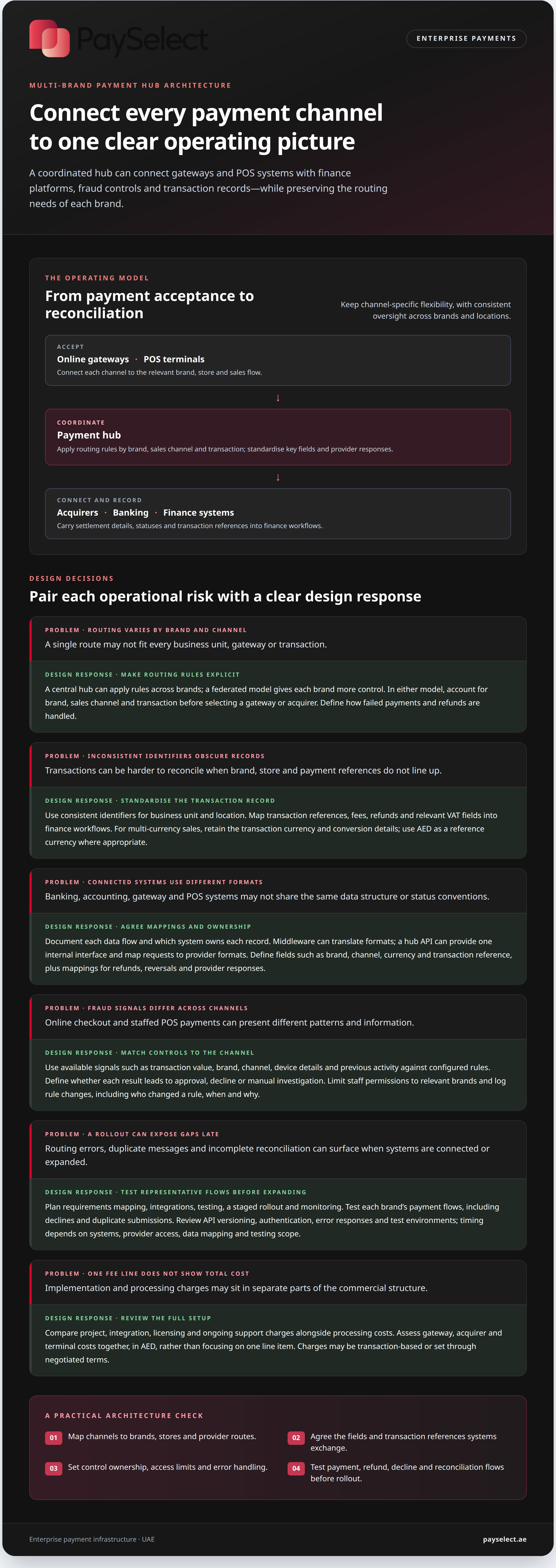
Adding another gateway or POS system won’t, by itself, create a smoother payment operation. A multi-brand enterprise payment hub architecture in the UAE brings these channels into a coordinated structure, connecting payment activity with financial systems, fraud controls and transaction records.
For a business operating across brands, locations or sales channels, consistent oversight matters, but not every payment needs to follow the same route. The right architecture can preserve that flexibility while making it easier to track transactions from acceptance through reconciliation.
This article explains how a payment hub connects gateways and POS systems, integrates with finance platforms, supports fraud controls and records transactions. It also covers key design decisions, including payment routing and the information systems need to exchange. Use it as a practical framework for assessing enterprise payment infrastructure in the UAE.
Key Takeaways
• Plan gateway and POS connections around each brand’s payment flows, while keeping oversight consistent across the enterprise.
• Map how payment data reaches finance systems so reconciliation and reporting use clear, consistent records.
• Coordinate fraud controls with transaction routing, and retain traceable transaction histories to support reviews and investigations.
• Assess provider capabilities and pricing across your payment setup to identify a suitable mix for your business requirements.
Enterprise payment gateways and POS systems
A well-designed multi-brand enterprise payment hub architecture in the UAE connects payment channels while preserving controls for each brand. Map online gateways, POS terminals and finance records to the operating needs of each business.
Gateway and Acquirer Routing
A central hub can apply routing rules across brands, while a federated model gives each brand more control. In either setup, routing rules should account for the brand, sales channel and transaction before selecting a gateway or acquirer.
Provider support depends on integrations, merchant agreements and routing capabilities. Assess these requirements across payment gateway connections, including how failed payments and refunds are handled for each brand.
Connect each POS terminal to the relevant brand and store profile. For example, when fitting out a new store, align its terminals with the group’s payment and reporting setup. Use consistent identifiers to distinguish transactions by business unit and location.
Choose payment methods to suit customer channels and provider support. A UAE enterprise may need cards, digital wallets and Aani alongside gateway and terminal transactions. Assess Aani for the intended use case rather than assuming it replaces other payment methods.
Set settlement and reporting requirements early. Use AED as the reference currency where appropriate, while retaining the transaction currency and conversion details for multi-currency sales. Map transaction identifiers, fees and refunds into finance workflows, with relevant VAT fields available for accounting and reconciliation.
Pricing and Deployment Planning
Implementation costs may include project, integration, licensing and ongoing support charges. Processing costs may be charged separately, based on transactions or negotiated terms. Compare the full commercial structure in AED, including gateway, acquirer and terminal costs, rather than focusing on one line item.
Deployment typically involves requirements mapping, integrations, testing, a staged rollout and monitoring. Timing depends on existing systems, provider access, data mapping and testing scope. Risks include inconsistent identifiers, routing errors and incomplete reconciliation. Test payment flows for each brand before expanding the rollout.
Open-standards financial-system integration
A multi-brand enterprise payment hub architecture in the UAE should connect payment activity with banking, accounting and operational platforms. Map each data flow before selecting interfaces, so updates reach the right systems.
Core Banking and Middleware Connections
Connections to banking systems can send settlement entries, account references and payment statuses into finance workflows. Middleware translates data between systems that use different formats. For example, it can match a gateway transaction reference to the corresponding entry in an enterprise resource planning platform.
Define which system owns each record, then determine how it handles errors and duplicate messages. A rejected settlement file, for example, can enter an exception queue for review. This gives finance teams a clear way to trace mismatches between banking records and internal accounts.
Open APIs and Ecosystem Links
Documented application programming interfaces connect payment platforms with gateways, POS software and accounting tools. REST APIs and JSON can support these exchanges, but teams still need agreed data fields and access controls. For example, a refund request should include the original transaction reference and the relevant brand identifier.
Review API versioning, authentication, error responses and test environments before connecting systems. These details shape how integrations handle updates and failures. For in-store operations, compare POS system options against each business unit’s reporting and integration needs.
Single API Integration
A single API gives internal teams one interface for sending payment requests across connected providers. The hub translates each request into the format required by the selected gateway or acquirer. This can simplify integrations for groups operating different brands and systems.
Standardise fields such as brand, channel, currency and transaction reference before rollout. Maintain clear mappings for provider responses, refunds and reversals so connected systems receive consistent statuses. Test representative transactions, including declines and duplicate submissions, before expanding access to more brands. Review mappings when a connected system changes.
Transaction security and fraud detection
A scalable payment hub should apply security controls across brands, gateways and POS channels. It also needs to connect transaction signals to fraud decisions while limiting access to necessary information.
For UAE Central Bank rules and PCI DSS, start by mapping the enterprise’s role and card-data flows. Identify which systems handle card information, then assign control owners and review responsibilities. This scoping exercise helps teams assess relevant obligations without assuming every brand or integration has the same exposure.
Fraud controls should use signals available when a payment is made. A hub can assess transaction value, brand, channel, device details and previous activity against configured rules. For example, an online purchase that differs from a customer’s usual pattern could be flagged for review. Define how each result affects approval, decline or manual investigation.
Set controls around the risks of each channel. An online checkout and a staffed POS terminal create different payment patterns. Use role-based access for administration tools, limit staff permissions to relevant brands and log rule changes. A review should show who changed a decision rule, when it changed and why.
Limit exposure to card information throughout the payment flow. If using tokenisation, document where tokens are created, stored and accepted. Map which components handle sensitive data and include those flows in the PCI DSS scope assessment. Tokenisation is one design control, not a substitute for reviewing the wider data environment.
Test realistic cases before rollout: a routine payment, a suspicious attempt, a decline and a refund. Confirm alerts reach the right team and that decisions retain a traceable reason. Review false declines alongside fraud outcomes, since overly strict rules can block genuine customers. Record test results and reassess controls when brands, channels or integrations change.
Audit trails and transaction history
A useful audit trail links each payment’s journey across the enterprise, from initiation to settlement or reversal. For a card sale at a UAE store, the record should connect the brand, location, POS terminal, gateway, acquirer and finance entry. A shared transaction reference helps teams trace the journey without relying on customer names alone.
Capture consistent fields across brands and channels. A transaction history can include the timestamp, amount, currency, payment method, route, status and provider reference. It should also distinguish authorisations from captures, refunds and reversals. For example, record a partial refund as a separate event linked to the original sale, rather than overwriting the original amount.
Reconciliation depends on matching hub records with provider settlement reports and finance entries. Compare transaction references, settlement dates, gross amounts, fees and net deposits. If an AED settlement differs from the expected total, transaction and adjustment records can help locate the cause. Keep currency conversion details with the original transaction when payments involve another currency.
Record operational changes as well as payment events. When an authorised user changes a routing rule or resolves a reconciliation exception, log the user, timestamp, action and reason. Access controls should limit who can view sensitive details or amend records. This gives reviewers a sequence of decisions, not just a final transaction status.
Reports should support practical searches by brand, location, date range, payment channel and status. When investigating a disputed purchase, for example, a finance team can trace the payment reference through its related events and provider response. Set retention and access policies according to applicable business and legal obligations, then document how archived records can be retrieved.
Before rollout, test whether a sample transaction can be followed from checkout through settlement, refund and reporting. Include declined payments and unresolved exceptions. Clear records help finance, operations and support teams work from the same transaction history, while exposing data-mapping gaps before the hub expands to more brands.
PaySelect
PaySelect helps UAE enterprises compare payment providers and infrastructure options against their operational needs. For a multi-brand group, this can mean reviewing gateway and POS requirements alongside provider capabilities, pricing structures and cross-border payment needs.
Use PaySelect’s comparison tools to assess gateway and POS options, or compare pricing across existing arrangements. This can help decision-makers identify where provider selection, payment routing or settlement requirements need further review. PaySelect also offers payment infrastructure consulting to help businesses assess how their current setup serves multiple brands, without assuming they need to replace existing providers.
For a useful assessment, prepare an overview of your brands, payment channels, current provider arrangements and reporting requirements. These details help define your operational needs and comparison criteria. Use PaySelect’s comparison tools or discuss your enterprise payment requirements with its team.
Set the Next Phase of Payment Growth
As your enterprise adds brands, markets or sales channels, payment decisions can become harder to coordinate. Treat the hub as an evolving operating model, not a one-time integration. Assign clear ownership for changes to routing, reporting and access so each expansion has a defined review process.
A multi-brand enterprise payment hub architecture in the UAE should fit the business you plan to operate, not just the systems in place today. For organizations looking to bridge corporate strategy with overarching technological infrastructure, enterprise architecture consulting from resources like ebsaconsult.net can provide valuable guidance. Before expanding, align finance, technology, risk and operations on the outcomes that matter most. That shared direction helps teams assess new requirements without losing sight of customer experience or operational control.
PaySelect can help you evaluate payment options and consider how they fit your enterprise requirements. For a tailored discussion about your payment hub, contact PaySelect about your payment hub. A clear next step can turn a complex payment environment into a more deliberate plan for growth.
Frequently Asked Questions
What is a multi-brand enterprise payment hub architecture?
It is a shared payment operating layer that lets a group manage payment activity across separate brands. Each brand can retain its own checkout experience, merchant settings and reporting view while following common governance. For example, a hospitality group could set different refund permissions for each brand while giving central finance a consolidated view of payment activity.
How do UAE payment hubs integrate with ERP, CRM, e-commerce, and POS systems?
They connect through supported interfaces that exchange payment requests, statuses and references with business applications. An e-commerce order can pass its order ID to the hub, while a POS sale can carry a store code. The ERP can use those identifiers for accounting, and the CRM can associate a payment status with the relevant customer record without storing unnecessary card details.
How do payment hub vendors compare on routing, tokenization, fraud controls, reporting, and uptime?
Compare vendors using the same business scenarios and evidence, not feature labels alone. Ask how brand-specific routing rules work, how tokens operate across connected providers and which fraud decisions teams can configure. Review sample reports for useful filters and traceable references. Assess uptime commitments, incident communication and recovery procedures in the proposed service terms, as these affect operational planning.
What are the UAE Central Bank and PCI DSS requirements for enterprise payment hubs?
Map the enterprise’s role and card-data flows, identify which systems handle card information, and assign control owners and review responsibilities. Include tokenisation flows in the PCI DSS scope assessment where used, and assess obligations for each brand and integration rather than assuming they have the same exposure.
Disclaimer
This content is for informational purposes only and should not be considered financial, legal, or regulatory advice. Payment provider availability, pricing, and approval processes vary depending on individual business circumstances. PaySelect does not guarantee provider acceptance or specific outcomes. Businesses should conduct their own due diligence before entering into any agreements.
Empowering businesses to achieve greater growth