
More supported currencies don’t automatically mean a better payment setup. When comparing a multi currency payment gateway uae options, look at the full payment flow: which currencies customers can pay in, when conversion happens, and which currency reaches your account.
Currency coverage is only one part of the decision. Fees, settlement arrangements, checkout clarity, and fit with your existing systems can all affect customer experience and daily operations. Comparing these details side by side helps you avoid overlooking costs or choosing capabilities that don’t match your sales.
This guide explains the difference between accepting, converting, and settling currencies, then gives you practical criteria for comparing gateway capabilities. You’ll learn how to map the currencies and payment flows your business needs, assess transaction-related charges and integration requirements, and choose a setup that supports your international sales.
PaySelect helps UAE businesses compare payment options through independent guidance and a matching tool that considers factors such as industry, transaction volume, and international requirements.
Key Takeaways
• Map the complete payment journey, from the currency shown at checkout to the currency deposited and recorded in your accounts.
• Compare a multi currency payment gateway uae option by its currency acceptance, settlement choices, checkout experience, reporting, and integration capabilities.
• Prioritise features according to your target markets, transaction volume, business model, and sales channels.
• Document the currencies customers use and how you sell before comparing solutions, so your shortlist reflects real business needs.
• PaySelect’s independent matching considers your industry, transaction volume, and international requirements to help you compare relevant payment options.
What a Multi-Currency Payment Gateway in the UAE Actually Does
A multi-currency payment gateway lets a business accept online payments in more than one customer-facing currency. It connects checkout to the payment process, passing transaction details for authorisation and helping move an approved payment toward settlement. A payment gateway supports the transaction, but accepting, converting, and settling currencies are separate functions. The currency a customer sees or pays in doesn’t have to be the currency the merchant receives.
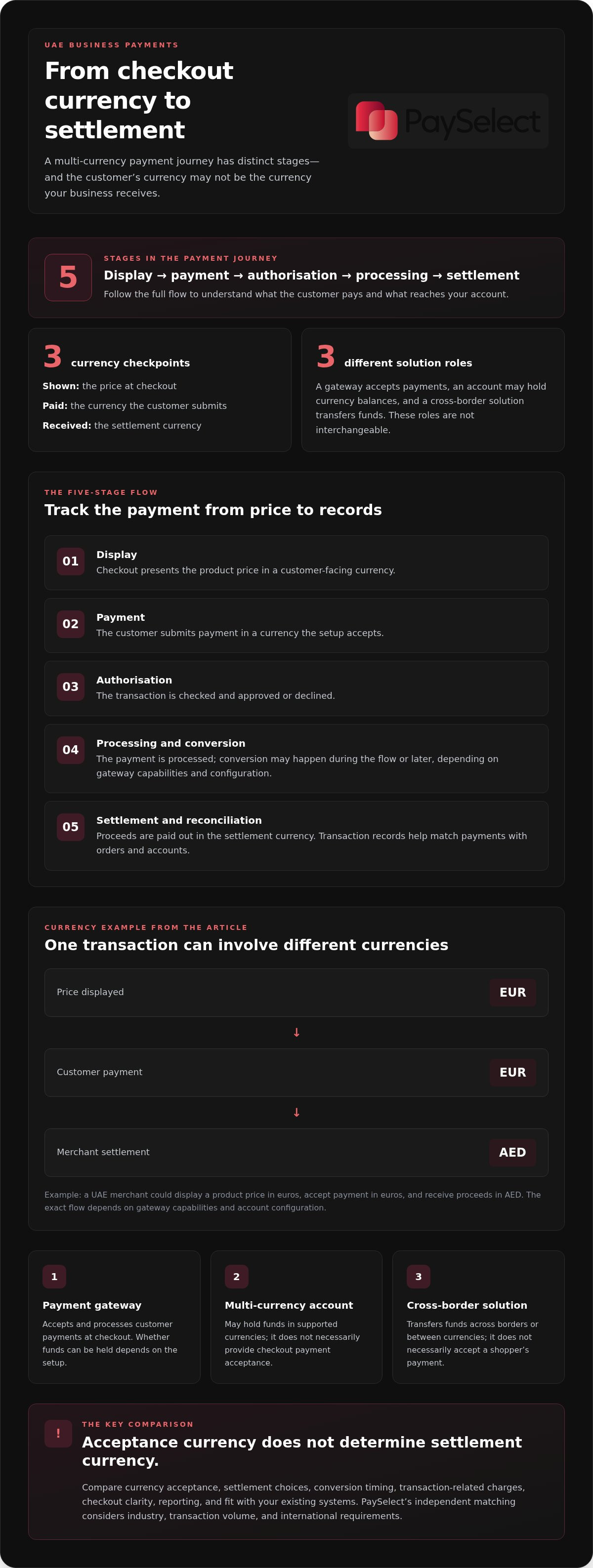
For example, a UAE merchant could display a product price in euros, accept the customer’s payment in euros, and receive the proceeds in AED. Whether conversion happens, when it happens, and what currency reaches the merchant depend on the gateway’s capabilities and the merchant’s configuration. Comparing a payment gateway in the UAE means looking beyond the list of currencies shown at checkout.
What happens when a customer pays in another currency?
The flow usually starts when checkout displays a price in the customer’s selected currency. The customer submits payment, and the gateway sends the transaction for authorisation. Once approved, the payment is processed. Conversion may happen during this process or later, depending on the setup. Funds are then settled according to the agreed arrangement, and transaction records support reconciliation.
These stages aren’t interchangeable. Displaying a price in a currency doesn’t necessarily mean the gateway accepts payment in it. Accepting payment in that currency also doesn’t automatically mean the merchant can hold or receive funds in the same currency.
Gateway, multi-currency account, or cross-border solution?
Each serves a different purpose. A gateway focuses on taking customer payments; an account may support holding balances in different currencies; a cross-border solution focuses on transferring funds between countries or currencies. A multi-currency account or transfer service isn’t automatically a payment gateway, even if it handles several currencies.
Payment gateway
Accepts and processes customer payments at checkout. Whether funds can be held depends on the setup.
Multi-currency account
Holds funds in supported currencies; it doesn’t necessarily provide checkout payment acceptance.
Cross-border payment solution
Transfers funds across borders or between currencies; it doesn’t necessarily accept a shopper’s payment.
If you need to move funds internationally rather than accept customer payments at checkout, compare cross-border payment solutions separately. PaySelect helps businesses compare these options alongside gateways. This distinction keeps your search for a multi currency payment gateway uae focused on the capabilities your payment flow actually requires.
How Multi-Currency Gateway Payments Move from Checkout to Settlement
A multi-currency transaction passes through several stages, and the currency can change along the way. For a UAE business, mapping each stage clarifies what the customer pays, how the transaction is processed, and what the business records and receives.
Which currencies does the customer see and pay in?
A familiar currency can make an international checkout easier to understand. The currencies a gateway can display and accept depend on its capabilities and how the merchant has configured it. Before comparing a multi currency payment gateway uae option, list your target markets and the currencies customers there expect to use. The International Trade Administration describes the UAE as an eCommerce leader among Gulf Cooperation Council (GCC) states, making a clear payment journey relevant to businesses serving customers across borders.
How conversion and settlement affect merchant operations
Conversion doesn’t happen automatically just because a gateway accepts payment in another currency. It may take place at a particular point in the payment flow, or the transaction may be settled in a different currency, depending on the gateway and merchant configuration. Finance teams should understand how the original payment, any conversion, and the settlement amount appear in transaction reports. Clear records make it easier to match payments with orders and account entries. Compare transaction-related charges separately, rather than assuming the currency displayed at checkout tells you the full cost.
Display
Checkout presents the product price in a customer-facing currency.
Payment
The customer submits payment in an accepted currency.
Authorisation
The transaction is checked and approved or declined.
Processing and conversion
The payment is processed; conversion may occur depending on the configured flow.
Settlement and reconciliation
Proceeds are paid out in the settlement currency, then the merchant matches transaction records against orders and accounts.
These currencies can differ. A customer might see and pay in one currency, the transaction may be processed in another, and the merchant may receive settlement in AED. The exact flow depends on gateway capabilities and account configuration.
Assess acceptance and settlement currencies separately: the currency a customer can pay in does not determine the currency your business receives.
PaySelect’s payment gateway comparison options help businesses assess gateway capabilities against their payment flows.
How to Compare UAE Multi-Currency Payment Gateway Capabilities
A useful comparison starts with your payment needs, not the longest list of supported currencies. For a multi currency payment gateway uae option, assess whether each capability fits your target markets, checkout journey, finance processes, and expected transaction activity.
Acceptance, settlement, and customer checkout
Separate the currencies customers can pay in from how your business receives and tracks proceeds. A currency listed as supported doesn’t, by itself, explain the settlement options or reporting available. Compare capabilities against the markets you serve, and distinguish stated features from assumptions.
Review checkout from the customer’s perspective, too. Is the amount and currency clear before payment? Does the currency selection match the expectations of your target markets? A clear display can reduce confusion, but it only helps if the payment flow supports the currency shown.
Integration, reporting, and operational fit
Consider how a gateway fits your existing website and finance workflow. Transaction reports should provide information your team can use to match payments to orders and account records. The importance of each capability depends on your model: an exporter may prioritise the currencies used in its key markets, while an established online merchant may focus on checkout and reconciliation. Higher transaction volumes or more complex operations can make reporting and system integration more central.
Capability | What to compare | Why it matters
Currency acceptance | Are the currencies used by your target customers supported for payment? | Keeps the comparison focused on currencies your customers use.
Settlement options | What settlement currencies and arrangements are described? | Helps align payouts with your business and finance needs.
Checkout experience | Can customers see the amount and currency clearly before paying? | Makes the payment decision easier to understand.
Reporting | What transaction details are available for reconciliation? | Helps finance teams match payments to sales records.
Integration | How does the gateway fit your website and current processes? | Helps identify potential friction in day-to-day operations.
Use consistent criteria across options, and record stated capabilities separately from assumptions. Let your business model, transaction volume, and target markets guide the weight you give each row. The broadest currency list isn’t automatically the best fit; the right capabilities are those that support your actual payment flow.
PaySelect’s payment gateway comparison helps you compare options against your business requirements.
A Practical Checklist for Matching a Gateway to Your International Sales
A clear requirements list makes it easier to compare options on equal terms. It also keeps the focus on what your business needs now while leaving room for planned international growth.
Define your markets and payment requirements
Start with your sales footprint. Record where you sell today, where you plan to expand, and which currencies customers in those markets expect to use. Then capture the practical details that shape your payment flow:
Markets and currencies
List current and planned customer markets, plus the currencies you need to display and accept.
Transaction volume
Estimate your payment activity so comparisons reflect the scale of your operations.
Sales channels
Note whether customers pay through your website, another online channel, or in person.
Business needs
Record any industry-specific payment requirements and the reporting your finance team uses.
Future plans
Separate essential capabilities from features that may become relevant as you enter new markets or add sales channels.
Priorities vary by business stage. A new exporter may focus on serving its first target markets and keeping checkout straightforward. An established online merchant may place more weight on fitting its current website and reconciliation process. A larger organisation may need to consider how gateway choices fit a broader payment infrastructure and multiple operational requirements.
Turn requirements into a fair comparison
Use the same criteria for each option. Mark capabilities as essential or useful, then compare the available information against your list. For a multi currency payment gateway uae comparison, distinguish stated details from assumptions. Keep features that aren’t described separate from confirmed requirements, rather than treating an unmentioned feature as available.
This approach avoids choosing based on one headline feature. A wide currency range may matter less than support for the specific markets you serve or a workable fit with your sales and finance processes. There’s no universal best option; the right match depends on your requirements, transaction volume, industry, and growth plans.
PaySelect’s payment gateway comparison gives you a way to assess options against your business needs.
How PaySelect Helps UAE Businesses Compare Multi-Currency Payment Options
Choosing a gateway involves more than checking which currencies it accepts. Businesses also need to weigh checkout requirements, transaction volume, industry needs, international sales, and how payments fit their operations. PaySelect is an independent comparison and advisory platform that helps businesses make these choices easier to assess.
What information helps PaySelect match your needs?
Useful comparisons start with your business context. Industry helps frame the payment requirements relevant to your operations. Transaction volume gives context to the scale of your payment activity, while international requirements clarify which markets and payment flows matter to your business.
Use the checklist from the previous section to organise your current and planned markets, customer currencies, sales channels, and priorities. This gives the matching process a practical foundation and helps distinguish immediate requirements from features that may support future expansion. PaySelect’s matching tool considers your industry, transaction volume, and international requirements to identify relevant options for comparison.
When comparison or payment advisory may be useful
Independent comparison can help turn a broad search into a focused shortlist. Rather than treating every capability as equally important, compare gateway information against your specific needs, including customer currency acceptance, settlement arrangements, checkout, reporting, and integration. This is especially useful when payment options are difficult to assess side by side.
Larger organisations reviewing their wider payment infrastructure may also benefit from PaySelect’s advisory and consulting services. This support can help assess how payment capabilities fit the organisation’s needs, including opportunities to optimise payment infrastructure and costs. For businesses assessing a multi currency payment gateway uae solution, a structured comparison makes it easier to focus on the requirements that matter.
PaySelect’s payment gateway comparison helps businesses assess payment options in light of their requirements.
Build a Payment Setup That Can Grow With You
The right payment setup starts with your business’s payment flow, not simply the number of currencies a gateway supports. Identify where you sell and what currencies customers expect, then assess acceptance, conversion, settlement, checkout, reporting, and integration as separate but connected needs.
That’s the practical way to assess a multi currency payment gateway uae businesses can use to support international sales. A gateway may let customers pay in one currency while your business settles in another, so compare capabilities against your actual markets, transaction volume, and finance processes. The right fit is the one that aligns with your requirements today and your plans for expansion.
PaySelect is an independent payment comparison and advisory platform. Its matching tool considers your industry, transaction volume, and international requirements, helping turn a complex choice into a focused comparison.
Start with your business requirements and compare payment gateway options for your business.
Frequently Asked Questions
What is a multi-currency payment gateway?
A multi-currency payment gateway lets a business accept online payments in more than one customer currency. It connects checkout with payment processing, but currency display, payment acceptance, conversion, and settlement are separate capabilities. For example, a customer might see and pay in their preferred currency while the business receives settlement in AED. The exact flow depends on the gateway’s capabilities and how the merchant has configured the payment setup.
Can a UAE business accept payments in different currencies through one gateway?
Yes, a UAE business may be able to accept payments in multiple currencies through one gateway, depending on the gateway’s supported currencies and the merchant’s configuration. List the markets you serve and the currencies customers there expect to use, then compare those needs with the currencies available for checkout and payment acceptance. A broad currency list is less useful if it doesn’t match your customers or payment flows.
What is the difference between a multi-currency payment gateway and a business account?
A payment gateway’s primary role is to accept and process customer payments at checkout. A multi-currency business account may let a business hold funds in different currencies, but that doesn’t automatically mean it can accept online payments. Some businesses may need both functions, while others may need a separate cross-border transfer solution to move funds internationally. Compare each service by what it does: accept, hold, or transfer money.
How does a multi-currency payment gateway handle conversion?
Currency conversion depends on the gateway’s capabilities and the merchant’s configuration. A customer may pay in one currency while the transaction is processed or settled in another, and conversion may happen at a particular stage of that flow. Don’t assume that accepting a currency means funds will be converted or settled in a specific way. Review how transactions are recorded and what conversion details are provided so your finance team can reconcile payments accurately.
Do customers need to pay in their own currency?
No. Customers don’t necessarily need to pay in their own currency. A merchant may present prices or accept payment in other currencies, depending on the gateway’s capabilities and checkout setup. Showing a familiar currency can make the amount easier for international customers to understand, but clarity matters: customers should be able to see the currency and amount before paying. Map your target markets and customer expectations before deciding which currencies to support.
What should a UAE business compare when choosing a multi-currency gateway?
Compare the currencies available for customer payment, settlement arrangements, checkout clarity, transaction reporting, and fit with your website and finance processes. Also consider your industry, transaction volume, sales channels, and target markets. Compare pricing alongside the features that matter to your payment flow. A suitable multi currency payment gateway uae businesses choose should fit their real operating needs, not just offer the broadest currency list.
Can a payment gateway accept payments and manage international transfers?
A gateway is primarily designed to accept customer payments; international transfers are a separate use case and may require a cross-border payment solution. Some business payment setups combine different services, but a gateway’s payment acceptance and cross-border transfers serve distinct purposes. PaySelect helps businesses compare gateways and cross-border payment options based on industry, transaction volume, and international requirements, making it easier to assess which capabilities fit each part of the payment journey.
Disclaimer
This content is for informational purposes only and should not be considered financial, legal, or regulatory advice. Payment provider availability, pricing, and approval processes vary depending on individual business circumstances. PaySelect does not guarantee provider acceptance or specific outcomes. Businesses should conduct their own due diligence before entering into any agreements.
Empowering businesses to achieve greater growth