
A network token can change the credential used in a card payment, but it can’t guarantee an approval. A clear answer to what is network tokenization for payments starts with the card details: a card network replaces the card number with a token that can be used in supported transactions, including checkout and saved-card payments.
It’s easy to confuse network tokens with gateway tokens, especially when both can reduce how often a merchant handles card details. The difference matters: network tokens are created within card-network infrastructure, while gateway tokens are created or managed within a payment provider’s system. Tokenization may support security and payment continuity, but the outcome depends on how the full payment setup works. It isn’t a shortcut to higher approval rates or a substitute for reviewing your wider payment needs.
This guide explains the tokenization flow in plain language, compares network tokens with gateway tokenization, and sets out what merchants should weigh before choosing payment options. For UAE businesses comparing gateways, PaySelect’s free comparison tool matches options to merchant requirements, helping make the decision more practical than relying on headline claims alone.
Key Takeaways
• Understand what is network tokenization for payments by tracing how a card credential is replaced and used in a payment flow.
• Compare network and gateway tokens by who creates them, where they are used, and how they fit into your payment setup.
• Assess possible security and payment-continuity benefits without treating tokenization as a guarantee of approval or compliance.
• Map your checkout, saved-card, recurring-payment, and cross-border needs before comparing payment options.
• Look beyond headline rates: compare documented capabilities, what each price includes, and how charges appear in statements.
What Is Network Tokenization for Payments?
A network token is a substitute for a card’s primary account number in a payment flow. The primary account number, or PAN, is the card number used to identify the payment account. Instead of using that number directly in a supported transaction flow, the payment setup can use a token created within card-network infrastructure.
Network tokenization replaces a card credential in a payment flow; it does not guarantee that a payment will be approved. The token changes which credential is used, but the card issuer still decides whether to authorize each transaction, based on the transaction and other relevant factors.
The token isn’t a new bank account, a separate payment method, or simply the card number in encrypted form. It serves as a substitute credential associated with the underlying card account. For a broader overview of payment tokenization and its applications, see Payment Tokenization Explained.
What information does a network token replace?
The PAN identifies the card account in a payment transaction. In supported flows, a network token can take its place, so the original card number doesn’t need to be used in the same way for each relevant transaction. The token represents a credential for making a payment, not a new source of funds.
This is useful to understand when assessing what is network tokenization for payments: the credential used in the flow changes, not the customer’s account or the merchant’s product. The card account remains the basis of the payment. Tokenization also shouldn’t be treated as a complete security solution or proof that sensitive information never enters any part of a merchant’s payment setup. The details depend on how that setup handles payment data.
Where can merchants encounter network tokens?
Merchants may encounter network tokens in online card payments, including checkout, saved-card purchases, and recurring-payment contexts. For example, a returning customer might pay using a card saved for a future purchase. If the payment setup supports network tokenization for that flow, a token may be used instead of the PAN.
That doesn’t mean every online payment or stored card automatically uses a network token. Availability depends on the merchant’s payment setup and the relevant capabilities of the card network and payment provider. When comparing options, ask how the setup handles each channel your business uses, including standard checkout, stored credentials, and recurring transactions.
For UAE merchants with international customers, payment needs can extend across markets and channels. Consider how credential handling fits alongside broader cross-border payment requirements, rather than assuming one feature covers every transaction type. Understanding the distinction between a token and the original card number gives merchants a clearer starting point for evaluating payment options.
How Network Tokenization Works During a Card Payment
A practical way to understand what is network tokenization for payments is to follow the credential from the customer’s first checkout to a later transaction. The exact steps depend on the merchant’s payment setup, but the roles are straightforward: the customer provides card details, the payment setup can request a token in an eligible flow, and the issuer makes a separate decision when a payment is attempted.
The customer enters card details.
At checkout, the customer provides card information to pay or, where the service supports it, save the card for later.
The merchant’s payment setup handles the request.
In an eligible flow, the merchant’s setup and payment provider can initiate a request for a network token. The way the request is made depends on the integration.
The card network creates the token.
The network creates the token within its infrastructure. It can serve as a substitute credential in supported payment flows.
The payment setup uses the token.
Depending on the arrangement, the token can be used for a later payment instead of the original card number. How it is stored and passed through the payment flow varies.
The issuer considers the payment.
When a payment is attempted, the request is routed through the relevant payment setup. The issuer then decides whether to authorize it.
In a supported setup, the merchant’s payment flow can request a network token for a card, then use that token as the payment credential in a later transaction, while the issuer separately decides whether to approve the payment.
From saved card details to token creation
Token creation may begin when a customer saves a card or enters card details in another eligible flow. The merchant’s payment setup and provider handle the request through the relevant card-network infrastructure, where the network creates the token. This doesn’t mean every saved card automatically receives one. Provisioning and implementation details vary across payment setups.
Using a network token in a later payment
For a future purchase, the merchant’s payment setup may submit the token in place of the original card number. This could apply to a customer-initiated checkout or a later transaction using saved card details, depending on the setup. Token creation and payment authorization are separate events. The issuer evaluates the payment when it is presented, so a token doesn’t promise approval or uninterrupted recurring billing.
For merchants, the practical point is to understand how the complete setup handles card entry, saved credentials, and later payment attempts. Compare gateway capabilities against those needs, and clarify which features apply to each payment flow. PaySelect helps UAE merchants compare payment gateway options based on their requirements.
Network Tokens vs Payment Gateway Tokens: What Is the Difference?
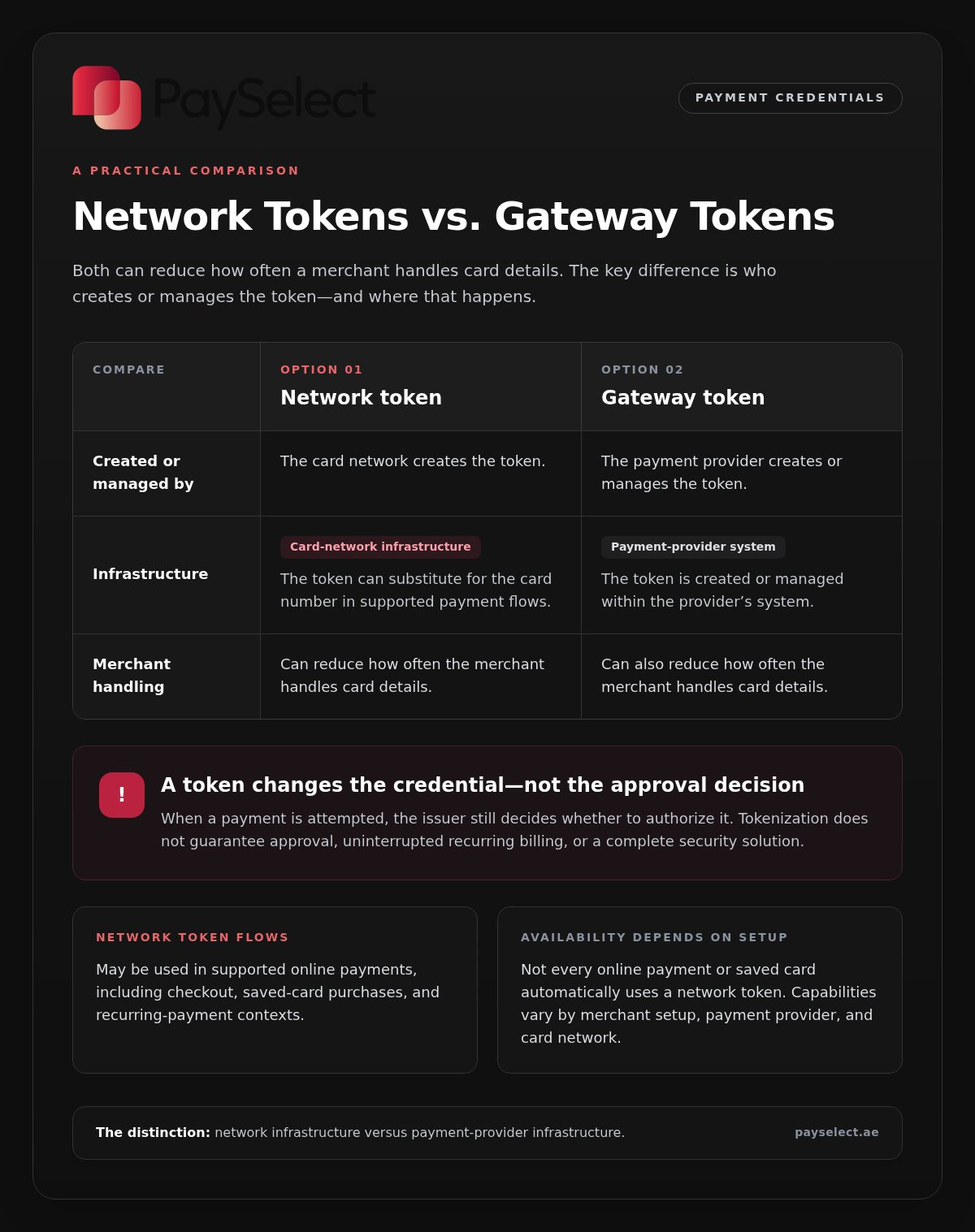
For merchants asking what is network tokenization for payments, the key distinction is who creates the credential and what it does in the payment flow. The word “token” can describe different things. A network token is associated with card-network infrastructure; a provider token is generally a reference used within a payment provider’s setup to handle a stored card. These credentials aren’t automatically interchangeable, and a payment setup may use one or both.
| Comparison point | Network token | Provider or gateway token |
|---|---|---|
| Who creates it | Created within card-network infrastructure. | Created or managed within a payment provider’s system, depending on its setup. |
| General purpose | Acts as a substitute payment credential in supported flows. | Typically acts as a stored-card reference that lets the provider handle later payment requests without the merchant using the original card details directly. |
| Typical role | Used in eligible transactions through the relevant payment setup. | Used to connect a merchant’s stored-card record with the provider’s payment process. |
Network token versus provider or gateway token
A provider token is often part of how a gateway or processor refers to a saved card in its own environment. The exact handling varies, so don’t assume every provider stores or manages credentials in the same way. A network token, by contrast, is issued within card-network infrastructure. Which token types appear, and how they work together, depends on the merchant’s implementation and payment setup.
A network token is created within card-network infrastructure and serves as a payment credential; a provider token is created or managed within a provider’s setup and typically serves as a reference to a stored card. This distinction describes their general roles, not a universal technical design. The shared name doesn’t mean the tokens are the same, or that using one rules out the other.
Network tokenization versus PCI tokenization
PCI tokenization is a broader term for replacing sensitive payment data with a token to reduce direct exposure of that data in a system. It describes a data-protection approach, not necessarily a credential issued by a card network. Network tokenization refers more specifically to a token associated with card-network infrastructure and used in supported payment flows.
These ideas can overlap, but they answer different questions: one describes a broader way to limit the use of sensitive data, while the other identifies the source and role of a particular payment credential. Tokenization alone doesn’t remove every security or compliance responsibility. Merchants still need to understand how payment information is handled across their own checkout and provider setup.
For a practical comparison, map how your business accepts payments and stores card details, then review each gateway’s documented token capabilities against those needs. This helps distinguish a network-issued credential from a provider’s stored-card reference without assuming every setup works the same way.
What Network Tokenization Can, and Cannot, Mean for Merchants
For merchants, the value of network tokenization depends on the payment flows it supports and the operational problems the business needs to solve. Understanding what is network tokenization for payments is only the starting point. Next, assess whether using a network token could reduce reliance on the original card number in relevant transactions, and whether that matters across your actual payment mix.
Potential benefits and their limits
In supported flows, a network token can replace the original card number as the credential used for a payment. That may be relevant to online checkout, saved-card purchases, or recurring transactions, depending on the payment setup. It can reduce the need to use the original card number in those flows, but it doesn’t mean sensitive data is absent from every part of the payment environment or that security responsibilities disappear.
Tokenization may also support payment continuity for stored-card use, but it can’t guarantee uninterrupted billing. Authorization remains a separate decision made by the issuer. The outcome can depend on factors beyond tokenization, so treat any change to approval rates, customer experience, or conversion as a possibility to assess, not a promised result.
When the capability may matter to a business
The feature may deserve closer attention if online card payments make up a meaningful part of your sales, or if customers often save cards for repeat purchases. If most transactions use other methods or happen through different channels, its relevance may be different. Assess its role in the complete payment setup rather than assuming it delivers the same value to every merchant.
Reporting matters too. Your team may need to understand how token-based transactions appear in payment records and how they fit into existing reconciliation processes. Link customer payment journeys with practical requirements such as visibility, support workflows, and managing recurring transactions.
Use this checklist to frame the decision:
Payment mix
Identify the channels and payment methods customers use most.
Stored-card use
Review how often customers save cards or make recurring payments.
Operational priorities
Consider data handling, reporting, reconciliation, and the customer payment experience.
Documented capabilities
Compare what each payment setup supports for the flows your business actually uses.
These points help separate a relevant capability from a headline claim. When assessing a gateway, compare its documented features alongside the wider setup. Review what each price includes and how charges appear on statements, rather than judging an option by its headline rate alone. To compare gateway options against your business requirements, use PaySelect’s payment gateway comparison.
How to Assess Network Tokenization in Your Payment Setup
Start with the payment journeys your business actually supports. Understanding the technology is only the starting point. To decide whether it matters, look at your sales channels, customer habits, and operational priorities. A gateway comparison can help organize these broader requirements, but it shouldn’t be treated as a direct assessment of tokenization features.
Build a merchant-side requirements checklist
Map your current setup before comparing options. Separate essential operating needs from features that could be useful but depend on how payments are configured. This keeps the evaluation focused on the customer experience and the work your team needs to manage.
Sales channels
Note where customers pay, such as online checkout or in person, and which channels matter most to your business.
Transaction patterns
Identify whether customers save card details, make repeat purchases, or use recurring payments.
Payment methods
Record the methods your customers use and any changes you expect to support.
International needs
Consider whether you accept payments from customers in other markets and what that means for your payment setup.
Operational priorities
List the capabilities your team needs, including reporting and how payment activity appears in records.
Then compare documented capabilities against this list. Treat network token support as relevant only where it connects to a real payment flow in your business. Review charges in context, including what each offer includes and how charges appear on statements. A headline rate alone won’t show the full commercial picture, and different pricing structures may present charges differently.
Use a comparison process without assuming a universal winner
There’s no single payment setup that suits every merchant. A useful comparison brings together your industry, transaction volume, payment methods, sales channels, and international requirements. It helps you assess gateway options against the way your business operates, without assuming that a comparison tool itself verifies a specific tokenization capability.
PaySelect’s Take the Test matches merchants to options based on their answers, including industry, volume, payment methods, and international needs. The test typically takes less than 2 minutes, is free to use, and doesn’t require registration. It organizes payment gateway options around your requirements; it doesn’t supply tokenization technology or process payments. PaySelect is not a licensed payment service provider and refers merchants to licensed providers. Information is shared only with matched providers after your consent, in compliance with UAE data-protection regulations.
This gives you a structured starting point for comparing payment options while keeping the decision grounded in your business needs, not a single feature or headline claim. You can compare payment gateway options as part of that broader evaluation.
Make Your Next Payment Decision Count
Understanding what is network tokenization for payments can help you ask sharper questions about how payment credentials fit into your setup. The next step is to compare gateway options against your business’s channels, transaction patterns, and operational priorities.
Compare payment gateway options with PaySelect’s free matching tool to assess options in the context of your requirements. A considered choice can help your payment setup support your business as it grows.
Frequently Asked Questions
What is network tokenization in simple terms?
In simple terms, network tokenization substitutes a card’s primary account number (PAN), the number identifying the payment account, with a network-issued credential in supported payment flows. The customer still pays from the same card account; the token isn’t a new payment method. For example, an online checkout may use a token if its payment setup supports it. Merchants should identify which flows use tokens, since not every card transaction does.
Who creates a network token for a payment card?
Card networks create network tokens. A merchant or payment provider may initiate a request or use the token through a supported payment setup, but that doesn’t make every credential a network token. A provider may also create or manage other types of payment tokens. For a merchant, the distinction helps clarify how credentials are handled in a particular setup. Token creation is separate from the issuer’s decision to approve or decline a payment.
Can network tokens be used for recurring payments?
Yes, network tokens can be used for recurring payments when the payment setup supports that flow. For example, a business charging a customer on a regular schedule may submit a token for a later transaction instead of the original card number. The merchant should assess how its recurring payment process handles credentials and records. A token doesn’t guarantee that each scheduled charge will succeed; the payment setup and issuer’s decision still matter.
Does network tokenization guarantee higher payment approval rates?
No, network tokenization doesn’t guarantee higher approval rates. A token may be one part of a payment setup, but the issuer makes the authorization decision for each transaction. For example, a tokenized recurring charge can still be declined. Merchants should assess any reported performance change using their own transaction data and relevant time periods, rather than treating a general claim as a forecast. Don’t assume a token alone will resolve declines.
What happens to a network token if a card is replaced?
A network-token arrangement may help keep a payment credential current when an issuer replaces a card, but handling can differ between setups. Don’t assume every replacement updates in the same way or that a saved-card payment will continue without interruption. For example, a business with scheduled charges should understand how replacement cards are reflected in its payment flow and how it will identify a failed charge requiring follow-up.
Does using network tokenization remove a merchant’s security responsibilities?
No. A token may reduce reliance on the original card number in supported flows, but it doesn’t remove every security or compliance responsibility. Merchants still need to understand how payment data moves through their checkout, systems, and provider arrangements. For example, consider which systems can access payment information and how staff manage payment-related records. Treat tokenization as one part of a broader payment security approach, not a complete replacement for other controls.
Disclaimer
This content is for informational purposes only and should not be considered financial, legal, or regulatory advice. Payment provider availability, pricing, and approval processes vary depending on individual business circumstances. PaySelect does not guarantee provider acceptance or specific outcomes. Businesses should conduct their own due diligence before entering into any agreements.
Empowering businesses to achieve greater growth