

Payment Advice for UAE Businesses: How to Reduce Costs and Optimise Your Payment Setup

The lowest headline rate isn’t always the lowest-cost payment setup. Effective payment advice for UAE businesses means comparing security, transaction and recurring fees, international card and currency-conversion costs, settlement terms, and compatibility with your e-commerce platform. Your gateway should also support the payment methods your customers prefer.
It’s easy to focus on the transaction fee alone, but costs can also accumulate through FX markups, declines, chargebacks, and settlement arrangements. The right setup depends on your sales channels, customer locations, transaction patterns, and operational needs.
This guide explains how to assess UAE payment gateways, compare providers on a like-for-like basis, and identify potential ways to reduce international payment costs. You’ll also learn how payment consulting can help review an existing setup, plan implementation, and decide whether to optimise your current arrangements or consider alternatives.
Key Takeaways
• Compare the full payment setup, including security, integration, settlement terms, and every fee category, rather than choosing by headline rate alone.
• Assess international transfers by looking at exchange-rate markups, conversion charges, payout fees, and transfer arrangements together.
• A review of transaction and settlement reports can reveal cost patterns and practical opportunities to improve an existing setup without switching providers.
• Use provider comparison and advisory support to match payment arrangements to your sales channels, customer locations, and operational needs.
Choosing an Online Payment Gateway for UAE Businesses
Assess a gateway as part of your complete payment setup, not as a standalone transaction tool. Compare fees, security, integration, settlement options, and how each method suits your customers.
Integrated Platform Fee Savings
An all-in-one platform can combine checkout, payment links, reporting, and payouts, reducing separate systems and duplicated charges. For UAE e-commerce sellers, an integrated setup can reduce costs by as much as 20-30%. Sellers in marketplaces, gifting, and fashion retail may save 20% or more compared with gateway-only models. Compare the total arrangement, including setup, transaction, and recurring charges, before choosing.
UAE Payment Method Comparisons
Cards provide a familiar online checkout, while digital wallets can simplify payment on compatible devices. Bank transfers suit some larger or account-based purchases, but may require customers to leave checkout to pay. Choose methods that fit your sales model and customer preferences, and make the available options clear before payment.
For an online store, confirm that the payment gateway integrates with its e-commerce platform. Test the full customer journey, from checkout to confirmation, before launch. Payment links can support invoicing or sales through direct messages. APIs connect the gateway with websites, accounting systems, and order tools. Automated reconciliation can match transaction records with orders and payouts, reducing manual entry.
Check that security includes PCI DSS, and confirm the payment partner is licensed by the relevant UAE authority, such as the Central Bank of the UAE or Dubai Financial Services Authority. Federal Tax Authority states that the standard VAT rate for UAE contractor invoices is 5%. According to the Federal Tax Authority, contractors must register for VAT when annual turnover exceeds AED 375,000.
To improve acceptance, review declined transactions by payment method and checkout step. Test mobile and desktop flows, remove unnecessary form fields, and display accepted methods before customers reach payment. For fraud and chargeback controls, use 3DS 2.0 for cross-border transactions and keep clear order, delivery, and payment records. Assess how each control affects customer friction as well as risk.
Q2: How can I reduce the cost of international business payments from the UAE?
Compare the total cost of each payment route, not just its advertised transfer charge. For UAE businesses, exchange-rate markups, payout fees, card charges, and settlement terms all affect the amount received.
Provider Fees and Exchange Rate Comparisons
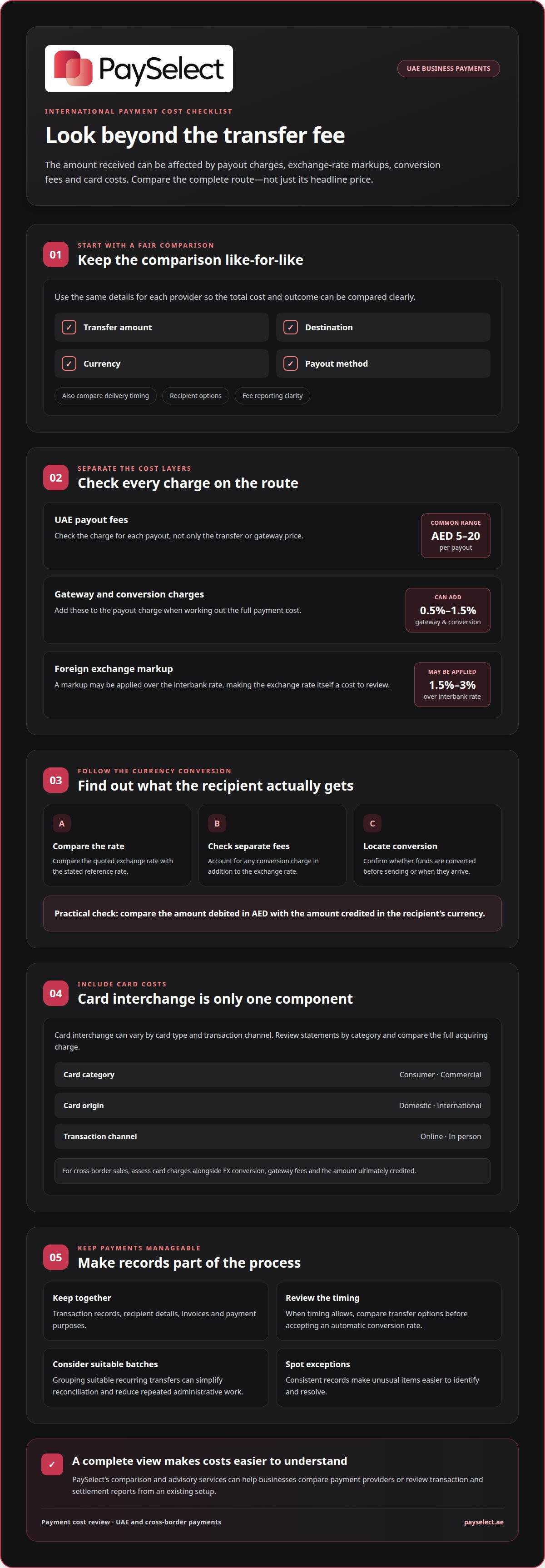
Compare providers using the same transfer amount, destination, currency, and payout method. UAE payout fees commonly range from AED 5 to AED 20 per payout, while gateway fees and currency conversion charges can add 0.5%-1.5%. Review the total cost alongside delivery timing, recipient options, and how clearly each payment system reports fees. This creates a more reliable comparison than headline pricing alone.
Cross-Border Payments and Foreign Exchange
Cross-border payments can involve separate charges for sending, receiving, and converting funds. UAE payment providers may apply an FX markup of 1.5%-3% over the interbank rate. For example, a business paying an overseas supplier should compare the amount debited in AED with the amount credited in the recipient’s currency. Also consider whether a transfer is individual or part of a planned batch.
International payments need to fit your documentation and compliance processes. Keep transaction records, recipient details, invoices, and payment purposes together. For recurring supplier or contractor payments, consistent records make exceptions easier to spot and resolve.
Foreign Exchange Conversion Costs
Conversion costs can be less visible than a transfer fee because they’re built into the exchange rate. Compare the quoted rate with the stated reference rate, then account for any separate conversion charge. Check whether conversion happens before sending or when funds arrive. This affects the currency credited and the final amount available to the recipient.
When payment timing allows, compare transfer options before conversion instead of accepting an automatic rate without reviewing its effect. Grouping suitable transfers can also simplify reconciliation and reduce repeated administrative work.
Card Interchange by Type and Channel
In the UAE, card interchange depends on card type and transaction channel, including whether a purchase is processed online or in person. Consumer, commercial, domestic, and international cards can have different cost structures. Interchange is one component of the merchant discount rate, so compare the full acquiring charge rather than treating interchange as the only card cost.
Review card statements by channel and card category to see which transactions drive costs. For cross-border sales, assess card charges alongside FX conversion, gateway fees, and the amount ultimately credited. A like-for-like cross-border payment comparison can help clarify those combined costs.
Payment consulting and implementation support
Payment consulting turns transaction data and business requirements into a workable payment plan. The process starts by mapping sales channels, customer locations, currencies, settlement needs, and existing provider relationships. A UAE retailer, for example, may need one arrangement for online orders and another for in-store payments. This assessment helps identify duplicated costs, approval issues, and gaps between checkout and accounting records.
A review of transaction and settlement reports can show where fees accumulate. Separate transaction charges, international card costs, FX markups, chargebacks, reserves, and settlement deductions. Also look for avoidable declines, delayed payouts, and manual reconciliation. These findings can inform practical recommendations, whether you want to improve your current setup or assess alternative payment solutions.
Implementation planning should connect commercial decisions with day-to-day operations. A structured plan can include:
• Mapping payment flows across websites, point-of-sale systems, and cross-border collections.
• Assigning responsibilities for onboarding, account access, testing, and issue escalation.
• Connecting transaction data with accounting records to simplify reconciliation.
• Setting reporting checks for fees, declines, settlement timing, and chargebacks.
Before launch, test the complete payment journey with realistic cases. For an online order, confirm that checkout, payment confirmation, refund handling, and settlement records align. For an international payout, trace the amount sent, currency conversion, recipient details, and final reconciliation. These checks can help identify process gaps before they affect routine transactions.
Make compliance and security reviews part of implementation, not a last-minute task. Map how payment information moves between your website, payment system, and accounting tools. Document access controls, transaction records, and escalation steps for unusual activity. After launch, ongoing optimisation can involve reviewing provider terms and performance, supporting negotiations, and refining payment routing as the business expands. The aim is a clearer operating model, with fewer disconnected processes and better visibility into payment costs.
UAE payment gateway provider comparisons
A useful UAE gateway comparison ranks the full operating fit, not provider names alone. Regional service providers’ transaction processing fees are reported at 2.69% to 2.99%. Treat that range as one comparison point, then assess how each proposal prices your business’s actual payment mix, currencies, and sales channels.
Build a like-for-like comparison around a typical order and checkout journey. Separate the transaction rate from setup charges, recurring costs, international card charges, FX conversion, refunds, and chargeback handling. Then examine settlement timing, payout currencies, reporting detail, and any reserve terms. A lower headline rate may not suit a business that needs additional integrations or cross-border collections.
Payment methods also shape the comparison. A UAE retailer may need online card acceptance, wallets, and in-store payments, while a service business may rely on invoices and payment links. Record which channels matter, which currencies customers use, and how transactions flow into accounting. This makes provider proposals easier to compare against real operations.
Pricing
compare each fee against the same transaction profile and channels.
Coverage
assess supported payment methods, currencies, and international acceptance.
Operations
compare integration requirements, settlement reporting, and payout processes.
Commercial terms
review reserves, onboarding steps, and dispute handling.
For larger businesses, compare how each arrangement can work across multiple acquiring relationships or markets. A smooth checkout is only one consideration. Finance teams also need usable transaction records, predictable reconciliation, and clear visibility into settlement deductions. For example, a business with separate online and in-store sales can assess whether consolidated reporting would simplify month-end review.
Use the same business profile to compare gateway options and identify the trade-offs that matter. Compare UAE payment gateway options against your channels, currencies, and integration needs.
PaySelect: Payment Infrastructure Consulting
PaySelect helps UAE businesses assess payment arrangements and plan improvements through Payment Infrastructure Consulting. This can be useful when transaction fees, settlement deductions, international payments, or multiple acquiring relationships make costs difficult to track. For an existing setup, the review can analyse transaction and settlement reports, benchmark current fees, identify unnecessary costs, and recommend practical changes. Switching is not the only option.
If you’re selecting a new setup, use the Payment Gateway Comparison Tool, POS System Selection Tool, or Cross-border Payment Solution Matching to compare options against your channels and operating needs. Larger organisations can also use advisory support to shape payment strategy across markets, providers, collections, and payouts. The goal is a clearer view of costs, terms, and implementation priorities.
Contact PaySelect to discuss your payment setup and find the support that fits your business.
Make Your Next Payment Decision Deliberate
Your payment setup should keep pace with your business. A new sales channel, market, or settlement requirement can change which arrangement fits best. Set a clear priority for your next review, such as simplifying finance operations, supporting international growth, or improving the checkout experience. Align the decision with your business roadmap, not just an immediate fee concern.
Payment advisory services can turn that priority into a practical plan, whether you’re assessing alternatives or improving relationships with current providers. PaySelect’s Payment Gateway Comparison Tool, POS System Selection Tool, and Cross-border Payment Solution Matching support decisions across online, in-person, and international payments.
For tailored payment advice, contact PaySelect about your payment setup. A clear next step can help your business build a payment operation ready for its next stage of growth.
Frequently Asked Questions
What payment advisory and consulting services are available to UAE businesses?
UAE businesses can use provider comparison, payment infrastructure consulting, cost audits, and cross-border solution matching. PaySelect’s comparison tool matches businesses with payment providers using details such as industry, transaction volume, and international requirements. Its advisory support can also help larger organisations assess payment costs and strategy. The comparison tool takes less than 2 minutes, and business details are shared with matched providers only after consent.
How can UAE merchants reduce payment processing fees and interchange costs?
Start by separating interchange from the full merchant discount rate and other charges. Review statements by card type, transaction channel, and sales market to identify which activity contributes most to costs. Then compare the same transaction profile across offers, including refunds and international sales. For example, a merchant with mostly online international card transactions should assess those costs separately from domestic in-store payments.
What are typical payment gateway and merchant account fees in the UAE?
Reported UAE merchant discount rates commonly range from 1.5% to 3%, while typical card processing fees are reported at 2.5%-3.5% per transaction. These figures describe different pricing measures, so compare the quote’s fee components rather than treating them as interchangeable. Ask how the offer handles setup, recurring charges, international cards, FX conversion, refunds, and chargebacks, then assess the total against your transaction mix.
How do UAE payment providers compare on pricing, settlement speed, and features?
Compare providers using one consistent business profile: sales channels, customer markets, currencies, and payment methods. Assess pricing alongside settlement schedules, reporting, integration needs, dispute handling, and support for your business model. Settlement speed affects cash planning, while reporting detail affects reconciliation effort. A retailer operating online and in person, for example, may value consolidated records more than a small difference in the headline transaction rate.
What hidden fees and contract terms should UAE merchants check when choosing a payment provider?
Review the full schedule of setup and recurring charges, international card fees, FX markups, payout deductions, refund costs, and chargeback fees. Read contract terms covering settlement timing, rolling reserves, minimum commitments, renewal, and termination. Check how pricing changes are communicated and how disputes are handled. A written comparison of each item helps finance teams understand the commercial impact before accepting an agreement.
Disclaimer
This content is for informational purposes only and should not be considered financial, legal, or regulatory advice. Payment provider availability, pricing, and approval processes vary depending on individual business circumstances. PaySelect does not guarantee provider acceptance or specific outcomes. Businesses should conduct their own due diligence before entering into any agreements.
Empowering businesses to achieve greater growth
