


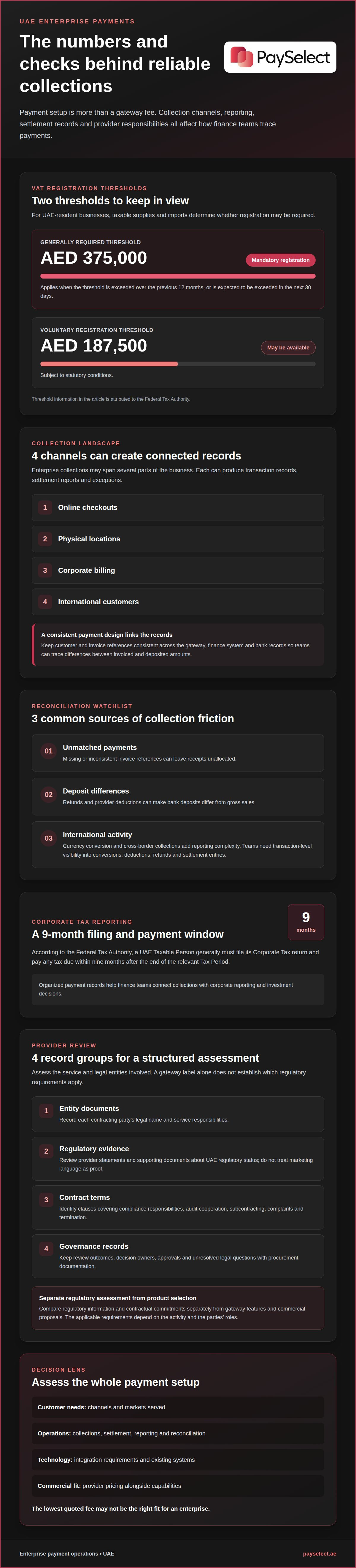
The gateway with the lowest quoted fee may be the wrong fit for a UAE enterprise. Effective payment advisory services for enterprises in the UAE assess the whole payment setup: how customers pay, how funds are collected and settled, and how providers fit existing systems and markets.
It’s understandable to focus on transaction costs when comparing gateways, but fees are only one part of the decision. This article explains how to assess gateway capabilities, identify collection and reconciliation challenges, and weigh factors such as international card acceptance, settlement arrangements, integration needs, and provider pricing. You’ll also learn how expert advice can help businesses already using payment providers review costs and improve their payment operations without making a switch the default answer.
Key Takeaways
• According to the Federal Tax Authority, UAE-resident businesses generally must register for VAT when taxable supplies and imports exceed AED 375,000 over the previous 12 months or are expected to exceed that threshold in the next 30 days; voluntary registration may be available from AED 187,500, subject to statutory conditions.
• Assess a payment provider’s role, regulatory fit, collection coverage, settlement process, and integration requirements before making a gateway decision.
• Review transaction and settlement reports to uncover fee patterns, reconciliation gaps, and areas to address in provider negotiations.
• Consider whether provider comparison, payment pricing analysis, or advisory support for an existing setup best fits your enterprise’s needs.
Payment Collection Challenges for UAE Enterprises
Enterprise collections can span online checkouts, physical locations, corporate billing, and international customers. Each channel generates transaction records, settlement reports, and exceptions. Finance teams may struggle to match payments with invoices and bank deposits when references differ. A consistent payment design connects these records and assigns clear ownership for investigating unmatched items.
VAT status affects how collection data supports finance operations. According to the Federal Tax Authority, UAE-resident businesses generally must register for VAT when taxable supplies and imports exceed AED 375,000 over the previous 12 months or are expected to exceed that threshold in the next 30 days. According to the Federal Tax Authority, UAE-resident businesses may be eligible for voluntary VAT registration from AED 187,500, subject to statutory conditions.
VAT, invoicing, and reconciliation all shape payment system design because records need to connect payment amounts, customer references, invoices, and settlement entries. A sound workflow preserves those references across the gateway, finance system, and bank records. This makes it easier to trace a payment when the invoiced amount and deposited amount differ.
International collections add currency and reporting considerations. A customer may pay in one currency while the enterprise manages accounts in another. Finance teams need transaction-level visibility into conversion, provider deductions, refunds, and settlement entries. For online acceptance, a suitable payment gateway setup should provide records that support the business’s reconciliation process.
Unmatched payments
Missing or inconsistent invoice references can leave receipts unallocated.
Deposit differences
Refunds and provider deductions can make deposits differ from gross sales.
International activity
Currency conversion and cross-border collections can add reporting complexity.
Security and disputes require defined controls. Enterprises should understand their PCI DSS scope with relevant payment partners, limit access to payment data, and assign responsibility for fraud review. Chargeback processes also need clear ownership, transaction records, and coordination between customer service and finance. These are operational safeguards, not a claim that one set of controls applies identically to every business.
For a UAE business, consistent collection records also support corporate tax administration and reporting. According to the Federal Tax Authority, a UAE Taxable Person generally must file its Corporate Tax return and pay any tax due within nine months after the end of the relevant Tax Period. Organized payment records help finance teams connect collections with corporate reporting and investment decisions.
UAE Regulations for Enterprise Payment Services and Providers
Regulatory review for a UAE enterprise should start with the specific service and legal entity involved. A gateway label alone does not establish which regulatory requirements apply. Avoid assuming that every technology provider has the same status or that one provider’s documentation covers every company in the arrangement.
A structured review can establish the right questions before procurement approval. The enterprise’s legal, compliance, and procurement teams can assess the provider’s contracting entity, activities, markets, and stated regulatory status. They can then compare those details with current official Central Bank of the UAE (CBUAE) materials and seek qualified legal advice where interpretation is needed.
For a practical assessment, the adviser can organize the review around these records:
Entity documents
Record the legal name of each contracting party and the service each party is responsible for.
Regulatory evidence
Review the provider’s statements and supporting documents about its UAE regulatory status, without treating marketing language as proof.
Contract terms
Identify clauses covering compliance responsibilities, audit cooperation, subcontracting, complaints, and termination.
Governance records
Keep the review outcome, decision owners, approvals, and unresolved legal questions with procurement documentation.
This process separates regulatory assessment from product selection. For example, a procurement team can evaluate a provider’s stated status and contractual commitments separately from its gateway features or commercial proposal. Legal review can then focus on the service arrangement under consideration, rather than a general description of payment technology.
Regulatory expectations can depend on the activity and the parties’ roles. Enterprises should not treat a generic checklist as a legal conclusion. A documented assessment gives decision-makers a clear record of what was reviewed and which issues need specialist advice, while keeping provider evaluation grounded in the enterprise’s actual arrangement.
Practical Advice for Choosing Enterprise Payment Gateways
For UAE enterprises, tailored gateway advice connects transaction needs with accounting workflows, customer markets, and reporting priorities. An independent adviser can help coordinate provider assessment and implementation planning.
Payment Strategy and Provider Advice
Enterprises seeking payment advisory services in the UAE can use an independent adviser to assess their transaction portfolio and business requirements. The adviser compares provider options against channels, customer markets, pricing structures, reporting needs, and integration requirements. For example, a company serving customers online and through physical branches may need a separate assessment for each channel.
The adviser can also review how proposed arrangements fit the enterprise’s existing systems and responsibilities. This includes identifying essential capabilities, where separate providers may be needed, and how options align with expansion plans across the Emirates. The result is a decision framework that helps finance, technology, and procurement teams weigh trade-offs together.
Implementation Steps and Timelines
Implementation typically progresses through requirements assessment, provider selection, onboarding, integration, testing, and rollout. The adviser coordinates these stages with the enterprise and relevant providers. Timing depends on the technical environment, onboarding processes, and the number of channels or markets involved. A project plan should therefore set milestones around those dependencies rather than assume a standard schedule.
Before launch, the adviser can coordinate testing of authorisations, refunds, reporting exports, and reconciliation using sample transactions. The team can also agree how exceptions move between finance and customer service. A phased rollout lets the enterprise assess one channel before extending the integrated setup to other operations.
Strong implementation planning brings together teams that rely on payment information. The adviser aligns accounting requirements, technical dependencies, and operational ownership, then tracks decisions and milestones with the project team. This keeps the rollout connected to business priorities.
Requirements
The adviser documents channels, markets, transaction types, and reporting needs.
Selection
The adviser evaluates provider capabilities and commercial terms against those requirements.
Delivery
The adviser coordinates onboarding, integration testing, team readiness, and phased rollout.
This approach gives UAE enterprises structured professional support while tying implementation decisions to their operating model and growth plans.
PaySelect: Payment Advisory
PaySelect helps UAE enterprises assess gateway choices, collection flows, and payment arrangements across business channels. Its advisory service supports decision-makers seeking an independent view of their options, whether they are reviewing an existing setup or considering alternatives. Payment advisory services for UAE enterprises can clarify the priorities behind those decisions without making a provider switch the default.
For online acceptance, the Payment Gateway Comparison Tool helps compare gateway options against business requirements. The POS System Selection Tool supports decisions about in-person payments. Cross-border Payment Solution Matching helps enterprises assess options for international collections and payouts alongside their broader payment strategy.
For a business already processing payments, advisory can include reviewing transaction and settlement reports, identifying fee patterns, and preparing for provider negotiations. This helps finance teams understand where further analysis may be useful while keeping the current provider in place. Payment advisory services for enterprises in the UAE can also support decisions involving multiple markets, channels, or acquiring relationships.
Gateway selection
Compare relevant capabilities and pricing structures against business channels, customer markets, and operational requirements.
Existing setup
Review transaction and settlement records to guide analysis without assuming a switch is needed.
International activity
Assess collection and payout requirements as part of the enterprise’s payment strategy.
These tools and advisory services are useful when payment decisions involve several teams or business priorities. They structure the assessment, clarify trade-offs, and support informed next steps based on the enterprise’s requirements.
For a discussion about your enterprise payment needs, contact PaySelect.
Frequently Asked Questions
What payment advisory services are available to enterprises in the UAE?
PaySelect provides payment advisory and provider comparison support for enterprise requirements. Businesses can compare options for different channels and markets based on their needs. Provider comparisons can consider industry, transaction volume, and international requirements. Contact PaySelect to discuss the services relevant to your business. PaySelect is not a licensed payment service provider.
How can a payment adviser compare payment gateways and acquiring banks serving UAE businesses?
A payment adviser can compare gateway and acquiring options against the enterprise’s industry, transaction profile, customer markets, and operational needs. For example, a business expanding online internationally can weigh checkout requirements against provider support for its markets and transaction mix. PaySelect’s comparison process uses business-specific requirements to identify relevant provider options, helping decision-makers assess overall fit rather than choosing based on a single feature.
How do UAE payment options differ for online, in-store, recurring, and B2B transactions?
Online checkouts, physical locations, corporate billing, and international collections create different transaction records and reconciliation needs. Assess each channel’s coverage, reporting, pricing, and integration requirements separately.
Disclaimer
This content is for informational purposes only and should not be considered financial, legal, or regulatory advice. Payment provider availability, pricing, and approval processes vary depending on individual business circumstances. PaySelect does not guarantee provider acceptance or specific outcomes. Businesses should conduct their own due diligence before entering into any agreements.
Empowering businesses to achieve greater growth
