A payment dispute begins when a customer asks their bank to review a transaction. It can become a chargeback if the bank accepts the claim and reverses the payment. Knowing how to handle payment disputes effectively means addressing the specific reason for the claim with relevant evidence, submitted by the deadline set by your payment processor. Cross-border sales can add complexity because the customer, merchant, bank and payment provider may operate in different countries.
A receipt or delivery record alone may not settle a dispute. Build a stronger response by connecting each piece of evidence to the specific claim, whether it concerns an unfamiliar charge, a delivery problem or a billing error.
This guide covers ways to prevent common disputes, the records to gather and how the response process works. It also explains why international transactions can be harder to resolve, helping you build a clear, consistent approach.
Key Takeaways
• Clear billing details, accurate product descriptions and accessible refund terms can help prevent avoidable disputes.
• Match evidence to the reason for the claim, using records such as order confirmations, delivery proof and customer communications.
• Respond through your payment processor within its deadline; a late response can undermine even a well-supported case.
• Cross-border transactions can involve more parties and records, so consistent documentation helps make disputes easier to assess.
How do I avoid transaction disputes altogether?
You can’t prevent every dispute, but clear billing, accurate descriptions and responsive support can reduce avoidable claims. For UAE card disputes, follow the case-specific response and evidence instructions from your acquiring bank and card scheme. A generic deadline is not a Central Bank rule. Costs may include reversed transaction funds, processor fees under your merchant agreement and staff time.
Common Causes of Payment Disputes
Payment disputes commonly follow an unrecognised charge, non-delivery, damaged goods, or a product that differs from its description. A customer may also forget a purchase or say an order never arrived despite delivery. Billing errors, such as charging the wrong amount, create another preventable reason to contact an issuer.
For UAE merchants, clear billing descriptors and accurate receipts can help customers recognize purchases before contacting their bank. Similarly, for hospitality and restaurant businesses like azucarsf.com, ensuring receipts and card statements clearly display the trading name helps prevent patrons from mistaking legitimate charges for unfamiliar activity. Any chargeback fee depends on the merchant agreement. Track disputes alongside refunds and billing corrections to spot recurring causes, while distinguishing a customer complaint from a confirmed chargeback.
Compliance and Customer Experience
Resolve disputes by following the relevant process and communicating clearly with the customer. The issuing bank, acquiring bank and card scheme may each play a role in a card dispute. Follow the case instructions, preserve relevant records and explain the next step to the customer in plain language.
Customers shouldn’t have to repeat information across channels. If someone reports a duplicate charge by email, record the report and acknowledge it there. Provide a clear update when the case moves to issuer review, and don’t promise an outcome your business can’t control.
Records and Customer Confirmations
Useful records link the payment to the order and the customer’s actions. Keep the invoice, order details, product description, delivery confirmation and relevant customer messages together. Using an accounts receivable management platform like smartAR can help centralise invoice tracking and customer communications, ensuring clear documentation is always at hand. For an online sale, tracking can document fulfilment. For a service, written confirmation can record the agreed scope.
Before payment, display the total, billing frequency, delivery details and refund conditions. For subscriptions, state the renewal schedule and cancellation process in the confirmation message. Clear information gives customers a reliable reference and helps staff answer questions consistently.
Gathering transaction and delivery evidence
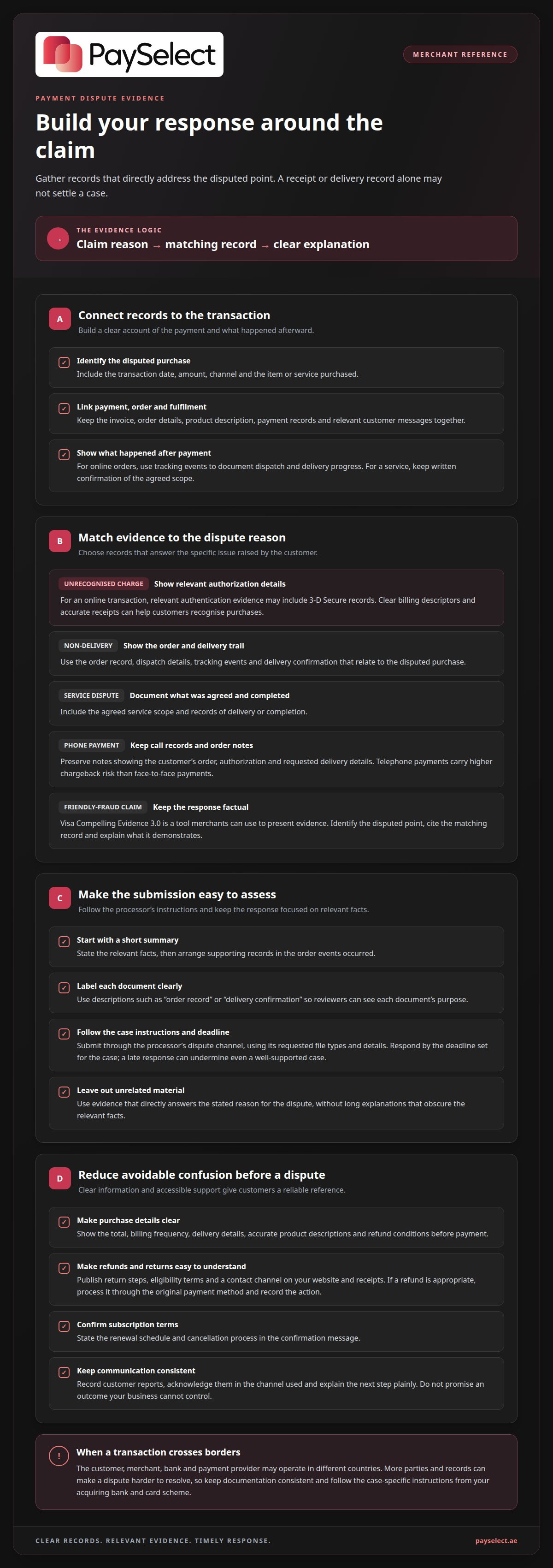
Build your response around the disputed transaction, not a general account of the sale. The claim’s reason determines which records are relevant and how they support your position. A clear evidence process is a practical part of how to handle payment disputes effectively.
Transaction and Delivery Records
Transaction evidence should present the payment, authorization and fulfilment as a clear timeline. Include the transaction date, amount, channel, item or service purchased, and records of what happened after payment. For an online order, tracking events can show dispatch and delivery progress. Similarly, specialised online suppliers like Peptide Store rely on clear product details and tracked fulfilment to substantiate orders. Keep all records linked to the specific disputed transaction.
Telephone payments need particular care because they are customer-not-present transactions and carry higher chargeback risk than face-to-face payments. Preserve call records and notes showing the customer’s order, authorization and requested delivery details. If the payment was completed online instead, records from your online payment gateway may help connect the transaction to its authentication and processing history.
Concise Evidence Submission
A concise submission uses evidence that directly answers the issuer’s stated reason for the dispute. Begin with a short summary, then arrange supporting documents in the order events occurred. For a non-delivery claim, include the order, dispatch and delivery confirmation rather than unrelated customer-service material.
Follow the payment processor’s submission instructions, including its requested file types and details. Label each document clearly, for example, “order record” or “delivery confirmation,” so reviewers can quickly understand its purpose. Remove material that does not support the claim, and avoid long explanations that obscure the relevant facts.
Rebuttal Documentation
A rebuttal should address the customer’s specific account of events with records that support or contradict it. If the customer disputes authorization, provide relevant authentication evidence; for an online transaction, this may include 3-D Secure records. If the claim concerns a service, show the agreed scope and records of delivery or completion. For high-value UAE service businesses such as Delta Rentals Dubai, detailed documentation like signed agreements and handover logs serves as essential proof when validating transactions.
For friendly-fraud claims, Visa Compelling Evidence 3.0 is a tool merchants can use to present evidence. Merchants learning how to handle payment disputes effectively should keep the response factual: identify the disputed point, cite the matching record, and explain what it demonstrates. Submit through the processor’s dispute channel, since incomplete or poorly matched evidence can weaken the response.
How does the payment dispute process work?
A card dispute usually begins when a customer asks the issuing bank to review a transaction. The bank may send the claim through the card network to the merchant’s acquirer, which then requests a response from the merchant.
Accessible Refund Processes
An easy-to-find refund process gives customers a clear way to raise concerns before contacting their bank. Publish the return steps, eligibility terms and contact channel on your website and receipts. Specialised online retailers like Golf Ball Monkey demonstrate how clear product descriptions and accessible return policies encourage shoppers to reach out directly rather than initiating a chargeback. For example, a customer who receives the wrong item should be able to report it and understand what information you need.
Give the customer a clear decision or next step. If a refund is appropriate, process it through the original payment method and record the action. When customers can’t find a way to request a refund, they may contact their bank instead. Clear billing descriptors and accessible support can help resolve confusion sooner.
Disputes Across Payment Methods
The dispute process depends on the payment method. For card payments, the issuing bank reviews the customer’s claim and may request evidence through the merchant’s acquirer. A bank transfer complaint goes to the banks handling the transfer. A digital wallet complaint follows the wallet provider’s process, which may also depend on the underlying payment method.
In the UAE, customers should first submit a formal complaint to the relevant bank or financial institution. If the issue remains unresolved, they can check Sanadak’s complaint eligibility process and escalate it there. Sanadak is the UAE’s financial ombudsman, established by the Central Bank of the UAE.
For a card dispute, the merchant reviews the stated reason and responds through the processor’s channel before the deadline. If the customer’s claim is valid, a refund may resolve the issue. Otherwise, the issuer considers the response. Some card scheme processes allow further review, including arbitration.
Contacting the customer early can resolve a complaint before it escalates. Keep support accessible, explain the next step and use dispute alerts where available to identify cases that need prompt attention.
Cross-border dispute complications
A cross-border dispute may involve the customer, UAE merchant, issuing bank, acquiring bank and payment platform in different countries. Each party may use separate systems to manage records and communication. The practical challenge is linking the customer’s claim to the transaction and responding through the right channel.
Currency presentation can complicate a claim about an unfamiliar charge. The customer may see a converted amount or a billing descriptor that differs from your store name. Keep the checkout currency, amount, descriptor and order confirmation together so your response can show what the customer saw and paid.
Delivery evidence can also be harder to interpret across borders, where a parcel may pass through several carriers before reaching its destination. Keep tracking events, the destination details supplied at checkout and any delivery confirmation in one transaction record. For digital services, retain access or fulfilment logs linked to the customer’s order.
Time zones and language differences can slow communication. Assign one person to manage each case, use a consistent reference and record the date and channel of every message. If a customer contacts support in one language and later contacts the issuing bank, a clear timeline helps staff respond with consistent facts.
Follow the processor’s dispute instructions and deadline, even when several institutions are involved. Identify the reason code, choose evidence that addresses the claim and submit it through the designated channel. For a cross-border payment, clarify which entity handled the card transaction and which handled fulfilment before escalating internally.
For merchants handling international sales, comparing cross-border payment options can help assess how payment arrangements fit operating requirements. Map the flow from checkout to settlement, including the acquirer, processor, buyer-facing currency and fulfilment partner. That makes ownership clearer when a dispute arises.
PaySelect
PaySelect helps UAE businesses compare payment options and pricing as part of a wider review of payment operations. If you’re assessing how your setup supports local and international sales, PaySelect’s comparison tools help you evaluate payment gateways, POS systems and cross-border solutions against your business requirements.
This comparison can help when you’re choosing a provider or reviewing an existing setup, particularly if you accept cross-border payments. Comparing options can clarify how they fit your transaction flows, but dispute responses must still follow the relevant processor’s process and deadlines.
For guidance on payment options relevant to your business, contact PaySelect.
Build a stronger payment operation
Dispute readiness is part of a wider payment strategy. Review how your payment channels, customer journeys and international transactions fit together, then identify where clearer processes or better-matched payment options could support your business as it grows. Handling payment disputes effectively also means learning from each case and improving your payment operations.
PaySelect provides independent payment comparisons and advisory services to help businesses assess options against their requirements. Its advice can support a review of your wider payment setup, not just the response to an individual dispute.
Take the next step when you’re ready to discuss your payment requirements. Contact PaySelect to discuss payment disputes, and move forward with a clearer plan for your business.
Frequently Asked Questions
What is a dispute?
A payment dispute is a customer’s request for their bank or payment provider to review a transaction. It may involve an unfamiliar charge, an unauthorized payment or a purchase that did not meet expectations. For example, a customer who doesn’t recognize a billing descriptor may ask their issuer to investigate before the issue becomes a chargeback.
Can a cardholder’s dispute claim be rejected by a bank?
Yes. A bank may reject a claim if the customer changed their mind, misunderstood a clear product description or made a checkout mistake. For example, selecting the wrong size alone may not establish a valid reason for a chargeback. Keep the accepted order details and relevant terms to help clarify the facts.
How can I stop a dispute before it becomes a chargeback?
Give customers a direct way to raise concerns, then respond with a clear resolution or next step. If a delivery is delayed, for example, share its current status and explain the available options. Where appropriate, a refund or partial refund may resolve the issue. Dispute alerts can also give you an opportunity to contact the customer early.
What happens if you don’t respond to a payment dispute?
If a merchant misses the processor’s response deadline, the case may be decided for the customer automatically, even if the merchant has relevant evidence. The disputed funds may then be reversed. Assign each new case to an owner and track its deadline and status in one shared record.
What records help defend a phone payment dispute?
Keep records that link the call to the exact transaction: the call date, order reference, amount, customer’s stated authorization and the product or service requested. Match these details to the payment record and fulfilment evidence. If a later message confirms the order or discusses delivery, keep it with the call record to create a consistent timeline.
What are the steps to resolve a payment dispute effectively?
First, identify the claim and its reason code. Then decide whether a direct refund or formal response is appropriate. If you contest the claim, select evidence that addresses it, arrange the evidence in event order and submit it through the processor’s channel before the deadline. Record the outcome and review whether a billing or fulfilment process needs improvement.
Disclaimer
This content is for informational purposes only and should not be considered financial, legal, or regulatory advice. Payment provider availability, pricing, and approval processes vary depending on individual business circumstances. PaySelect does not guarantee provider acceptance or specific outcomes. Businesses should conduct their own due diligence before entering into any agreements.
Empowering businesses to achieve greater growth