


A business can accept payments without opening its own merchant account. That’s the central idea behind a payment facilitator. Understanding what a payment facilitator (PayFac) is means looking at how it uses a master merchant account to process payments for businesses, known as sub-merchants, and manages key parts of their payment relationship.
This model can make payment acceptance feel more integrated, especially when payments are built into a software platform. The convenience comes with responsibilities: the PayFac manages merchant onboarding, risk assessment, settlement and disputes, while working with acquiring banks and payment processors behind the scenes.
This guide explains how master merchant accounts work and how a PayFac differs from a payment processor, payment gateway, ISO and other payment providers. It also covers familiar examples and operational trade-offs for businesses in the UAE and GCC, helping you understand where the model fits before comparing payment options.
Key Takeaways
• A PayFac lets businesses accept payments through a master merchant account, with each business operating as a sub-merchant.
• Understand how onboarding, settlement and merchant responsibilities are organised before deciding whether this model fits your business.
• Processors, gateways, ISOs and aggregators play different roles, so compare the arrangement against your payment setup and operational needs.
• PaySelect can help compare payment options and assess pricing, including for businesses reviewing their existing provider relationships.
What Is a Payment Facilitator?
A payment facilitator, or PayFac, enables businesses to accept payments through a shared payment structure instead of arranging payment acceptance independently. It connects merchant-facing services with banking and processing infrastructure.
The PayFac Definition
A PayFac is an intermediary that enables businesses to accept payments and may deposit proceeds into a designated bank account. It supports parts of the payment relationship, such as merchant onboarding and integrating payment acceptance into a platform. For a business, this can make payments part of the software experience rather than a separate setup.
PayFac Examples and Roles
Shopify, Airbnb and Uber offer payment services within their platforms, but their payment arrangements can vary by service and market. Their inclusion does not mean that each operates as a payment facilitator in every context. A software platform can integrate payment acceptance into the same service merchants use to manage bookings, sales or other activity. This lets the platform shape the payment experience alongside its core product, rather than leaving payment setup entirely outside its software.
A PayFac may also support fraud protection, secure data storage and tokenization as part of its payment services. For example, a booking platform could onboard a host and provide payment acceptance within its own interface. The platform remains the merchant-facing point of contact, while financial partners support processing and fund movement. This model is useful to understand when assessing how payments fit into a platform’s customer experience and operations.
These responsibilities may include underwriting and risk assessment, settling funds with sub-merchants, managing chargebacks and disputes, and meeting payment-industry compliance requirements. A PayFac typically underwrites its sub-merchants and may bear associated risk if a merchant commits fraud, disappears or generates too many disputes. PayFacs are expected to perform due diligence when onboarding sub-merchants, including checking transaction legitimacy and whether a business complies with established regulations. Underwriting processes and risk responsibilities vary by provider and arrangement. PayFacs can set pricing and payouts more flexibly than the ISO model, but accepting more merchants can also increase risk. These responsibilities are important when assessing how a payment facilitator operates.
How PayFac Merchant Accounts Work
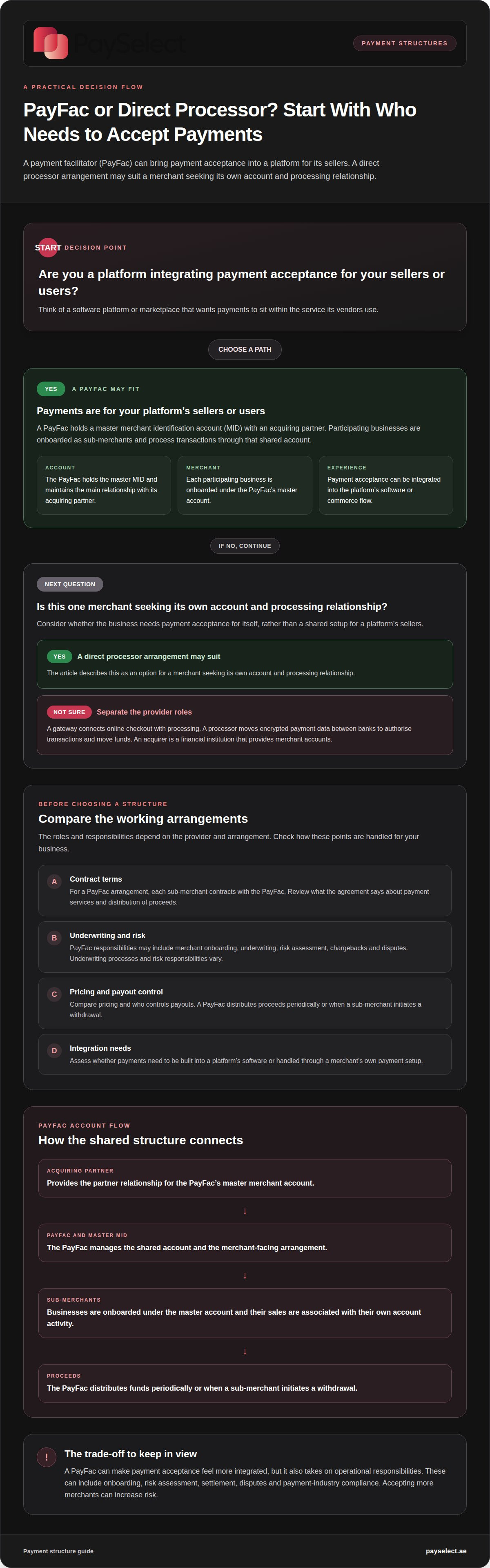
The PayFac holds a master merchant identification account (MID) with an acquiring partner. Participating businesses process transactions through this account as sub-merchants.
The Master Merchant Account
The master merchant account is the primary account through which the PayFac submits transactions for sub-merchants. The PayFac holds the MID and maintains the main relationship with its acquiring partner. This lets a platform centralise payment operations while its vendors accept customer payments. The PayFac manages the shared account and coordinates how proceeds reach participating businesses.
Sub-Merchant Accounts
A sub-merchant is a business onboarded under the PayFac’s master account rather than applying for a separate account. The platform can create a record for each seller, connect it to transactions and manage its payment access. For example, a marketplace can onboard a vendor as a sub-merchant and associate that vendor’s sales with its own account activity.
Each sub-merchant contracts with the PayFac, which acts as the primary merchant in this arrangement. Contract terms describe the payment services and how proceeds are distributed. A platform can integrate checkout into its commerce flow, allowing a vendor to accept payments within the service it uses to manage sales. After transactions enter the master account, the PayFac distributes proceeds periodically or when a sub-merchant initiates a withdrawal. This links onboarding, payment acceptance and settlement within one operating structure. For a UAE merchant, the key details are who holds the master MID, who contracts with the business and how the platform routes sales proceeds.
PayFacs Versus Processors, Gateways, ISOs and Aggregators
Payment providers handle different parts of a transaction and merchant relationship. Understanding what a payment facilitator (PayFac) is helps clarify how these roles fit together.
PayFacs, Processors, and Acquirers
A processor moves encrypted payment data between banks to authorise transactions and move funds. An acquirer is a financial institution that provides merchant accounts and belongs to card networks such as Visa. A PayFac works with these partners while managing the merchant-facing arrangement. Identifying each party helps UAE businesses clarify who provides the account, who processes transactions and who handles merchant support.
Gateways, ISOs, and Aggregators
A payment gateway connects an online checkout with payment processing, while a PayFac can also manage merchant onboarding and payment relationships. For example, a retailer may use a gateway to accept online card payments; payment gateway options relate to this checkout layer. An ISO typically supports sales and service, but usually doesn’t underwrite merchants or take underwriting risk. Aggregators group businesses under a shared processing arrangement, a structure associated with the PayFac model.
Choosing a Processor or PayFac
For UAE businesses, the practical choice depends on whether payments serve one merchant or a platform’s users. A PayFac can suit a software company integrating payment acceptance for its sellers. A direct processor arrangement may suit a merchant seeking its own account and processing relationship. Compare contract terms, underwriting responsibilities, pricing, payout control and integration needs to see which structure aligns with your business model and operating requirements.
Payment Facilitator Compliance and Risk Management
A PayFac’s payment services come with underwriting, security and financial risk responsibilities. These controls affect how merchants are screened and supported.
Compliance and Risk Responsibilities
A PayFac assesses merchant risk, monitors activity and manages disputes linked to its payment services. It uses Know Your Customer (KYC) checks to verify merchant identities and follows anti-money laundering (AML) and fraud prevention requirements. Payment facilitators must maintain PCI DSS Level 1 compliance, a payment card security standard. These controls matter because the facilitator bears financial liability for sub-merchants’ activities and chargebacks.
Merchant Underwriting and Onboarding
Underwriting assesses a merchant’s business and payment risks before or during onboarding. A PayFac performs due diligence, verifies identity through KYC, and reviews activity for fraud and compliance concerns. Some facilitators assess risk after onboarding, but the model still requires ongoing monitoring. To become a PayFac, a platform typically pursues bank and card-network underwriting, network registration, applicable licences and approvals, compliance processes and legal preparation. Capital reserves help cover potential losses.
Merchant Fees and PayFac Revenue
PayFacs earn money by adding a markup to the transactions merchants process; these commissions are known as residuals. Merchant charges can reflect the payment services and risk management included in the arrangement. The exact fee structure depends on the facilitator’s pricing model and services, so businesses should distinguish transaction charges from other contract terms. Clear pricing helps merchants understand how payment costs relate to their transaction activity.
How PaySelect Can Help
PaySelect helps UAE businesses assess payment options after they understand how a PayFac model works. Its independent comparison platform helps merchants compare providers and consider how different payment setups may fit their business. This gives them a clearer basis for comparing a shared account arrangement with other payment options.
For businesses selecting providers, PaySelect helps compare suitable options based on their requirements. Businesses accepting online payments can compare payment gateway solutions, while merchants taking in-person payments can explore POS options. Businesses with cross-border collections or payouts can compare relevant international payment solutions.
Pricing is another part of the decision. PaySelect helps businesses understand provider pricing in context, rather than treating a headline rate as the full cost. Merchants can consider transaction patterns, payment channels and operational needs together to make a more useful comparison for a UAE business.
A platform considering embedded payments can use PaySelect to clarify its requirements before comparing providers. For example, it can outline whether it needs payments integrated into its software, a separate merchant relationship, or a mix of in-person and online acceptance. A business already processing payments can also review whether its current arrangement still fits its operations.
PaySelect provides an independent way to compare payment solutions and understand how different arrangements may fit a business. Merchants can use its comparison platform when setting up payment acceptance or reassessing existing options.
For guidance on your payment requirements, contact PaySelect.
Frequently Asked Questions
What is a PayFac?
A PayFac enables platforms to integrate payment acceptance into their services. For a merchant, the practical point is understanding how the arrangement affects day-to-day operations. Review who appears in the merchant agreement, how payment activity is reported and which party provides support. These details clarify the merchant’s relationship with the platform and its payment partners.
What is a payment facilitator (PayFac) and how does it work?
A PayFac coordinates payment acceptance for businesses using its platform. A typical transaction involves a customer completing checkout, payment partners authorising the card and the platform recording the sale for later reconciliation. Merchants should understand how refunds, transaction records and payout schedules appear in their systems. These details help finance teams match payment activity to sales and resolve discrepancies.
What is the difference between a PayFac, payment processor, and merchant acquirer?
To see who handles each part of the process, review the relevant documents and tasks. Check the merchant agreement to identify the contracting party, the transaction statement for processing details, and support information for the dispute contact. This practical review can show where to direct questions about pricing, transaction errors or account terms, without confusing payment operations with merchant support.
How much does it cost to set up and operate a PayFac?
PayFac costs depend on the operating model, transaction complexity and markets served. Budget planning should account for technology, merchant monitoring, underwriting resources, fraud controls, dispute handling, network registration and capital reserves. A platform should also consider ongoing maintenance and the staff needed to manage these functions. Comparing an in-house build with a partner-supported arrangement can clarify the resources each approach requires.
What are the risks and liabilities of operating a PayFac?
For a sub-merchant, practical risks may include delayed payouts, account holds, limited payment customisation or service disruption. Contract terms explain when funds may be held, how disputes are handled and what happens if the relationship ends. For the platform, operational failures can affect merchant trust and reputation. Reviewing these scenarios helps businesses understand the impact beyond transaction processing.
What security and PCI DSS requirements apply to PayFacs?
PCI DSS requirements for a PayFac depend on its role, payment-data environment and the applicable card-network and acquiring-partner rules. Level 1 compliance is not a universal requirement for every PayFac; the applicable validation level should be confirmed with the acquirer or relevant card network. The practical security scope depends on how payment data moves through the platform, including which systems store, process or transmit card details. Mapping those data flows helps identify systems and vendors that require security controls. Platforms should also define access permissions and monitoring processes so sensitive payment information is handled consistently across connected services.
Disclaimer
This content is for informational purposes only and should not be considered financial, legal, or regulatory advice. Payment provider availability, pricing, and approval processes vary depending on individual business circumstances. PaySelect does not guarantee provider acceptance or specific outcomes. Businesses should conduct their own due diligence before entering into any agreements.
Empowering businesses to achieve greater growth
