
The lowest transaction rate can still be the wrong choice if settlement terms, checkout integration or international payment needs don’t fit your business. When comparing ccavenue alternatives uae, look at the full operating fit, not just the headline price.
Your current setup may no longer support the way your business sells or manages payments. But switching without a clear comparison can disrupt checkout and internal processes. Use this guide to assess alternatives against your transaction needs, pricing, settlement terms and technical setup, so you can identify what matters before making a change.
PaySelect helps UAE businesses compare payment options using business requirements such as industry, transaction volume and international needs. Its Take the Test tool provides a starting point for identifying relevant options. You’ll also find practical ways to compare costs, assess operational readiness and plan a manageable next step. For larger organizations, PaySelect’s payment infrastructure advisory and consulting can support a broader review of systems and costs. The goal is a more informed decision based on what your business needs.
Key Takeaways
• Review your payment setup when expansion, new sales channels, customer markets or reporting needs change what your business requires.
• Compare gateway alternatives in the UAE against the same business scenarios, considering channels, currencies, integration, settlement, support and fees.
• Plan a gateway switch as an operational project by mapping payment touchpoints, internal owners, customer communications and reporting dependencies.
• Use transaction and support records to assess total impact and readiness instead of relying on headline claims or unsupported benchmarks.
• Use PaySelect’s comparison tools to structure your evaluation, with advisory support for broader infrastructure and cost reviews.
When should a UAE business consider payment gateway alternatives?
Consider an alternative when your business needs or operations have changed, not simply because another gateway makes a stronger claim. Expansion, new sales channels, different customer markets or new reporting priorities can expose gaps in your current setup. One inconvenience may need only a targeted fix. Recurring problems across checkout, payment management and reporting may signal a broader mismatch.
Start by reviewing the role your gateway plays in accepting and managing online payments. For a concise foundation, see What is a Payment Gateway? Then map your own payment flows. A setup that worked for one channel or customer base may no longer fit how your business operates. A review doesn’t commit you to switching. It helps you decide whether your current arrangement still fits and what an alternative would need to improve.
Which business changes can make a gateway review worthwhile?
Growth can change the demands on payments. Selling into new customer markets may bring different currency and payment requirements. Adding a website, app, in-person sales or payment links can create extra checkout and reconciliation tasks. Transaction patterns may also shift with sales volume or seasonal peaks. If existing reports no longer give your team the information needed to track transactions or resolve issues, include reporting in your review.
Look for patterns rather than reacting to one isolated incident. A minor reporting inconvenience may be manageable, while recurring manual work across several channels can consume team time and make performance harder to assess. Compare your current workflows with the needs created by the change. A structured payment gateway comparison can help organize that assessment around your business requirements.
What should you define before comparing alternatives?
Write down how payments operate in your business before reviewing options. Include the channels you use, the customer markets you serve, and the people or systems involved in payment handling and reporting. Then record recurring problems and the outcome you want. “Improve reporting” is broad; “reduce manual steps when reconciling sales across channels” gives the comparison a clearer direction.
Channels
List where customers pay and how each payment is managed.
Markets
Note the customer locations and currencies relevant to your sales.
Workflows
Map who handles payment queries, reconciliation and reporting.
Constraints
Set acceptable limits for disruption, staff effort and implementation complexity.
Separate essential requirements from preferences. An alternative isn’t automatically better because it offers more features. Those features matter only if they address a real need. This baseline helps you compare options against the same business scenario and avoid a switch that adds complexity without solving the underlying problem.
How to compare payment gateway alternatives for your UAE business
A useful comparison measures each option against the same business needs. Start with the sales channels, customer markets and payment workflows you rely on, then record what the available information says about each option. This keeps your review grounded in actual operations rather than broad claims or a single attractive feature.
A structured payment gateway comparison can help you organize criteria side by side. Use this table as a working template, and enter only details you can substantiate.
| Criterion | What to compare | Useful question |
|---|---|---|
| Business fit | Alignment with your industry, transaction profile and business requirements | Does the option suit the way we sell and manage payments? |
| Channels | Supported sales channels relevant to your business | Can we assess the channels we currently use? |
| Currencies | Published currency information for the customer markets you serve | Does the available information address our market needs? |
| Integration | Documented integration approach and fit with existing systems | What changes would our team need to plan for? |
| Settlement | Published settlement terms and any stated conditions | Can we compare the terms on the same basis? |
| Support | Published support arrangements and relevant operating details | Does the information fit our support requirements? |
| Fees | Published transaction-related, recurring or one-time charges | Which charges are specified, and which remain unknown? |
Which comparison criteria matter beyond headline fees?
Check each option against your actual sales mix. A business selling through several channels may need different integration and reporting capabilities from one using a single checkout flow. Consider how payment information connects with existing processes, which transaction details your team can review, and what ongoing work the setup may require. For fees, separate transaction-related charges from recurring or one-time charges only when the available information distinguishes them. Compare settlement terms on the same basis, including stated conditions. Similar labels don’t necessarily mean identical arrangements.
How can you make provider comparisons fair and useful?
Give every option the same scenario: the same transaction profile, markets, channels, workflows and questions. Where available, use a consistent period or transaction sample from your own records. If a detail isn’t published or can’t be compared, mark it “unknown.” Missing information is something to account for in your evaluation, not proof that an option performs poorly.
Record the source and date of each detail so your team can distinguish stated terms from assumptions. Then summarize the trade-offs against your priorities. The best-fit option depends on your business requirements, not on one headline feature. This approach makes comparisons of ccavenue alternatives uae clearer and more useful for decision-making.
What changes when you switch payment gateway alternatives?
Changing a payment gateway is an operational project, not simply a checkout setting. The payment flow may connect to sales channels, finance routines, customer messages and internal reports. A new setup could address a current limitation or better support business needs, but a switch doesn’t guarantee lower costs or stronger performance. The outcome depends on how well the alternative fits your workflows and how carefully the transition is planned.
Before moving, trace what happens from the moment a customer pays to when your team records, reviews or resolves the transaction. This map shows which tasks need to continue smoothly and where a change could affect customers or staff.
Which workflows should a merchant map before a change?
Document each place customers pay, such as an online checkout or another active sales channel, and note how payment information reaches finance or operations. Include integrations with business systems, reconciliation routines, refund or query handling, and reports staff rely on. Mark each workflow as essential, optional or no longer needed. For international acceptance, include relevant cross-border payment requirements in the map.
This inventory can help you avoid carrying unnecessary processes into a new setup. It also highlights dependencies to review before making a change, such as reports built around existing transaction records.
How can a business plan a controlled transition?
Assign owners for the decision, technical coordination, testing, finance checks and customer communication. Agree on the work sequence, who signs off at each stage, and how issues will be recorded and escalated internally. The right sequence depends on your channels, integrations and team capacity, so there’s no universal transition timeline.
Plan checks around real business tasks. Confirm that checkout behaves as expected, payment activity appears in the reports staff use, and relevant teams know how to handle customer questions during the change.
Assign ownership
Name a responsible person for each operational area affected.
Plan testing
Check key customer payment journeys and the information finance needs afterward.
Prepare communication
Tell relevant staff what is changing, when their process changes, and where to report problems.
Monitor the transition
Track checkout issues and reporting gaps, then document how they are resolved.
Keep the expected benefits and trade-offs visible throughout planning. A different setup might better meet current needs, but it can also require staff time, process changes or adjustments to connected systems. Compare those demands with the problem you’re trying to solve, and decide what evidence would show that the new arrangement is working for your business.
For businesses reviewing ccavenue alternatives uae, a workflow map turns a provider decision into a manageable change plan. It gives your team a shared view of what must keep working, what could improve and what needs attention before the transition begins.
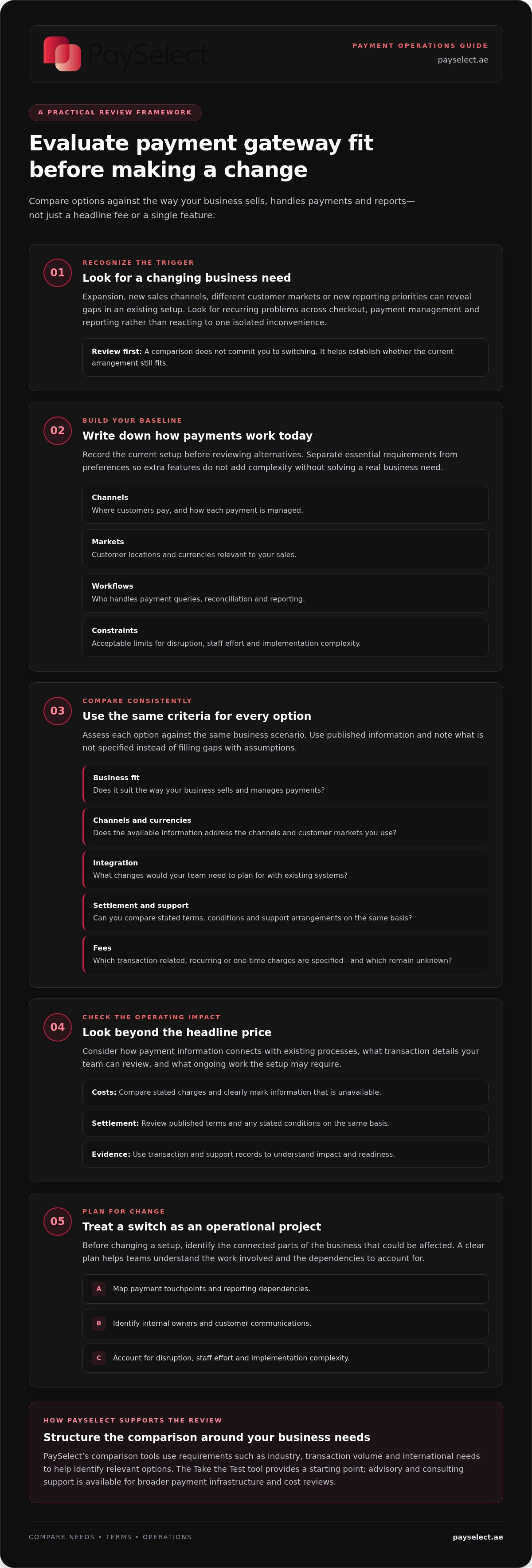
How to assess gateway fit, fees, and operational readiness
A sound decision balances provider fit, expected costs and the work required to make a change. Use evidence from your own payment activity wherever possible, and keep stated details separate from estimates or unanswered questions. This gives your team a practical basis for deciding whether an alternative addresses a real need.
Define needs.
Set out the business requirements the gateway must support, including customer experience, reporting, settlement and essential payment workflows.
Compare evidence.
Review each option against the same requirements. Record published information and mark unavailable details as unknown rather than filling gaps with assumptions.
Calculate total impact.
Gather published fees and settlement terms, then consider relevant integration dependencies and staff effort alongside direct charges.
Test readiness.
Confirm that owners, testing responsibilities and handover plans are in place, and that critical checkout and reporting needs are documented.
Decide.
Weigh the likely benefits against cost, customer experience and operational effort. Proceed only when the evidence supports a change that fits the business.
How should merchants assess total payment costs?
Start with the published pricing and settlement terms for every option under review. Identify which charges are stated, how they’re described, and whether the information allows a fair comparison. Don’t assume similarly named fees cover the same thing. Use your transaction records, where available, to understand the business activity against which the published terms would apply.
Published pricing shows stated charges; a merchant-specific total-cost assessment also considers transaction patterns, settlement terms, integration dependencies and operational effort. Avoid projecting savings unless you have comparable terms and business-specific data to support the calculation.
How can you decide whether the business is ready to move?
Check that the right internal owners can support evaluation, testing and operational handover. Confirm that checkout, reporting and reconciliation requirements are recorded, and that the teams responsible for those workflows understand what a change could affect. Existing support records can also help show where payment issues create repeated work or customer friction.
Keep a short decision log: list established findings, unresolved questions, who owns each follow-up and how each open point affects the decision. A gap in available information isn’t automatically a reason to reject an option, but it should remain visible in your assessment.
For businesses assessing ccavenue alternatives uae, this sequence grounds the decision in operating needs rather than assumptions. Compare gateway options against your business requirements using a structured view of fit and pricing.
How PaySelect helps UAE businesses compare gateway alternatives
Comparing gateways can take time when information is spread across different provider pages and each option describes its services differently. PaySelect gives UAE businesses a structured comparison and advisory platform to assess fit against their requirements. It helps businesses identify options to evaluate and focus their comparison on relevant criteria.
For businesses considering ccavenue alternatives uae, the goal is not to promote a universal winner. It’s to connect business needs with relevant provider capabilities, then assess the differences using consistent criteria. PaySelect earns success-based referral fees from selected providers and provides transparent comparison data, helping readers understand the platform’s role as they use its tools to inform their decisions.
What does PaySelect use to match business requirements?
PaySelect’s Take the Test tool considers factors such as industry, transaction volume and international requirements. These inputs frame the comparison around how a business operates instead of relying on a generic shortlist.
Industry
Business type can shape payment workflows and the priorities that matter in a comparison.
Transaction volume
The scale of payment activity is one input when matching a business with relevant options.
International requirements
Businesses serving customers across borders can include those needs in their assessment.
These details help narrow the evaluation to options that may align with the business profile. The result is an organized starting point, not a substitute for reviewing the specific terms, costs and operating requirements that apply to your business.
When is payment infrastructure advisory useful?
Larger organizations may have multiple systems, teams or payment workflows to consider. For them, a gateway comparison can be one part of a broader review of payment infrastructure and costs. PaySelect provides payment infrastructure advisory and consulting for enterprise-scale organizations, helping frame the review around business goals and the existing setup.
A structured review can bring separate concerns into one discussion: how current infrastructure supports business activity, where costs or processes need closer analysis, and which requirements should guide the next decision. This is especially useful when a change affects more than checkout or when teams need to evaluate payment costs across a wider setup.
Whether you’re comparing a gateway for a focused business need or reviewing a larger payment environment, PaySelect helps create a clearer route from requirements to comparison. Compare payment gateway options with PaySelect.
Turn your payment review into a confident next step
A gateway review doesn’t have to end with an immediate switch. It can clarify what your business needs now, which gaps matter most, and whether a change is worth the effort. For teams assessing ccavenue alternatives uae, that clarity is valuable even if the current setup remains the right fit. Use your findings to set priorities, share a clear rationale with decision-makers, and keep any future transition aligned with how your business operates.
PaySelect offers an independent comparison platform with transparent guidance, and its matching process considers business requirements. Larger organizations can also use its advisory and consulting support to review payment infrastructure and costs.
Compare payment gateway options with PaySelect and take a practical next step toward a setup that supports your business as it grows. A considered decision today can make future payment changes easier to manage.
Frequently Asked Questions
Is switching payment gateways worth it for a UAE business?
It may be worth assessing when your current setup repeatedly gets in the way of business operations or no longer supports how you sell. For example, adding a checkout channel may leave staff with extra manual steps to keep payment records aligned. Before deciding, identify the specific issue, the improvement you expect and the effort a change would require. A review doesn’t mean you must switch.
How do I compare payment gateway alternatives in the UAE?
Use the same requirements and business scenario to assess every option. Include how customers pay, the markets you serve, how payment activity fits existing systems, and what information your team needs for day-to-day decisions. When reviewing ccavenue alternatives uae, record what each option’s published information supports and what remains unclear. That makes it easier to compare practical fit without letting a prominent feature dominate the decision.
What should I check before changing payment gateways?
Check that the people responsible for checkout, finance and customer support understand what a change could affect. Walk through a typical sale, refund or payment query and note where staff rely on the existing setup. This can reveal overlooked handoffs, such as a report someone updates manually. Review these workflows with the relevant team and assign someone to track issues during the transition.
Can a different payment gateway reduce business costs?
It may, but savings depend on your business activity and the terms that apply to your transactions. A lower advertised rate alone doesn’t show whether the overall cost will fall. For example, reducing one charge could also involve more staff time or adjustments to connected systems. Use your own transaction history and comparable published terms to assess possible savings, and treat estimates cautiously when key information is missing.
What fees should I compare when reviewing payment gateways?
Compare the charges each option publishes, and note the basis for each one. Separate transaction-related charges from recurring or one-time charges only when the available information clearly distinguishes them. Record settlement terms alongside fees, since timing and conditions can affect cash planning. If a charge or term isn’t clear, mark it as unresolved instead of treating an assumption as a confirmed cost.
How can I compare payment gateways for international customers?
Begin with the markets and currencies relevant to your customers, then review published information about how each option addresses those needs. Consider how international sales fit your checkout, records and finance processes, not just whether an option mentions cross-border use. For example, a business selling to customers in several markets may need to understand how payment information will be organized for reporting. PaySelect can include international requirements in its matching process.
Does PaySelect process payments for businesses?
No. PaySelect is a comparison and advisory platform, not a payment processor. It helps businesses evaluate payment solutions rather than handling customer transactions. Its comparison tools support decisions about gateways and related payment needs. Larger organizations can also use PaySelect’s payment infrastructure advisory and consulting to review their setup and cost priorities. This distinction helps businesses identify whether they need decision support or a service that directly processes payments.
Disclaimer
This content is for informational purposes only and should not be considered financial, legal, or regulatory advice. Payment provider availability, pricing, and approval processes vary depending on individual business circumstances. PaySelect does not guarantee provider acceptance or specific outcomes. Businesses should conduct their own due diligence before entering into any agreements.
Empowering businesses to achieve greater growth