
What if your current transaction costs are quietly eroding a significant portion of your net profit before you even see a settlement? It's a common reality for many businesses in a market where digital payments are projected to reach US$27.3 billion by 2028. Managing payment gateway fees uae has become an exercise in frustration. You're likely facing a fragmented landscape of 1.5% MDR caps on domestic cards, steep 5% rates for high-risk sectors, and opaque monthly maintenance costs that hinder your cash flow.
This guide promises to help you master these complexities and optimize your payment infrastructure for maximum profitability. We provide a clear framework for comparing providers and reducing operational overhead. You'll learn how to secure faster settlement times and turn your payment stack into a strategic tool for expansion. PaySelect helps you overcome these hurdles by providing an independent platform to compare solutions with clarity. By using our comparison tools and infrastructure audits, you can remove the manual effort of vetting dozens of providers. We'll show you how to eliminate hidden barriers and build a frictionless payment ecosystem that supports your international ambition.
Key Takeaways
• Transform your payment infrastructure from a standard operational expense into a strategic catalyst for business expansion.
• Navigate the complexities of payment gateway fees uae by mastering the balance between merchant discount rates and fixed transaction costs.
• Uncover hidden operational drains, such as settlement charges and refund penalties, that frequently impact your bottom line.
• Implement a clear framework to negotiate better rates and choose between flat-rate or volume-based pricing models.
• Utilize independent comparison tools to streamline your provider selection and accelerate your path to maximum profitability.
Understanding the UAE Payment Landscape in 2026
The UAE digital economy is a global leader. By 2028, the digital payments market is projected to reach US$27.3 billion. To capture this growth, businesses must treat their payment infrastructure as a strategic asset rather than a simple utility. What is a Payment Gateway? At its core, it is the digital bridge that connects your storefront to the banking network. In the UAE, this bridge is governed by strict Central Bank regulations that shape the payment gateway fees uae merchants encounter daily. These regulations, including the 1.5% MDR cap on domestic credit cards, ensure a stable environment but require specific local expertise to navigate effectively. The Central Bank's role extends beyond mere regulation; it acts as a catalyst for fintech innovation, ensuring that the national infrastructure remains competitive on a global scale.
Merchant expectations have shifted significantly. It is no longer enough to just accept cards. Modern leaders demand speed, security, and total cost-efficiency. This evolution is driven by a need to remove operational barriers that slow down international expansion. Unlike global markets where generic solutions might suffice, the UAE requires a specialized approach. It accounts for local acquiring, regional consumer behavior, and specific regulatory frameworks. Optimization is the new standard for business transformation.
The Shift Toward Integrated Financial Ecosystems
Standalone gateways are becoming obsolete. Businesses now prioritize omnichannel solutions that unify online and in-store transactions. Local acquiring is a critical factor for success. It ensures higher approval rates and lower processing costs by keeping transactions within the national banking network. By 2026, compliance with 3D Secure 2.0 is the baseline for security. This standard protects both the merchant and the customer, fostering a reliable digital environment that inspires confidence. This connectivity removes operational barriers and facilitates smoother capital movement across borders.
Why One-Size-Fits-All Pricing No Longer Works
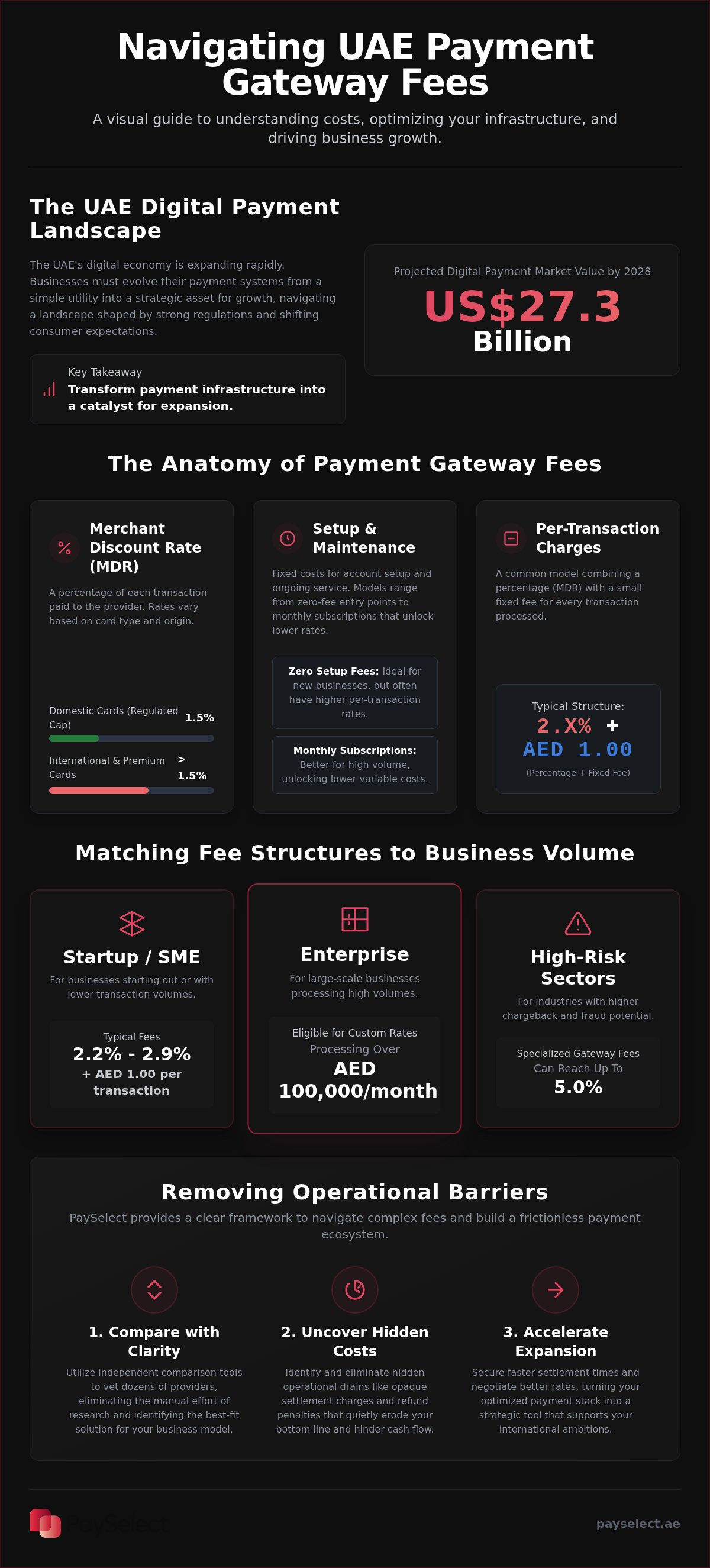
The UAE market is diverse. A boutique e-commerce startup has different needs than a large-scale hotel group or a high-volume retailer. Consequently, fee structures must reflect these operational realities. Startups often face transaction fees between 2.2% and 2.9% plus fixed AED 1.00 charges. In contrast, enterprises processing over AED 100,000 monthly can negotiate customized rates. Specialized gateways are also emerging for high-risk sectors, where fees can reach 5%. Finding the right fit requires an independent payment gateway comparison to ensure you aren't overpaying for features you don't use. PaySelect assists businesses in navigating these options, providing a neutral framework that leads to informed decisions without the manual effort of independent research. This strategic selection helps you manage payment gateway fees uae and improves cash flow predictability.
The Anatomy of Payment Gateway Fees
Financial clarity is the foundation of any successful expansion. For a CFO, tracking the intricate layers of payment gateway fees uae is essential to protecting margins. MDR is the percentage a merchant pays to the provider for processing a credit card transaction. This rate isn't static. It fluctuates based on card origin and risk profile. Domestic credit cards in the UAE are generally subject to a 1.5% MDR cap, but international transactions often carry higher premiums due to cross-border complexities and currency conversion. As the UAE eCommerce Landscape grows more global, the ratio of domestic to international sales will dictate your total cost of acceptance.
Setup and Recurring Maintenance Costs
Entry-level models often feature zero setup fees, which is ideal for testing new markets. However, these models typically offset the lack of upfront cost with higher per-transaction rates. You must evaluate if a monthly subscription fee makes financial sense for your volume. Subscriptions often unlock lower variable rates, creating a "break-even" point where fixed costs become more economical than high percentage-based fees. Don't overlook integration costs or premiums for dedicated technical support. These fixed costs can quickly bloat your operational budget if not accounted for during the selection process. Using a payment gateway comparison helps you visualize these trade-offs before you commit to a contract.
Transaction-Based Charges
Most providers utilize a "percentage plus fixed fee" structure, commonly including a charge of approximately AED 1.00 per transaction. This fixed component can heavily impact low-ticket items, making it a critical variable for retail and F&B sectors. Tiered pricing models offer another layer of complexity; your rates may drop automatically as your monthly volume scales beyond certain milestones, such as AED 100,000. Underpinning every transaction are interchange fees, the base costs set by card networks that providers must pay. By understanding this anatomy, you can identify which providers offer true transparency versus those that bundle fees into opaque, all-in rates. This knowledge empowers you to optimize your payment infrastructure for long-term profitability.
Identifying Hidden Costs and Operational Charges
Headline transaction rates are only the surface of your financial commitment. To understand the total cost of ownership, you must look deeper into the contract terms. Many providers advertise low entry rates but offset them with settlement fees, which are the costs of moving your earned capital into your business bank account. These payment gateway fees uae can silently erode your margins if you don't account for administrative penalties. Chargebacks and refunds aren't just lost sales; they often trigger fixed processing penalties that stay on your balance sheet regardless of the outcome. Many merchants also overlook minimum monthly processing requirements. If your volume falls below a specific threshold, you might face "low-volume" penalties that punish your business during slower months.
The Impact of Settlement Cycles on Cash Flow
Speed often comes with a premium. Settlement cycles generally range from T+1 to T+7. A T+1 cycle ensures your funds are available the next business day, which is vital for maintaining liquidity. However, some providers charge higher bank transfer fees for this accelerated service. Choosing a T+7 cycle might reduce your immediate costs, but it can create operational barriers to growth by locking up your working capital. You should evaluate the frequency of your settlements against the associated transfer fees to find a balance that supports your operational rhythm without overpaying for unnecessary speed.
Currency Conversion and Cross-Border Complexities
International expansion introduces a new layer of expense. According to recent E-commerce Market Trends, the rise of digital wallets and diverse payment methods is making multi-currency processing essential. When you sell to customers outside the country, you'll encounter foreign exchange (FX) markups. These aren't always transparent. Most providers apply a "spread" on top of the mid-market exchange rate, which functions as a hidden fee on every international sale. To maintain profitability, you need strategies for optimizing cross-border payments. This involves comparing how different providers handle currency conversion and identifying those that offer competitive rates for your specific target markets. PaySelect provides the independent audit tools necessary to uncover these hidden spreads, allowing you to choose a partner that facilitates global growth without excessive friction.
Strategic Selection: Matching Fees to Business Volume
Selecting a provider based on the lowest headline rate is a common strategic pitfall. To truly optimize your payment gateway fees uae, you must perform a rigorous break-even analysis. This involves comparing flat-rate models, subscription-based structures, and tiered volume discounts. Flat-rate models provide predictability for low volumes but become a significant drain as you scale. Subscription models offer lower transaction percentages in exchange for a fixed monthly cost. The technical stack also dictates long-term value; a cheap gateway that lacks robust API documentation or local support costs you more in development hours than it saves in fees. An independent payment gateway comparison is the only way to ensure your choice aligns with your specific transaction volume and growth trajectory.
The Startup Model: Prioritizing Low Entry Barriers
For new businesses, cash flow is the primary priority. Choosing a provider with zero monthly fees allows you to test your market without fixed overhead. You'll likely pay higher transaction fees, often ranging between 2.2% and 2.9%, but this variable cost only scales with your success. It's a low-risk entry strategy that removes operational barriers. However, you must prepare your infrastructure for future scalability. Ensure your chosen gateway can transition to a more cost-effective model once your volume stabilizes. This prevents technical debt and ensures a smooth transition when you're ready to expand. Don't let high setup fees for new businesses stall your initial momentum.
The Enterprise Approach: Cost Optimization and Audits
High-volume merchants operate on a different financial logic. If you process over AED 100,000 a month, you have the leverage to negotiate customized pricing. This is where standardized rates end and bespoke strategy begins. At this scale, even a 0.1% reduction in MDR results in significant annual savings. Payment infrastructure audits are essential to identify inefficiencies in your transaction flow. These audits examine everything from settlement speed, cross-border routing, to currency conversion spreads. By leveraging independent advisory services, you can design a bespoke payment strategy that reduces your total cost of ownership. Ready to optimize your bottom line? Take the test and compare your options today to find your ideal match.
Removing Operational Barriers with PaySelect
PaySelect acts as the independent catalyst for your business growth. In a market where providers often push their own agendas, we offer a neutral ground for strategic decision-making. The complexity of payment gateway fees uae merchants face requires a specialized, unbiased perspective. Our platform removes the manual effort of vetting dozens of providers, allowing you to focus on your core operations. By using our comparison tool, you gain immediate clarity on the total cost of ownership. The "Take the Test" tool is designed to match your specific business model with the ideal provider, ensuring you don't overpay for unnecessary features. Managing payment gateway fees uae effectively requires this level of precision to protect your margins.
A Data-Driven Approach to Selection
Transparency is our primary objective. The UAE market is fragmented, with inconsistent onboarding processes and varying fee structures. We bring these variables into a single, manageable view. You can compare gateways, POS machines, and cross-border solutions in one place. This consolidated approach reduces your time-to-market. Instead of spending weeks in negotiations, you receive expert matching that aligns with your transaction volume and operational needs. It's a strategic tool for business transformation that turns technical utility into a competitive advantage. We provide the clarity needed to make informed decisions without hesitation.
Consultancy for Large-Scale Organizations
Large-scale organizations require more than just a gateway; they need a sophisticated infrastructure. We provide bespoke advisory for enterprises, such as hotel groups and large retailers, looking to optimize their existing payment stacks. Our independent audits uncover hidden inefficiencies that standard reports often miss. We analyze your routing, settlement cycles, and currency conversion spreads to ensure maximum performance. Partnering with an elite facilitator like PaySelect ensures your expansion is built on a rock-solid foundation. We act as a bridge between complex global infrastructures and your intuitive business needs. This forward-thinking approach ensures your payment ecosystem is ready for the future digital economy, removing operational barriers and facilitating international ambition.
Scaling Your Digital Commerce with Financial Precision
Success in the UAE's digital economy depends on your ability to turn operational costs into strategic advantages. You've learned that mastering payment gateway fees uae involves more than just looking at transaction percentages. It requires a deep understanding of domestic MDR caps, the hidden impact of settlement cycles, and the strategic shift from flat-rate to volume-based pricing as you scale. By identifying hidden operational drains like FX spreads and administrative penalties, you can protect your margins and ensure your capital remains fluid for expansion.
PaySelect provides the independent and unbiased data you need to navigate this fragmented landscape with confidence. Trusted by UAE SMEs and enterprises, we specialize in payment cost optimization audits that reveal the true total cost of ownership. Whether you're a startup seeking low entry barriers or a large-scale organization refining a complex infrastructure, our tools remove the manual effort of provider selection. It's time to eliminate operational friction and accelerate your growth trajectory. Find the most cost-effective payment gateway for your business with PaySelect and build a foundation for long-term profitability.
Frequently Asked Questions
What is the average payment gateway fee for a new business in the UAE?
Typical payment gateway fees uae for new merchants range from 2.2% to 2.9% alongside a fixed charge of AED 1.00 per transaction. These rates reflect the risk profile of businesses without an established processing history. High-risk sectors may see rates climb to 5%. It is a variable cost that scales directly with your sales volume. PaySelect helps you compare these entry-level structures to find the most efficient starting point for your unique business model.
Are there setup fees for online payment gateways in the UAE?
Setup fees vary across the provider landscape. Some companies offer zero-setup models to lower entry barriers for startups; others charge an upfront fee to cover integration and technical support. While a zero-fee model seems attractive, it often comes with higher per-transaction costs. You must evaluate the total cost of ownership over your first year. Use our comparison tool to weigh these upfront costs against your projected long-term transaction efficiency.
How do domestic and international card transaction fees differ?
Domestic transactions are generally more cost-effective due to the Central Bank's 1.5% MDR cap on most domestic credit card categories. International transactions incur higher fees because they involve cross-border routing and currency conversion. These rates are often significantly higher than domestic equivalents. Understanding this split is vital for businesses targeting global customers. We provide insights into how different providers handle this discrepancy to protect your international profit margins and maintain cash flow.
What are settlement fees and how do they affect my cash flow?
Settlement fees are the charges associated with transferring your processed funds from the gateway to your business bank account. These costs impact your cash flow by adding a layer of expense to every payout. Depending on your provider, you might face different bank transfer charges for daily versus weekly settlements. Faster settlement cycles like T+1 often carry higher premiums. Choosing the right frequency is a balance between liquidity needs and operational overhead.
Can I negotiate my payment gateway rates as my business grows?
Negotiation is possible and expected as your business scales. Merchants processing over AED 100,000 monthly have the leverage to secure customized pricing and lower MDR rates. This transition from standardized plans to bespoke contracts is a critical growth milestone. PaySelect assists by providing the data needed for these discussions. We help you identify when your volume justifies a rate review to ensure your infrastructure remains a strategic tool for expansion.
What hidden costs should I look for in a payment service provider contract?
Look for minimum monthly processing requirements that penalize low volume. Chargeback and refund administrative penalties are also common hidden drains on your profit; these fees remain even if the transaction is reversed. Some contracts also include hidden monthly maintenance or security compliance fees. Reviewing the fine print is essential to avoid unexpected charges. Our independent audits are designed to uncover these inefficiencies before they impact your bottom line and operational stability.
How does multi-currency processing impact my total transaction fees?
Multi-currency processing introduces foreign exchange markups that increase your total transaction costs. Providers typically apply a spread on top of the mid-market exchange rate. This hidden fee can quietly erode the profitability of international sales. While offering local currencies improves customer experience, you must account for these conversion costs in your pricing strategy. PaySelect helps you compare how different gateways manage these cross-border complexities to keep your global growth profitable.
Why should I use a comparison tool instead of going directly to a bank?
Comparison tools provide an independent, unbiased view of the entire market. Banks only offer their own proprietary solutions, which may not fit your specific operational needs. Using a neutral platform like PaySelect allows you to compare multiple providers, POS systems, and cross-border solutions in one place. This transparency removes operational barriers and saves weeks of manual research. It is the most efficient way to optimize your payment gateway fees uae.
Disclaimer
This content is for informational purposes only and should not be considered financial, legal, or regulatory advice. Payment provider availability, pricing, and approval processes vary depending on individual business circumstances. PaySelect does not guarantee provider acceptance or specific outcomes. Businesses should conduct their own due diligence before entering into any agreements.
Empowering businesses to achieve greater growth