
For a transaction of just $10, a fixed fee of $0.30 represents 3% of your total value before you even factor in percentage-based rates. If your effective rate feels significantly higher than the flat fee you signed up for, you aren't alone. Most merchants find themselves buried under opaque monthly statements and unexpected deductions for international cards. Identifying the specific payment gateway hidden costs to avoid is the first step toward reclaiming your margins and scaling your international ambition with confidence.
We agree that reconciling these costs creates an unnecessary manual workload that drains your team's energy. This 2026 guide promises to strip away the complexity. We provide a framework to audit your infrastructure, compare providers fairly, and eliminate the friction that slows your global expansion. You'll gain a complete understanding of every fee layer, including PCI DSS v4.0.1 compliance penalties and currency conversion markups. We'll show you how to optimize your setup for speed, transparency, and performance.
Key Takeaways
• Learn why headline transaction rates are often deceptive and how to calculate your true effective rate to reveal the real cost of processing.
• Identify the most common payment gateway hidden costs to avoid, including administrative fees and compliance surcharges that quietly erode your profit margins.
• Discover how fragmented payment systems create a hidden tax by increasing the time and errors associated with manual data reconciliation.
• Master a two-step audit process to cross-reference settlement reports against bank deposits and uncover ghost fees in your infrastructure.
• Leverage independent comparison tools to match your business with a provider based on actual volume and specific industry needs.
Beyond the Headline Rate: Why Low Transaction Fees Can Be Deceptive
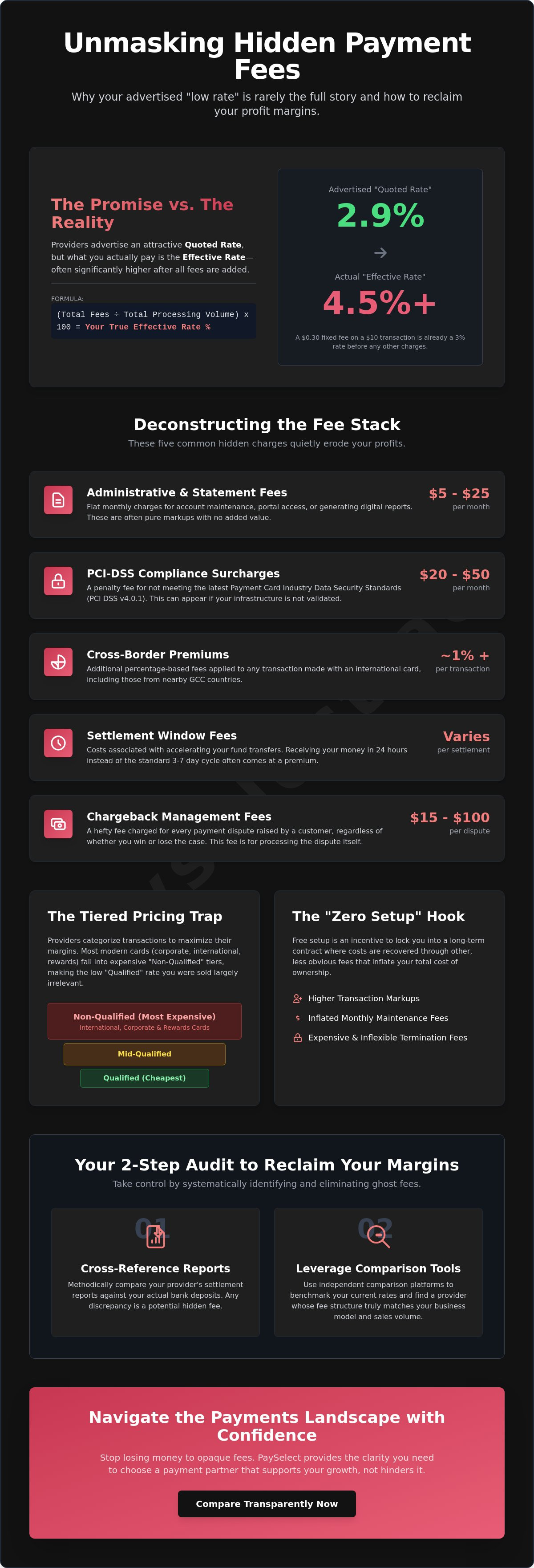
Marketing hooks are designed to distract. Many businesses sign up for a seemingly low 2.9% rate only to realize their monthly statement tells a completely different story. Understanding how a Payment Service Provider (PSP) structures its revenue is essential for maintaining healthy margins. The "Quoted Rate" is the attractive number you see on a sales page. The "Effective Rate" is the reality: your total fees divided by your total processing volume. This discrepancy is frequently where you'll find the payment gateway hidden costs to avoid.
Tiered pricing adds another layer of complexity to your decision-making process. Providers often categorize transactions as "qualified," "mid-qualified," or "non-qualified." While the qualified rate looks low, many modern transactions, such as corporate or international cards, fall into the expensive non-qualified bucket. This psychological tactic makes merchants feel they're getting a deal while the provider maximizes its margin on the majority of their sales. It creates a disconnect between expected costs and actual deductions.
The Allure of the Zero-Setup Hook
Zero-setup fees are a powerful incentive, but they rarely mean a service is free. Providers typically recoup these initial costs by adding a markup to every transaction or charging higher monthly maintenance fees. The Entry Trap is a strategy designed to lock in high-volume merchants by removing initial financial friction while embedding long-term, inflexible cost structures. These low entry barriers often come paired with aggressive termination fees that make switching providers prohibitively expensive once you realize the true cost of the service.
Transparency as a Strategic Business Asset
In 2026, sophisticated merchants are prioritizing clarity over low-cost promises. Clear pricing models allow for accurate cash flow forecasting and build investor confidence by removing financial volatility. Using an independent payment gateway comparison tool helps you cut through the marketing noise to see the data that matters. Moving from a reactive mindset to proactive infrastructure optimization ensures your payment stack supports global expansion rather than draining resources through hidden leakage. Transparency isn't just a preference; it's a strategic advantage that allows you to scale without friction.
Deconstructing the Fee Stack: 5 Common Hidden Charges in 2026
Identifying the specific payment gateway hidden costs to avoid requires a granular look at your monthly merchant statement. Beyond the base transaction percentage, providers often embed layers of secondary charges that significantly inflate your total expenditure. These costs frequently hide behind technical jargon or are bundled into service packages that offer little tangible value to your operations. Success in 2026 depends on your ability to deconstruct these five common fee layers.
Administrative and Statement Fees
These are flat monthly charges for generating digital reports or maintaining your account.
PCI-DSS Compliance Surcharges
Penalties for not meeting the latest security standards.
The Cross-Border Premium
Additional percentages applied to international and GCC-issued cards.
Settlement Window Fees
Costs associated with receiving your funds in 24 hours rather than the standard three-day cycle.
Chargeback Management
Fees ranging from $15 to $100 per dispute, regardless of the outcome.
Administrative and Compliance Surcharges
Many providers charge between $5 and $25 per month simply for portal access or digital statements. These are often arbitrary markups that don't reflect actual operational costs. More critical is the shift to PCI DSS v4.0.1, which became the mandatory standard on March 31, 2025. If your infrastructure doesn't provide continuous operational evidence of compliance, you may see non-compliance fees ranging from $19.95 to $49.95 appearing on your monthly bill. A thorough understanding credit card processing fees helps you distinguish between these provider-inflated costs and mandatory regulatory requirements. Always check for minimum monthly processing penalties, which penalize your business during slower sales cycles.
The Complexity of Cross-Border Payments
For UAE merchants, regional trade agreements in 2026 have introduced new dynamics to transaction fee volatility. Cross-border transactions often trigger a 2% network surcharge, which gateways frequently supplement with their own 1% to 1.5% fee. When you add a currency conversion markup of 1% to 3% on top of the mid-market rate, an international sale becomes significantly more expensive than a local one. Implementing specialized cross-border payment solutions can mitigate these regional spikes by utilizing local acquiring. This approach reduces the reliance on expensive international rails and keeps your margins predictable. To ensure you aren't overpaying for global reach, you can perform a payment pricing comparison to see how different providers handle international traffic.
Operational Friction: The Hidden Cost of Manual Reconciliation
Profitability isn't just about the percentage deducted at the point of sale. It's about the hours your team spends behind the scenes. Manual reconciliation is a silent drain on resources, often representing a significant portion of the payment gateway hidden costs to avoid. When your financial data doesn't flow seamlessly from the gateway to your accounting software, you're paying a "human-in-the-loop" tax. Calculating the hourly cost of manual data entry often reveals that the seemingly cheaper gateway is actually the most expensive option for your business.
Slow reporting creates a dangerous visibility gap. If your team takes several days to reconcile a weekend’s worth of sales, you're making critical business decisions based on outdated information. This delay hinders your ability to manage inventory, allocate marketing spend, or respond to sudden cash flow requirements. High-performance businesses require real-time data connectivity to maintain their competitive edge in a fast-moving digital landscape. By streamlining your reconciliation process, you eliminate the most persistent payment gateway hidden costs to avoid while gaining absolute clarity over your financial health.
Fragmented Systems and the Productivity Gap
Mismatched technology creates what experts call "integration debt." If your e-commerce gateway doesn't communicate with your physical POS machines, you're forced to manage fragmented data silos. This lack of unity leads to a massive productivity gap. Some industry reports suggest that moving to an integrated infrastructure can save up to 20 hours of accounting labor every month. Removing these operational barriers allows your team to focus on growth rather than chasing spreadsheet errors across disconnected platforms.
Error Rates and Security Vulnerabilities
Manual handling of payment data is a primary source of error. "Ghost transactions"—sales that appear successful in your store but never settle in your bank account—often go unnoticed without automated auditing. Unreconciled refunds are another common source of leakage that erodes your margins. Beyond the financial loss, manual intervention increases the risk of compliance breaches. Every time an employee manually accesses sensitive transaction logs to resolve a discrepancy, your security perimeter weakens. A unified technical stack mitigates these risks, providing the calm assurance that your data is both accurate and secure. Investing in intuitive, automated systems isn't just a technical upgrade; it's a strategic tool for business transformation that reduces long-term operational overhead. To learn how to streamline your own operations, visit UPDAT Technologies Ltd.
The Merchant’s Audit: How to Identify and Eliminate Ghost Fees
Auditing your payment infrastructure is a strategic tool for business transformation. It moves your finance department from a reactive posture to a proactive one, ensuring every dirham is accounted for. To effectively identify the specific payment gateway hidden costs to avoid, you must look past the summary page of your monthly statement. A structured five-step audit provides the technical utility needed to reclaim your margins and optimize performance.
Request a Pricing Breakdown
Demand a comparison between Interchange-Plus and Blended models. Interchange-Plus offers absolute transparency by separating the wholesale cost from the provider's markup.
Cross-Reference Reports
Match your settlement reports directly against bank deposits. This process identifies "leakage" where funds are lost to unexplained deductions or processing errors.
Challenge Redundant Fees
Scrutinize line items labeled as "service," "portal," or "security" fees. These are often arbitrary additions that provide no additional value.
Benchmark Your Rates
Use independent industry data to verify if your current pricing aligns with your transaction volume and sector standards.
Consolidate Providers
Evaluate if the redundancy of multiple gateways is worth the cost. Often, consolidating your volume with a single provider unlocks significant discounts.
Reviewing Monthly Statements for Inconsistencies
Transparency often fades after the initial onboarding phase. Look for "miscellaneous" or "other" line items that appear on your statement after the first 90 days of service. These are common indicators of fee creep. You should also analyze the variance in fees between different card networks. If certain networks consistently trigger higher surcharges without explanation, it's time to investigate. Verify the frequency of "batch processing" fees on your daily reports; these small charges can accumulate into a substantial monthly expense if left unchecked.
Negotiating Better Terms with Data-Driven Insights
Data is your most powerful leverage during contract renewals. Presenting your transaction volume and growth projections forces providers to offer more competitive terms to retain your business. Never enter a negotiation without at least three competitive quotes from alternative providers to establish a clear baseline. It's also critical to protect your flexibility; never sign a contract that includes a "termination for convenience" fee or aggressive exit penalties. Using a payment pricing comparison tool allows you to enter these discussions with the confidence of an industry leader. If you're ready to optimize your infrastructure, you can start a payment cost optimization audit today to uncover immediate savings.
Navigating the Payments Landscape with PaySelect’s Independent Comparison
Choosing a financial partner shouldn't involve guesswork. Since pricing structures evolve constantly, PaySelect provides the clarity you need to make informed decisions. We act as an unbiased digital platform, ensuring our insights are rooted in your actual transaction data. This independence is essential. It removes the inherent conflict of interest found in traditional sales pitches. By focusing on objective metrics, we help you pinpoint the specific payment gateway hidden costs to avoid before they erode your monthly profits.
The financial benefits of a thorough payment gateway comparison are immediate. For a merchant processing high volumes, a fractional difference in the effective rate translates to thousands of dirhams saved in annual surcharges. We offer tailored advisory that scales with you. Whether you're an agile SME or a complex international enterprise, our platform matches you with solutions that prioritize performance. We're here to turn your payment stack from a necessary expense into a strategic advantage.
Using the Matching Tool for Precision Selection
Our matching tool provides technical precision. It filters providers based on the unique demands of your industry, such as the specific needs of hospitality or the security requirements of e-commerce. Every sector has its own friction points. We simplify the MENA payment landscape by providing transparent data that lets you compare providers fairly. This ensures your international expansion is supported by the right cross-border rails, keeping your transactions fluid and your costs predictable. By matching your requirements with the right provider, you remove the operational barriers that hinder speed.
Strategic Infrastructure Audits for Large-Scale Organizations
Large-scale organizations like hotel groups and major retailers often deal with fragmented systems that slow down growth. Our strategic infrastructure consulting identifies these hidden bottlenecks. We perform a deep-dive payment cost optimization audit to find ghost fees and streamline your reporting. This results-oriented approach ensures your global infrastructure is both robust and efficient. If you're ready to find your optimal payment partner and eliminate fee leakage, take the test today and gain the transparency your business deserves.
Future-Proof Your Payment Infrastructure
Transparency is the foundation of sustainable international commerce. By deconstructing your fee stack and auditing your monthly statements, you transform your payment infrastructure from a cost center into a strategic tool for growth. You now understand that the true price of processing includes headline rates, hidden compliance surcharges, and the heavy tax of manual reconciliation. Identifying the specific payment gateway hidden costs to avoid allows you to reclaim your margins and focus on what matters: scaling your business across the UAE and beyond.
PaySelect provides the independent and unbiased data you need to cut through marketing noise. Trusted by SMEs and Enterprises throughout the region, we offer expert advisory for even the most complex payment infrastructures. Our tools remove operational barriers, enhance system performance, and ensure your technical stack is ready for the future. Don't let opaque pricing or inefficient systems slow your momentum.
Find the most cost-effective gateway for your business with our free comparison tool and start optimizing today. Your path to a more fluid and profitable financial future is just one click away.
Frequently Asked Questions
What is the difference between blended and interchange-plus pricing?
Blended pricing charges a single, fixed percentage for every transaction regardless of the card type used. Interchange-plus is more transparent; it separates the card network's wholesale cost from the provider's markup. This model allows businesses to see exactly what they pay to the bank versus the processor. It's often the preferred choice for high-volume merchants seeking to identify payment gateway hidden costs to avoid.
Are setup fees for payment gateways still common in 2026?
Setup fees have largely vanished as providers use "free" onboarding as a primary marketing hook. However, these upfront savings are often recouped through higher per-transaction markups or monthly administrative fees. It's essential to look at the long-term effective rate rather than just the initial entry cost. Proactive infrastructure optimization helps you look past these hooks to find the true cost of service.
How can I tell if I am being overcharged for international transactions?
You can identify overcharging by looking for currency conversion spreads and cross-border surcharges on your monthly statement. Most gateways add a markup of 1% to 3% over the mid-market exchange rate. If your international fees consistently exceed your domestic rates by more than 2%, you may benefit from utilizing local acquiring. This approach bypasses expensive international rails and keeps your margins predictable.
What is a typical chargeback fee in the UAE?
A typical chargeback fee in the UAE ranges from $15 to $100 per incident. This fee is applied by the processor regardless of whether you win the dispute to cover the administrative cost of the reversal. High-risk industries or businesses with high dispute rates may face even steeper penalties. Reducing these costs requires robust fraud prevention tools and a unified technical stack for better transaction visibility.
Do payment gateways charge extra for PCI-DSS compliance?
Many providers charge a monthly non-compliance fee, typically between $19.95 and $49.95, if you don't provide continuous operational evidence of security. Under PCI DSS v4.0.1, which became mandatory in 2025, these standards are more rigorous. While some gateways include compliance support in their base service, others treat it as a separate revenue stream. Understanding these penalties is a key part of identifying payment gateway hidden costs to avoid.
Can I negotiate my payment gateway fees as a small business?
Small businesses can negotiate fees by using their transaction volume and growth projections as leverage during contract renewals. Having competitive quotes from multiple providers is the most effective way to secure better terms. PaySelect's comparison tools help you gather this independent data, allowing you to enter negotiations with the authority of an industry leader. Never accept a first offer without benchmarking it against current market standards.
How often should I audit my payment processing statements?
You should audit your payment processing statements at least once a month. Fee creep often happens gradually; small "miscellaneous" charges frequently appear after the initial 90-day onboarding period. Regular reviews allow you to catch these inconsistencies early and challenge redundant service fees. A monthly audit ensures your infrastructure remains lean and your margins stay protected as you expand into new markets.
Why do some providers charge a "minimum monthly" fee?
Providers charge a minimum monthly fee to ensure they remain profitable even if your transaction volume is low. If your total processing fees don't meet a specific threshold, the provider charges you the difference. This is a common pain point for seasonal businesses or startups with fluctuating sales. Comparing providers helps you find those that offer more flexible structures suited to your specific sales cycle and operational needs.
Disclaimer
This content is for informational purposes only and should not be considered financial, legal, or regulatory advice. Payment provider availability, pricing, and approval processes vary depending on individual business circumstances. PaySelect does not guarantee provider acceptance or specific outcomes. Businesses should conduct their own due diligence before entering into any agreements.
Empowering businesses to achieve greater growth