Payment Gateway Reporting and Analytics Explained: A Strategic Guide for 2026

Is your payment dashboard a strategic asset or just a collection of digital noise? For many businesses across the UAE, transaction data often feels like a puzzle that never quite fits, especially when bank statements don't align with gateway reports. This guide to payment gateway reporting and analytics explained clarifies the data behind your transactions so you can stop guessing and start growing. We'll show you how to move beyond simple reporting to embrace deep analytics that reveal exactly why payments fail and where your revenue is leaking.
You already know that every transaction carries a cost, but you might not realize how much efficiency you're leaving on the table. We'll help you master your data to optimize costs, reduce friction, and drive business growth. By the end of this guide, you'll be ready to automate reconciliation, identify specific areas to cut payment fees, and improve customer experience by reducing false declines. It's time to transform your payment infrastructure from a back-office necessity into a powerful competitive advantage.
Key Takeaways
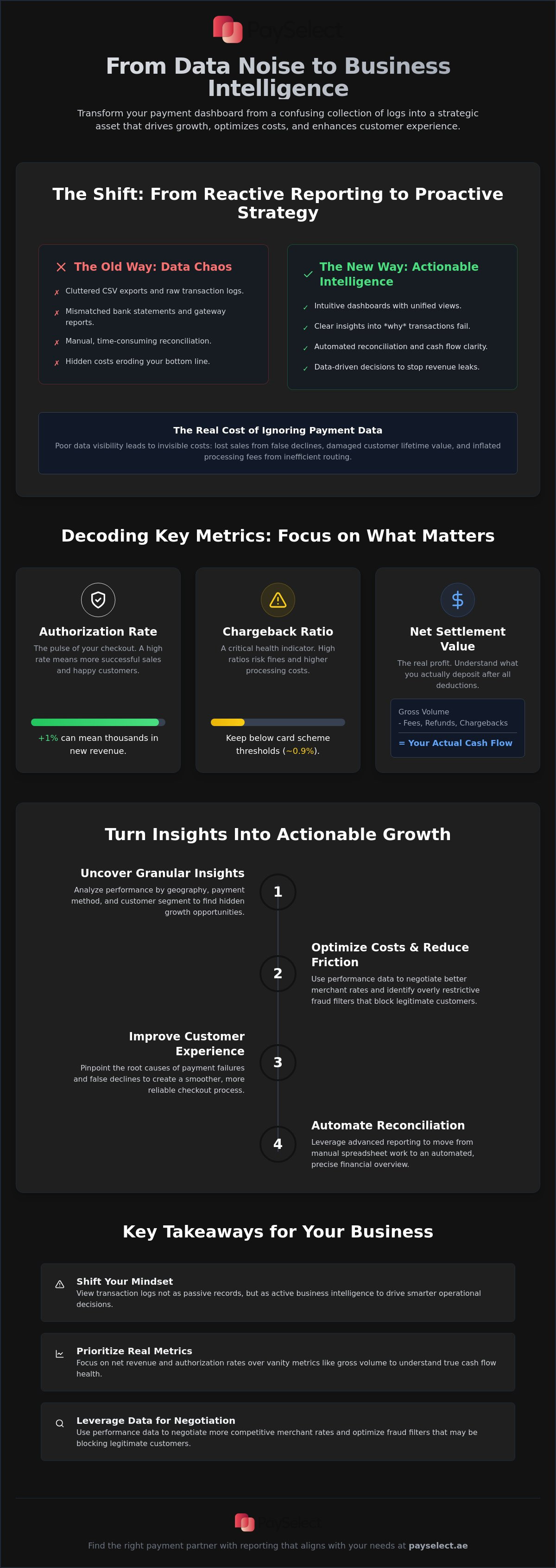
• Shift from viewing transaction logs as passive records to using them as active business intelligence to drive smarter operational decisions.
• Prioritize net revenue and authorization rates over vanity metrics like gross volume to understand the true health of your cash flow.
• Get payment gateway reporting and analytics explained to uncover granular insights by geography and payment method that reveal hidden growth opportunities.
• Leverage performance data to negotiate more competitive merchant rates and identify restrictive fraud filters that may be blocking legitimate customers.
• Utilize PaySelect’s comparison tools to find a payment partner whose reporting capabilities align perfectly with your specific industry requirements.
Understanding the Strategic Role of Payment Gateway Reporting
Modern commerce moves at the speed of light. If you're still treating your payment reports as simple end-of-month receipts, you're missing the engine room of your business. Data visibility isn't just a technical requirement anymore; it's the foundation of a modern payment infrastructure. Most businesses feel overwhelmed by data noise, yet they lack the actionable insights needed to scale. Having payment gateway reporting and analytics explained means shifting your focus from what happened to why it happened. This visibility acts as a vital bridge between your digital storefront and your finance department, ensuring every transaction aligns with your broader growth goals.
From Transaction Logs to Business Intelligence
Raw data is often just a cluttered CSV export. It's hard to read and even harder to act upon. Interpreted analytics transform these rows of numbers into intuitive dashboards that drive strategy. A sophisticated Payment Service Provider (PSP) now uses advanced logic to highlight anomalies in transaction patterns before they become systemic issues. For multi-channel businesses, having single-pane-of-glass visibility is essential. It allows you to see online sales, in-store POS transactions, and payment links in one unified view. This clarity removes operational barriers and simplifies the complex task of reconciling bank statements with gateway reports.
The Real Cost of Ignoring Payment Data
Ignoring your data leads to invisible costs that erode your bottom line. High transaction failure rates often go unnoticed because there's no clear explanation provided in basic reports. These false declines don't just lose a single sale; they damage customer lifetime value and push buyers toward competitors. Reporting helps identify inefficient routing or outdated protocols that quietly increase your fees. Payment transparency is the ability to trace every Dirham from the moment of checkout to the final settlement in your bank account.
PaySelect helps businesses overcome these hurdles by providing a payment gateway comparison tool that evaluates providers based on their data capabilities. Instead of settling for a gateway that leaves you in the dark, you can find a partner that offers the granular detail necessary to stop revenue leaks. Whether you're dealing with high transaction volumes or complex cross-border settlements, the right analytics setup ensures you aren't just processing payments, but actually optimizing them for growth.
Decoding Key Metrics: What Your Dashboard Should Tell You
Your payment dashboard shouldn't just be a list of numbers; it should be a roadmap for growth. Understanding core data points is the first step toward true optimization. When looking at payment gateway reporting and analytics explained, three metrics stand out as pillars of financial health: authorization rates, chargeback ratios, and net settlement values. Gross volume might look impressive on a slide deck, but it's a vanity metric that hides the true performance of your business. Real profit lives in the net revenue remaining after fees, refunds, and operational costs are deducted.
Critical Success Metrics for Modern Merchants
Authorization rates are the pulse of your checkout experience. A mere 1% increase in this rate can translate into thousands of Dirhams in additional monthly revenue without spending a single extra fils on marketing. Conversely, your chargeback-to-transaction ratio requires constant vigilance. Exceeding card scheme thresholds doesn't just result in fines; it can lead to account suspension or higher processing costs. Tracking refunds is equally vital. High return rates in specific segments often signal product quality issues or misaligned customer expectations that need immediate attention.
Settlement and Reconciliation Data
Reconciling accounts shouldn't be a manual nightmare for your team. Modern reporting clarifies the difference between gross and net settlement, ensuring your finance department doesn't mistake processed volume for available cash. Settlement cycles vary significantly between providers, appearing in your reports as daily, rolling, or monthly windows. Distinguishing between "pending" and "cleared" funds allows you to manage operational cash flow with precision. Security is the silent partner in these transactions, and ensuring your provider adheres to PCI DSS standards is non-negotiable for protecting this sensitive data stream.
Decline codes offer the most direct path to improving checkout conversion. Instead of showing a generic "failed" message, detailed codes explain if the issue is insufficient funds, an expired card, or suspected fraud. Interpreting these signals helps you refine your checkout flow, reduce customer friction, and salvage potentially lost sales. If your current dashboard feels like a black box that hides these insights, you can use a payment gateway comparison tool to find a partner that prioritizes data transparency and actionable metrics.
Evaluating Advanced Analytics Features and Capabilities
Selecting a payment partner requires looking beyond simple transaction processing. While basic gateways offer static logs, advanced reporting engines provide the dynamic intelligence needed to scale. Finding payment gateway reporting and analytics explained in a way that serves your specific business model is critical. You need granular data that allows you to filter performance by device type, customer geography, and specific payment methods. This level of detail identifies whether a checkout friction point is localized to mobile users in Dubai or a specific card type used by international shoppers.
Data portability is a non-negotiable feature for any growing enterprise. Your gateway shouldn't be a data silo. Look for providers that offer robust API access and seamless CSV exports. This ensures your technical teams can pull data into custom environments while your finance team maintains its workflows. The user experience of the reporting interface matters just as much as the data itself. If your non-technical staff can't navigate the dashboard to find a specific settlement, the system's utility is halved. Intuitive design saves time, reduces training costs, and empowers every department to make data-backed decisions.
Real-Time Monitoring vs. Historical Batch Reporting
Real-time data is your first line of defense during high-stakes events like flash sales or product launches. It allows you to monitor authorization spikes and catch fraudulent patterns as they happen. Historical batch reporting serves a different purpose, offering the long-term perspective needed for seasonal business planning. By using year-on-year comparison reports, you can measure true growth and identify cyclical trends in your customer's spending habits. This balance of immediate visibility and deep historical context ensures you're never caught off guard by market shifts.
This requirement for real-time clarity is shared by other high-stakes financial sectors; for example, prediction market participants use professional-grade data terminals like auspexterminal.com to track complex market movements with precision.
Customization and Automated Data Exports
The most effective analytics engines allow for custom tags and metadata. This capability lets you track specific marketing campaigns or sub-merchant performance directly within your gateway reports. Automation is the next step in operational efficiency. You can schedule reports to arrive in the inboxes of your CFO or marketing team every Monday morning, removing manual tasks from your to-do list. Integrating this data with existing ERP or accounting software like Zoho or Xero creates a frictionless flow of information. PaySelect simplifies this search by offering a payment gateway comparison tool that specifically highlights providers with the integration capabilities your business requires. Instead of guessing which engine fits your tech stack, you can match with a partner that supports your existing tools and future ambitions.
Turning Analytics into Action: Optimizing Your Infrastructure
Data isn't just a record of the past; it's leverage for your future. Having payment gateway reporting and analytics explained gives you the tools to transform raw numbers into a leaner, more profitable operation. One of the most immediate benefits of deep data visibility is the ability to negotiate better Merchant Discount Rates (MDR). When you can prove your business has high authorization rates and low chargeback ratios through verifiable reports, you're no longer a "standard" risk. You become a high-value partner who can demand more competitive pricing from providers.
Beyond fees, analytics help you identify "False Positives" in your security stack. Many fraud filters are set so aggressively that they block legitimate sales, frustrating customers and driving them to competitors. By analyzing your decline codes, you can see exactly where these legitimate transactions are failing. This allows you to fine-tune your settings to maximize revenue while still maintaining robust security. It's about finding the perfect balance between protection and profit.
Identifying and Reducing Transactional Friction
Customer patience is a finite resource. Analyzing "Time-to-Payment" data reveals hidden bottlenecks in your checkout flow that cause users to abandon their carts. If your reports show a high drop-off rate on specific devices or for certain payment methods, it's a clear signal that your current infrastructure isn't meeting customer preferences. You might find that supporting more local payment methods or simplifying the mobile interface leads to an immediate jump in conversions. Remember that optimization is a continuous loop of measuring, adjusting, and re-measuring.
Leveraging Data for Better Reconciliation
Manual reconciliation is a drain on your resources and a source of constant human error. The "Match-Rate" challenge, linking individual orders to bulk bank deposits, often leaves finance departments struggling to balance the books. Automated reporting eliminates this friction by providing clear, line-item visibility that connects every transaction to its final settlement. This level of clean data doesn't just save your team hours of manual spreadsheet work; it significantly reduces the time and cost associated with annual financial audits. When your data is structured and transparent, your entire business becomes more agile.
If your current setup isn't providing the level of detail you need to cut costs, it's time for a professional review. You can start by using a Payment Cost Optimization Audit to identify exactly where your infrastructure is leaking revenue and how to fix it.
Finding Your Ideal Reporting Partner with PaySelect
Understanding the nuances of payment gateway reporting and analytics explained in the previous sections is only half the battle. The final, most critical step is selecting a partner that actually delivers on these technical promises. Every industry has distinct requirements. A subscription-based service needs deep churn analytics, while a high-ticket retailer requires precise fraud breakdown. There is no universal solution that fits every UAE enterprise. PaySelect acts as your independent advisor, cutting through the marketing noise to find the specific infrastructure that supports your business growth.
Moving from selection to implementation requires a clear roadmap. You need to ensure your data stack is ready to ingest the information your gateway provides. Many businesses feel overwhelmed by "data noise" because they choose a provider with features they don't need, while missing the ones they do. We help you identify these gaps early. By matching your operational needs with the right technology, you avoid the common pain point of reconciling bank statements with reports that don't speak the same language.
Why Reporting Quality Varies Across Gateways
Not all data is created equal. Reporting quality is a major factor where payment gateways differentiate themselves from the competition. One major variation is the data retention period. Some providers only allow you to access detailed transaction logs for 90 days, while others offer years of historical data for trend analysis. API depth also varies significantly. A gateway with a shallow API might prevent you from pulling the custom metadata needed for advanced marketing attribution. Choosing a partner with robust integration capabilities ensures your data remains portable and useful as you scale.
How PaySelect Simplifies the Selection Process
We've removed the guesswork from building your payment stack. Our "Take the Test" tool is designed to match you with data-rich providers based on your specific transaction volume and industry type. If your current setup suffers from high transaction failure rates with no clear explanation, our payment infrastructure consulting can uncover the hidden data gaps causing the issue. We provide a side-by-side comparison of pricing and reporting features, ensuring you see the full picture before signing a contract.
Mastering your transaction data is the fastest way to optimize costs and reduce friction across your entire organization. Don't let valuable insights sit trapped in a dashboard you can't use. Take control of your financial intelligence and ensure every Dirham is accounted for. Start your comparison today to find the right analytics partner.
Transform Your Data Into a Competitive Advantage
Mastering your transaction data is no longer optional for businesses aiming to lead in the UAE’s digital economy. You’ve seen how moving beyond basic logs to deep analytics reveals hidden revenue leaks and identifies high-value growth opportunities. With payment gateway reporting and analytics explained, you now have the strategic blueprint to negotiate better merchant rates and eliminate the friction of false declines. Clean, portable data is the foundation of a scalable enterprise infrastructure.
Success requires more than just raw information; it demands the right technology partner to interpret it. PaySelect provides independent and unbiased comparisons to help you cut through the noise. Our expert advisory for enterprise infrastructure ensures you find a solution tailored for the UAE market. You don't have to navigate these complexities alone. Compare Payment Gateways and Their Reporting Features today to align your payments with your ambitions. It’s time to take control of your financial future and scale with absolute confidence.
Frequently Asked Questions
What is the difference between a payment report and a bank statement?
A payment report provides a granular breakdown of individual transaction fees, taxes, and customer data, whereas a bank statement only reflects the net settlement deposited into your account. This distinction is vital for reconciliation because bank statements don't explain the gap between your gross sales and the final amount received. Using payment gateway reporting and analytics explained in this guide helps you bridge that gap by showing exactly where every fils was allocated during the processing cycle.
How often should I review my payment gateway analytics?
High-volume businesses should monitor real-time dashboards daily to catch fraud spikes or technical failures immediately. Strategic reviews of your overall payment health, including cost optimization and trend analysis, should happen at least once a month. Regular reviews allow you to adjust your infrastructure before small inefficiencies turn into significant revenue leaks. This proactive approach ensures your payment setup remains aligned with your current business scale.
Can payment reporting help me reduce my chargeback rate?
Reporting identifies specific patterns that lead to disputes, allowing you to implement targeted fraud filters or improve product descriptions. By analyzing chargeback data, you can see if specific payment methods or geographical regions are high-risk. This visibility helps you block suspicious activity without impacting legitimate customers. Reducing your chargeback rate is essential for maintaining a healthy merchant account and avoiding heavy penalties from card schemes.
What are decline codes and why are they important for my business?
Decline codes are standardized messages from the issuing bank that explain why a transaction was unsuccessful. They are critical because they distinguish between issues like insufficient funds, expired cards, or technical processing errors. Understanding these codes allows you to provide better customer support and refine your checkout flow. If you see frequent technical declines, it’s a clear signal that your gateway infrastructure needs an audit or a potential upgrade.
Does every payment gateway offer real-time reporting in the UAE?
Not every provider in the UAE offers real-time data visibility. Many traditional gateways still rely on batch reporting, where transaction data is only updated once a day or after a settlement cycle. This can be a major pain point during high-traffic events like flash sales. When comparing providers, it’s important to ask about their data refresh rates and consider how StatusPulse can provide additional transparency through uptime monitoring, ensuring you have the immediate visibility required for modern digital commerce.
How can I integrate my gateway data with my accounting software?
Most modern gateways provide pre-built integrations or robust APIs to sync transaction data directly with accounting software like EmLedger. This automation removes the need for manual data entry and reduces the risk of human error. It’s important to verify that your chosen provider supports your specific accounting stack. PaySelect’s comparison tools help you identify which gateways offer the deepest integration capabilities for your existing financial tools.
What are the most important KPIs for a new e-commerce business?
For new e-commerce ventures, the three most critical KPIs are authorization rates, net revenue after fees, and the chargeback-to-transaction ratio. Focusing on these metrics ensures you aren't distracted by vanity numbers like gross volume. Mastering payment gateway reporting and analytics explained early in your journey allows you to build a lean operation. These KPIs provide a clear picture of your actual profit margins and operational efficiency from day one.
Is it possible to export payment data for external audits?
Standard gateways allow you to export transaction logs in CSV, Excel, or PDF formats for external financial audits. Advanced reporting engines offer even more granular exports, including tax breakdowns and fee structures, which simplify the audit process. Having clean, accessible data ensures your business remains compliant and reduces the time your finance team spends on manual preparation. Always check a provider’s data retention policy to ensure you can access historical records when needed.
Disclaimer
This content is for informational purposes only and should not be considered financial, legal, or regulatory advice. Payment provider availability, pricing, and approval processes vary depending on individual business circumstances. PaySelect does not guarantee provider acceptance or specific outcomes. Businesses should conduct their own due diligence before entering into any agreements.
Empowering businesses to achieve greater growth