
With the average data breach in the Middle East now costing a staggering $8.7 million, security is no longer a back-end technicality. It's a strategic asset for your survival. You've likely felt the mounting pressure of shifting regulations like the PDPL and the latest CBUAE mandates. It's a difficult balance to maintain rigid compliance while ensuring the smooth, frictionless checkout experience your customers expect. Understanding the current payment gateway security standards uae is the only way to protect your revenue and stay ahead of the curve.
The September 2026 compliance deadlines are fast-approaching. This guide will help you master the landscape of UAE payment security to ensure your business remains protected and compliant. We'll provide a clear framework to compare security across different providers, distinguish mandatory features from optional ones, and show you how to future-proof your infrastructure. PaySelect simplifies this transition by auditing your payment stack and matching you with providers that meet these rigorous standards. You'll learn how to optimize your setup, remove operational barriers, and drive international growth. Let's transform your payment stack from a source of anxiety into a strategic tool for business transformation.
Key Takeaways
• Understand how the Central Bank of the UAE’s 2026 roadmap integrates international protocols with local mandates to protect your digital revenue.
• Identify the non-negotiable payment gateway security standards uae required for 2026, including the transition to PCI-DSS v4.0 and enhanced authentication.
• Master the complexities of the UAE Personal Data Protection Law (PDPL) to ensure your customer data residency remains compliant and secure.
• Learn to evaluate provider security claims using a strategic framework that prioritizes long-term stability over the risks of the cheapest transaction fees.
• Discover how PaySelect’s independent comparison tools and infrastructure audits simplify the selection of a future-proof payment stack.
The 2026 UAE Payment Security Landscape: An Overview
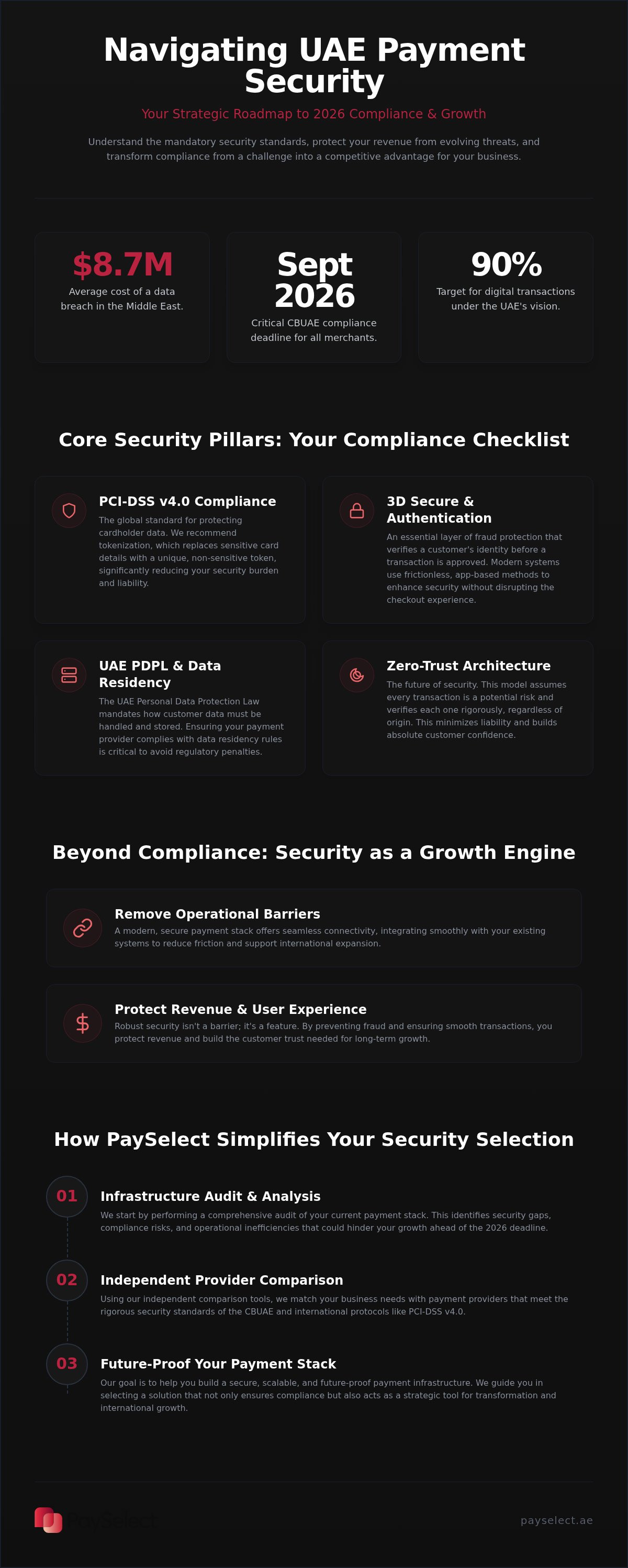
Modern commerce in the UAE operates at the intersection of global innovation and rigorous local oversight. The payment gateway security standards uae merchants must follow are no longer just suggestions; they are the bedrock of a digital economy projected to reach AED 48.8 billion by 2028. This landscape is a sophisticated blend of the international Payment Card Industry Data Security Standard (PCI-DSS) and specific mandates from the Central Bank of the UAE (CBUAE). As the nation pushes toward a target of 90% digital transactions by 2026, security has become the primary driver of consumer trust and business scalability.
The September 2026 compliance deadline serves as a critical milestone for all merchants. It marks the point where legacy security gaps must be closed to align with the CBUAE digital roadmap. Businesses that fail to adapt risk more than just regulatory fines; they face the very real threat of being excluded from a rapidly maturing financial ecosystem. 21% of all cybersecurity incidents in the region target financial services, making robust payment gateways a non-negotiable requirement for operational continuity.
The Role of CBUAE and RPSCS Regulations
The Retail Payment Services and Card Schemes (RPSCS) Regulation is the cornerstone of the CBUAE's oversight strategy. In simple terms, it ensures that every entity involved in processing payments is properly licensed and adheres to strict risk management protocols. This regulation protects the national financial ecosystem from systemic risk by categorizing businesses based on their model and volume. Whether you are a small boutique or a large enterprise, your payment stack must reflect the licensing requirements of your category. This structure creates a rock-solid institutional environment where innovation can thrive without compromising stability.
The Impact of the 2026 Digital Economy Vision
The UAE is positioning itself as an elite global leader in secure fintech. This vision demands a transition from legacy systems to modern, secure payment architectures that support fluidity and expansion. Staying ahead of these standards is a prerequisite for any business looking to scale internationally. Modern architectures focus on three core pillars:
• Removal of operational barriers through seamless connectivity.
• Enhanced performance through app-based authentication.
• Strategic protection of the user experience as a competitive advantage.
By embracing these changes, you don't just achieve compliance; you gain a strategic tool for business transformation. PaySelect helps you navigate this transition by auditing your current infrastructure and identifying solutions that align with this forward-thinking vision.Core Security Pillars: PCI-DSS, 3D Secure, and Beyond
Achieving the highest payment gateway security standards uae requires a multi-layered approach that moves beyond simple compliance. It's no longer enough to tick a box; security must be a strategic foundation for your digital growth. Modern gateways are shifting toward zero-trust architectures. This model assumes that every transaction or access request is a potential risk, verifying each one regardless of its origin. This rigorous stance reduces your liability, protects your revenue, and builds absolute customer confidence. By implementing these pillars, you create an environment where security and fluidity coexist, allowing your business to scale without operational barriers.
PCI-DSS Compliance: Protecting Cardholder Data
The Payment Card Industry Data Security Standard (PCI-DSS) v4.0 is the global benchmark for protecting sensitive card information. For merchants in the UAE, tokenization is the most effective way to manage this requirement. This technology replaces sensitive card details with a unique identifier, or token, during the transaction process. Because the actual data never touches your servers, your security burden is significantly reduced. Compliance is categorized into different levels based on your annual transaction volume. While high-volume enterprises face more intensive audits, every merchant must adhere to these fundamental rules to ensure a secure financial ecosystem. Staying compliant is also a key step in aligning with the UAE Personal Data Protection Law (PDPL), which governs how personal information is handled.
3D Secure 2.0: Balancing Security and Conversion
3D Secure (3DS) is the industry standard for authenticating online card transactions. While earlier versions often caused checkout friction, 3DS 2.0 is designed for a mobile-first world. It uses rich data sets to verify customers behind the scenes, which helps reduce "false declines" and cart abandonment. This is a critical component of payment gateway security standards uae, especially as the Central Bank mandates a phase-out of SMS and email OTPs by March 31, 2026. The transition to app-based authentication and biometrics, such as face recognition or fingerprint scanning, ensures that the user experience is both rock-solid and intuitive. This shift not only prevents fraud but also enhances the overall performance of your payment stack.
The interaction between these pillars creates a frictionless environment where data is protected and identities are verified in real-time. If you're looking to optimize your infrastructure, you can compare payment gateways using our independent tool to find a partner that meets these rigorous benchmarks while supporting your expansion goals.
Data Residency and the UAE Personal Data Protection Law (PDPL)
Security in the digital age isn't just about how data is encrypted; it's about where it lives. For businesses operating in the region, the payment gateway security standards uae requires are deeply intertwined with data residency mandates. The UAE Personal Data Protection Law (PDPL), which has been in force since January 2, 2022, creates a comprehensive framework for how personal information must be handled. Storing payment data in non-compliant jurisdictions isn't just a technical oversight. It's a strategic operational barrier that can lead to significant regulatory friction and limit your ability to scale within the local economy.
The tension between global expansion and local compliance often surfaces when managing cross-border payments. While international reach is essential for growth, the PDPL places strict conditions on transferring personal data outside national borders. Merchants must ensure their payment stack doesn't inadvertently bypass these protections. A secure, future-proof infrastructure requires a partner that maintains local data centers or adheres to equivalent protection standards, ensuring that your path to international commerce remains smooth and legally sound.
Understanding Data Sovereignty in the UAE
Data sovereignty is the principle that data is subject to the laws of the country in which it is located. In the UAE, certain financial and personal data must remain within national borders to protect the integrity of the digital economy. When evaluating providers, it's vital to verify if they utilize local data centers that comply with the UAE Information Assurance Standards (IAS). Ignoring these mandates carries long-term risks, including loss of accreditation and exclusion from critical infrastructure projects. High-end providers prioritize these local requirements to offer a rock-solid foundation for their partners, removing the anxiety of sudden regulatory shifts.
Merchant Responsibilities Under PDPL
Compliance is a shared responsibility. Under the PDPL, you have a duty to inform your customers exactly how their payment data is managed, stored, and protected. In a sophisticated market, transparency regarding data privacy is directly linked to brand reputation. Customers are increasingly aware of their digital rights, and a breach of trust can be more damaging than a technical failure. Integrating these data protection measures into your broader payment infrastructure is a strategic tool for transformation. PaySelect helps you navigate these responsibilities by identifying providers that align with the highest payment gateway security standards uae, allowing you to focus on performance and expansion with calm assurance.
Comparing Security Across Providers: A Business Framework
Selecting a provider based on transaction fees alone is a high-risk strategy that often backfires. In a landscape where 21% of regional cyber incidents target financial services, the "cheapest" option frequently carries hidden costs. These include outdated fraud detection, frequent system downtimes, or a reactive approach to payment gateway security standards uae. A sophisticated framework for comparison focuses on three specific pillars: technical robustness, regulatory proactivity, and operational fluidity. You need a partner that treats security as a strategic engine for growth rather than a back-office burden.
The onboarding and KYC process is a primary indicator of a provider's technological maturity. A fluid, digital-first onboarding experience suggests the provider has invested in a modern, integrated tech stack. If the initial setup feels clunky or manual, it's a red flag that their underlying security protocols may also be legacy-based. Elite providers are already proactive, implementing the Central Bank's 2026 authentication mandates well ahead of the deadline. This foresight ensures your business won't face sudden operational barriers when new regulations take effect.
Security vs. Latency: Finding the Sweet Spot
High-end security shouldn't come at the cost of transaction speed. Some gateways implement heavy, legacy layers that increase latency, which directly leads to cart abandonment. You should prioritize a gateway that utilizes high-performance infrastructure to process complex security checks in milliseconds. API uptime and reliability are just as vital in a high-growth environment. If your gateway isn't consistently available, your revenue stops. Look for providers that offer documented 99.9% uptime and low-latency processing to ensure a frictionless checkout experience for your customers.
Fraud Prevention and Risk Management Tools
Modern risk management goes far beyond basic card verification. Look for providers offering AI-driven fraud detection that analyzes behavioral patterns in real-time. These systems implement velocity limits to stop automated attacks and protect your bottom line from the rising cost of chargebacks. The ability to customize security rules to match your specific industry risk profile is a strategic advantage. It allows you to fine-tune the balance between protection and conversion, ensuring you don't block legitimate customers while keeping bad actors out.
Finding the right balance between these technical and regulatory factors is essential for long-term stability. You can compare payment gateways using our independent tool to filter for providers that meet the highest security benchmarks without sacrificing performance.
How PaySelect Simplifies Your Security Selection
PaySelect acts as an independent navigator in a market that is often opaque and rapidly evolving. We decode the technical complexities of payment gateway security standards uae to ensure your business remains both compliant and competitive. Our platform doesn't just list providers; it filters them based on their ability to meet the rigorous benchmarks set by the CBUAE and international protocols. By removing the guesswork from your selection process, we help you eliminate operational barriers and focus on scaling your international commerce with calm assurance. Trust is the currency of the digital economy, and we help you build it through strategic infrastructure choices.
The value of an independent audit cannot be overstated. Many businesses operate with legacy systems that haven't been updated to reflect the 2026 digital roadmap. This creates hidden vulnerabilities that can lead to transaction friction or regulatory penalties. PaySelect identifies these gaps, providing a clear framework to compare the security features of different providers. We look beyond the marketing claims to verify uptime, encryption protocols, and data residency compliance. This objective perspective ensures that your payment stack is a rock-solid foundation for your business transformation.
Independent Advisory for Complex Infrastructures
Enterprise-scale organizations often struggle with fragmented payment stacks that create operational silos. PaySelect offers bespoke payment infrastructure consulting to audit your current security layers and identify areas for optimization. We analyze your system connectivity, processing performance, and regulatory alignment to find the perfect balance between risk management and cost efficiency. This process ensures your technology is a catalyst for growth rather than a bottleneck. Our advisory services are designed to inspire absolute confidence, providing you with a roadmap to a more sophisticated and secure financial ecosystem.
Take the Test: Matching Security with Strategy
Every industry faces unique threats, and a one-size-fits-all approach to security is no longer viable. Our "Take the Test" tool considers your specific industry requirements to match you with a payment gateway that is fully prepared for the 2026 mandates. Whether you need advanced biometric authentication, AI-driven fraud detection, or localized data residency, we provide the clarity needed to make a confident decision. Securing your future in the national digital economy starts with a stack that is future-proof, fluid, and frictionless. We help you move quickly from high-level strategy to specific functional advantages, ensuring your business is ready for the challenges of tomorrow.
Securing Your Growth in the 2026 Digital Economy
Mastering the payment gateway security standards uae requires is a strategic necessity for any business aiming to scale. You've seen how the convergence of CBUAE mandates, PCI-DSS v4.0, and strict data residency under the PDPL creates a complex but rewarding environment. By prioritizing app-based authentication and local data storage, you don't just avoid penalties. You build a frictionless customer journey that drives conversion and loyalty.
PaySelect is an independent UAE-based digital platform dedicated to simplifying these choices. We offer expert advisory for 2026 compliance and a comprehensive comparison of national payment solutions to remove your operational barriers. Our tools ensure your infrastructure is ready for the future. Find a secure, CBUAE-compliant payment gateway for your business today. Take control of your payment stack and lead your business toward international success with absolute confidence.
Frequently Asked Questions
What is the most important security standard for UAE payment gateways?
The most critical standard is the integration of PCI-DSS v4.0 with the Central Bank's specific licensing mandates. These protocols provide a unified framework for protecting cardholder data while ensuring your provider is authorized to operate within the national financial ecosystem. Adhering to these integrated rules is non-negotiable for legal operation. It ensures your business is protected against systemic risks and remains fully aligned with the latest national digital roadmap for 2026.
Do I need to be PCI compliant if I use a hosted payment page?
Yes, you still need to be PCI compliant, though your operational burden is much lower. Using a hosted page means you don't store or process sensitive data on your own servers, which simplifies the audit process. You'll typically only need to complete a Self-Assessment Questionnaire (SAQ-A). This ensures that while the provider handles the technical heavy lifting, you're still responsible for maintaining a secure and reliable business environment for your customers.
How does the UAE Personal Data Protection Law affect my online payments?
The PDPL mandates that personal data, including payment information, must be handled with extreme transparency and, in many cases, stored within national borders. It requires you to have clear consent from customers and a legitimate reason for data processing. Failing to align your payment stack with these residency rules can create significant legal friction. It's vital to choose a partner that understands these local data sovereignty requirements to ensure long-term stability and expansion.
What is the September 2026 deadline I keep hearing about?
September 2026 is the critical milestone for full implementation of the UAE's National Cybersecurity Strategy. By this time, the CBUAE expects all licensed financial entities to have finalized the transition to more secure biometric and app-based authentication systems. Merchants must ensure their payment stack is fully upgraded by this date to avoid operational disruptions. Staying ahead of this deadline ensures your infrastructure meets the latest national security benchmarks without causing friction for your users.
Can security standards impact my transaction success rates?
Modern security standards like 3DS 2.0 are designed to increase conversion by reducing false declines. Unlike older protocols that often interrupted the checkout flow, newer systems use rich data to verify identities behind the scenes. This creates a frictionless experience that boosts transaction success rates while maintaining high protection levels. Conversely, using outdated security can lead to higher abandonment rates as customers encounter unnecessary barriers or performance delays during the payment process.
How do I verify if a payment gateway is licensed by the CBUAE?
You can verify a provider's status by visiting the official Central Bank website and searching their register of Licensed Financial Institutions. Look for entities specifically authorized under the Retail Payment Services and Card Schemes Regulation. It's essential to confirm that your partner holds the correct license for their specific service category. This verification step ensures you're working with a rock-solid institutional partner that adheres to all national financial safety and performance mandates.
What is tokenization and why is it recommended for UAE merchants?
Tokenization replaces sensitive card numbers with unique, non-sensitive identifiers called tokens. It's highly recommended because it ensures that sensitive data never enters your business environment, which drastically reduces your liability. This technology is a core component of payment gateway security standards uae merchants use to simplify their compliance audits. By using tokens, you protect your revenue and customer trust even if your primary systems are compromised, as the tokens are useless to unauthorized parties.
How often should I audit my payment gateway security?
You should conduct a comprehensive audit of your payment infrastructure at least once a year. Additionally, an audit is necessary whenever you make significant changes to your checkout process or integrate new software. Regular reviews help you stay ahead of evolving payment gateway security standards uae and identify any new vulnerabilities. PaySelect provides bespoke infrastructure audits to help you optimize costs and ensure your security stack remains future-proof against the latest digital threats.
Disclaimer
This content is for informational purposes only and should not be considered financial, legal, or regulatory advice. Payment provider availability, pricing, and approval processes vary depending on individual business circumstances. PaySelect does not guarantee provider acceptance or specific outcomes. Businesses should conduct their own due diligence before entering into any agreements.
Empowering businesses to achieve greater growth