
By September 16, 2026, every startup in the UAE must comply with the Federal Decree-Law No. (6) of 2025 or risk obsolescence in an e-commerce market climbing toward $12.3 billion. Choosing the wrong infrastructure doesn't just delay your launch; it erodes your margins through hidden fees and complex integrations. This payment gateway selection checklist for startups is your roadmap to navigating this high-stakes landscape with absolute precision.
You likely agree that a seamless checkout is no longer a luxury but a baseline requirement for the 79% of customers shopping via smartphone. We understand the frustration of watching thin margins disappear into opaque fee structures or struggling to secure a merchant account as a new entity. This guide promises to simplify these technical hurdles, offering a clear path to transparent pricing and operational fluidity. We'll examine the critical differences between provider fee structures and regulatory requirements to ensure your choice supports long-term expansion. From leveraging the Digital Dirham to passing a gap analysis for new CBUAE regulations, we provide the insights you need to turn payment processing into a strategic tool. PaySelect facilitates this transition by offering specialized comparison tools and infrastructure consulting, ensuring you select a partner that matches your specific transaction profile.
Key Takeaways
• Identify how your choice of payment infrastructure acts as a strategic catalyst for regional expansion rather than just a technical necessity.
• Decode complex fee structures by distinguishing between the Merchant Discount Rate and fixed costs like setup or annual renewal fees.
• Utilize a comprehensive payment gateway selection checklist for startups to verify essential features like multi-currency support and PCI DSS Level 1 compliance.
• Navigate the 2026 UAE regulatory environment by ensuring your gateway aligns with Central Bank mandates and data residency requirements.
• Eliminate weeks of manual research by using comparison tools to match your startup’s specific transaction profile with the ideal payment solution.
Understanding the Role of a Payment Gateway in Startup Growth
A payment gateway serves as the vital digital bridge between your online storefront and the global banking network. It's the engine that encrypts sensitive data, authorizes transactions, and ensures funds move from the customer's wallet to your business account. For founders, viewing this as a mere technical utility is a mistake. In the UAE's competitive economy, your choice of payment service provider is a strategic lever for growth. This decision impacts your speed, security, and scalability. It acts as the primary interface between complex global infrastructures and the intuitive needs of modern entrepreneurs.
The user experience at checkout often determines your survival during early-stage scaling. With mobile commerce driving 79% of UAE transactions, a friction-heavy payment process leads to abandoned carts and permanent customer churn. Startups must decide between hosted payment pages, which redirect users to a secure external site, and integrated API solutions that keep customers on your domain. While hosted pages simplify security compliance, API integrations offer the brand consistency and fluidity required for elite digital experiences. Utilizing a payment gateway selection checklist for startups helps founders weigh these technical trade-offs against their specific business goals.
The Strategic Value of Independent Selection
Many startups fall into the trap of "provider lock-in" by choosing the first available option without a thorough audit. This lack of foresight leads to hidden fees and rigid systems that can't evolve. Independent selection ensures you maintain operational agility. By using a payment gateway comparison tool, you gain access to unbiased data on fee structures and service levels. This transparency allows you to build a foundation that is cost-effective, adaptable, and ready for global scaling. PaySelect helps bridge this gap by providing the clarity needed to avoid restrictive contracts and opaque pricing models.
Payment Infrastructure vs. Simple Transactions
Scaling a startup requires moving beyond the basic ability to accept cards. You need a robust financial stack that supports multi-currency settlement, recurring billing, and advanced fraud detection. Your infrastructure choice today dictates how easily you can enter new markets tomorrow. Data portability is a critical factor; if you decide to switch providers later, you must ensure your customer card data can move with you. A comprehensive payment gateway selection checklist for startups prioritizes these long-term capabilities. It ensures your infrastructure remains an asset for expansion rather than a barrier to entry, allowing you to focus on performance and market dominance. For startups whose growth requires specialized power for AI or computing tasks, eCircles LLC provides the high-performance GPU infrastructure needed to maintain a technical edge in the digital economy.
Decoding Fee Structures: The Financial Criteria
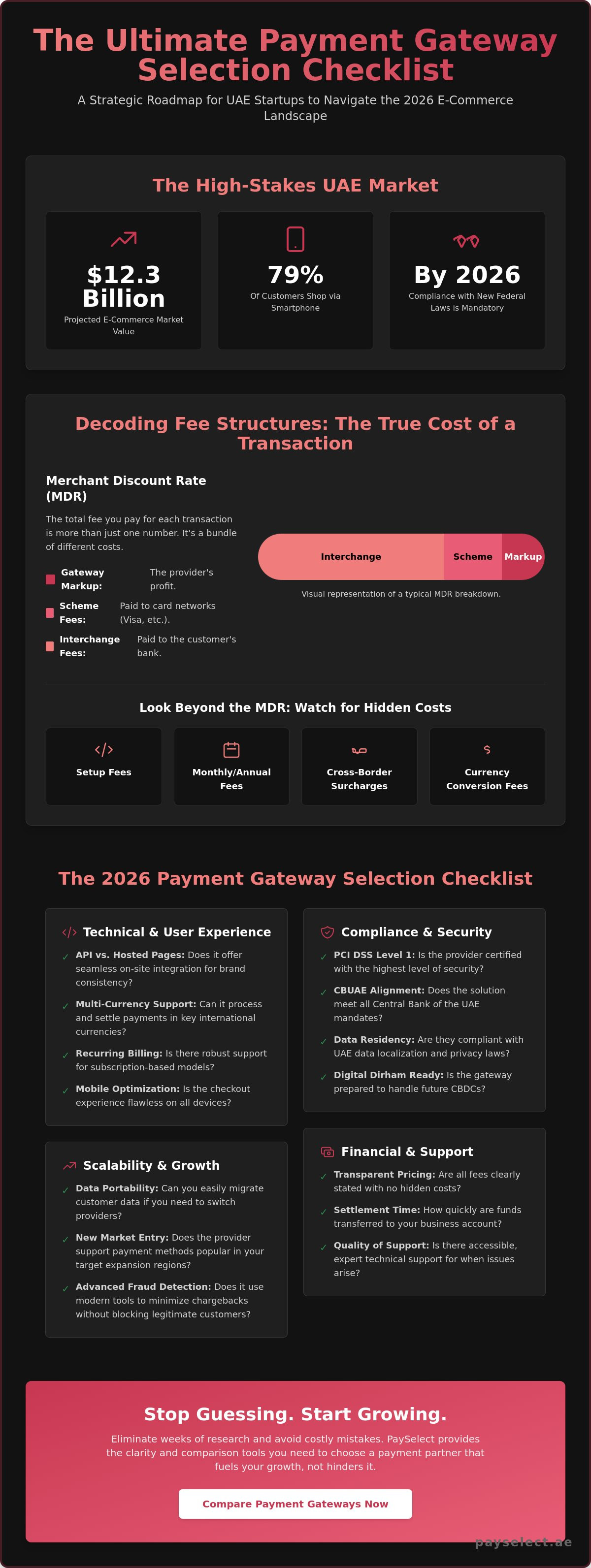
Founders often fixate on a single percentage, yet the true cost of processing is a multi-layered equation. The Merchant Discount Rate (MDR) typically bundles three distinct elements: interchange fees paid to the card issuer, scheme fees for the network, and the gateway's own markup. A robust payment gateway selection checklist for startups must scrutinize these layers to prevent margin erosion. Beyond the transaction fee, you'll encounter setup charges, monthly maintenance fees, and annual renewals. Some providers favor high upfront costs with lower rates, while others offer low-entry models that scale aggressively as your volume grows. Identifying these thresholds early allows you to align your infrastructure with your projected revenue curves.
Cross-border commerce adds another layer of complexity. Since 58% of UAE online shoppers purchase from international vendors, currency conversion and cross-border surcharges are unavoidable. These fees can fluctuate based on the card's origin and the settlement currency. Understanding how these costs interact with the UAE's Regulatory Framework For Stored Values and Electronic Payment Systems is essential for maintaining compliance while optimizing your cost base. You can use a payment pricing comparison tool to model these variables before committing to a specific partner.
Settlement Cycles and Liquidity Management
For an early-stage startup, cash is oxygen. The difference between a T+1 settlement (funds available in 24 hours) and a T+7 cycle (funds held for a week) is often more critical than a 0.1% fee reduction. Payout delays can disrupt payroll, stall inventory restocks, and shorten your operational runway. High-risk industry classifications can further complicate this, leading to longer holding periods or mandatory reserves. Evaluate how efficiently a provider transfers funds to local UAE business bank accounts to ensure your liquidity remains fluid and predictable.
Hidden Operational Costs
Technical integration and ongoing maintenance carry significant price tags that don't appear on a fee schedule. You must weigh the cost of developer hours for custom API work against the speed of out-of-the-box plugins. Security is another overhead; maintaining PCI DSS compliance requires time and specialized resources. Finally, consider refund processing fees. Many providers don't return the original transaction fee when you issue a refund, which can quietly impact your net revenue. A comprehensive payment gateway selection checklist for startups accounts for these invisible drains on your capital, ensuring your financial stack remains lean and high-performing.
The 2026 Payment Gateway Selection Checklist for Startups
Selecting the right partner requires a rigorous, data-driven approach. This payment gateway selection checklist for startups serves as your blueprint for building a high-performance financial stack. It's not just about accepting payments; it's about ensuring every transaction is a frictionless step toward expansion. By following these criteria, you align your technical infrastructure with the elite standards of the 2026 UAE digital economy. Industry experts often highlight What Startups Need From Their Payment Gateway, emphasizing that scalability and security are paramount. Use the following items to evaluate potential partners:
Multi-Currency and Local Support
Verify compatibility with digital wallets, which accounted for 53% of transactions in 2024, and ensure support for the 58% of shoppers buying internationally.
Security Standards
Confirm mandatory PCI DSS Level 1 compliance and built-in fraud detection to protect your liquidity.
Integration Agility
Assess whether the provider offers seamless API connectivity or simple plugins for your specific e-commerce platform.
Technical Support
Evaluate developer documentation and the availability of 24/7 technical assistance to prevent launch delays.
Subscription Readiness
Confirm automated recurring billing features if your business model relies on SaaS or repeat services.
Security and Risk Mitigation
When applying this payment gateway selection checklist for startups, founders must prioritize advanced risk mitigation. The implementation of 3D Secure 2.0 is essential; it reduces friction by utilizing data-rich authentication rather than simple passwords. Tokenization plays a parallel role, securing customer data for recurring payments without storing sensitive card details on your servers. Top-tier providers in 2026 differentiate themselves through AI-driven fraud tools that identify suspicious patterns in real-time. These systems protect your margins from chargebacks while maintaining high authorization rates for legitimate customers. You can find detailed breakdowns of these security features using a payment gateway comparison tool.
Customer Experience and Checkout Flow
Efficiency at the point of sale is a competitive advantage. With smartphones driving 79% of all e-commerce transactions in the UAE, a mobile-first checkout design is non-negotiable. One-click payment options significantly reduce cart abandonment by removing unnecessary steps for returning users. Your gateway should also offer deep customization, allowing you to match the user interface with your brand's visual identity. This consistency builds trust and encourages conversion. A successful integration ensures that the payment process feels like a fluid extension of your service, not a jarring technical hurdle. This focus on user experience transforms a utility into a strategic tool for business transformation.
Integration, Compliance, and National Regulations
The UAE regulatory environment is undergoing a significant transformation. Under Federal Decree-Law No. (6) of 2025, all financial technology providers must align with new Central Bank of the UAE (CBUAE) standards by September 16, 2026. For founders, this means a payment gateway selection checklist for startups must prioritize licensed entities that offer long-term stability. Choosing an unlicensed or offshore provider might offer lower barriers initially, but it risks operational shutdown if local data residency requirements aren't met. Transaction data often must remain within national borders or be handled by providers with specific regional clearances. A licensed partner ensures your business remains compliant with evolving open finance and virtual asset protocols.
Streamlining the Know Your Customer (KYC) process is another hurdle for new entities. Startups often face delays in obtaining merchant accounts due to rigorous documentation needs. To navigate these requirements and ensure your business is properly registered from the start, Sarsan Corporate Services provides essential support for company formation. Look for partners that utilize digital onboarding tools to accelerate this phase. This efficiency allows you to move from registration to your first transaction without weeks of administrative friction. Ensuring your provider has a clear roadmap for the Digital Dirham as legal tender is also a forward-thinking move for 2026 compliance.
Technical Integration Methods
Your choice of integration dictates your control over the user journey. API-led integrations provide maximum flexibility, allowing you to design a checkout flow that mirrors your brand’s elite standards. This method requires more developer hours but results in a superior, frictionless experience. Alternatively, Software Development Kits (SDKs) for mobile apps offer a middle ground, providing pre-built components that ensure security while reducing time-to-market. Balancing speed with customization is a core strategic decision for any scaling business.
Cross-Border Capabilities for Global Ambition
With 58% of UAE shoppers purchasing from international vendors, your infrastructure must handle more than just local debit cards. A robust system facilitates cross-border payments by accepting diverse regional schemes and managing Foreign Exchange (FX) risks. Top-tier dashboards allow you to monitor FX fluctuations in real-time, protecting your margins from volatile currency shifts. Including international scalability in your payment gateway selection checklist for startups ensures you aren't limited by your borders. This international ambition requires a partner capable of bridging the gap between local infrastructure and global commerce.
If you're unsure which infrastructure aligns with these local mandates, use our Payment Gateway Comparison Tool to match your business with a compliant, licensed partner today.
Simplifying the Search: How PaySelect Bridges the Gap
The challenge of choice in the UAE’s fintech sector is a significant barrier to entry. Founders often lose weeks manually comparing incompatible providers, getting bogged down in technical jargon and opaque fee schedules. While the payment gateway selection checklist for startups provides the necessary framework, executing that audit alone is a drain on your most valuable resource: time. PaySelect transforms this friction into a streamlined, data-driven process. We act as the bridge between complex global infrastructures and your specific operational needs, ensuring you don't just find a provider, but the right partner for your growth stage.
Our Payment Gateway Comparison Tool replaces manual research with precise matching. By analyzing your transaction volume, target markets, and average order value, we filter out noise to present solutions that align with your strategic goals. This independent advisory is critical for reducing long-term transaction costs. We help you move from the selection phase to full implementation with the confidence that your financial stack is optimized for both performance and compliance. Our goal is to ensure your payment infrastructure remains a catalyst for expansion rather than a bottleneck.
A Tailored Approach to Payment Infrastructure
A "one-size-fits-all" gateway is a myth for ambitious startups. Every business has a unique profile, whether it's a high-frequency micro-transaction model or a high-ticket service platform. PaySelect identifies the specific pain points in your current setup, such as hidden currency conversion costs or slow settlement cycles that threaten your liquidity. We use data-driven comparisons to give you the leverage needed to negotiate better rates. This tailored approach ensures your infrastructure is built for the 2026 landscape, where speed and operational fluidity are non-negotiable.
Your Next Steps to a Seamless Payment Stack
The path to a high-performance payment system starts with an objective audit of your current capabilities. You can begin by comparing payment gateways that are specifically tailored to your industry and growth projections. Once you've narrowed your choices, we recommend a Payment Cost Optimization Audit to identify immediate saving opportunities within your transaction flow. Finally, consult with our infrastructure experts to future-proof your architecture against upcoming regulatory shifts. Taking these steps today ensures your startup is ready to dominate the UAE’s $12.3 billion e-commerce market with a secure, efficient, and scalable payment stack.
Accelerating Your Path to Scalable Commerce
In the high-velocity 2026 UAE digital landscape, your choice of payment infrastructure isn't just a technical requirement; it's a strategic asset for international expansion. You've seen how decoding fee structures and prioritizing liquidity through faster settlement cycles can protect your margins. By applying the payment gateway selection checklist for startups, you move beyond basic transactions to build a rock-solid financial stack that complies with the latest CBUAE mandates.
PaySelect simplifies this journey by providing independent and unbiased comparison data. We remove the guesswork by offering tailored matching based on your specific transaction volume and growth stage. Our expert advisory for complex payment stacks ensures that your technical utility becomes a strategic tool for business transformation. Find the perfect payment gateway for your startup today and secure the fluidity your business needs to thrive. Your ambition deserves a foundation that removes operational barriers. Start building your seamless checkout experience now.
Frequently Asked Questions
What is the most important factor for a startup when choosing a payment gateway?
Scalability and regulatory compliance are the most critical factors for any early-stage venture. A gateway must support your current transaction profile while offering the flexibility to integrate emerging features like the Digital Dirham as you grow. Founders should prioritize partners that align with the Federal Decree-Law No. (6) of 2025 to ensure long-term stability and avoid operational disruptions.
How long does it typically take to integrate a payment gateway in the UAE?
Integration timelines typically range from 48 hours to several weeks depending on your technical requirements. Using pre-built plugins for major e-commerce platforms allows for rapid deployment; however, custom API integrations require more extensive developer hours. The primary bottleneck is often the KYC phase, so having your trade license and corporate documentation ready is essential for a fast launch.
Can a startup accept international payments without a local entity?
Startups can accept international payments via global providers, but settling those funds into a UAE bank account usually requires a local trade license. Without a local entity, you'll likely face higher cross-border surcharges and currency conversion fees. Most regional gateways require a valid UAE registration to complete onboarding and provide domestic settlement services.
What are the typical transaction fees for new businesses in 2026?
Typical transaction fees for new businesses in 2026 range between 2.5% and 2.9% plus a fixed fee of AED 1.00 per transaction. Some providers offer startup-specific plans with monthly fees around AED 180 that provide slightly lower rates for high-volume periods. It's vital to include these variables in your payment gateway selection checklist for startups to maintain healthy margins during your scaling phase.
Is it better to use a global payment provider or a regional one?
The choice depends on whether your primary focus is local market dominance or international reach. Regional providers often offer superior support for local payment methods and faster domestic settlement cycles. Global providers typically excel in multi-currency support and offer more advanced developer tools. Comparing these infrastructure differences helps you select the partner that best matches your specific expansion goals.
What security certifications should I look for in a gateway?
PCI DSS Level 1 compliance is the mandatory security standard you must verify for any gateway handling cardholder data. You should also ensure the provider supports 3D Secure 2.0 to reduce friction while maintaining high fraud protection. These certifications are essential for protecting your liquidity and building consumer trust in a digital economy where security is a top priority.
How do payout cycles affect my startup cash flow?
Payout cycles directly dictate your liquidity by determining how quickly sales revenue becomes available for operational use. While some providers offer T+1 settlement, others may hold funds for 7 days or more. Fast payout cycles are a core component of a payment gateway selection checklist for startups because they ensure you have the capital needed for payroll and inventory restocks.
What happens if my startup is classified as a "high-risk" business?
High-risk classifications typically lead to higher transaction fees and the implementation of mandatory rolling reserves. Providers may hold a percentage of your revenue for a fixed period to mitigate potential chargeback risks. If your industry falls into this category, it's essential to partner with a gateway that has experience managing high-risk profiles to ensure service stability and predictable cash flow.
Disclaimer
This content is for informational purposes only and should not be considered financial, legal, or regulatory advice. Payment provider availability, pricing, and approval processes vary depending on individual business circumstances. PaySelect does not guarantee provider acceptance or specific outcomes. Businesses should conduct their own due diligence before entering into any agreements.
Empowering businesses to achieve greater growth