Payment Machine Guide 2026: How to Choose the Best POS Hardware for Your Business
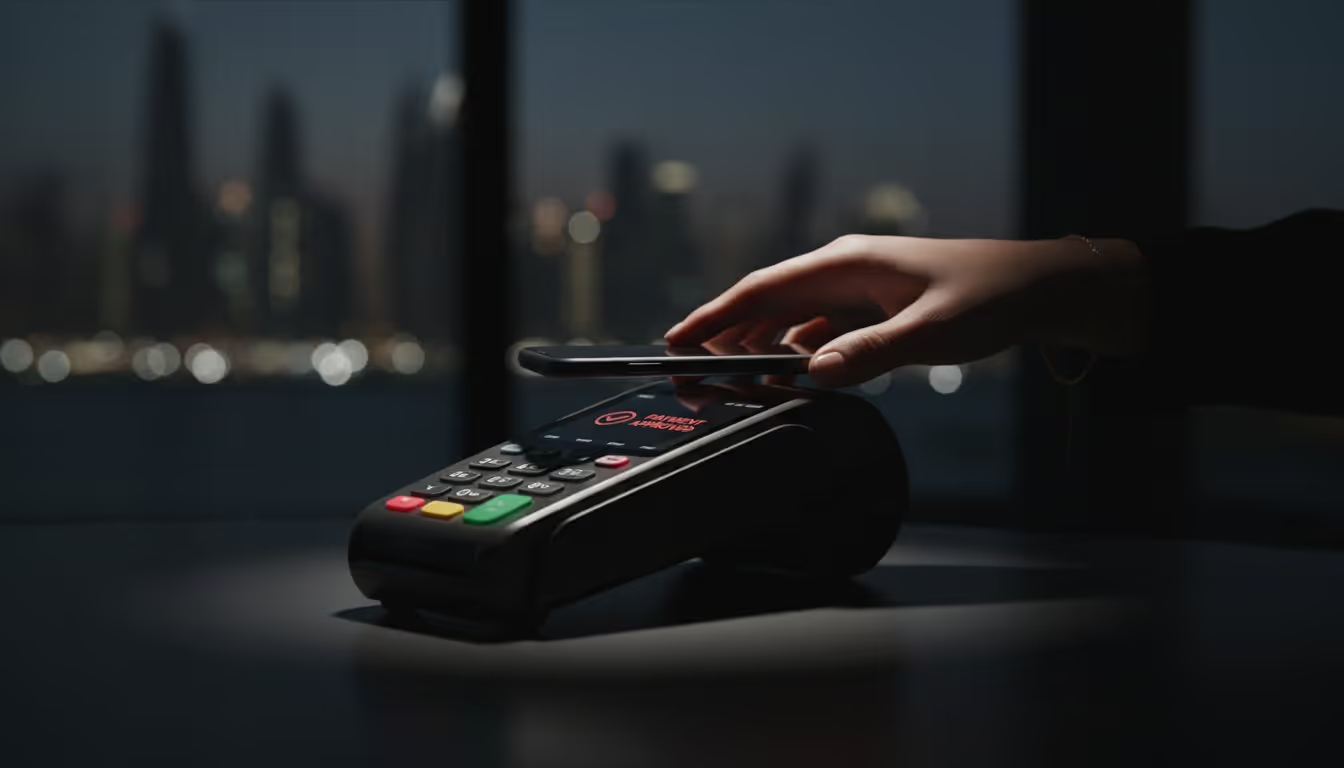
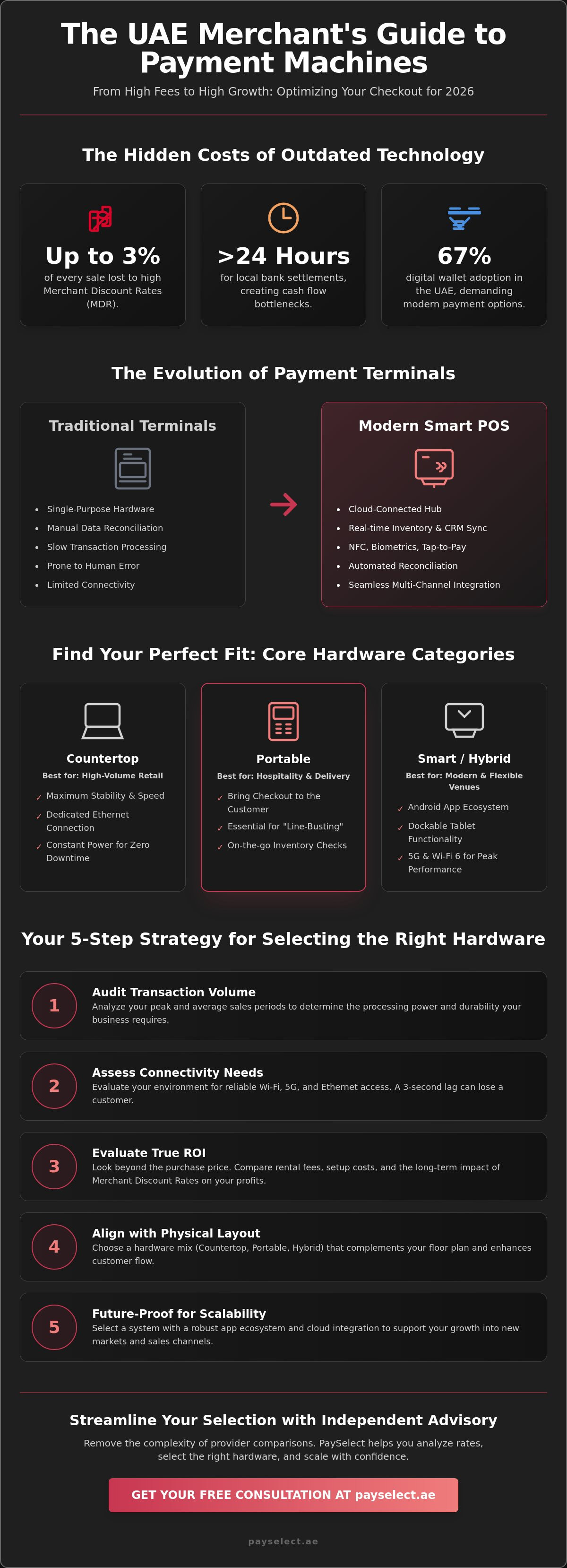
Why are you still losing up to 3% of every sale to high merchant discount rates while your competitors settle their accounts in under 24 hours? In the UAE, where digital wallet adoption reached 67% in 2023, the wrong payment machine does more than just process cards. It acts as a bottleneck for your growth, your cash flow, and your customer loyalty. You likely feel the daily friction of outdated hardware and slow settlement periods from local banks that don't match the speed of your business.
We're here to help you regain control and optimize your bottom line. You'll learn how to master the selection process to reduce transaction costs and enhance the customer experience across your UAE storefronts. This guide breaks down the essential hardware features, consolidated reporting methods, and settlement timelines that will transform your checkout from a simple utility into a strategic advantage for 2026.
Key Takeaways
• Understand how the modern payment machine has evolved into a cloud-connected hub that integrates transactions with real-time inventory and CRM data.
• Compare the functional advantages of Android-based smart POS systems against traditional terminals to optimize your customer checkout experience.
• Evaluate the true ROI of your hardware by analyzing rental fees, purchase prices, and the impact of Merchant Discount Rates on your AED profits.
• Follow a strategic five-step audit to align your hardware selection with specific transaction volumes and connectivity requirements in the UAE.
• Discover how independent advisory removes the complexity of provider comparisons, allowing you to streamline your setup and scale with confidence.
The State of Payment Machine Technology in 2026
The 2026 payment machine is no longer a static hardware unit designed for a single purpose. It has evolved into a cloud-integrated terminal that bridges physical storefronts with complex digital commerce ecosystems. Modern businesses in the UAE now treat these devices as intelligent command centers rather than simple tools for processing transactions. This transition from legacy card readers to app-based POS ecosystems is now complete. These systems allow merchants to manage inventory, track customer loyalty, and settle funds across borderless markets from a single interface. Security remains the foundation of this progress. Every hardware choice must align with PCI-DSS compliance standards to protect sensitive data and maintain consumer trust in an era of sophisticated digital threats.
From Swipe to Seamless: The Evolution of Customer Expectations
Consumer expectations in Dubai and Abu Dhabi have shifted radically over the last few years. NFC and tap-to-pay technology are now the bare minimum requirements for establishing consumer trust. In the UAE, facial recognition and biometric authentication have moved from experimental features to standard checkout options. A Payment terminal acts as a gateway between physical commerce and digital settlement. We've also seen the rise of "soft-POS" technology, which allows standard mobile devices to accept payments. While this provides flexibility for mobile vendors, high-volume retailers still prioritize dedicated payment machine hardware for its superior durability and processing speed. This evolution ensures that the checkout process is an invisible part of the customer journey.
Why Your Hardware Choice Impacts Your Business Scalability
Your choice of hardware directly influences your ability to scale operations without friction. Reliable terminals ensure high transaction approval rates, which is critical during high-traffic periods like the Dubai Shopping Festival. Modern machines significantly reduce human error by automating the reconciliation process and eliminating the need for manual data entry. This precision saves business owners hours of administrative labor every week. Payment speed also plays a vital role in customer retention. Slow processing times lead to long queues and lost revenue. By investing in high-performance hardware, you optimize your workflow and empower your staff to focus on service rather than troubleshooting connectivity issues. Efficient hardware isn't just a utility; it's a strategic asset that supports rapid expansion into new markets.
Cloud Connectivity
Real-time data syncing across all business locations.
Multi-Channel Integration
Seamlessly connecting in-store hardware with online sales platforms.
Operational Efficiency
Reducing the time spent on manual settlement and error correction.
Core Hardware Categories: Finding the Right Fit for Your Business
Selecting the right payment machine is no longer just about swiping cards. It's about architectural integration. In the UAE, where digital payment adoption reached a record 95% among consumers in 2023, your hardware choice dictates your operational speed and customer satisfaction. You need a solution that aligns with your floor plan, transaction volume, and growth targets. Whether you operate a boutique in Dubai Design District or a high-traffic pharmacy in Abu Dhabi, the hardware must be a catalyst, not a bottleneck.
Portable vs. Countertop: Assessing Your Physical Layout
Fixed countertop units remain the gold standard for high-speed retail environments. These machines offer maximum stability, constant power, and dedicated Ethernet connections to ensure zero downtime. They're built for the grind of constant use. Conversely, mobility is a non-negotiable requirement for the hospitality and delivery sectors. Portable handhelds allow your team to bring the checkout experience directly to the customer, whether at a restaurant table or a doorstep in a residential tower.
The smartest approach involves choosing modern POS machines that offer hybrid functionality. These systems often feature a dockable tablet that functions as a fixed station during peak hours but can be detached for line-busting or inventory checks. This flexibility helps businesses manage floor space efficiently while maintaining a professional appearance. For high-volume environments, look for devices with 5G and Wi-Fi 6 capabilities. A connection lag of just three seconds can frustrate a queue, so hardware with superior antenna arrays is essential for maintaining momentum.
Smart Terminals and the App Ecosystem
The rise of Android-based terminals has transformed the payment machine into a comprehensive business hub. These aren't just tools for processing Dirhams; they're platforms for optimization. Smart terminals allow you to run inventory management, staff scheduling, and CRM apps directly on the device. This integration removes the friction of switching between different screens or manual data entry. You can sync your stock levels in real-time as sales happen, ensuring your digital storefront and physical shelf stay aligned.
Loyalty Integration
Enroll customers in rewards programs at the point of sale with a single tap.
Cloud Reporting
Access transaction data and sales trends from any device, anywhere in the world.
Third-Party Support
Install niche apps tailored for specific sectors like salon booking or table management.
Modern businesses also prioritize battery life. For a mobile business, a terminal must last a full 12-hour shift without needing a charge. High-end smart terminals now feature fast-charging capabilities that provide hours of life from a 15-minute plugin. If you want to future-proof your setup, you can explore advanced hardware options that combine these smart features with rugged durability. Transitioning to an app-based ecosystem ensures your business stays agile and ready to scale as market demands shift.
Calculating the Real ROI: Beyond the Machine Purchase Price
Forward-thinking UAE business owners look past the initial sticker price. Selecting a payment machine based solely on its upfront cost is a common mistake that impacts long-term profitability. Total Cost of Ownership (TCO) includes the purchase price or rental fee, maintenance costs, and the Merchant Discount Rate (MDR). In the competitive Dubai and Abu Dhabi retail sectors, even a 0.2 percent difference in MDR can result in thousands of Dirhams lost annually as your volume scales.
The "free" machine offer is a frequent objection during the procurement process. These zero-upfront deals often hide higher transaction fees or lock businesses into restrictive three-year contracts. If a provider offers a complimentary terminal but charges an extra 0.5 percent per transaction, a business processing AED 200,000 monthly will pay an additional AED 12,000 per year. This far exceeds the cost of purchasing high-end hardware outright. Reliability and settlement speed also play critical roles in ROI. Faster settlement times, such as T+1 or same-day deposits, improve your cash flow and allow you to reinvest capital into inventory or marketing without delay.
Understanding Fee Structures and Hidden Charges
Clarity in pricing is essential for accurate financial forecasting. Flat-rate models are simple but can be expensive for high-volume merchants. Tiered pricing often looks attractive but frequently pushes transactions into "non-qualified" categories with much higher rates. Interchange-plus is the gold standard for transparency, as it separates the card network cost from the provider's markup. Watch for hidden AED 100 monthly minimums, statement fees, or annual PCI compliance charges that inflate your bills. Implementing payment gateway integration helps unify these pricing structures across your physical and online channels, creating a borderless view of your revenue.
Integration: The Key to Operational Efficiency
Your payment machine must act as a data hub that communicates directly with your accounting and ERP software. When a sale occurs, the system should automatically update inventory levels and log the entry in your financial records. This seamless synchronization eliminates the need for manual end-of-day reconciliations which are prone to human error. Automated system integration reduces back-office labor costs by at least 20 percent by removing the burden of manual data entry. This efficiency transforms your payment setup from a simple utility into a strategic tool for business optimization and rapid scaling.
How to Select Your Payment Machine: A Comprehensive 5-Step Guide
Choosing the right hardware is a strategic move that dictates your daily operational speed. A poorly chosen device creates bottlenecks; however, the right payment machine acts as a catalyst for seamless commerce. Follow this structured five-step framework to ensure your selection supports your 2026 growth targets.
Step 1 & 2: Volume Analysis and Connectivity
Your transaction data is your strongest negotiating tool. Before speaking to providers, audit your last six months of processing. If your business handles over AED 100,000 in monthly card sales, you possess the leverage to negotiate lower processing rates and hardware subsidies. High ticket sizes often favor fixed-rate models, while high-volume, low-value transactions require a fee structure that doesn't eat into slim margins.
Connectivity is the backbone of your checkout experience. You must evaluate your physical space for signal reliability. Use this checklist to assess your environment:
• Identify thick concrete or glass partitions that obstruct 5G signals.
• Confirm if your checkout counter has dedicated Ethernet ports for 99.9% uptime.
• Test Wi-Fi strength during peak hours when customer devices might crowd the bandwidth.
Fixed retail spots benefit most from high-speed Ethernet. If you operate a restaurant or a mobile boutique in a venue like City Centre Mirdif, 5G-enabled mobility is non-negotiable for tableside or floor-side service.
Step 3, 4 & 5: Comparison and Final Selection
Don't limit your business to traditional bank ecosystems. While legacy banks offer stability, independent fintech providers often deliver superior integration capabilities and faster settlement cycles. Independent platforms prioritize borderless payments and modern APIs, making them more agile for businesses looking to scale quickly across the UAE. Compare providers based on their ability to sync with your existing inventory software rather than just their brand name.
Technical support is your safety net. In the fast-paced UAE market, a "hot-swap" guarantee is essential. Demand a policy where faulty hardware is replaced within 4 hours. If a device fails during a Saturday rush, every minute of downtime results in lost revenue and diminished customer trust. Look for providers with local, on-the-ground support teams rather than distant call centers.
Finally, conduct a usability test. Put the payment machine in the hands of your front-line staff. If the interface is cluttered or requires more than three taps to complete a standard sale, it's a liability. A clean, intuitive UI reduces training time and accelerates the checkout line, directly impacting your bottom line. Testing for staff efficiency ensures your technology empowers your team instead of slowing them down.
Ready to upgrade your checkout experience with the latest hardware? Explore PaySelect POS solutions to find the perfect fit for your business.
Streamlining Your Selection with Independent Advisory
Selecting the right payment machine often feels like a full-time job. With dozens of providers in the UAE market, businesses face a fragmented landscape of varying fee structures and hardware capabilities. PaySelect removes this complexity by offering a centralized, independent platform designed to provide clarity. Instead of spending 20+ hours researching individual bank offers, you can access unbiased data that highlights the actual value of each solution.
Moving toward a best-in-class infrastructure means you're no longer tied to a single-provider mindset. This shift allows enterprise-level organizations to optimize their costs significantly. In the UAE, where transaction volumes are projected to grow by 15% annually through 2026, even a 0.1% reduction in processing fees can save thousands of AED. Independent consulting ensures your chosen hardware integrates seamlessly with your existing software, preventing technical bottlenecks that stall growth.
The Power of Unbiased Comparison
Transparency is the most valuable currency in the fintech sector. Many merchants find themselves locked into contracts with hidden costs or outdated technology because they lacked a side-by-side comparison. PaySelect's "Take the Test" tool changes this dynamic. It analyzes your specific business volume, industry type, and regional needs to match you with an ideal provider.
The Middle Eastern payment landscape is unique, governed by Central Bank of the UAE (CBUAE) regulations and specific settlement cycles. Expert guidance helps you understand these nuances without getting lost in technical jargon. You gain the power to choose a partner based on performance metrics rather than marketing promises. This approach ensures you secure:
• Competitive transaction rates tailored to your industry.
• Hardware that supports local payment methods and digital wallets.
• Reliable settlement windows that protect your daily cash flow.
Next Steps: From Selection to Implementation
Efficiency doesn't end at selection. A seamless transition requires organized documentation. Prepare your trade license, passport copies of shareholders, and bank statements for the last three months to accelerate your onboarding. This preparation can reduce your setup time by up to 40%, getting your new payment machine operational faster and reducing downtime.
Use PaySelect to audit your current infrastructure. Many businesses discover they're paying for redundant features or inflated cross-border fees. By identifying these inefficiencies, you can reclaim your margins and reinvest in your core operations. A simple audit often reveals savings of 5% to 12% on monthly processing costs, providing an immediate boost to your bottom line.
Optimize your payments today. Take the first step toward a more profitable future by leveraging independent expertise to secure the best possible pos machines and terms for your business.
Secure Your Competitive Edge in the 2026 Payment Landscape
Success in the UAE's evolving market demands more than just a tool for transactions; it requires a strategic hardware investment that scales with your ambition. You've learned that calculating true ROI goes beyond the initial sticker price, focusing instead on seamless integration and long-term operational reliability. Navigating the diverse landscape of UAE providers is often complex, especially when businesses face the common pain points of opaque fee structures and rigid technical requirements. PaySelect streamlines this journey through expert advisory for infrastructure optimization. We provide an independent comparison of the local market, ensuring you aren't locked into a sub-optimal ecosystem. By using our data-driven matching tool, both SMEs and enterprises can bypass traditional bottlenecks and deploy a payment machine that maximizes every Dirham of revenue. Don't let outdated hardware limit your growth potential in a digital economy that moves at lightning speed. It's time to empower your business with a solution that's as forward-thinking as your vision.
Find the perfect payment machine for your business with PaySelect
Frequently Asked Questions
What is the average cost of a payment machine in the UAE in 2026?
In 2026, a high-performance payment machine in the UAE typically costs between AED 1,200 and AED 2,800 for an outright purchase. Many businesses prefer the flexibility of monthly rental models, which usually range from AED 75 to AED 200 per month depending on the device's capabilities. These costs reflect the integration of advanced security features and cloud-based reporting tools that have become standard in the local market.
Can I use one payment machine for multiple business bank accounts?
Most standard setups link a single device to one primary business bank account to maintain clear financial records. However, modern fintech solutions now offer automated split settlements that distribute funds across different accounts based on your specific rules. This technology removes the barrier of manual transfers and allows you to manage diverse revenue streams or partner payouts with absolute precision and speed.
How long does it take to get a payment machine approved and delivered?
You can expect your payment machine to be approved and delivered within 3 to 5 business days when working with agile fintech providers. Traditional banking institutions often follow a more manual documentation process that can extend this timeline to 14 business days or more. PaySelect accelerates this transition by offering digital onboarding that eliminates traditional paperwork, ensuring your business stays ready to accept payments without delay.
Do all payment machines in the UAE support Apple Pay and Google Pay?
Yes, all modern terminals deployed in the UAE are equipped with NFC technology to support Apple Pay, Google Pay, and Samsung Pay. Contactless payments have reached a 95% adoption rate across the Emirates, making this feature a mandatory requirement for any merchant. Using a payment machine with these capabilities ensures a seamless checkout experience that aligns with the digital-first preferences of local and international customers.
What is the difference between a bank-issued terminal and a third-party POS?
Bank-issued terminals are provided by traditional lenders and often feature rigid software that's difficult to integrate with other business tools. Third-party POS systems prioritize optimization and offer faster settlement cycles, better data analytics, and borderless payment options. While banks offer a traditional foundation, third-party providers focus on the user experience and provide the technical agility needed to scale your business in a competitive economy.
What happens if my payment machine loses internet connectivity during a sale?
Modern devices utilize dual-SIM 5G connectivity and Wi-Fi failover to ensure your business never stops moving. If all signals fail, many terminals feature a secure offline mode that encrypts and stores transaction data until the connection is restored. This safeguard prevents the common pain point of lost revenue during peak hours, allowing you to process transactions with confidence even in challenging network environments.
Are there specific payment machines required for the hospitality industry?
The hospitality sector requires specialized hardware that supports unique functions like tableside ordering, digital tipping, and bill splitting. These portable devices are built with long-lasting batteries and rugged frames to withstand the high-intensity environment of restaurants and hotels. Choosing hardware specifically designed for hospitality streamlines your operations and empowers your staff to provide a faster, more professional service to every guest.
Disclaimer
This content is for informational purposes only and should not be considered financial, legal, or regulatory advice. Payment provider availability, pricing, and approval processes vary depending on individual business circumstances. PaySelect does not guarantee provider acceptance or specific outcomes. Businesses should conduct their own due diligence before entering into any agreements.
Empowering businesses to achieve greater growth