
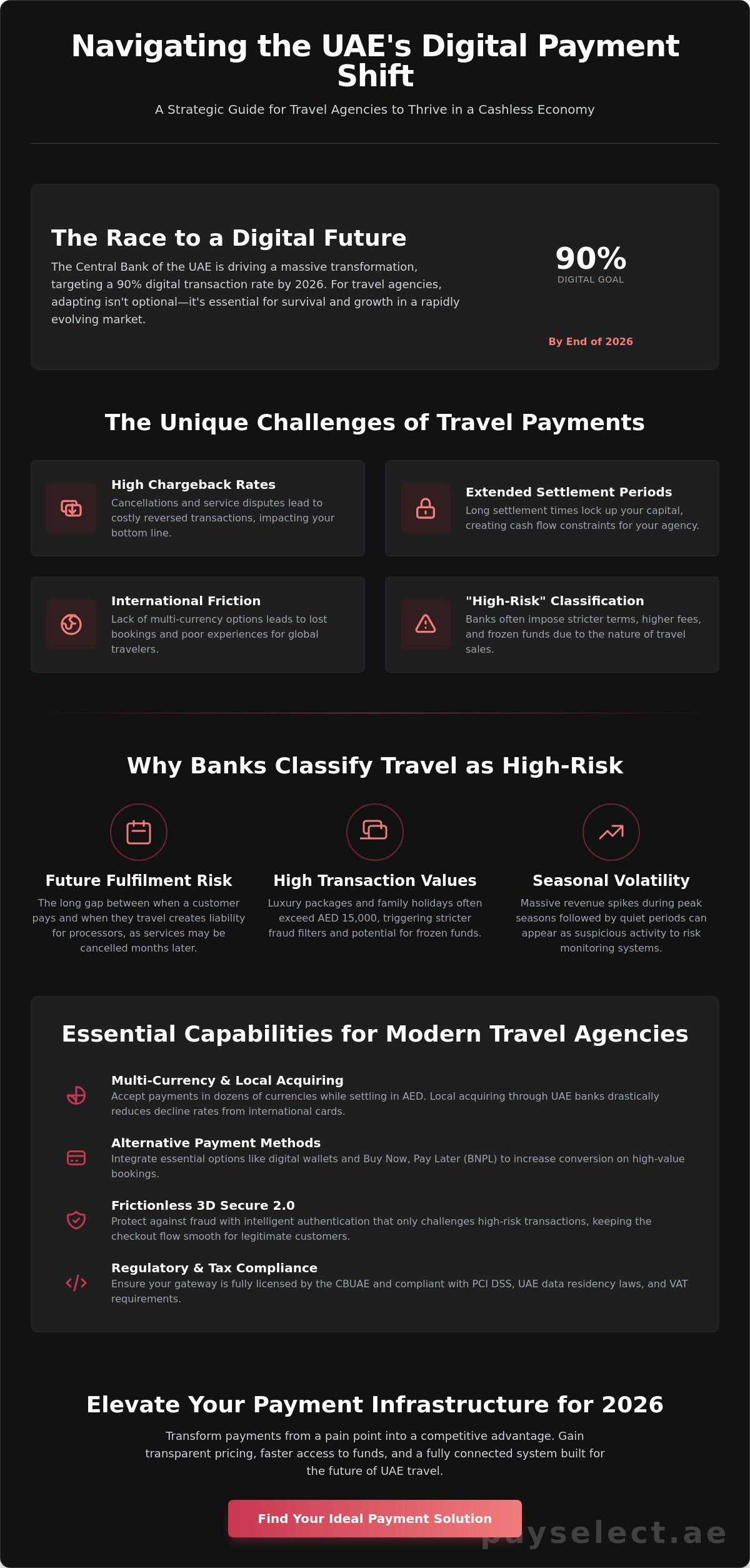
Did you know that the UAE is targeting a 90% digital transaction rate by the end of 2026? For local travel firms across the Emirates, this shift means that finding the best payment gateway for travel agencies in the UAE is no longer a luxury; it's a fundamental requirement for operational survival. You've likely felt the sting of high chargeback rates from last-minute cancellations or the drain of extended settlement periods that lock up your cash flow in AED. It's frustrating to manage international travelers who expect seamless multi-currency options while you're stuck battling complex fee structures and high-risk labels that stall your momentum.
We understand that your goal is to move faster, expand further, and operate with absolute clarity. This guide provides a strategic framework to help you secure transparent pricing, gain quicker access to processed funds, and achieve total system connectivity. We'll explore the impact of the latest Central Bank of the UAE regulations, compare the structural differences between regional providers, and show you how to transform your payment infrastructure into a competitive advantage. It's time to remove the operational barriers and secure the fluidity your agency deserves.
Key Takeaways
• Understand how the Central Bank of the UAE’s 2026 digital mandates impact your licensing requirements and operational compliance.
• Identify the essential multi-currency and alternative payment capabilities needed to capture high-value international bookings without friction.
• Discover a step-by-step framework to audit your transaction data and secure the best payment gateway for travel agencies in dubai.
• Learn proven strategies to mitigate high-risk classifications and protect your margins from the volatility of travel-related chargebacks.
• Leverage independent comparison tools to gain an unbiased view of the market and match your agency with the most efficient payment infrastructure.
The Landscape of Travel Payment Processing in the UAE
Travel commerce in Dubai isn't a simple exchange. It's an intricate promise of future service. While a retail store settles a transaction for a physical product instantly, your agency manages capital for trips that may be months away. This gap creates "Future Fulfilment" risk, a factor that makes searching for the best payment gateway for travel agencies in dubai a unique challenge. Financial institutions view this time delay as a potential liability, necessitating a more robust infrastructure than standard e-commerce setups.
The Central Bank of the UAE (CBUAE) now maintains strict oversight through Federal Decree-Law No. 6 of 2025. This law mandates that every payment service provider must secure specific approvals and licenses by September 16, 2026. These regulations ensure that the digital economy remains secure as Dubai moves toward its goal of 90% cashless transactions. For your agency, this means your chosen payment gateways must not only be efficient but also fully aligned with these evolving national standards.
Local card acquisition is another critical performance driver you can't ignore. When your gateway routes transactions through UAE-based banks, you significantly reduce decline rates. International banks often flag high-value travel transactions from the Middle East as suspicious; local processing bypasses these barriers. This ensures more of your AED reaches your account without friction, providing the liquidity you need to pay global vendors and local staff on time.
Why Travel Agencies are Classified as High-Risk
Banks classify the travel sector as high-risk primarily due to the long lead times between booking and service delivery. If a tour operator fails or a flight is cancelled six months after the customer pays, the processor faces significant chargeback liability. High transaction values, often exceeding AED 15,000 for luxury holiday packages, trigger additional fraud filters that can lead to frozen funds. Seasonal volatility also plays a role. Your processing history might show massive spikes during peak winter months followed by quieter periods, which can look like suspicious activity to unrefined risk-monitoring systems.
Regulatory Compliance and National Standards
Compliance in the UAE is about more than just security; it's a prerequisite for market access. Your infrastructure must align with UAE data residency laws, ensuring that sensitive traveller data is stored and handled according to national security standards. PCI DSS compliance remains the non-negotiable benchmark for protecting cardholder information. Additionally, your setup must handle VAT requirements for digital receipts across all seven Emirates. Ensuring every AED 100 spent is accounted for correctly within your booking engine saves countless hours during your annual audit and keeps your agency in good standing with the Federal Tax Authority.
Essential Payment Capabilities for Modern Travel Agencies
Modern travellers expect a frictionless checkout. If your agency can't process a booking in the client's home currency, you risk losing them to a global competitor. Finding the best payment gateway for travel agencies in dubai requires a focus on multi-currency capabilities. By accepting payments in dozens of global currencies while settling in AED, you eliminate the sticker shock that often occurs when travellers see foreign transaction fees on their bank statements. This transparency is a powerful tool for building international trust.
Beyond traditional cards, your infrastructure must support digital wallets and cross-border payments. In the UAE, mobile-first payment methods have moved from optional to essential. Additionally, Buy Now, Pay Later (BNPL) solutions are transforming high-ticket travel sales. Offering travellers the ability to split an AED 20,000 holiday into manageable monthly instalments significantly increases conversion rates. This allows your agency to capture larger bookings without increasing your own credit risk, as the provider manages the collection process.
Security shouldn't come at the cost of the user experience. Implementing 3D Secure 2.0 is mandatory for fraud prevention, but it must be done intelligently. Modern gateways use frictionless authentication that only challenges high-risk transactions. This keeps your checkout flow smooth while ensuring you remain compliant with international card brand rules. If you're unsure which setup fits your volume, you can compare payment infrastructure options to find the right balance of security and speed.
Dynamic Currency Conversion (DCC) and FX Management
DCC provides absolute transparency by showing the final price in the traveller's local currency at the point of sale. This builds confidence and reduces "friendly fraud" chargebacks caused by currency confusion. For the agency, effective FX management is about more than just the customer. It's about protecting your margins when you pay global suppliers. Choosing a gateway with competitive exchange rates ensures that your AED profits aren't eroded by hidden markups during international settlement.
Seamless Integration with Booking Engines
Your payment gateway must talk to your existing tools. Whether you use a Global Distribution System (GDS) or a custom property management system, API flexibility is vital. This connectivity allows for automated payment links, which are perfect for securing deposits on bespoke itineraries without requiring a full website checkout. For last-minute excursion bookings, a mobile-optimised interface ensures that travellers can confirm their plans on the go, using whichever device is in their hand.
Mitigating High-Risk Classifications and Chargeback Volatility
Chargebacks are the primary threat to the stability of a travel agency's merchant account. In the UAE, the high-risk classification stems from the extended time between the customer’s payment in AED and the actual date of travel. This "future fulfillment" window exposes banks to significant liability if an agency cannot deliver the service. While global platforms often rely on rigid, automated bots to handle disputes, the best payment gateway for travel agencies in dubai provides access to robust local dispute management. These teams understand the nuances of the UAE market and the specific documentation required to win a challenge against "friendly fraud."
Reducing chargeback volatility starts with absolute clarity. Your cancellation and refund policies must be prominent at the point of sale, not buried in a footer. When a traveller understands exactly how their AED 25,000 booking fee is handled in the event of a change, they're less likely to initiate a dispute through their bank. Modern payment gateways also allow you to set custom descriptors on credit card statements. This ensures the traveller recognises your agency name immediately, preventing accidental disputes triggered by forgotten transactions.
Building a Robust Fraud Prevention Strategy
Effective fraud prevention requires a balance between security and conversion. Address Verification Service (AVS) and CVV checks are your first line of defence, but they're only pieces of the puzzle. You must identify high-risk booking patterns, such as last-minute, high-value excursions booked from unfamiliar IP addresses. By implementing 3D Secure 2.0, you shift the liability for fraudulent transactions back to the issuing bank. The key is to refine your fraud rules so you block the criminals without frustrating your legitimate, high-spending clients.
Navigating Settlement Cycles and Reserve Funds
Settlement delays are a reality for high-risk sectors. Because of the future fulfillment risk, many providers will implement a "rolling reserve," where a percentage of your processed funds is held for a set period. This protects the processor against potential chargebacks. As your agency builds a solid processing history with low dispute rates, you can often negotiate better settlement terms. Efficient liquidity management is vital here; knowing exactly when your AED will hit your business account allows you to pay hotels and airlines without straining your operational cash flow. Using a comparison tool to audit these terms across different providers can reveal significant differences in how reserves are managed.
A Framework for Selecting the Best Payment Gateway in Dubai
Choosing the best payment gateway for travel agencies in dubai requires a disciplined, data-driven approach. You can't rely on headline rates alone. Instead, use this five-step framework to evaluate potential partners through the lens of your specific operational needs. A well-chosen gateway isn't just a cost; it's a strategic tool for scaling your agency's international reach.
Step 1: Audit your transaction data.
Calculate your average ticket size and monthly volume in AED. High-ticket agencies processing luxury packages need different risk parameters than high-volume firms focusing on budget excursions.
Step 2: Compare Merchant Discount Rates (MDR).
Evaluate how different payment gateways structure their fees. Look beyond the basic percentage to find the real cost of processing.
Step 3: Evaluate national presence.
A provider with a local Dubai office and deep ties to UAE banks offers a significant advantage in dispute resolution and technical support.
Step 4: Verify integration compatibility.
Ensure the API connects seamlessly with your GDS or booking engine to avoid manual data entry and operational errors.
Step 5: Scrutinize the contract.
Look for setup fees, monthly maintenance costs, or hidden refund penalties that can drain your margins over time.
Decoding Payment Processing Fees
Blended pricing models offer a flat rate for all card types. While simple, they often mask higher costs. Interchange Plus models are more transparent, showing you the raw cost of the transaction plus the provider's margin. Don't be fooled by the lowest headline rate. A slightly higher rate that includes better fraud protection and local support is often more cost-effective. You should also watch for gateway minimums and "per-transaction" fees that can add up if you process many low-value bookings.
The Value of Local vs. International Gateways
Domestic UAE providers often provide superior authorization rates for local cards issued by banks like Emirates NBD or FAB. International gateways, however, might offer better global reach and support for niche alternative payment methods. Many sophisticated agencies now use a hybrid model for redundancy. If one system experiences downtime, your bookings don't stop. This multi-gateway strategy ensures your business remains fluid and resilient. To find the right mix for your agency, you can compare payment gateways and audit their specific feature sets side-by-side.
Finding the right partner is often the most time-consuming part of scaling a travel business. With hundreds of variables to consider, from settlement cycles to MDR structures, the search for the best payment gateway for travel agencies in dubai can feel overwhelming. PaySelect exists to simplify this journey. We don't process payments; we provide the clarity you need to choose the partner that does. Our platform offers an independent, unbiased view of the UAE market, ensuring that your decision is based on data rather than sales pitches.
For many agencies, the primary pain point is a lack of transparency. You might be paying high fees for services you don't use or suffering from slow access to your AED. Our payment gateway comparison tool allows you to look past the marketing and see how different providers stack up against your specific transaction volume and average ticket size. By conducting a thorough payment infrastructure audit, we help you identify where costs are leaking and where performance can be enhanced. This data-driven approach removes the guesswork from your financial operations.
Enterprise-level travel groups face even greater complexities. Managing high-value bookings across multiple borders requires a sophisticated approach to cross-border payments. Our consulting services provide the strategic oversight needed to optimize these flows, ensuring that every dirham is accounted for and every transaction is secure. We act as a bridge between your agency's ambition and the technical reality of global commerce, allowing you to focus on delivering world-class travel experiences.
The PaySelect Advantage: Transparency First
We believe that transparency is the foundation of growth. Our platform allows you to access side-by-side comparisons of the UAE’s leading payment solutions without the pressure of a direct sales environment. This helps you eliminate unnecessary transaction costs and find a provider that truly understands the high-risk nature of the travel sector. Staying updated on fintech innovations in the MENA region is no longer a full-time job for your team; we provide the insights you need to stay ahead of the curve and maintain a competitive edge.
Next Steps for Your Travel Agency
The first step toward a more efficient payment setup is a comprehensive audit of your current performance. Gather your recent processing statements and identify your highest-volume corridors. To find your ideal match quickly, you can use our "Take the Test" tool on our platform. This interactive diagnostic matches your agency's unique profile with the most compatible infrastructure. Preparing your documentation now, including your trade license and bank statements, ensures a smooth application process when you're ready to switch to the best payment gateway for travel agencies in dubai.
Elevate Your Payment Infrastructure for 2026
The UAE travel sector is evolving rapidly, driven by Dubai’s 2026 cashless strategy and the Central Bank’s new regulatory frameworks. Staying competitive requires more than just accepting cards. It demands a sophisticated infrastructure that manages multi-currency volatility and high-risk chargeback threats with precision. By auditing your transaction volume and prioritizing local card acquisition, you ensure that more of your AED remains in your account. Identifying the best payment gateway for travel agencies in dubai is no longer just an operational task; it's a strategic necessity for long-term growth and international ambition. To maximize this growth potential, many travel firms partner with digital marketing experts like EmirAds to reach and convert high-value travelers across the region.
Don't let complex fee structures or settlement delays stall your momentum. PaySelect provides the independent and unbiased comparison tools you need to remove operational barriers. Our expert advisory focuses on cost optimization and MENA-focused payment intelligence to help you scale with absolute confidence. We act as your strategic partner, bridging the gap between technical complexity and your need for fluid, reliable commerce.
Find the best payment gateway for your travel agency with PaySelect today and take control of your financial future. Your journey toward a more fluid and profitable agency starts with a single, data-driven decision.
Frequently Asked Questions
Why is travel considered a high-risk industry for payment processing in the UAE?
Travel is high-risk because of the future fulfillment model where customers pay weeks or months before their trip. This creates a long window for chargebacks if an agency closes or a trip is cancelled. UAE banks also scrutinize the high transaction values common in luxury travel, as these represent a higher financial liability for the processor if a dispute occurs.
How long does it typically take to get a payment gateway approved for a travel agency?
Approval times generally range from 10 business days to four weeks for most agencies. Because travel is a high-risk sector, processors conduct a rigorous review of your trade license, bank statements, and refund policies. Having your documentation organized and using an independent comparison tool to find the right partner can significantly speed up this process.
What are the average transaction fees for travel agencies in the UAE?
Most providers in the UAE charge between 2.25% and 2.9% per transaction, often with a fixed fee of AED 1.00. International cards usually incur an extra 1% to 1.5% fee for processing and currency conversion. Some plans also include monthly maintenance fees starting around AED 200. It's essential to audit these costs to ensure you're getting a fair rate for your specific volume.
Can I accept international credit cards with a local UAE payment gateway?
Yes, a local gateway allows you to accept global credit and debit cards while settling the funds in AED. This is a core feature of the best payment gateway for travel agencies in dubai. Accepting international cards is crucial for capturing the millions of overnight visitors Dubai welcomes annually, ensuring a frictionless booking experience for global travellers from any region.
How can I reduce the number of chargebacks my travel agency receives?
Reducing chargebacks requires a combination of clear communication and technical security. Implement 3D Secure 2.0 to shift fraud liability to the bank and ensure your agency name is clearly visible on the customer's bank statement. Providing instant digital receipts and making your refund policy easy to find at checkout also prevents many "friendly fraud" disputes before they start.
What is the difference between a payment gateway and a merchant account for travel?
The payment gateway is the software that captures and encrypts card data at checkout. The merchant account is a specialized bank account that holds those funds during the processing cycle before they're settled into your main business account. Many modern providers offer these as a bundled service to simplify your financial operations and reduce the technical barriers to entry.
Do I need a separate license to accept online payments for my tour business?
You don't need a specific "payment" license, but your existing UAE trade license must reflect your actual travel activities. Additionally, under Federal Decree-Law No. 6 of 2025, you must ensure your chosen provider is fully licensed by the Central Bank of the UAE. Compliance with national data residency and security standards is mandatory for all digital commerce operations within the Emirates.
Disclaimer
This content is for informational purposes only and should not be considered financial, legal, or regulatory advice. Payment provider availability, pricing, and approval processes vary depending on individual business circumstances. PaySelect does not guarantee provider acceptance or specific outcomes. Businesses should conduct their own due diligence before entering into any agreements.
Empowering businesses to achieve greater growth