


A payment terminal is only the visible edge of PCI DSS scope. Scope covers the people, processes, and technologies that store, process, or transmit cardholder data, as well as connected systems that can affect its security. To understand what PCI scope is and how to reduce it, start by tracing those connections.
That wider reach can make boundaries harder to define, especially when support desks, backup systems, administrative tools, and network access sit near payment systems. This article explains which systems count and how network segmentation, reduced data handling, and PCI DSS v4.0.1 shape scope reduction.
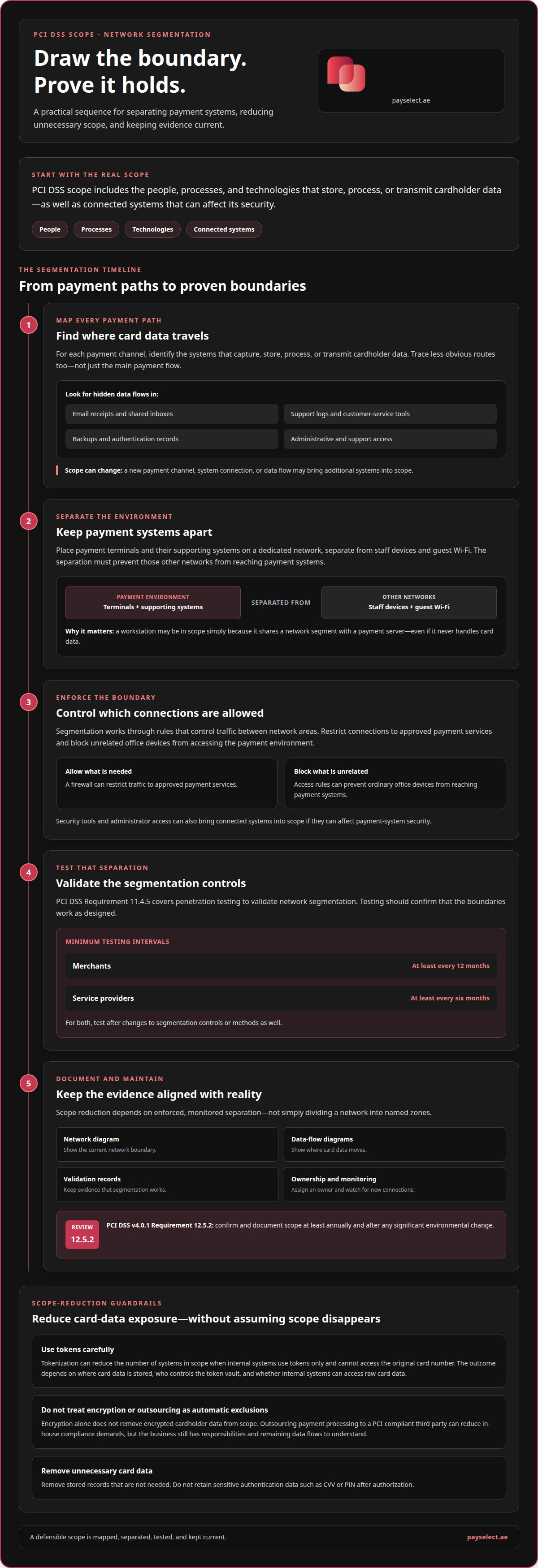
A workstation that never handles card numbers can still matter if it shares a network segment with a payment server. Security tools and administrator access can also bring systems into scope. The aim is not to label every system in scope by default. It is to define the boundary, keep card data out of places that do not need it, and maintain evidence that separation remains effective as the environment changes.
Key Takeaways
• Trace card data across every payment channel, then look for ways to avoid storing it in internal systems.
• Outsourcing payment handling can reduce in-house PCI work, but the provider’s role doesn’t automatically remove your own responsibilities.
• Keep scope boundaries defensible with segmentation evidence and regular control testing: merchants test at least every 12 months, while service providers test at least every six months.
• PCI DSS v4.0.1 calls for scope documentation to be reviewed at least annually and after significant environmental changes.
Network segmentation
Network segmentation separates the cardholder data environment from other business networks. For example, a retail office workstation should not automatically share network access with a payment server.
Network Boundary Enforcement
Segmentation creates network boundaries and enforces them through rules controlling traffic between separate areas. A firewall can restrict connections to approved payment services, while access rules block unrelated office devices. This matters because a workstation on the payment server’s network segment may be in scope even if it never handles cardholder data. Effective boundaries can reduce the number of systems assessed.
Network Isolation
Isolation keeps the payment environment separate from systems that do not need to process or access card data. For instance, a business can place payment terminals and supporting systems on a dedicated network, separate from staff devices and guest Wi-Fi. The separation must prevent those other networks from reaching payment systems. If ordinary devices can still connect to the cardholder data environment, they may remain in scope.
Network Segmentation and Validation Testing
Segmentation needs testing to show that its boundaries work as designed. PCI DSS Requirement 11.4.5 is a penetration-testing requirement for validating network segmentation. Merchants must test segmentation controls at least once every 12 months and after changes to segmentation controls or methods. Service providers must test at least every six months and after changes to segmentation controls or methods. These intervals make testing part of ongoing security, not a one-time setup task.
Keep evidence of how the boundary works: a current network diagram, data-flow diagrams, and records of segmentation validation. Assign an owner to the architecture decision and monitor the boundary as systems change. A new connection, such as remote support access to a payment server, can change which systems affect its security. Scope reduction depends on enforced, monitored separation, not simply dividing a network into named zones.
Which payment systems fall under PCI-DSS scope?
PCI DSS scope covers systems and people handling cardholder data, including the points where they store, process, or transmit it. Outsourcing payment handling can narrow internal responsibilities, but it does not remove every business obligation.
PCI DSS v4.0.1 Requirement 12.5.2 requires scope to be confirmed and documented at least annually and after any significant environmental change. A new payment channel, system connection, or data flow can change which systems belong in scope. Understanding what PCI scope is and how to reduce it starts with tracing those flows.
For businesses in the UAE, PCI DSS scope depends on how cardholder data is handled, not simply on the business’s location. Map each payment channel and identify the systems that capture, store, process, or transmit card data.
Hidden Data Flows and Scope Creep
Hidden data flows are transfers of card data into systems that are not obvious from the main payment route. For example, a payment receipt emailed to a shared inbox or a support log containing primary account numbers can extend the cardholder data environment. Map backups, logs, customer service tools, and authentication records to find these paths. Review them again after payment or system changes.
Tokenization and Scope Reduction
Tokenization replaces a primary account number with a unique, non-sensitive token, allowing internal systems to use the token instead of raw card data. This can reduce the number of systems in scope when they handle only tokens and cannot access the original number. The outcome depends on where cardholder data is stored, who controls the token vault, and whether internal systems can access raw card data. Encryption alone does not remove encrypted cardholder data from scope. When considering what PCI scope is and how to reduce it, assess token access and vault control.
Outsourcing payment processing to a PCI-compliant third party can reduce in-house compliance demands, but businesses still need to understand their responsibilities and remaining data flows. For example, using services like wapay.ai to automate invoicing and generate payment links keeps cardholder details out of messaging channels and administrative devices. Remove unnecessary card data, including stored records, and do not retain sensitive authentication data such as CVV or PIN after authorization.
How does PCI DSS v4.0 impact scope reduction strategies?
PCI DSS v4.0.1 makes accurate scope definition and shared responsibility central to compliance. A smaller, well-defined environment can reduce the systems and evidence involved in assessment.
Shared PCI Compliance Responsibility
Shared responsibility means a business and its payment service provider each manage the PCI controls assigned to them. Outsourcing payment handling can reduce internal work, but it doesn’t transfer every obligation. Document which controls the provider manages and which remain with your team. PCI DSS v4.0.1 Requirement 12.5.2 requires scope to be confirmed and documented at least annually and after any significant environmental change. Use that review to update system boundaries and responsibility records.
Compliance Costs and Audit Complexity
Audit complexity grows with the number of systems in scope, connected processes, and controls that require evidence. Reducing the systems in scope can lower documentation, control testing, and assessment effort. For example, removing an unnecessary server that stores card data may simplify the evidence required for that environment. The operational impact depends on the data flows and systems that remain, not just the size of the network.
PCI DSS v4.0.1 also requires accurate scoping records, including a written scope definition, network diagram, data-flow diagram, and inventory of in-scope systems. Keep these aligned as payment channels or system connections change. Clear documentation helps internal teams explain why a system is included or excluded during audits.
Compliance Levels and Burden
PCI DSS has four compliance levels, based largely on transaction volume. The applicable level affects validation requirements, while the systems handling cardholder data determine scope. Fewer systems can make an assessment more manageable, but they do not remove controls that still apply.
SAQ types differ by payment channel and how card data is handled. A correctly implemented tokenization arrangement may reduce an assessment from SAQ D, described as having 300+ questions, to SAQ A, described as having approximately 22 questions. Merchants using a PCI SSC-validated P2PE solution may qualify for SAQ P2PE, described as having 33 questions, for physical payment channels.
Connected-to systems and security control systems
A system can fall within PCI DSS scope without storing a payment card number. Network access to cardholder-data systems, or the ability to affect their security, can bring connected systems into scope.
Consider a shared administrator workstation used to manage payment servers and ordinary office devices. If it can access the cardholder data environment, its security may affect payment systems. The same applies to identity tools, remote support software, logging platforms, and backup processes. Assess each connection and its security impact rather than relying on system labels alone.
Security control systems need careful treatment. Firewalls, access-management tools, and monitoring platforms may enforce the boundary around payment systems. If those tools fail or an administrator can change their rules, the payment environment may be affected. For organizations looking to protect connected infrastructure, managed security providers such as cyberone.security offer detection and response services to safeguard critical control environments. NIST SP 800-53 Rev 5 control SC-7 concerns boundary protection; PCI DSS sets the payment security requirements. Both perspectives help explain why control systems matter.
Use a simple connection review to identify systems that reach or protect payment data:
• Trace administrator access, support connections, and service accounts to payment systems.
• Review whether logging, backups, or security tools receive cardholder data or can change payment controls.
• Record each connection and its purpose in the network diagram and data-flow documentation.
Encryption alone does not remove cardholder data from scope if the organization can decrypt it or access the keys. Systems handling only tokens, or encrypted data without access to the decryption keys, are not in scope. That distinction can change the number of systems assessed, but only when the data flow and key access support it. Include changes to access, encryption, and security processes in scope management.
For example, a new payment channel may add a gateway connection or administrative access path. Compare payment gateway options in the context of your payment flow, then assess how each setup affects connected systems and operational demands.
PaySelect
PaySelect helps businesses in the UAE compare payment options when reviewing how payment channels affect PCI DSS scope. Its Payment Gateway Comparison Tool and POS System Selection Tool match business needs with suitable payment setups, while Cross-border Payment Solution Matching supports businesses handling international transactions. Payment pricing comparison can also help clarify differences between options.
These tools can help you assess payment models, channels, and costs as you plan changes to card-data handling. They do not replace a PCI DSS assessment or determine scope; your systems, data flows, and access controls do that. If you are reviewing payment infrastructure and want help comparing options, use PaySelect’s comparison tools.
Make your next payment decision with scope in mind
A payment setup is also a security boundary. Before adding a channel, changing a system, or expanding into new markets, consider how the decision affects data flows, access, and operational ownership. Understanding what PCI scope is and how to reduce it can help your business plan these changes with fewer surprises.
Use your next review to connect payment requirements with the systems and processes that support them. If you are evaluating payment options as part of that work, PaySelect can help compare gateways, POS systems, and cross-border solutions against your business needs.
Contact PaySelect about your payment setup and take the next step with a clearer view of your options. A considered payment decision can support secure operations while keeping your business ready to grow.
Frequently Asked Questions
What Is PCI DSS Scope?
PCI DSS scope is the boundary of systems, people, and processes subject to payment card security requirements. For example, an online retailer’s checkout application may be included, along with systems that administer or protect it. The boundary depends on how payment data moves and which connections could affect its security. A clear scope helps focus assessment work on the relevant environment.
What is the Cardholder Data Environment (CDE)?
The cardholder data environment, or CDE, is the connected environment that captures, processes, stores, or safeguards cardholder data. It can include payment applications, servers, and network components. Think of it as the payment system’s operational zone, together with the components that protect it. A system outside that zone may still affect PCI DSS scope through access or security connections.
Does migrating to the cloud change PCI DSS scope?
Moving payment systems to the cloud doesn’t automatically remove them from PCI DSS scope. The data handled, system connections, access permissions, and responsibility split still matter. For example, a cloud console that administers systems in the CDE can affect their security. PCI DSS v4.0.1 Requirement 8.4.2 explicitly requires MFA for cloud console access in CDE scope from 31 March 2025.
What is PCI-DSS?
PCI DSS is the Payment Card Industry Data Security Standard, which sets security requirements for organizations that store, process, or transmit cardholder data. It was introduced in 2004 as online payments expanded. The standard applies to payment environments across channels, including online checkout and in-person transactions. Businesses use its requirements to structure safeguards and assess how payment data is protected.
What does PCI DSS scope mean?
PCI DSS scope defines the boundary used to determine which parts of a business’s payment environment are assessed. It does not automatically include every company asset. For example, a separate marketing laptop may sit outside scope if it cannot access or affect payment systems. The key distinction is its connection to the payment environment, not its department, location, or ownership.
Which systems, people, and processes are in PCI DSS scope?
Scope can include checkout applications, payment terminals, administrators, and processes that access or move cardholder data. A customer-service workflow can matter if staff view card details, while a software update process can matter if it changes a payment application. Review job roles and system permissions together: a person’s access may bring their workstation, tools, or support process into the assessment boundary.
Disclaimer
This content is for informational purposes only and should not be considered financial, legal, or regulatory advice. Payment provider availability, pricing, and approval processes vary depending on individual business circumstances. PaySelect does not guarantee provider acceptance or specific outcomes. Businesses should conduct their own due diligence before entering into any agreements.
Empowering businesses to achieve greater growth
