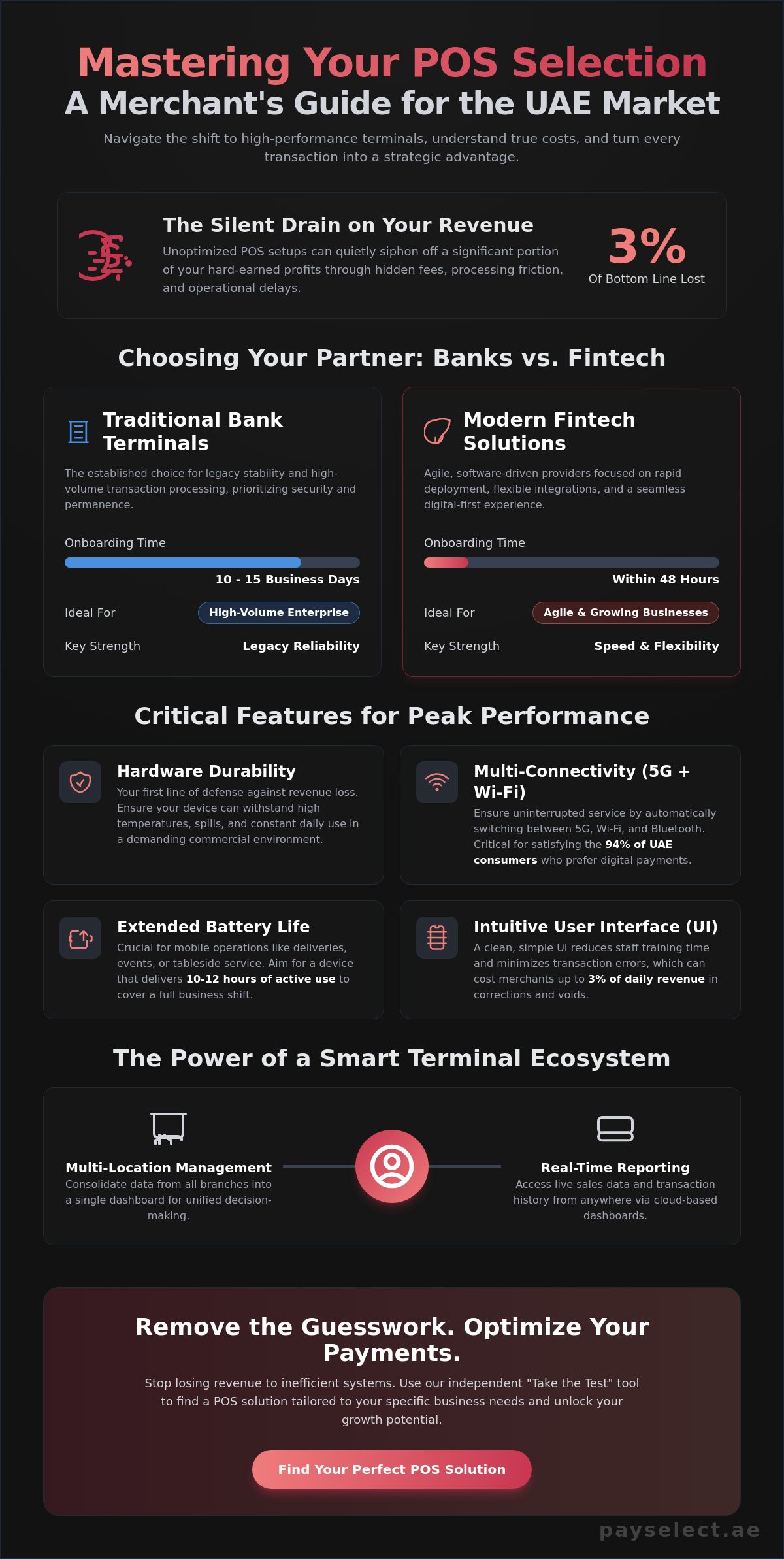
How much of your daily revenue is quietly disappearing into hidden processing fees and opaque settlement structures? Most merchants accept these costs as an unavoidable burden, yet 2024 industry data suggests that an unoptimized pos machine uae setup can drain up to 3% of a company's bottom line through friction alone. You've likely felt the frustration of complex setup processes and settlement delays that stall your momentum. It's time to regain control over your margins.
This guide empowers you to master the evolving financial landscape and select a payment solution that optimizes your costs, streamlines your operations, and scales your business. We've built this resource to bridge the gap between complex global infrastructure and your daily operational needs. You'll learn how to demand fee transparency, accelerate your settlement cycles, and implement a seamless payment strategy that turns every transaction into a strategic advantage. We'll explore the critical differences between providers and the specific steps required to build a borderless, high-performance checkout experience for 2026.
Key Takeaways
• Navigate the shift from basic card swipers to high-performance Android terminals designed to streamline your checkout experience and scale operations.
• Prioritize hardware durability and multi-connectivity—including 5G and Wi-Fi—to ensure your pos machine uae provides uninterrupted service during peak demand.
• Break down complex fee structures and monthly rentals in AED to accurately forecast your total cost of ownership and protect your profit margins.
• Match payment technology to your specific business model to eliminate technical friction, reduce overhead, and optimize every customer interaction.
• Leverage PaySelect’s independent "Take the Test" tool to remove the guesswork and find a tailored solution that empowers your business growth.
Understanding the Modern POS Ecosystem in the UAE
The UAE digital economy moves at a relentless pace. A pos machine uae serves as the vital link between your storefront, your customer's wallet, and the banking network. It's the foundation of modern commerce. Merchants have moved away from basic card swipers toward sophisticated Android-powered smart terminals. This transition is fueled by the Central Bank of the UAE's push for a cashless society, where security standards and national compliance are non-negotiable. Understanding What is a Point of Sale (POS) System? helps clarify that this technology manages the critical moment of exchange. High-performance payment acceptance isn't just a utility; it's a strategic tool that empowers businesses to scale without friction.
The current market shift reflects a demand for speed and security. In 2023, digital payment volumes in the Emirates saw a 20% increase, signaling a permanent change in consumer behavior. Modern terminals now handle contactless payments, mobile wallets, and QR codes instantly. This evolution ensures that businesses stay compliant with local regulations while providing the seamless experience customers expect in a high-end market like Dubai or Abu Dhabi.
Traditional Bank Terminals vs. Fintech Solutions
Traditional financial institutions remain the backbone for high-volume enterprise stability. They provide a sense of permanence, though their onboarding can be slow, often taking 10 to 15 business days for full approval. Fintech solutions offer a faster alternative for more agile businesses. They reduce the administrative burden with digital-first documentation and can often achieve setup within 48 hours. While established banks offer deep roots and massive transaction capacity, fintech providers prioritize flexible software integrations and rapid deployment. Your choice depends on whether your priority is legacy reliability or the ability to launch and iterate quickly.
The Role of Smart Terminals in Business Intelligence
Smart terminals act as the brain of your daily operations. The move toward "all-in-one" pos machine uae hardware has turned the payment device into a mini-computer. These units handle thermal printing, barcode scanning, and payment processing simultaneously. They offer several key advantages for growing brands:
Real-time Reporting
Access sales data and transaction history through cloud-based dashboards from any location.
Inventory Syncing
Track stock levels automatically as sales occur to prevent shortages.
Multi-location Management
Consolidate data from several branches into a single source of truth for better decision-making.
By 2026, the standard for a pos machine uae will include full integration between payment hardware and back-office software. This level of intelligence turns a simple transaction into a data point for expansion. It removes the barriers to growth by automating the most tedious parts of retail and hospitality management.
Critical Features to Prioritize in Your POS Selection
Selecting a pos machine uae requires looking beyond the physical device. You need a tool that thrives in your specific operational environment. A high-traffic boutique in Dubai Mall has different needs than a logistics company managing last-mile deliveries. Hardware durability is your first line of defense. Devices must withstand high temperatures, occasional spills, and constant handling. If your hardware fails, your revenue stream stops instantly.
Uninterrupted service depends on multi-connectivity. Your terminal should switch between 5G, Wi-Fi, and Bluetooth without dropping the transaction. This redundancy is vital for the 94% of UAE consumers who now prefer digital payments. Reliability here supports the broader UAE Economic Overview, where digital transformation remains a pillar of commercial growth. Battery life is equally critical for mobile or curbside scenarios. Aim for a device that delivers at least 10 to 12 hours of active use to cover a full shift without a recharge.
Simplicity in the user interface (UI) directly impacts your bottom line. Complex menus lead to long queues and frustrated staff. A clean, intuitive UI reduces training time from days to minutes. This minimizes transaction errors that can cost merchants up to 3% of daily revenue in manual corrections and voids. You can explore modern, user-centric pos machines to see how streamlined design improves speed.
Contactless and NFC Payment Standards
Supporting Apple Pay, Google Pay, and Samsung Pay is no longer an upgrade; it's a baseline requirement in the Emirates. Consumers expect a "Tap to Pay" experience that takes less than three seconds. This technology relies on tokenization, which replaces sensitive card data with unique digital identifiers. It's a high-security standard that protects both the merchant and the customer from data breaches. Faster checkouts during peak hours mean higher turnover and better customer retention.
Software Flexibility and Third-Party Integrations
Your POS software must talk to the rest of your business. Manual data entry is a significant pain point for many UAE business owners during setup. Look for systems that sync directly with accounting platforms or ERP systems to automate your reconciliation. Open APIs empower you to build custom workflows that fit your unique business model. Features like "Pay by Link" generated directly from the terminal allow you to collect deposits or handle phone orders with ease. This level of integration transforms a simple payment tool into a strategic asset for scaling your operations.
Analyzing the Total Cost of POS Ownership
Fee structures for a pos machine uae often feel like a maze for local entrepreneurs. The primary hurdle isn't just the sticker price but the layers of recurring costs that follow. You'll generally face a choice between purchasing hardware outright or committing to monthly rentals. While buying a terminal upfront requires more capital, it eliminates the monthly tech tax that eats into your margins over time. Rentals offer lower entry costs but can become more expensive over a three-year business cycle.
Many providers lure merchants with zero setup offers that seem attractive on paper. These deals usually hide higher transaction margins that cost you more as your business scales. Merchant Discount Rate (MDR) is the percentage fee charged on every card transaction.
Transaction Fees and MDR Structures
Pricing models typically split into flat-rate or tiered structures. Flat rates offer simplicity, while tiered models charge different amounts for debit cards versus premium credit cards. Smart merchants focus on three key variables: pricing structure, negotiation leverage, and international surcharges. As your business grows, your leverage increases. High-volume merchants can often negotiate lower rates by demonstrating a consistent transaction history and reliable settlement patterns.
International fees and Dynamic Currency Conversion (DCC) also impact your bottom line. With the rapid growth of the UAE E-commerce Market, accepting diverse payment methods is essential for any retail footprint. International cards often carry a 1% to 2% surcharge above standard local rates. Choosing a provider that handles these cross-border complexities ensures you don't lose profit on every tourist purchase or international corporate card swipe.
Hidden Operational and Settlement Costs
Beyond the transaction, look for the fine print fees that can drain your accounts. Some providers charge for technical support visits or impose heavy penalties for early contract termination. You should also evaluate settlement cycles carefully. Most providers in the Emirates offer T+1 or T+2 settlements, meaning your money arrives one or two days after the sale. Delayed settlements can stifle your cash flow and limit your ability to restock inventory or pay staff on time.
Transparent reporting is the only way to avoid statement shock at the end of the month. You need a digital dashboard that breaks down every fee in real-time rather than waiting for a confusing monthly PDF. This level of optimization allows you to streamline your accounting and focus on expanding your reach. For more details on hardware options and pricing transparency, explore our guide on pos machines to find the right fit for your business model.
Matching POS Solutions to Your Specific Business Model
Selecting a generic system often leads to technical friction and wasted capital. Every industry in the Emirates operates on its own logic. A high-volume supermarket in Dubai requires millisecond processing speeds to prevent queue abandonment. Conversely, a luxury boutique focuses on the aesthetic of the device and personalized clienteling. A one-size-fits-all approach ignores these nuances, often forcing businesses to pay for features they never use or, worse, missing the tools they need to scale.
Retailers processing over 500 transactions daily need hardware that is rugged and responsive. For hospitality venues, the requirements shift toward specific workflows like split-billing, tip adjustment, and real-time table mapping. If you are managing a national fleet, visibility is your primary concern. You need a system that allows you to monitor terminal health and push software updates to a pos machine uae in Abu Dhabi and Sharjah simultaneously from a single central office. This level of control reduces downtime and ensures compliance across all Emirates.
POS for Service-Based and Professional Organizations
Consultants and field service providers benefit from portable terminals equipped with 4G connectivity. These devices eliminate the need for bulky hardware and allow for payments at the client's location. SoftPOS technology is disrupting the market by transforming any NFC-enabled smartphone into a secure payment reader. This lowers the entry barrier for SMEs and independent professionals. Integrating these terminals with digital booking systems ensures that deposits paid during an appointment are automatically reconciled with the final settlement, reducing manual data entry by up to 30%.
Omnichannel Readiness: Bridging Online and In-Store
Modern consumers expect a unified experience where the digital and physical worlds meet. A customer might browse a product online and choose to pay in-person. Connecting your physical terminals with online payment gateways creates a single source of truth for your business. This centralized data allows you to build loyalty programs that reward users regardless of where they shop. A single dashboard provides a bird's-eye view of your entire cash flow, which streamlines reconciliation and simplifies financial planning for the 2026 fiscal year.
Managing multiple payment streams shouldn't be a hurdle. PaySelect helps businesses overcome the pain point of fragmented reporting by consolidating all transaction data into one intuitive interface. This allows you to focus on growth rather than chasing spreadsheets.
Optimizing Your Selection Process with PaySelect
Selecting the right pos machine uae solution is a strategic decision that impacts your bottom line every single day. PaySelect serves as the independent bridge between your business and the complex world of payment providers. We don't sell hardware. We provide clarity. Our "Take the Test" tool eliminates the guesswork that often leads to overpaying for features you don't need. By analyzing your specific transaction patterns, we help you build a payment stack that is both resilient and cost-effective for the 2026 market.
How Independent Comparison Protects Your Margins
Traditional bank relationships can sometimes limit your perspective on the market. PaySelect maintains strict independence, meaning we don't favor any specific provider over another. Our goal is your margin protection. Using our POS machine selection tool is significantly faster than managing individual inquiries with multiple financial institutions. Most merchants spend over 15 hours researching providers manually. We reduce that time to minutes.
We specialize in identifying the fine print that business owners often overlook. This includes hidden service fees or non-standard interchange rates that can erode profits by 0.5% or more per transaction. For a business processing 500,000 AED monthly, that's a potential loss of 2,500 AED every month. We bring these costs into the light. This allows you to choose a partner based on transparency rather than marketing promises.
Next Steps: From Comparison to Implementation
The UAE market moves fast. What worked for your business last year might be outdated by 2026. Optimization is a continuous cycle, not a static setup. Start by conducting a thorough payment audit to pinpoint where your current system fails. Are your settlement times too slow? Are you losing sales due to terminal downtime? These are common pain points that indicate it's time for a change.
Once you identify these inefficiencies, our platform delivers tailored recommendations. We guide you through the transition from your legacy setup to a high-performance infrastructure. This move ensures your business remains competitive and ready to scale across the region. Optimize your payment infrastructure with PaySelect today to take full control of your financial future and streamline your operations.
Future-Proof Your UAE Payment Strategy
The UAE payment landscape is moving toward total integration and borderless efficiency. To thrive in 2026, you must prioritize a solution that aligns with your specific industry volume while minimizing hidden fees that erode your margins. Selecting the right pos machine uae provider is no longer a utility decision; it's a strategic move to accelerate your growth and streamline every customer interaction.
PaySelect removes the complexity of this transition by offering an independent and unbiased comparison of all major providers in the Emirates. We provide specialized advisory for enterprise-scale payment optimization and use data-driven matching to ensure your hardware fits your exact business model. Our process eliminates the friction of manual research, letting you focus on scaling your operations with absolute confidence.
Find the perfect POS machine for your business
Your business deserves a payment partner as ambitious as your vision.
Frequently Asked Questions
How much does a POS machine cost in the UAE?
A POS machine in the UAE typically costs between AED 500 and AED 2,500 for the initial hardware setup. You'll also encounter transaction fees that generally range from 1.5% to 3.0% depending on your business volume and card types. Monthly maintenance or software subscription fees often average around AED 150 per terminal according to standard 2024 market rates.
Can I use a POS machine without a local bank account?
You can't operate a pos machine uae without a local corporate bank account because Central Bank regulations require funds to settle within the country. All merchant service providers must link your terminal to a UAE-registered account to ensure compliance with anti-money laundering laws. This structure guarantees that your settlements arrive securely, usually within 24 to 48 hours of your daily batch closure.
What is the difference between a traditional POS and a Smart POS?
A traditional POS serves as a dedicated terminal for card swipes and chip inserts, while a Smart POS runs on an Android-based operating system. Smart devices empower your business by integrating inventory management, VAT reporting, and digital receipts directly on the screen. While traditional units are reliable for basic transactions, Smart POS systems streamline operations by connecting your physical sales data with cloud-based analytics.
How long does it take to get a POS machine approved and installed?
The approval and installation process for a pos machine uae usually takes 3 to 7 business days from the moment you submit your documents. Some providers offer an accelerated path, completing the digital verification and physical delivery within 48 hours for standard retail categories. Your timeline depends on the accuracy of your paperwork and the specific risk profile of your business industry.
Are there hidden fees associated with POS machines in the UAE?
Commonly overlooked costs include PCI-DSS compliance fees, monthly minimum volume charges, and terminal replacement insurance. You might face a penalty fee if your monthly transaction volume stays below a threshold like AED 10,000. PaySelect removes these friction points by providing transparent fee schedules, helping you avoid the unexpected costs that often stall business growth.
What documents are required to apply for a merchant account and POS?
You must provide a valid UAE trade license, a Memorandum of Association (MOA), and the Emirates ID or passport copies of all owners. Most providers also require the last three months of your corporate bank statements to verify business activity. Having these documents ready in high-resolution digital formats ensures a seamless application process and faster terminal deployment.
Can my POS machine handle international credit cards and currency conversion?
Most modern terminals in the UAE support international cards and offer Dynamic Currency Conversion (DCC) for global travelers. This feature allows customers to pay in their home currency while your business receives the exact amount in AED. It's a vital tool for the 20 million international visitors the UAE hosts annually, as it provides clarity at checkout and reduces chargeback risks.
Is it possible to integrate my POS machine with my existing e-commerce website?
You can integrate your physical POS with an online store using unified commerce APIs that synchronize your stock and sales data. This integration ensures that when a product sells in your shop, your website inventory updates instantly to prevent overselling. PaySelect specializes in removing these technical barriers, allowing you to scale your business across both physical and digital borders effortlessly.
Disclaimer
This content is for informational purposes only and should not be considered financial, legal, or regulatory advice. Payment provider availability, pricing, and approval processes vary depending on individual business circumstances. PaySelect does not guarantee provider acceptance or specific outcomes. Businesses should conduct their own due diligence before entering into any agreements.
Empowering businesses to achieve greater growth