
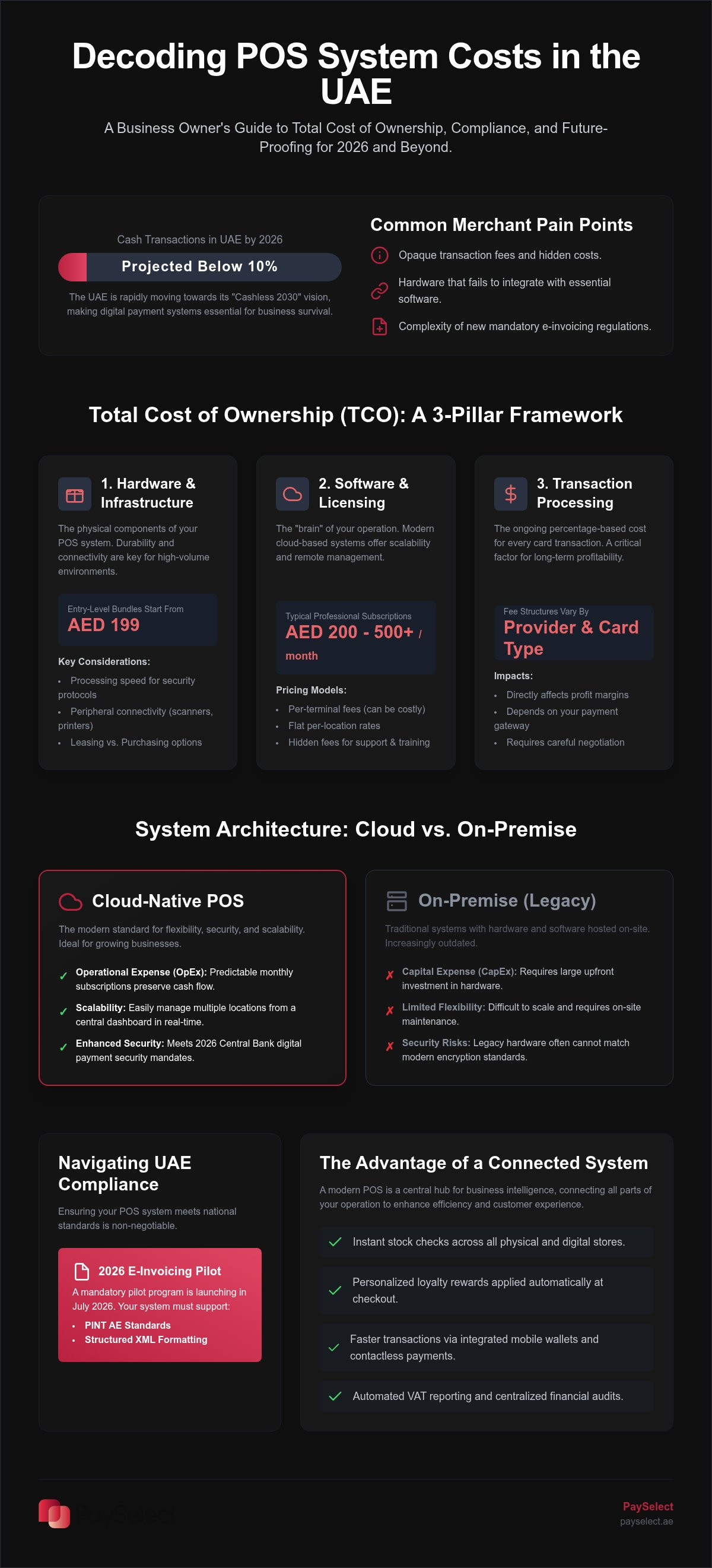
With cash transactions in the UAE projected to drop below 10% by the end of 2026, your point-of-sale is no longer a peripheral tool; it's the heartbeat of your digital commerce. Many merchants find themselves trapped by opaque transaction structures, hardware that won't integrate, and the looming complexity of mandatory e-invoicing. Mastering the total pos system cost uae requires looking beyond the initial sticker price to find a solution that offers fluidity, connectivity, and performance.
You probably feel the weight of shifting regulations and the frustration of incompatible payment gateways. This guide provides a professional framework designed for cost optimization and absolute regulatory compliance. We'll break down the layers of hardware costs starting from AED 199, professional software subscriptions, and the specific PINT AE e-invoicing standards required by UAE authorities. This checklist provides a transparent roadmap to ensure your infrastructure is ready for the July 2026 pilot and beyond.
Key Takeaways
• Master the Total Cost of Ownership (TCO) by identifying hidden fees in hardware implementation, software subscriptions, and ongoing technical support.
• Ensure seamless regulatory compliance with the 2026 mandatory e-invoicing pilot by selecting systems that support structured XML and PINT AE standards.
• Evaluate the pos system cost uae through a lens of fluidity, balancing initial setup expenses against long-term transaction fee structures.
• Conduct a comprehensive audit of your current payment infrastructure to eliminate operational barriers and ensure compatibility with preferred payment gateways.
• Utilize independent comparison tools and the "Take the Test" diagnostic to match your specific industry requirements with the most efficient provider.
The Evolution of POS Systems in the UAE Marketplace
The UAE's retail and hospitality sectors are undergoing a radical shift as the nation marches toward its "Cashless 2030" vision. Digital payments are no longer a convenience; they're a requirement for survival. Understanding what a point of sale (POS) system is in the context of 2026 requires looking beyond the receipt printer. Today, a POS functions as a centralized hub for business intelligence, connecting your physical storefront to your digital inventory, accounting, and customer loyalty programs. Traditional legacy systems were often isolated boxes that required expensive on-site maintenance. Modern merchants have abandoned these for cloud-native ecosystems that offer total fluidity. This transition has changed the way businesses calculate their pos system cost uae. Instead of one-time hardware purchases, the focus is now on software connectivity and the ability to scale across borders. For firms expanding into the wider MENA region, a POS must integrate seamlessly with cross-border payments to ensure operational barriers don't hinder growth.Cloud vs. On-Premise: Operational Flexibility
The debate between cloud and on-premise solutions is over. Cloud-native architectures provide the scalability needed for multi-unit operations, allowing a business owner to monitor multiple operating units across the nation in real time. Security is the primary driver for this shift. Modern cloud systems are built to meet the 2026 Central Bank of the UAE digital payment security mandates, offering encryption that legacy hardware simply can't match. From a financial perspective, this moves the pos system cost uae from a heavy capital expenditure (CapEx) model to a predictable subscription-based model. This preservation of cash flow is vital for SMEs looking to remain agile in a fast-moving digital landscape.Data Centralization as a Growth Catalyst
Connectivity is the ultimate competitive advantage. When your POS system talks to your inventory management and supply chain tools, you eliminate manual errors and stockouts. This centralized reporting is also essential for institutional financial audits and the upcoming mandatory e-invoicing pilot. A connected system improves more than just the back office. It enhances the customer experience by facilitating:• Instant stock checks across all physical and digital locations.
• Personalized loyalty rewards applied automatically at the point of transaction.
• Faster checkout speeds through integrated mobile wallets and contactless options.
Decoding POS System Cost: A TCO Framework
Evaluating the pos system cost uae requires a shift from viewing it as a one-time purchase to a continuous operational expense. Merchants often fall into the trap of choosing the lowest entry price. They later discover that legacy hardware or restricted software tiers create bottlenecks. A true Total Cost of Ownership (TCO) framework accounts for three pillars: hardware, software licensing, and transaction processing. Auditing these layers together ensures your system remains a catalyst for growth rather than a drain on your margins.
The relationship between software tiers and operational features is direct. Lower tiers might handle basic billing, but they often lack the connectivity required for automated VAT reporting or multi-branch inventory sync. Identifying hidden fees early is essential. Implementation, staff training, and ongoing technical support can add thousands to your annual budget if not negotiated upfront. To find the right balance, you can use a POS system selection tool to audit your specific business needs.
Hardware and Peripheral Infrastructure
Durability is non-negotiable in high-volume UAE retail and hospitality environments. While entry-level bundles for POS machines can start from as low as AED 199, these often lack the processing speed for complex 2026 security protocols. Peripheral connectivity adds another cost layer. Scanners, thermal printers, and mobile terminals must communicate without friction to maintain speed of service. From a CFO perspective, leasing hardware preserves liquidity, while purchasing offers long-term depreciation benefits. Your choice should align with your expansion velocity and cash flow strategy.
Software Licensing and Subscription Models
Professional software subscriptions in the UAE typically range from AED 200 to over AED 500 per month. Pricing structures vary significantly between providers. Some favor per-terminal fees, which can become expensive for large showrooms, while others offer flat per-location rates. Premium integrations for loyalty programs, CRM, and advanced analytics might seem like an added expense, but their ROI is realized through higher customer retention. Automated inventory management features are particularly valuable; they remove operational barriers and reduce the labor costs associated with manual stock checks.
Transaction fees remain the most significant recurring pos system cost uae merchants must manage. Standard fees for local cards usually fall between 2.4% and 2.9% plus a fixed fee of 1 AED. International transactions can reach 3.9%. Beyond these, be vigilant about chargeback fees, which generally fall between AED 75 and AED 150 per dispute. You can simplify this complexity by running a payment pricing comparison to see how different fee structures impact your specific transaction volume.
Navigating UAE Regulatory and Compliance Standards
Compliance in the UAE is no longer a static checklist; it is a dynamic requirement for operational fluidity. As the nation accelerates its digital transformation, merchants must ensure their infrastructure aligns with the stringent mandates set by the Central Bank of the UAE and the Federal Tax Authority (FTA). Failing to account for these standards doesn't just invite penalties; it creates operational barriers that can stall your expansion. When calculating your pos system cost uae, the investment in a fully compliant system must be viewed as a strategic safeguard for your business reputation.
The 2026 fintech landscape requires absolute adherence to the Payment Card Industry Data Security Standard (PCI DSS). This certification is the global benchmark for protecting cardholder data and is a non-negotiable requirement for any merchant processing digital payments. Beyond security, you must consider the Personal Data Protection Law (PDPL). This regulation includes strict restrictions on the transfer of personal data outside the UAE, making data residency a critical factor in your selection process. Ensuring your provider stores data locally or within approved jurisdictions is essential for long-term legal resilience.
VAT Automation and Financial Transparency
The manual era of tax reporting is ending. A pilot program for mandatory e-invoicing begins on July 1, 2026, signaling a major shift for UAE businesses. Large enterprises with revenue exceeding AED 50 million must go live by January 1, 2027, while SMEs have until July 1, 2027, to comply. Your POS software must generate structured XML invoices in the PINT AE standard to meet these requirements. Traditional PDFs or scanned documents will no longer be accepted by authorities.
Automating these processes delivers three core benefits:
• Eliminates manual entry errors that trigger FTA audits.
• Ensures real-time tax calculation for every transaction.
• Simplifies end-of-year reporting for national SMEs and large firms alike.
By integrating these features, you remove the administrative weight of tax compliance and focus on performance enhancement.Security Protocols and Fraud Prevention
Security is the foundation of consumer trust. Modern POS systems must implement end-to-end encryption for every transaction to protect against sophisticated cyber threats. With the establishment of the Federal Authority for Artificial Intelligence and Data in June 2026, enforcement of data privacy is expected to intensify. Breaches can result in penalties reaching up to AED 5,000,000 per violation, making the pos system cost uae of a secure system far lower than the price of a data leak.
To fortify your defenses, prioritize systems that offer biometric or two-factor authentication for staff access. These protocols ensure that sensitive financial data remains accessible only to authorized personnel. High-end systems act as a bridge between complex security infrastructure and the intuitive needs of your team, allowing for fast, secure checkouts that don't compromise on safety. This commitment to security protects your bottom line and projects an image of a deeply reliable institutional partner.
A Professional Strategy for Selection and Cost Optimization
Selecting a POS system is a strategic exercise in financial engineering. It requires a move away from impulsive hardware purchases toward a structured audit of your entire payment ecosystem. To minimize the pos system cost uae, you must evaluate how every component interacts with your bottom line. Following a professional framework ensures you don't just buy a tool; you build an infrastructure designed for performance enhancement. This process transforms technical utility into a strategic tool for business transformation.
Success begins with a rigorous five-step methodology:
Step 1
Conduct a comprehensive audit of your current payment infrastructure to identify existing bottlenecks and redundant fees.
Step 2
Define industry-specific requirements, such as sophisticated table management for hospitality or multi-channel inventory synchronization for high-end retail.
Step 3
Analyze the interplay between your POS software and payment gateways to ensure frictionless data flow and avoid compatibility issues.
Step 4
Evaluate scalability for future GCC and international expansion to avoid costly system migrations as you enter new markets.
Step 5
Use independent comparison tools to identify the most efficient provider based on your specific transaction profile and volume.
Identifying and Reducing Operational Barriers
Operational barriers often hide in the fine print of "locked-in" contracts. These rigid agreements hinder business agility, making it difficult to switch providers as your volume grows or as newer, faster technologies emerge. Processing speeds also play a vital role in your success. Slow checkout times decrease turnover and negatively impact customer satisfaction, creating an invisible cost that erodes your margins. Payment cost optimization is the strategic reduction of avoidable transaction overhead. By identifying these inefficiencies early, you can redirect capital toward growth initiatives rather than administrative waste. Removing these barriers ensures your business remains as dynamic as the digital landscape it operates in.
Negotiating Terms with Service Providers
Merchant discount rates (MDR) are the primary lever in managing your ongoing pos system cost uae. While standard rates are common for entry-level merchants, they are rarely set in stone for established or high-volume businesses. Use your historical transaction data to secure more favorable processing terms during the negotiation phase. If you operate both physical storefronts and e-commerce platforms, push for unified pricing across all channels. This creates a smooth transition for your accounting team and provides a clearer view of your total margins. Leveraging your volume is the most effective way to inspire confidence in your financial partners and lower your long-term overhead. To begin identifying these savings, you can use a POS system selection tool to audit your current provider's efficiency.
How PaySelect Simplifies the POS Selection Landscape
The fintech market in the UAE is crowded with vendors who prioritize their own inventory over your operational needs. Unlike traditional distributors who push specific hardware brands, PaySelect operates as an independent digital platform. We act as a bridge between complex global infrastructures and the intuitive needs of modern entrepreneurs. This neutrality ensures that your search for the ideal pos system cost uae is guided by data, not sales quotas. We don't process payments; we empower you to choose the provider that does it best for your specific model.
Our "Take the Test" tool serves as the essential first step in this selection process. By analyzing your specific transaction volume and industry niche, it matches your business with providers that offer the best technical fit. For enterprise organizations and large-scale hotel groups, we provide bespoke advisory services that go beyond simple comparisons. We focus on infrastructure audits and cost optimization to ensure every dirham spent contributes to your performance enhancement. This structural clarity ensures that even the most complex technical solutions are presented as simple and ready for implementation.
Expansion is a core objective for many UAE businesses. PaySelect bridges the gap between your local point-of-sale setup and cross-border payment solutions. This synergy allows you to manage international commerce with the same fluidity you expect from your local storefront. By removing operational barriers, we help you scale with absolute confidence. Mastering the pos system cost uae means looking at the total ecosystem, from the terminal on your counter to the digital gateway that processes global sales.
Transparency in a Complex Fintech Market
Fee structures in the MENA payments space are notoriously opaque. PaySelect provides the structural clarity you need to decode these costs. We break down initial vs. recurring fees and highlight how different technical capabilities impact your long-term overhead. A neutral facilitator is vital in a landscape where hidden transaction fees can quickly erode margins. Our platform ensures your POS system is a catalyst for growth, not a technical bottleneck that limits your potential. We provide the calm assurance you need to navigate a fast-moving digital landscape.
Next Steps for UAE Merchants
The road to a more efficient payment ecosystem starts with a clear understanding of your current status. You can begin a comprehensive payment infrastructure audit with our experts today. This process gives you access to transparent data that drives informed procurement decisions. Don't let complex tech dictate your business outcomes; take control of your financial future through our independent platform. It's time to transform your technical utility into a strategic tool for business transformation.
Optimize your payment infrastructure with PaySelect’s selection tool today.
Future-Proof Your Payment Infrastructure
The UAE's transition toward a cashless economy and the 2026 e-invoicing mandates make your choice of point-of-sale system a critical strategic decision. Optimizing the pos system cost uae requires more than just comparing hardware prices; it demands a deep audit of transaction fluidity and regulatory resilience. By prioritizing systems that offer automated VAT reporting and seamless gateway integration, you remove operational barriers and position your business for international expansion.
PaySelect acts as your rock-solid institutional partner in this fast-moving digital landscape. We provide independent advisory for enterprise organizations and specialized cost-optimization audits designed to protect your margins. Our experts offer deep guidance on the MENA payment landscape to ensure your infrastructure is built for long-term performance enhancement. Don't let technical complexity hinder your ambition or slow your speed to market.
Find the ideal POS provider for your business and start building a more efficient, compliant, and scalable operation today. Your growth journey deserves a foundation of absolute confidence and technical excellence.
Frequently Asked Questions
What is the average cost of POS software in the UAE for 2026?
Professional software subscriptions typically range from AED 200 to over AED 500 per month. This pos system cost uae depends on whether you choose per-terminal or per-location pricing models. High-end tiers often include advanced features like automated inventory management and CRM integrations that drive long-term ROI. Selecting the right tier ensures your software remains a catalyst for growth rather than a technical bottleneck.
Does my POS system need to be approved by the Federal Tax Authority (FTA)?
Your POS system must comply with FTA e-invoicing standards, specifically the PINT AE format. Starting July 1, 2026, a pilot program makes structured XML invoices mandatory for selected firms. Large businesses must go live by January 1, 2027, followed by SMEs in July 2027. Ensuring your software supports these specific digital formats is essential to avoid penalties and remain compliant with UAE authorities.
Can I use any POS software with my existing UAE bank account?
Most modern POS systems are designed to be gateway-agnostic, but you must verify compatibility with your specific acquiring bank. Integration fluidity is essential to avoid manual reconciliation errors. Using an independent comparison tool helps you identify which software provides the most reliable connectivity with your current financial infrastructure. This prevents compatibility issues that can create operational barriers during high-volume periods.
What is the difference between a POS system and a payment gateway?
A POS system is your central business hub that manages sales, inventory, and staff, while a payment gateway is the secure bridge that authorizes transactions between your business and the bank. The pos system cost uae usually includes the software license, but transaction fees are determined by the gateway provider you choose to integrate. Both must work in harmony to ensure a seamless customer experience.
Is cloud-based POS software secure enough for enterprise retail in the UAE?
Cloud-based solutions are the industry standard for security, provided they maintain PCI DSS certification. These systems utilize end-to-end encryption and meet the 2026 Central Bank of the UAE digital payment security mandates. Cloud architectures often provide superior data protection compared to legacy on-premise hardware due to real-time security patches and redundant backups. This projects an image of a brand that is both high-end and deeply reliable.
How long does it typically take to implement a new POS system nationally?
Implementation timelines vary from a few days for single-site SMEs to several months for large-scale enterprise groups with complex multi-unit requirements. Factors affecting speed include hardware procurement, staff training, and the migration of existing inventory data. A structured audit of your current payment infrastructure helps streamline this transition and reduces operational downtime. Planning ahead ensures a smooth transition that values your team's time.
Can POS software manage cross-border payments for GCC expansion?
Many professional POS systems support cross-border payment matching through integrated gateways that handle multiple currencies and regional regulations. This capability is vital for businesses looking to expand into Saudi Arabia, Qatar, or other GCC markets. Selecting a system with international connectivity removes operational barriers and ensures a smooth transition as you scale. This focus on expansion is a strategic tool for business transformation.
What happens to my cloud-based POS if the internet connection fails?
Leading cloud-native POS systems feature an offline mode that allows you to continue processing transactions and printing receipts without an active connection. Data is stored locally on the hardware and automatically syncs with the cloud once the connection is restored. This ensures your service remains frictionless and prevents lost sales during temporary network outages. It provides the calm assurance needed to operate in a fast-moving digital landscape.
Disclaimer
This content is for informational purposes only and should not be considered financial, legal, or regulatory advice. Payment provider availability, pricing, and approval processes vary depending on individual business circumstances. PaySelect does not guarantee provider acceptance or specific outcomes. Businesses should conduct their own due diligence before entering into any agreements.
Empowering businesses to achieve greater growth