POS System Pricing in the UAE: The 2026 Merchant’s Guide to Costs and Integration

Could an unoptimized checkout setup cost your business AED 50,000 in regulatory fines? In the fast-moving UAE market, the sticker price of a terminal is rarely the final figure. Many merchants struggle with unpredictable transaction fees and the manual headache of reconciling sales data with bank deposits while researching pos system pricing uae. It's frustrating when technology creates operational barriers instead of removing them.
This guide simplifies the complexity of hardware, software, and integration fees. You'll discover how to transition to high-performance systems that handle real-time inventory and 5% VAT compliance automatically. We'll explore the total cost of ownership, comparing monthly subscriptions starting from AED 49 against one-time EPOS investments of AED 3,499. You'll gain a clear roadmap to a frictionless payment infrastructure that satisfies both your customers and the Federal Tax Authority. We'll break down essential hardware costs and 2026 e-invoicing standards, showing you how independent comparison tools can accelerate your decision making and ensure your business remains ready for expansion.
Key Takeaways
• Master the three-pillar cost structure of hardware, software, and transaction fees to gain a complete view of pos system pricing uae for 2026.
• Learn how to balance monthly cloud-based subscriptions against one-time hardware investments to maximize your long-term ROI and operational efficiency.
• Ensure seamless compliance with FTA regulations by identifying systems that automate 5% VAT calculations and meet mandatory e-invoicing standards.
• Apply a professional 5-step framework to calculate your Total Cost of Ownership, accounting for future transaction volumes and multi-branch expansion.
• Discover how independent comparison tools and infrastructure audits remove operational barriers to help you select a neutral, high-performance payment stack.
Understanding the Multi-Layered Structure of POS System Pricing in the UAE
Selecting the right infrastructure for your business starts with a clear view of pos system pricing uae. In 2026, the UAE's digital economy has matured, moving beyond basic transaction tools toward integrated business hubs. A modern Point of Sale (POS) system is now a strategic asset that balances upfront investment with long-term operational costs. This shift reflects a market that demands speed, transparency, and absolute reliability.
The pricing landscape is built on three distinct pillars. Hardware includes the physical touchscreens, receipt printers, and barcode scanners. Software subscriptions provide the cloud-based logic that manages your sales and inventory. Finally, transaction processing fees are the variable costs associated with every payment. National merchants are increasingly favoring "As-a-Service" pricing models. This transition replaces heavy Capital Expenditure (CapEx) with predictable Operational Expenditure (OpEx). It's a move that prioritizes business agility and cash flow over the ownership of depreciating physical assets.
Operational Efficiency and Financial Fluidity
Integrated pricing models are designed to solve the "double-entry" problem that often plagues accounting departments. When your POS machines are fully synced with your back-end systems, every transaction is recorded instantly. This creates a state of financial fluidity where manual errors are virtually eliminated. Real-time synchronization between physical storefronts and digital inventory platforms ensures your stock levels are always accurate across all channels. This level of connectivity doesn't just help the back office; it transforms the customer experience. Faster checkouts and support for diverse payment methods ensure that your point of sale is a driver of growth rather than a bottleneck.
Identifying Hidden Costs in the National Landscape
Operating with data silos is a significant risk for businesses looking to scale within the UAE. Hidden costs often emerge from non-integrated payment terminals that require manual reconciliation with bank statements. This fragmentation leads to "leakage," where small discrepancies in transaction costs accumulate into substantial losses over time. If your finance team is stuck reconciling data manually, you're paying a high price in lost productivity. A connected system removes these operational barriers by providing a single source of truth. By auditing your payment stack and eliminating these silos, you ensure that every dirham is accounted for. This transparency is essential for making informed decisions and maintaining a competitive edge in a fast-moving economy.
Decoding Software Subscriptions and Hardware Investment Costs
Understanding the split between software and hardware is vital for accurate budget forecasting. When analyzing pos system pricing uae, businesses often choose between cloud-based agility and one-time ownership models. Cloud software typically ranges from AED 49 for micro-businesses to AED 499 per month for enterprise-level features. These subscriptions ensure you always have the latest security patches and feature updates without needing manual intervention. Conversely, a one-time payment for an EPOS package, often around AED 3,499, eliminates recurring software fees but requires a higher upfront capital commitment.
Hardware essentials vary by the scale and nature of your operations. Every piece of equipment must comply with national standards, including NFC for contactless payments and Chip & Pin for secure transactions. High-performance setups usually include a combination of the following:
Mobile Tablets
Ideal for boutique environments or floor-side service to reduce queue times.
Industrial Terminals
Heavy-duty touchscreens designed for the rigors of high-traffic retail and supermarkets.
Peripherals
Standard components such as barcode scanners (AED 250 to AED 450) and thermal receipt printers (AED 350 to AED 800).
Cash Drawers
Secure storage units typically priced between AED 150 and AED 300.
Software Capabilities and Feature Alignment
Software must align with your specific industry to provide real value. Retailers need robust SKU management and automated stock alerts, while hospitality providers require split-billing and table-mapping modules. Given the UAE's role as a global tourism hub, multi-currency support is a non-negotiable feature for capturing international sales. Since the country employs a diverse, global workforce, a multilingual user interface is essential. It reduces the learning curve for staff and prevents costly entry mistakes during busy shifts.
The Payment Gateway Bridge
The software doesn't work in isolation. It relies on APIs to communicate with financial tools, translating sales data into secure transaction requests. This bridge is critical for maintaining data encryption and protecting customer information. Adhering to UAE Fintech Laws and Regulations ensures your setup remains compliant with national oversight and security standards. Finding a gateway that integrates seamlessly with your chosen software is a key step in selecting the right payment gateways. If you're looking for a neutral perspective on your infrastructure, you can compare POS options to find a tailored fit for your business needs.
The Impact of Integration on Transaction Fees and Regulatory Compliance
Integration is far more than a technical convenience; it's a strategic financial decision. When evaluating pos system pricing uae, the depth of your system's integration directly influences your Merchant Discount Rate (MDR). Unoptimized setups often lead to higher transaction fees because they lack the smart routing capabilities found in modern, connected infrastructure. By streamlining the path from the physical terminal to the bank, integrated systems reduce the risk of reconciliation errors and lower the overall cost of processing each dirham.
Regulatory compliance in 2026 is a critical driver for POS selection. The Federal Tax Authority (FTA) mandates that all invoices meet strict digital standards, including the generation of specific XML files for e-invoicing. Non-compliance isn't just an operational risk; it carries heavy financial consequences, with fines ranging from AED 5,000 to AED 50,000 per violation. Additionally, the Central Bank of the UAE (CBUAE) emphasizes real-time processing and data sovereignty. To remain compliant with national consumer protection laws, customer-facing displays must also support the Arabic language, ensuring transparency for the entire national population.
VAT Reporting and Financial Transparency
Automating the 5% VAT calculation at the point of sale is the only way to ensure absolute accuracy in a high-volume environment. Manual tax entry is a magnet for errors that complicate your quarterly filings. An integrated system generates audit-ready reports that satisfy national regulatory bodies instantly. For SMEs, this automation simplifies the tax filing process, transforming a complex administrative burden into a routine background task. This transparency ensures that your financial records are always ready for inspection, providing peace of mind for your finance team.
Connectivity and Uptime in National Infrastructure
Maintaining a 99.9% uptime is essential for protecting your revenue stream. Enterprise-level organizations often prioritize local data hosting to align with national security and performance standards. A sophisticated payment stack utilizes redundancy strategies, allowing the system to switch between different gateways if one encounters a delay. This fluidity ensures that your checkout process never stalls. Even during temporary internet outages, your hardware should offer offline functionality. This allows you to continue serving customers without interruption, syncing all transaction data once the connection is restored. This resilience is a hallmark of a high-end, reliable payment partner.
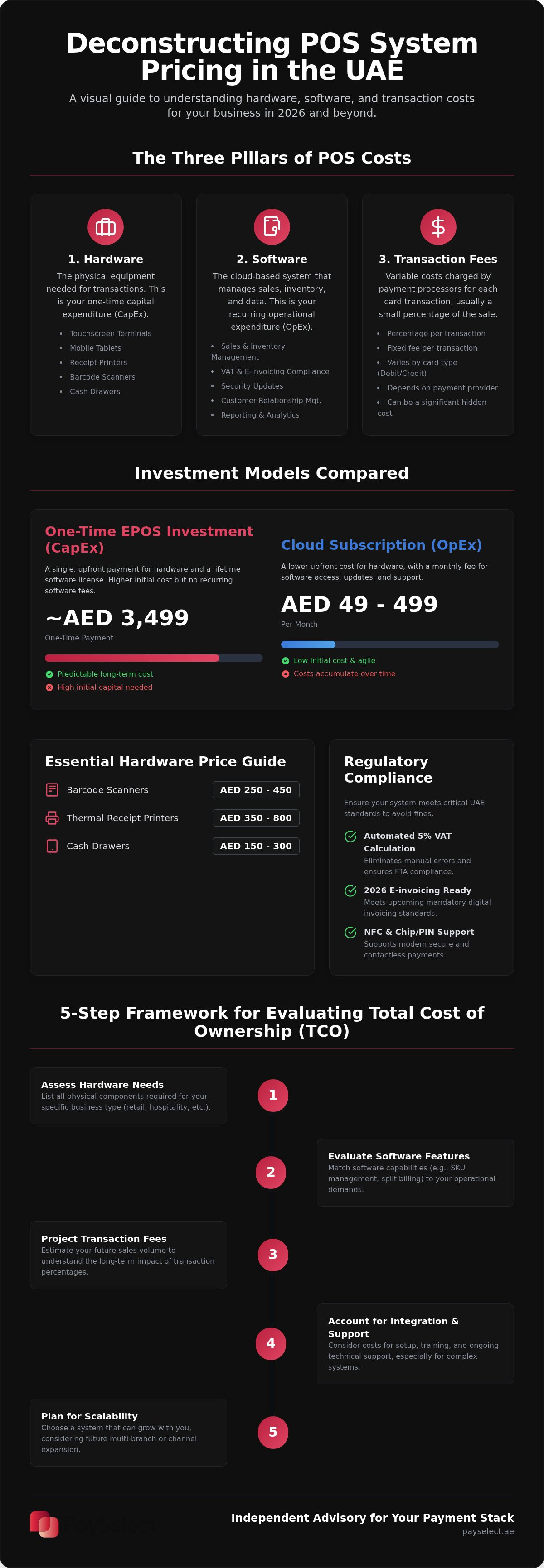
A 5-Step Framework for Evaluating Total Cost of Ownership (TCO)
Calculating the true cost of your infrastructure requires looking far beyond the initial purchase price. In a market as competitive as the UAE, a narrow focus on the sticker price often leads to unexpected operational expenses later. To gain full control over your pos system pricing uae, you must apply a structured evaluation framework that accounts for every dirham spent over a three-year cycle. This approach ensures your technology remains a facilitator of growth rather than a drain on your margins.
Step 1: Audit Transaction Volume
Analyze your current monthly volume and project your growth for the next 36 months. A system that's cost-effective at AED 50,000 in monthly sales might become prohibitively expensive as you scale toward AED 500,000.
Step 2: Define Non-Negotiable Features
Identify industry-specific requirements, such as real-time inventory for retail or table management for hospitality. Avoid paying for bloatware that doesn't serve your core business.
Step 3: Calculate the "All-In" Cost
Include one-time onboarding fees, which can reach AED 1,500, and on-site training sessions typically priced around AED 500. Don't forget recurring costs like e-invoicing subscriptions.
Step 4: Test Software-Gateway Synergy
Ensure your POS software communicates flawlessly with your payment gateway. Poor synergy leads to failed transactions and frustrated customers.
Step 5: Verify Local Support
Confirm the provider has a proven track record for national maintenance. Downtime in the UAE's high-speed economy is a cost you cannot afford to ignore.
Analyzing Transaction Margins
A low monthly subscription fee can be deceptive if it's paired with high per-transaction costs. You must evaluate the Merchant Discount Rate (MDR) alongside your software fees to find the most efficient balance. Hidden costs often lurk in mandatory software updates or hardware maintenance contracts. For example, replacing a barcode scanner can cost between AED 250 and AED 450, while a thermal printer might require an investment of up to AED 800. Understanding these POS machine options and infrastructure costs is essential for protecting your bottom line.
Scalability and Future-Proofing
Your integrated solution should handle multi-branch expansion across the UAE without requiring a complete system overhaul. Modern systems must also support emerging payment trends like Buy Now, Pay Later (BNPL) to meet evolving consumer expectations. Modular software allows you to add new capabilities as your business complexity grows, ensuring your initial investment remains relevant. This flexibility is a strategic advantage that removes operational barriers to expansion. To find the setup that best aligns with your expansion goals, take the PaySelect test today for a neutral evaluation of your payment infrastructure.
Optimizing Your Payment Stack with Independent Advisory
In a market saturated with competing claims, achieving total clarity on pos system pricing uae requires a neutral perspective. Most merchants are frequently approached by providers who prioritize their own ecosystem over the merchant's specific operational needs. This often leads to vendor lock-in, where a business is tied to a single suite of tools that may not offer the best value or performance. Independent advisory changes this dynamic by shifting the power back to the business owner, ensuring that every component of the payment stack is selected based on merit and ROI.
PaySelect acts as a bridge between complex global infrastructures and the intuitive needs of modern entrepreneurs. By utilizing the "Take the Test" tool, you can match your specific business profile against the entire national landscape of providers. This data-driven approach removes the guesswork from infrastructure selection, allowing you to identify a setup that eliminates operational barriers and facilitates rapid expansion. For enterprise-level organizations, bespoke infrastructure audits provide a deep dive into cost optimization, uncovering inefficiencies that often go unnoticed in high-volume environments.
The PaySelect Advantage: Independence and Transparency
Neutral guidance is the catalyst for superior long-term ROI. When you aren't tethered to a single provider, you gain the fluidity to pivot as new technologies and better rates emerge. This independence allows you to access a wider network of financial tools, ensuring your business stays at the cutting edge of the UAE's digital economy. Leveraging expert insights also provides a significant advantage during negotiations. Understanding the nuances of Merchant Discount Rates (MDR) across different providers enables you to secure more competitive terms, directly improving your transaction margins. This transparency ensures that your payment infrastructure is a strategic tool for transformation rather than just a recurring expense.
Next Steps for Your Business Infrastructure
The path to a high-performance payment setup begins with a baseline audit of your current transaction costs. You must identify exactly where your dirhams are going, from software subscriptions to hidden reconciliation fees. Once you have this baseline, use the PaySelect comparison tool to benchmark your current setup against the latest market offerings. This process often reveals immediate opportunities for system upgrades that enhance speed and security. As you look toward international growth, it's also vital to explore cross-border payment solutions that can expand your reach beyond national borders. Taking these steps ensures your business is not just compliant with 2026 regulations, but also positioned as a leader in a fast-moving global landscape.
Future-Proofing Your Business Infrastructure for 2026 and Beyond
Mastering your payment stack requires a strategic balance between upfront hardware investments and recurring software subscriptions. We've explored how seamless integration reduces transaction fees while ensuring absolute compliance with FTA regulations and national e-invoicing standards. By applying a structured framework to evaluate your total cost of ownership, you transform your technology from a simple utility into a catalyst for expansion. Navigating pos system pricing uae doesn't have to be a manual burden when you have access to a neutral, data-driven perspective.
PaySelect provides the independent and unbiased advisory needed to optimize your infrastructure without vendor bias. Our platform offers tailored matching for UAE merchants and expert payment infrastructure audits to ensure your setup is built for high-end performance. It's time to eliminate data silos and reclaim your margins through a more transparent financial ecosystem that values your time as much as your security.
Ready to streamline your operations? Compare the best POS and payment solutions for your business today and take the first step toward frictionless growth.
Frequently Asked Questions
What is the difference between a standalone POS and an integrated POS in the UAE?
A standalone POS operates independently from your payment terminal, requiring staff to manually enter the sale amount on the card machine. An integrated POS automates this process by linking your software directly to the payment hardware. This eliminates manual errors and speeds up the checkout process significantly. For businesses evaluating pos system pricing uae, integrated systems offer better long-term value by reducing reconciliation labor and improving data accuracy.
Are all POS systems in the UAE VAT-compliant by default?
Not every system is VAT-compliant out of the box. Merchants must verify that their chosen software automates the 5% VAT calculation and generates FTA-approved invoices. In 2026, compliance also requires the ability to produce e-invoice XML files in the PINT-AE standard. Using a non-compliant system can lead to substantial fines, so it's essential to confirm these features are built-in rather than assuming they are standard across all providers.
Can I use any payment gateway with my chosen POS software?
Compatibility depends entirely on the technical integration and APIs available between the software and the gateway. While many modern POS systems support a variety of payment partners, some are closed ecosystems that restrict your choices. Before committing to a specific pos system pricing uae plan, you should verify that your preferred gateway is supported. This flexibility allows you to negotiate better transaction rates and avoid being locked into a single financial provider.
How much does it typically cost to integrate POS software with a payment gateway?
Integration costs vary based on the complexity of your setup. Many cloud-based providers include basic integration as part of their monthly subscription, while others may charge a one-time onboarding fee of approximately AED 1,500. You should also account for potential on-site training sessions, which typically cost around AED 500. Understanding these all-in costs is vital for accurate budgeting and ensuring your infrastructure is optimized from the first day of operation.
Does my business need a local UAE bank account for POS integration?
Yes, a local UAE bank account is mandatory for receiving settlements from national payment providers. While the POS software itself might be international, the financial routing and transaction processing must comply with Central Bank of the UAE regulations. Having a local account ensures that your dirham deposits are processed efficiently and that your business remains compliant with national financial oversight. This local presence is also necessary for managing VAT and corporate tax obligations.
What happens to my integrated POS if the internet goes down?
High-quality integrated systems feature an offline mode that allows you to continue processing sales during a temporary internet outage. The transaction data is stored locally on the terminal and automatically synchronized with the cloud once the connection is restored. This resilience protects your revenue and ensures a consistent customer experience. You should confirm that your hardware supports this feature, as it prevents operational bottlenecks during unexpected connectivity issues that could stall your sales.
How long does the POS software integration process usually take?
The integration process typically takes between one to two weeks, depending on the complexity of your inventory and the number of branches. This timeframe includes hardware setup, software configuration, and staff training sessions. While some plug-and-play solutions are faster, enterprise-level infrastructure audits and bespoke configurations require more time to ensure everything is optimized. Planning for this transition period helps you avoid disruptions to your daily operations during the switch to a new system.
Is integrated POS software secure against data breaches?
Integrated POS systems are designed with high-level security protocols to protect sensitive transaction data. To ensure safety, you must choose providers that maintain PCI-DSS compliance and use advanced data encryption. These standards prevent unauthorized access to customer payment information and reduce the risk of data breaches. A secure system acts as a bridge between your business and the global economy, inspiring confidence in your customers while protecting your professional reputation and financial integrity.
Disclaimer
This content is for informational purposes only and should not be considered financial, legal, or regulatory advice. Payment provider availability, pricing, and approval processes vary depending on individual business circumstances. PaySelect does not guarantee provider acceptance or specific outcomes. Businesses should conduct their own due diligence before entering into any agreements.
Empowering businesses to achieve greater growth