Your POS system is quietly costing you more than you think. Most business owners searching for POS system providers in the UAE focus on the hardware price tag and miss the fees, integration headaches, and hidden merchant discount rates that erode their margins every single month.
You're right to feel frustrated. Comparing providers is genuinely difficult when pricing structures are opaque, technical jargon is everywhere, and a system that works beautifully for a café can completely fail a multi-branch retail operation. The market has matured fast, and in 2026, choosing a POS provider is less about picking a terminal and more about selecting a strategic data partner that fits your entire business infrastructure.
This guide cuts through that complexity. Using an independent, cost-optimization framework, you'll learn exactly how to evaluate UAE POS providers across the metrics that actually matter: transaction costs, hardware reliability, software integration, and consolidated reporting across every sales channel. By the end, you'll have a clear, structured method for making a confident decision without being steered by a provider's sales pitch.
Key Takeaways
• The leading POS system providers in the UAE have shifted from selling hardware to delivering cloud-based ecosystems — understanding this distinction is the foundation of a smarter selection decision.
• Hidden costs like Merchant Discount Rates, monthly licensing fees, and exit penalties can significantly erode your margins, and knowing where to look is half the battle.
• A high-performance POS system must be evaluated on hardware durability, software flexibility, and API compatibility — not just upfront price.
• An independent selection framework, built around SLA accountability and multi-location scalability, protects you from being steered by a provider's sales agenda.
• Tools like PaySelect's 'Take the Test' matching system can cut through the complexity and align your specific business profile with the right provider — faster and without bias.
The Evolving Landscape of POS System Providers in the UAE
A point of sale system used to mean one thing: a terminal that processed a card payment and printed a receipt. That definition is now outdated. The point of sale systems operating across UAE businesses in 2026 are integrated commercial ecosystems, combining payment processing, inventory management, customer data, and real-time analytics into a single operational layer. Choosing the right one is a fundamentally different decision than it was even three years ago.
The UAE has emerged as one of the most advanced cashless economies globally. The Central Bank of the UAE has played a direct role in accelerating this shift, establishing frameworks that govern digital payment security, data handling, and interoperability between financial institutions. These regulatory standards aren't just compliance checkboxes; they actively shape which POS system providers in the UAE can operate, how they must store transaction data, and the security protocols their hardware and software must meet.
This matters to you as a business owner because it narrows the field. Any provider operating outside these standards creates legal and financial exposure. Understanding the regulatory environment isn't optional; it's the first filter in any serious selection process.
Unified Commerce: The New Standard
The most significant shift in the market is the move toward unified commerce. Businesses no longer operate a physical store and an online store as separate entities. Customers expect a seamless experience across both, and your POS infrastructure needs to support that. This means real-time inventory synchronization across every sales channel, a consolidated customer profile that tracks purchases whether they happen in-store or online, and loyalty programs that function without friction regardless of where a transaction originates. Providers that still operate on siloed, standalone hardware simply can't deliver this.
Regulatory Compliance in the UAE Market
Local data residency requirements mean that financial transaction records must be stored within approved jurisdictions, a detail that directly affects which cloud-based providers are viable for your business. VAT integration is equally non-negotiable; your POS system must automate tax reporting in alignment with Federal Tax Authority standards, removing the risk of manual error. For contactless payments, the 2026 security protocols mandate EMV 3DS authentication and tokenization standards across all NFC-enabled terminals, ensuring every tap-to-pay transaction meets the Central Bank's current security requirements.
The bottom line is this: evaluating POS system providers in the UAE without understanding the regulatory and technological context means you're making a decision with incomplete information. The landscape has matured, and so must your selection criteria.
Essential Features of a High-Performance POS System
Once you understand the regulatory and market context, the next question becomes practical: what does a genuinely capable POS system actually need to do? The answer depends heavily on your business model, but there are non-negotiable performance standards that apply across every sector. Getting these right separates a system that supports your growth from one that quietly constrains it.
Hardware vs. Software: Finding the Balance
Ergonomics matter too, particularly in premium retail and hospitality settings where the terminal is part of the customer experience. A clunky, dated terminal communicates the wrong message at the point of purchase. The best pos system providers in the UAE now offer hardware that's both functionally robust and aesthetically considered.
That said, hardware is increasingly the less critical half of the equation. Software flexibility determines your ceiling.
An API-first architecture is the single most important software characteristic to evaluate. It means the system is built to connect with external platforms cleanly and reliably, rather than locking you into a closed ecosystem. Without it, every integration becomes a custom project with a cost attached. With it, your POS becomes a hub that talks to your other tools without friction.
Offline mode capability is equally critical and frequently overlooked during demos. Connectivity drops happen. A system that stops processing payments when your internet goes down isn't a reliable operational foundation. Look for local transaction queuing that syncs automatically when connectivity is restored.
Integration Ecosystems
A POS system that doesn't connect to your broader business infrastructure is just an expensive till. The integrations that deliver real operational value include:
Accounting software
Automated reconciliation eliminates manual data entry and reduces VAT reporting errors at source.
CRM platforms
Every transaction becomes a data point that builds a richer customer profile, enabling personalized engagement and targeted retention strategies.
Supply chain and inventory tools
Real-time stock depletion data fed directly into procurement workflows prevents both overstock and stockout scenarios.
Advanced reporting is where the real competitive advantage lives. Daily sales summaries are the baseline. Predictive analytics, identifying which product lines are trending before you run short, or flagging which customer segments are at risk of churning, is where a modern POS system earns its cost.
If you're unsure which integration capabilities your specific operation actually needs, exploring an independent POS comparison is a faster and more reliable starting point than relying on a single provider's feature checklist.
Evaluating POS Providers: An Independent Selection Framework
Most businesses make the same mistake: they evaluate a POS provider based on a sales demo and a brochure. The problem is that both are designed to impress, not to inform. A structured, independent framework cuts through the performance and gives you the information that actually protects your business long-term.
Start with the Service Level Agreement. A provider's SLA is the single most revealing document they'll give you, yet most buyers never read it carefully. What matters isn't the headline uptime figure; it's what happens when that uptime isn't met. Look for clearly defined response times for critical failures, compensation clauses for extended downtime, and escalation paths that don't dead-end at a generic support inbox. If a provider can't show you a clear SLA, treat that as a red flag, not a minor omission.
Scalability is the next pressure point. A system that works smoothly across one location can fracture quickly when you add a second or third. Multi-location businesses need centralized reporting, consistent pricing and promotions pushed across all branches simultaneously, and staff permissions that can be managed without touching each terminal individually. Ask providers directly: how does your system handle a ten-location rollout? The quality of that answer tells you more than any feature list.
Security patch frequency is another underrated evaluation criterion. Cyber threats evolve constantly, and a provider that releases infrequent or delayed updates is leaving your transaction data exposed. Ask for their patch release history and check how quickly they responded to past vulnerabilities. Reputation here is measurable, not just claimed.
This is precisely why independent comparison matters. When you evaluate pos system providers in the UAE through a provider's own sales channel, you're receiving a curated view. An independent platform gives you a consistent framework across all options without commercial bias steering the outcome.
Industry-Specific Requirements
Generic POS capabilities rarely survive contact with sector-specific operations. In hospitality, table management, kitchen display system integration, and split billing aren't nice-to-haves; they're operational necessities. A system that can't route orders to the right kitchen station or split a table's bill cleanly creates friction at the exact moment the customer experience matters most.
Retail operations demand a different kind of depth. Complex inventory matrices, covering multiple sizes, colors, and variants across several warehouses, require a system built for that granularity. A flat inventory structure breaks down fast in high-SKU environments.
In the service sector, appointment scheduling and staff performance tracking are the core operational layer. A POS system that doesn't connect booking data to revenue data leaves you managing two separate systems manually, which defeats the purpose entirely.
The Vendor Vetting Process
Before signing anything, ask these questions directly:
Who owns your data?
Some providers retain rights to your transaction data in their terms. That's a non-negotiable deal-breaker for most businesses.
How easy is migration?
If you want to switch providers in two years, what does that process actually look like? A provider confident in their product won't make exit difficult.
Can they show you references from businesses your size and sector?
Generic case studies aren't enough. You want to speak to an operator running a similar model.
Verifying a provider's track record with comparable businesses is one of the most reliable signals available. It's also one that most buyers skip in the rush to get a system live. Don't skip it.
For a structured, unbiased starting point, compare POS machines and providers through an independent platform rather than relying on any single vendor's self-assessment. That one shift in approach changes the quality of every decision that follows.
Hidden Costs and Payment Optimization Strategies
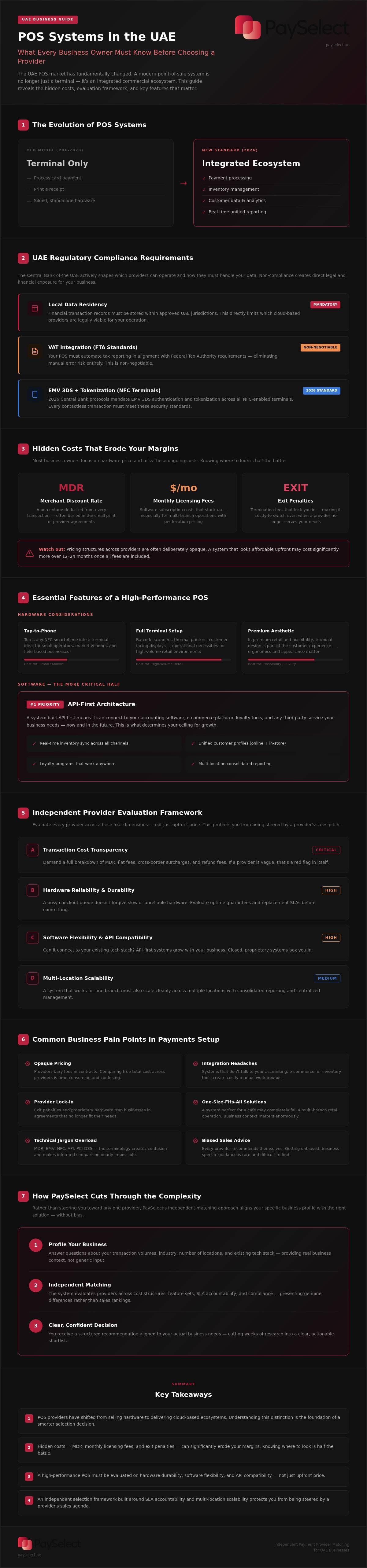
The price you see on a provider's proposal is rarely the price you pay. For most businesses evaluating pos system providers in the UAE, the headline cost covers hardware and basic setup. What it doesn't cover is the steady drain of fees that accumulate quietly every month, eroding margins that your sales figures never fully reveal.
Start with the Merchant Discount Rate. This is the percentage deducted from every card transaction before the funds reach your account. It's not a flat number. It shifts based on card type, transaction method, and the acquiring bank's risk assessment of your business category. A provider quoting you a single MDR figure is simplifying a structure that's rarely that clean in practice.
Beyond the MDR, the fees that catch most businesses off-guard include:
Monthly software licensing fees
that increase as you add users, locations, or feature tiers
Hardware maintenance charges
that aren't always bundled into the initial contract
PCI compliance fees
billed annually, sometimes without clear justification
Exit or termination penalties
that lock you into a provider long after the relationship stops working for your business
Exit fees deserve particular attention. They're often buried in contract appendices and only surface when you attempt to switch. A provider confident in their product shouldn't need contractual penalties to retain customers. If the exit clause is punishing, treat that as a signal about the relationship you're entering.
Understanding Transaction Fee Structures
Two pricing models dominate the market. Flat-rate pricing charges a fixed percentage on every transaction regardless of card type, which is predictable but often more expensive for businesses processing higher volumes. Interchange-plus pricing passes the actual interchange cost through to you with a fixed markup on top, which is more transparent and typically more competitive at scale. The gap between these models widens significantly as your monthly transaction volume grows.
Card origin matters too. Processing a locally issued card costs less than processing an international card, because international transactions carry higher interchange rates and additional cross-border fees. For businesses in tourism, hospitality, or e-commerce where international cards are common, this cost difference compounds fast. Micro-transaction fees compound this further in retail environments, where a fixed per-transaction charge on low-value purchases can consume a disproportionate share of the margin on each sale.
Cost Optimization Audits
A payment stack audit is worth running any time your transaction volume has grown significantly, when you've added a new sales channel, or when you're approaching a contract renewal. The audit maps every fee you're currently paying against what comparable providers charge, identifies redundant subscriptions running in parallel, and surfaces renegotiation opportunities your current provider won't volunteer.
Consolidating providers is one of the fastest ways to reduce costs. Many businesses accumulate separate contracts for in-store processing, online payments, and recurring billing that could sit under a single, better-negotiated agreement. Optimize your payment gateway costs by comparing your current structure against the market before your next renewal cycle, not after.
Transaction volume is your most underused negotiating lever. Providers compete for high-volume accounts and will adjust rates accordingly, but only if you ask with data behind the request. An independent audit gives you exactly that: a documented, evidence-based case for a better deal.
If you haven't reviewed your full payment cost structure in the past twelve months, the savings available are likely larger than you expect. An independent payment cost optimization audit is the fastest way to find out where your margins are leaking and what it takes to stop it.
Streamlining Your Search with PaySelect
Finding the right POS system shouldn't take weeks of back-and-forth with sales teams who have a vested interest in one outcome. PaySelect exists to remove that friction entirely. As an independent UAE-based comparison platform, it sits outside the provider ecosystem, which means the guidance you receive isn't shaped by commission structures or preferred partnerships.
That independence is the core advantage. When you're evaluating pos system providers in the UAE through a platform that doesn't sell processing services itself, the data you're working with is genuinely comparative rather than curated to favor a particular outcome.
The PaySelect Methodology
The 'Take the Test' matching tool is built around the variables that actually determine fit: your industry, transaction volume, number of locations, and the specific operational workflows your business runs on. It doesn't ask you to browse a generic product catalogue. It maps your inputs against the provider landscape and surfaces the options that align with your profile, cutting the selection timeline from weeks of research to a matter of minutes.
For SMEs, that speed matters. Owners running lean operations don't have time to read through ten provider contracts. For enterprise-scale businesses, particularly hotel groups managing complex, multi-property payment infrastructures, the methodology scales up accordingly. The matching logic accounts for the kind of layered requirements that a single-location café simply doesn't have: centralized reporting, multi-currency settlement, property management system integrations, and tiered staff access across dozens of terminals.
Transparency is built into the process. You see comparison data across providers on a consistent framework, not a curated shortlist assembled by a provider's marketing team.
Next Steps for Your Business
The fastest starting point is the digital tool itself. It requires no commitment and no sales conversation to get a matched result. If your situation is more complex, PaySelect's consulting service moves into bespoke territory: a payment infrastructure audit that maps your current cost structure, identifies where fees are leaking, and builds a case for renegotiation or consolidation backed by independent market data.
For businesses with regional ambitions, the picture extends beyond in-store processing. Explore cross-border payment solutions to understand how your payment infrastructure needs to evolve as you expand across borders, because the provider that works well for a single UAE location may not be equipped for the settlement complexity that comes with regional growth.
The right decision starts with the right information. Independent, structured, and built around your business, not a provider's sales target.
Make Your Next POS Decision Count
Choosing between pos system providers in the UAE is no longer a straightforward hardware decision. It's a strategic commitment that shapes your transaction costs, operational efficiency, and growth capacity for years ahead. The key is knowing what to look for: transparent fee structures, genuine integration capability, regulatory compliance, and a provider whose scalability matches your ambitions.
Most businesses overpay because they don't have independent data to negotiate with. That's the gap PaySelect closes. Trusted by UAE hospitality and retail sectors, the platform delivers unbiased guidance built around your specific business profile, not a provider's sales target. Expert-led cost optimization audits surface exactly where your margins are leaking, and the matching tool gets you to the right shortlist without weeks of research.
The right system is closer than you think. Take the test to find your perfect POS provider and get a matched result in minutes, backed by independent expertise that works entirely in your corner.
Frequently Asked Questions About POS System Providers in the UAE
What is the average cost of a POS system for a small business in the UAE?
POS system costs vary widely depending on whether you're buying hardware outright, leasing it, or opting for a software-only setup using existing devices. For a small business, you're typically looking at a combination of upfront hardware costs, monthly software licensing fees, and per-transaction charges. Rather than quoting a figure that may not reflect your specific setup, running an independent comparison against your actual transaction volume gives you a far more accurate cost picture than any provider's headline pricing.
Can I use my existing bank with a new POS provider?
Not always, and this is a detail worth clarifying before you commit. Some POS providers operate through specific acquiring banks, meaning your settlement account must be held with a partner institution. Others are bank-agnostic and will settle directly into your existing business account. Ask any provider upfront which banks they support for settlement, and factor in whether switching banks would create additional friction or fees for your business.
How long does it take to install and integrate a new POS system?
A straightforward single-location setup can be operational within a few days once hardware is delivered and software is configured. Multi-location rollouts or systems requiring deep integration with accounting platforms, inventory tools, or CRM software take considerably longer, often several weeks, depending on the complexity of your existing infrastructure. The integration timeline is one of the most underestimated variables in the selection process, so ask providers for a realistic project plan, not just a demo.
Is it better to buy or lease POS hardware in the UAE?
Buying outright gives you ownership and eliminates monthly hardware costs, but it ties you to a specific terminal generation and puts maintenance responsibility on you. Leasing keeps your upfront investment low and often includes hardware replacements and support, but the cumulative cost over a multi-year contract can exceed the purchase price. For businesses that expect to scale or upgrade frequently, leasing offers more flexibility. For stable, single-location operations, buying often delivers better long-term value.
Do POS systems in the UAE support multi-currency transactions for tourists?
Many POS system providers in the UAE offer dynamic currency conversion, which allows international cardholders to pay in their home currency at the point of sale. This is particularly relevant for hospitality and retail businesses with high tourist footfall. It's worth noting that multi-currency transactions typically carry higher processing fees than local card transactions, so understanding how those costs are structured is important before enabling the feature across your terminals.
What happens to my sales data if the POS provider goes offline?
A well-built POS system handles connectivity loss through offline mode, queuing transactions locally on the device and syncing automatically once the connection is restored. The critical question isn't whether offline mode exists, but how it works in practice: does it accept card payments offline, or only cash? How long can it queue transactions? What's the reconciliation process when it reconnects? These are questions to test during your demo, not discover during a live outage.
Are there specific POS providers that handle VAT reporting automatically?
VAT automation is a standard capability among established providers operating in the UAE, but the quality of implementation varies significantly. Some systems generate FTA-aligned reports automatically; others require manual configuration or a third-party accounting integration to produce compliant output. Before selecting a provider, verify that their VAT reporting aligns with current Federal Tax Authority requirements and ask to see a sample report rather than taking the feature description at face value.
How do I switch POS providers without losing my transaction history?
Data portability is a question you should ask before signing any contract, not when you're ready to leave. Reputable providers will export your transaction history in a standard format such as CSV or JSON, which can then be imported into your new system or accounting software. Some providers make this process straightforward; others create friction that effectively locks you in. Reviewing the data ownership and exit clauses in your contract is a non-negotiable step in any vendor vetting process.
Disclaimer
This content is for informational purposes only and should not be considered financial, legal, or regulatory advice. Payment provider availability, pricing, and approval processes vary depending on individual business circumstances. PaySelect does not guarantee provider acceptance or specific outcomes. Businesses should conduct their own due diligence before entering into any agreements.
Empowering businesses to achieve greater growth