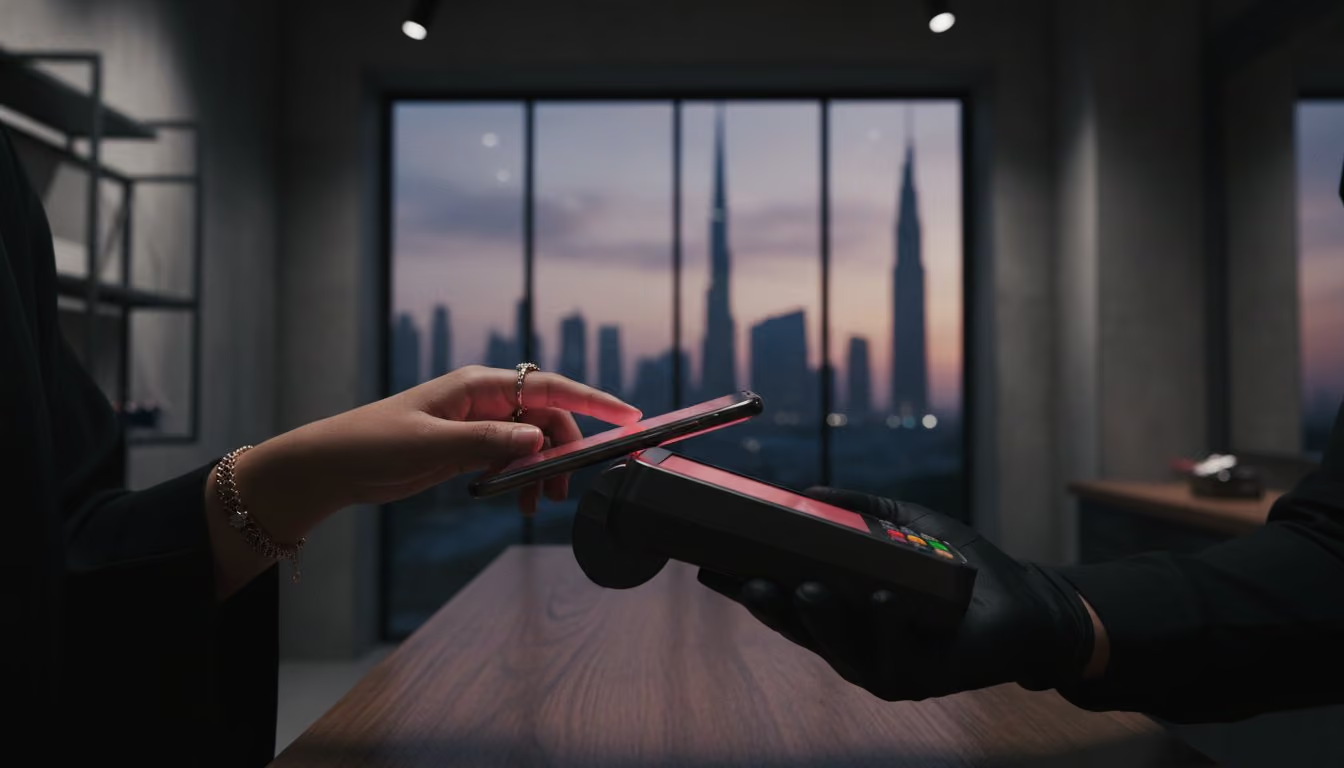
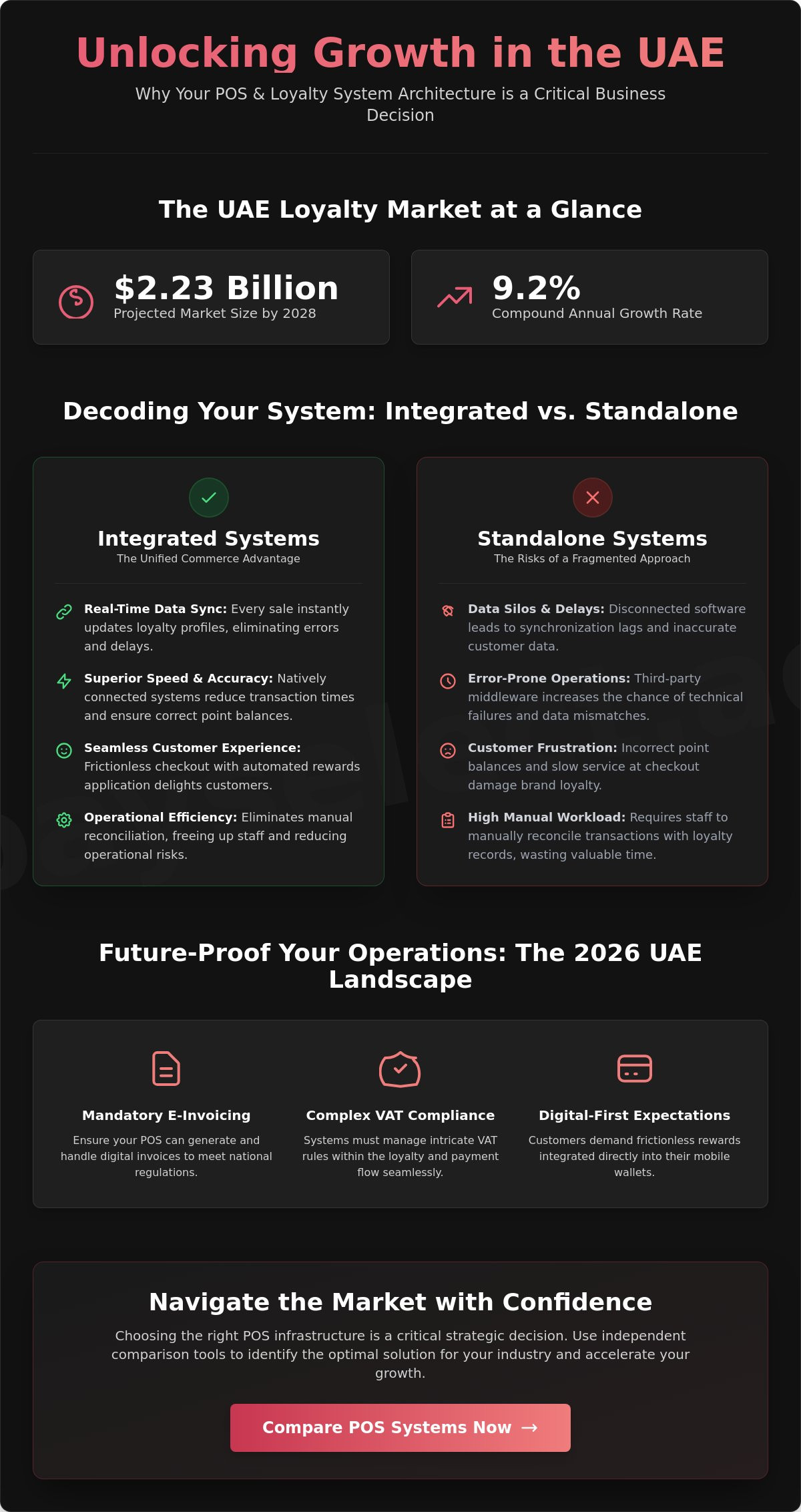
The loyalty market in the UAE is projected to reach US$2.23 billion by 2028, growing at a steady annual rate of 9.2%. In this fast-moving landscape, securing a high-performance POS system with customer loyalty program uae is no longer a luxury; it's a strategic data asset. You likely feel the sting of rising acquisition costs and the frustration of managing disconnected data across multiple store locations. It's exhausting to reconcile payments with rewards while trying to maintain a consistent brand experience for your customers.
This guide promises to simplify your transition to a unified commerce model. You'll discover how to select an integrated system that ensures a seamless checkout, automates customer rewards, and provides actionable insights into spending habits. We will also cover critical 2026 updates, including mandatory e-invoicing and the latest VAT regulations, to keep your operations compliant and fluid. We'll preview how comparing payment infrastructure and POS options can help you identify the most efficient tools to eliminate operational barriers and accelerate your growth.
Key Takeaways
• Learn why transitioning from fragmented software to an integrated POS system with customer loyalty program uae is essential for maintaining data accuracy and operational speed.
• Discover how to transform standard transactional data into a strategic asset that lowers acquisition costs and increases customer lifetime value.
• Identify the critical features required for a future-ready system, including automated profile management and seamless omnichannel reward synchronization.
• Gain a structured framework for auditing your current hardware and aligning your loyalty infrastructure with specific business retention goals.
• Understand how to leverage independent comparison tools to navigate the UAE market and identify the optimal POS infrastructure for your specific industry.
The Evolution of POS Systems with Customer Loyalty Programs in the UAE
The UAE retail and hospitality sectors have undergone a radical transformation over the last few years. Merchants no longer view their checkout hardware as a simple cash register. Instead, a modern POS system with customer loyalty program uae serves as a sophisticated command center. This ecosystem integrates payment processing with deep behavioral analytics, allowing national merchants to move beyond basic transactions toward long-term relationship management. By 2026, the shift from physical punch cards to digital-first loyalty is complete, driven by a consumer base that demands speed and personalization.
Transactional data acts as the engine for this evolution. Every tap, swipe, or mobile payment provides a window into customer preferences that was previously inaccessible to small and medium-sized enterprises. By capturing these details at the point of sale, businesses build a foundation for effective retention. It's about knowing exactly what a customer buys and how often they visit your store; for instance, a specialist retailer like McPet can use this data to ensure pet owners never run out of their preferred supplies. This intelligence allows merchants to shift away from expensive, broad-market advertising. Instead, they focus on nurturing existing relationships, which is a vital move as customer acquisition costs continue to rise across the Emirates. Investing in retention through your POS infrastructure is no longer an option; it's a requirement for staying competitive.
Beyond Points: Modern Loyalty Definitions
Loyalty models have matured far beyond simple "buy ten, get one free" schemes. While simple cashback remains popular, many brands now utilize tiered rewards to gamify the shopping experience. These tiers encourage higher spending by offering exclusive benefits to top-level members. Real-time data is the key to personalizing this journey. When a customer checks out, the system should immediately recognize their status and suggest relevant offers. POS Loyalty Integration is a unified data bridge that connects a customer’s payment identity directly to their unique reward profile in real-time. This ensures that customer loyalty programs are active participants in every sale, rather than an afterthought at the end of a transaction.
The UAE Market Landscape in 2026
Consumer expectations in 2026 are defined by digital fluidity. With contactless payments holding a massive share of the market, customers expect rewards to be just as frictionless as their payments. Physical cards are obsolete; digital-first solutions integrated into mobile wallets are the standard. National digital transformation initiatives, including the rollout of mandatory e-invoicing, are pushing merchants to adopt more advanced POS machines. These systems must handle complex VAT compliance while simultaneously processing local payment methods within the loyalty flow. This convergence of regulation and technology means that choosing the right infrastructure is a critical strategic decision for any growing business looking to scale efficiently.
Integrated vs. Standalone: Decoding POS Loyalty Architectures
Choosing between an integrated or standalone architecture is a pivot point for your business efficiency. Fragmented software stacks represent a significant operational risk. When your loyalty data lives in a separate silo from your transaction records, you face constant synchronization delays. These lags lead to inaccurate point balances and frustrated customers at the counter. A POS system with customer loyalty program uae that is natively integrated eliminates these barriers by ensuring that every dirham spent is instantly reflected in the user's reward profile. This connectivity is the hallmark of a high-performance retail operation.
Speed is a competitive advantage in the UAE's high-traffic malls and business hubs. Native loyalty modules offer superior data accuracy because they remove the need for third-party middleware. This setup reduces the technical "surface area" for potential errors. While custom-developed loyalty solutions might seem attractive for brand uniqueness, they often lead to ballooning maintenance costs. Most modern merchants find that a subscription-based, integrated model provides a more predictable return on investment. If you are uncertain which architecture suits your specific volume, you can compare POS machine capabilities to find a solution that aligns with your growth strategy.
The Native Integration Advantage
Native integration removes the friction of manual data entry during the checkout process. When the loyalty program is part of the core POS software, staff can identify customers via mobile number or digital QR code in seconds. This speed ensures that rewards don't slow down the queue. Furthermore, an integrated system allows for real-time inventory adjustment. If a customer redeems points for a specific product, your stock levels update automatically across all national branches. This level of fluidity is essential for maintaining a consistent brand experience as you scale from a single boutique to a multi-location enterprise.
When to Consider Standalone Solutions
Standalone solutions still have a place, particularly for businesses tied to legacy hardware that lacks modern loyalty features. In these cases, evaluating API connectivity is vital. You need to ensure the external software can "talk" to your existing payment terminal without causing transaction timeouts. Enterprise-scale firms with highly specialized niche requirements might choose standalone platforms for deeper customization. However, the trade-off is often a steeper learning curve and increased complexity. As experts suggest when customer loyalty program strategies are being developed, the best system is ultimately the one that provides the most frictionless experience for the end-user.
Essential Features of a High-Performance Loyalty POS
A high-performance POS system with customer loyalty program uae must do more than track points; it must act as a revenue engine. Manual registration is a relic of the past. Modern systems utilize automated customer profiling, capturing data via mobile numbers or digital wallets during the initial transaction. This creates a frictionless entry point for the consumer. Once registered, the system should support omnichannel capabilities, ensuring that a reward earned through an e-commerce storefront in Dubai is instantly redeemable at a physical branch in Abu Dhabi. This level of connectivity prevents fragmented brand experiences and builds genuine trust.
Data-driven merchants also require advanced reporting that goes beyond basic sales volume. Your POS should provide a clear ROI on specific promotional campaigns, allowing you to identify which rewards actually drive repeat visits. Combined with dynamic pricing and automated discount triggers, these features enable you to run sophisticated "happy hour" or "slow day" promotions without manual intervention. This automation ensures your staff focuses on service while the software manages the logic of complex tiered rewards. By streamlining these operations, you eliminate the friction that often kills the momentum of a successful loyalty initiative.
Data Security and Compliance
Operating a loyalty program in the Emirates requires strict adherence to Federal Decree-Law No. 45 of 2021 on the Protection of Personal Data. A high-end POS system must provide secure storage for transaction histories and personal identifiers. Transparency is vital. Your system needs built-in, clear opt-in and opt-out flows to remain compliant with Consumer Protection Regulations under Federal Law No. 15 of 2020. Since the 2026 VAT amendments require rigorous documentation for tax reclaims, your loyalty module must accurately record the monetary value of redeemed points to ensure your tax reporting remains audit-ready. To further secure this sensitive information, many merchants rely on OAD Technologies for advanced cybersecurity and data loss prevention.
Payment Gateway Synchronisation
The interaction between loyalty data and payment gateways is often overlooked, yet it's critical for checkout speed. During peak redemption periods, such as national holidays or shopping festivals, the communication between your POS and the gateway must be instantaneous. Any lag in verifying a loyalty balance can lead to abandoned carts or frustrated queues. Integrating these systems effectively often leads to a measurable increase in Average Transaction Value (ATV). When customers see their rewards applied in real-time, they're more likely to add premium items to their purchase. Understanding the technical nuances between different payment providers can help you choose a gateway that supports these high-speed, data-heavy loyalty flows without compromising security.
Strategic Implementation: Launching Your Loyalty Infrastructure
Implementing a POS system with customer loyalty program uae requires a structured, phased approach to ensure operational fluidity. It isn't just about plugging in new hardware; it's about aligning your technology with specific commercial objectives. A successful rollout bridges the gap between technical capability and customer experience. To achieve this, merchants should follow a clear five-step framework designed for the local market.
Step 1: Define clear business goals.
Determine if your primary objective is lowering acquisition costs through retention or using rewards as a hook for new customers.
Step 2: Audit existing hardware and connectivity.
Ensure your current internet infrastructure can handle real-time data pings. This is vital given the 2026 mandate for POS systems to generate structured digital invoices.
Step 3: Map the customer journey.
Identify every touchpoint from the initial signup at the counter to the moment a customer redeems a reward on their mobile device.
Step 4: Train staff on advocacy.
Your team must be experts in the program. If they don't understand the reward value, your customers won't either.
Step 5: Launch a pilot phase.
Test the system in one location or with a focused group of users to identify any friction points before a national rollout.
Designing Your Reward Structure
Establishing point values and redemption thresholds is a delicate balance. You must ensure the rewards are attainable enough to keep customers engaged but structured to protect your margins. Creating exclusive tiers for high-value national customers encourages brand advocacy among your most profitable segments. A frictionless signup process is essential to increase participation and ensure that rewards are captured at the point of first contact. This simplicity is what separates successful UAE retailers from those who struggle with low engagement rates.
Avoiding Common Implementation Pitfalls
Complexity is the primary reason loyalty programs fail. Overly complex reward rules confuse both staff and customers, leading to abandoned transactions and negative reviews. Hardware reliability is another critical factor, particularly during high-traffic shopping festivals when system downtime can result in significant revenue loss. In the UAE, your implementation must also account for the 2026 VAT amendments. Your system needs to accurately document the monetary value of redeemed points to comply with the five-year time limit for reclaiming excess refundable tax. Managing the transition from legacy systems without data loss is essential for maintaining both regulatory compliance and customer trust.
Navigating these technical and strategic choices is simpler when you have access to the right data. You can use PaySelect’s POS selection tool to compare infrastructure that supports these advanced loyalty frameworks while ensuring full compliance with UAE regulations.
Selecting the Right POS System with PaySelect
Choosing a POS system with customer loyalty program uae is a high-stakes decision that defines your operational efficiency for years. Most ranking pages are vendors selling one specific solution, often claiming their system is the only choice for your business. This lack of independent comparison creates a significant barrier for merchants who need objective data. PaySelect eliminates this confusion by acting as a sophisticated bridge between complex global infrastructures and your specific business needs. We provide an unbiased platform to evaluate different providers based on performance, connectivity, and support standards.
Identifying the optimal POS machines requires looking beyond the initial hardware price. Merchants must compare the total cost of ownership, which includes subscription fees, transaction percentages, and potential integration costs. Some providers favor a SaaS model with low upfront costs but higher monthly fees, while others offer lifetime licenses that require a larger initial investment. PaySelect helps you navigate these differences without favoring one provider over another. We deliver the structural clarity you need to ensure your technology stack remains manageable and ready for rapid implementation.
The PaySelect Matching Process
The "Take the Test" tool on our platform simplifies the vendor landscape by filtering options through your specific industry requirements. Whether you operate in high-traffic retail or specialized hospitality, your search is customized to find the loyalty features that matter most. You can access unbiased data on how different systems handle real-time rewards, automated profiling, and multi-location synchronization. This process removes operational barriers and allows you to select a partner that acts as a catalyst for your growth rather than a technical bottleneck.
Next Steps for Your Business
Optimizing your payment infrastructure is a strategic tool for business transformation. For enterprise-scale firms, requesting a payment infrastructure audit can uncover hidden inefficiencies and provide a clear path to cost optimization. If your ambition includes regional expansion, evaluating cross-border payments is essential to ensure your loyalty program remains fluid across international borders. We help you move from high-level value propositions to specific functional advantages in minutes. This logical flow ensures you value your time as much as your security.
Ready to upgrade your infrastructure? Find your perfect POS system with our comparison tool today.
Future-Proof Your UAE Merchant Operations
Integrating payments and rewards is the only way to maintain a competitive edge in the Emirates' evolving digital landscape. By consolidating your transactional data into a single POS system with customer loyalty program uae, you eliminate operational silos and ensure every sale fuels long-term growth. We've explored how native architectures and automated profiling protect your margins while providing the frictionless experience your customers expect. Aligning your technology with the latest VAT and e-invoicing regulations isn't just about compliance; it's about building a foundation for scalable success.
Navigating the diverse vendor landscape doesn't have to be a manual burden for your team. You can leverage our independent market comparison and payment industry expert advisory to identify the infrastructure that best suits your specific sector. Our comprehensive UAE provider database ensures you find a partner that offers the speed, security, and connectivity required for the 2026 economy. This strategic approach removes technical barriers and positions your brand as a leader in customer retention.
Match with the best POS system for your business and start optimizing your customer lifetime value today. Your business is ready for a more efficient, data-driven future.
Frequently Asked Questions
What is the average cost of a POS system with a loyalty program in the UAE?
Costs for a POS system with customer loyalty program uae typically follow a subscription or one-time license model. Monthly plans for premium systems including CRM and loyalty often start around AED 500; however, some providers offer a one-time lifetime license. You should evaluate the total cost of ownership, including hardware and software updates, to ensure the system remains a sustainable strategic asset for your business.
Can I integrate a loyalty program into my existing POS machine?
Integration is possible if your existing hardware supports modern API connectivity or third-party middleware. Native integration is generally superior for maintaining data accuracy and checkout speed. If your current system is a legacy model, you might face operational barriers that hinder real-time synchronization. Comparing different infrastructure options helps you decide if an upgrade is more cost-effective than a complex custom integration.
Are digital loyalty programs better than physical cards for UAE customers?
Digital loyalty programs are far more effective for UAE customers who prioritize speed and mobile connectivity. With contactless payments holding over 62% of the market share in 2025, physical cards are becoming obsolete. Digital systems integrated with mobile wallets offer a smoother user experience. This fluidity encourages higher participation rates and provides you with more actionable insights into customer spending habits.
How does a loyalty program affect my merchant transaction fees?
A loyalty program does not typically change your merchant transaction fees directly, but it significantly impacts your overall profitability. By driving repeat business, you lower your customer acquisition costs and increase the average transaction value. Some payment providers offer different pricing structures based on volume or industry. Comparing these providers allows you to optimize your payment infrastructure costs while running a high-performance rewards system.
What data regulations apply to customer loyalty programs in the UAE?
Businesses must comply with Federal Decree-Law No. 45 of 2021 on the Protection of Personal Data and Federal Law No. 15 of 2020 on Consumer Protection. You're required to obtain explicit consent before collecting customer data and must be transparent about how rewards are earned or redeemed. Additionally, 2026 VAT rules require precise documentation of the monetary value of redeemed points to ensure your tax reclaims remain compliant.
Do POS loyalty systems work for both online and in-store sales?
Modern cloud-based systems bridge the gap between online and in-store sales channels through a unified dashboard. This setup allows customers to earn points on your website and redeem them at any physical branch. This connectivity is a core feature of an omnichannel retail strategy. It ensures a consistent brand experience and provides a complete view of customer behavior across every touchpoint in your sales network.
How long does it take to set up a new POS loyalty system?
Setup time varies depending on the complexity of your requirements and the type of system you choose. Cloud-based SaaS models can often be implemented within a few days; however, enterprise-level systems with custom integrations may take several weeks. A structured implementation flow, including staff training and a pilot phase, ensures a smooth transition. Speed and operational efficiency are critical to minimizing downtime during the rollout.
Can I manage loyalty programs across multiple branches from one dashboard?
You can manage loyalty programs across multiple branches from a single, centralized dashboard using a cloud-based POS system with customer loyalty program uae. These systems offer remote access and automatic updates, allowing you to track spending habits and inventory levels in real-time across all locations. Centralized control removes operational barriers and makes it simple to launch national promotional campaigns. It ensures your loyalty strategy remains cohesive as your business expands.
Disclaimer
This content is for informational purposes only and should not be considered financial, legal, or regulatory advice. Payment provider availability, pricing, and approval processes vary depending on individual business circumstances. PaySelect does not guarantee provider acceptance or specific outcomes. Businesses should conduct their own due diligence before entering into any agreements.
Empowering businesses to achieve greater growth