
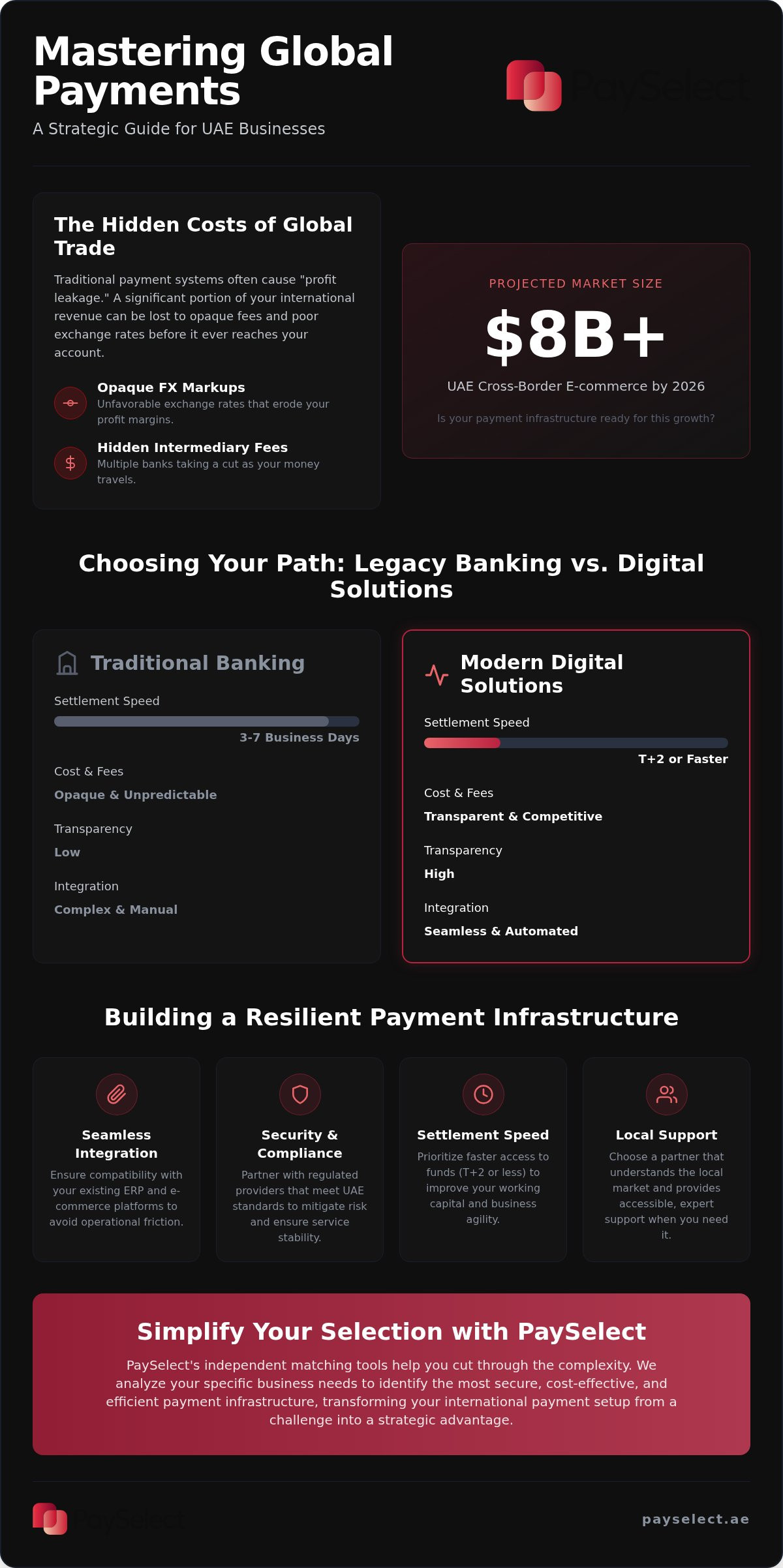
Why is your enterprise still losing a significant percentage of every global invoice to opaque exchange markups and hidden intermediary fees? In a market where cross-border e-commerce is projected to surpass $8 billion in 2026, relying on slow, legacy settlement systems is no longer a viable strategy for growth. You likely recognize that unpredictable payment timelines and complex compliance hurdles are more than just an inconvenience; they're direct threats to your business liquidity.
Finding the best way to receive international payments for business uae requires moving beyond traditional banking towards a more agile, transparent infrastructure. This guide provides the clarity you need to master global commerce by identifying methods that offer predictable settlement dates and seamless integration with your existing financial stack. We'll explore how to remove operational barriers, optimize your transaction costs, and leverage smart comparison tools to select the right partner. You'll learn how to transform your payment setup from a complex bottleneck into a streamlined engine for international expansion. By aligning your transaction volume with the right providers, you can ensure every dirham is accounted for without the stress of hidden costs.
Key Takeaways
• Protect your profit margins by identifying and eliminating "leakage" caused by hidden intermediary fees and opaque foreign exchange markups.
• Determine the best way to receive international payments for business uae by comparing real-time settlement speeds against traditional institutional bank cycles.
• Evaluate the strategic trade-offs between the established reliability of traditional banks and the technical efficiency of modern digital payment gateways.
• Reduce operational friction by implementing multi-currency solutions that streamline compliance documentation and mitigate the risks of exchange rate volatility.
• Leverage independent matching tools to quickly identify the most secure and cost-effective payment infrastructure tailored to your specific enterprise needs.
The Landscape of International Business Payments in the UAE
The UAE stands as a premier global trade hub, connecting eastern and western markets through a sophisticated financial ecosystem. As cross-border e-commerce transactions are projected to surpass $8 billion in 2026, the volume of international inflows continues to accelerate at a rapid pace. For many enterprises, identifying the best way to receive international payments for business uae is no longer just an operational task; it's a strategic necessity to maintain a competitive edge. Modern businesses require a payment landscape that supports high-value transactions with minimal friction and maximum security as they expand into new territories.
Traditional methods of handling these inflows often result in significant "leakage." This occurs when funds pass through multiple layers of the global financial system, with each touchpoint extracting a fee or applying a spread to the exchange rate. The Central Bank of the UAE maintains a robust regulatory framework to ensure stability, yet businesses frequently struggle with the opacity of legacy banking fees. The shift toward hybrid digital infrastructures is driven by a need for transparency and the ability to scale operations without being throttled by outdated settlement cycles. Choosing a solution that grows with your enterprise ensures you aren't forced to overhaul your financial stack every time you enter a new market.
Why Traditional Wire Transfers May Hinder Your Growth
While the SWIFT network has been the standard for decades, it often lacks the speed and transparency required by modern enterprises. Wire transfers rely on a chain of intermediary banks, each introducing potential delays and costs that erode the final transaction value. These "hidden" fees can make financial planning difficult and unpredictable. Additionally, settlement times that stretch between 3 to 7 days can severely impact your company's working capital. When funds are locked in transit, you lose the ability to reinvest in stock, pay vendors, or cover operational overheads, creating unnecessary friction in your daily growth trajectory.
The Rise of Digital Payment Gateways and Fintech Solutions
Modern fintech aggregators and cross-border specialists have redesigned the payment flow to bypass these traditional friction points. By utilizing cross-border payment solutions, businesses can access multi-currency accounts that allow them to receive funds like a local entity in global markets. This approach eliminates double currency conversion and accelerates settlement times significantly. For any business looking for the best way to receive international payments for business uae, transitioning to a digital-first infrastructure provides the fluidity needed to capture global opportunities. If you're unsure which setup fits your volume, PaySelect's matching tools provide an immediate way to audit your infrastructure and select a partner that removes operational barriers effectively.
Critical Evaluation Criteria for Global Payment Solutions
Selecting the right infrastructure for global inflows requires a move beyond surface-level fee comparisons. To find the best way to receive international payments for business uae, you must evaluate the "Total Cost of Acceptance." This figure includes not only the visible transaction fee but also the foreign exchange (FX) spread and any fixed monthly maintenance costs. A low headline rate can quickly become expensive if the provider applies a significant markup on currency conversion. Efficiency is found where transparent pricing meets operational speed.
Settlement cycles are equally critical for maintaining healthy liquidity. While traditional banking often operates on T+5 cycles, modern digital solutions frequently offer T+2 or even near real-time settlement. For a growing enterprise, the speed at which funds move from a client's account to your working capital can dictate your ability to respond to market opportunities. Technical compatibility also plays a major role; your chosen solution should integrate with your existing ERP or e-commerce platform without requiring extensive custom development. Finally, ensure your partner provides local support and maintains a solid regulatory standing within the national framework to avoid service disruptions.
Transparency in Foreign Exchange and Transaction Fees
Hidden markups are a common pain point in cross-border commerce. Many providers market "zero-fee" transfers while embedding their profit into a widened FX spread. To protect your margins, you must understand the difference between the mid-market rate—the "real" exchange rate seen on global markets—and the commercial rate offered to you. Identifying these discrepancies is the first step toward cost optimization. For those looking to dive deeper into these mechanics, you can learn more about optimizing cross-border payments to ensure your revenue isn't eroded by avoidable costs.
Security, Compliance, and Regulatory Frameworks
Security is the foundation of institutional trust. Any solution you implement must adhere to PCI-DSS compliance if you're accepting card payments. This ensures that sensitive financial data is handled according to rigorous international standards. The Central Bank of the UAE oversees the landscape to ensure stability and protect businesses from fraud. By September 16, 2026, fintech providers must meet updated regulatory requirements, making it essential to choose a partner that is already compliant. Independent verification of a provider's credentials serves as a critical trust builder, ensuring your funds remain secure throughout the transaction lifecycle. If you're feeling overwhelmed by these technicalities, you can compare compliant gateway options using independent matching tools to find a secure fit for your enterprise.
Traditional Banking vs. Digital Payment Gateways: A Strategic Comparison
Choosing between a traditional bank and a modern digital gateway isn't a zero-sum game. For many entrepreneurs, the best way to receive international payments for business uae involves a strategic hybrid approach that leverages the unique strengths of both infrastructures. While institutional banks offer rock-solid reliability and deep-rooted trust, digital gateways provide the technical agility required to operate in a fast-paced global economy. Understanding where these two paths diverge is essential for optimizing your cash flow and reducing operational friction.
The "Relationship Banking" model remains a cornerstone for organizations dealing with high-value, low-frequency transactions. In contrast, "Technical Efficiency" is the hallmark of digital tools, which prioritize automated workflows and rapid settlement. Your choice depends largely on your business model. A high-volume retail enterprise requires the frictionless checkout experience of a gateway, whereas a B2B consultancy might prioritize the institutional backing of a corporate bank account. By integrating both, you create a resilient financial stack that can handle diverse payment scenarios without compromising on security or speed.
When to Stick with Institutional UAE Banking
Traditional banking is often the superior choice for high-value, complex B2B contracts that require specialized services like trade finance or letters of credit. The presence of a dedicated account manager provides a human layer of support, which is invaluable when navigating complex regulatory queries or high-stakes transfers. For enterprise-level organizations, the perception of security associated with a nationally licensed bank can also act as a trust builder for international partners. If your business primarily handles large, infrequent inflows that require manual oversight and strict institutional documentation, the legacy banking system provides a stable foundation for these operations.
When to Transition to a Digital Payment Gateway
Digital gateways are designed for the modern era of high-frequency commerce, making them indispensable for SaaS models, e-commerce platforms, and digital agencies. These solutions excel at bypassing the slow settlement times associated with traditional wire transfers, often providing funds within days rather than weeks. Features such as automated invoicing and payment links allow you to collect receivables with a single click, significantly reducing the administrative burden on your finance team. To see how these tools align with your specific volume and goals, you can compare leading payment gateways for your business using independent data. This technical efficiency ensures that your global expansion isn't slowed down by manual processing or outdated settlement cycles, allowing for more predictable liquidity. Using a digital-first approach helps you capture international revenue with the same ease as a local transaction.
Overcoming Common Friction Points in Cross-Border Transactions
Friction in cross-border commerce often manifests as sudden account freezes or exhaustive documentation requests. These disruptions typically occur when a provider's risk engine flags high-value inflows without sufficient context. For an enterprise, this isn't just a minor delay; it's a freeze on working capital that can stall operations. Identifying the best way to receive international payments for business uae involves selecting a partner that balances rigorous compliance with an intuitive user experience. If your checkout process is too complex or lacks the preferred local payment options for your global clients, abandonment rates will climb, directly impacting your bottom line.
Reconciling these global inflows with local accounting software shouldn't require hours of manual data entry. The most efficient systems offer seamless connectivity between your payment gateway and your financial stack, providing real-time visibility into your liquidity. When your backend systems don't talk to each other, you risk errors in financial reporting and tax compliance. To find a solution that integrates perfectly with your current setup, you can match with the right cross-border solution here.
Streamlining Compliance and Documentation
KYC (Know Your Customer) data is the foundation of global trust. Modern platforms now automate much of this verification by pulling data from verified business registries, which significantly reduces settlement delays. Anti-Money Laundering (AML) checks in the UAE are mandatory regulatory procedures designed to prevent the movement of illicit funds through the national financial system. By preparing your documentation in advance and choosing a provider with automated compliance workflows, you ensure that your international revenue flows without interruption. This proactive approach prevents the "account freeze" cycle that often plagues businesses using legacy systems.
Managing Multi-Currency Volatility
FX volatility can erode profit margins faster than transaction fees. The ability to receive and hold funds in your client's native currency, such as USD, EUR, or GBP, is a strategic advantage. This allows for "natural hedging," where you use those same global funds to pay international vendors or expenses without ever converting them back to AED. It's a simple way to bypass exchange rate fluctuations entirely. Finding a provider that offers competitive FX spreads for your specific currency pairs is vital for long-term cost optimization. You don't need to be a currency trader to protect your revenue; you just need the right infrastructure that offers transparency in every conversion.
How PaySelect Simplifies Your International Payment Infrastructure
Identifying the best way to receive international payments for business uae doesn't have to be a trial-and-error process. PaySelect serves as an independent bridge between your enterprise and the complex landscape of global payment providers. We don't process your payments; instead, we provide the transparency you need to select the most efficient, cost-effective, and secure partners. By removing the guesswork from your financial stack, we empower you to focus on international expansion while we handle the technical comparison and cost optimization.
Our platform is built on the principle of absolute neutrality. We don't favor one provider over another; we simply provide the data you need to make an informed decision. This independence ensures that the insights you receive are based on your specific business requirements rather than a provider's marketing budget. Whether you're a high-volume retailer or a specialized B2B consultancy, our mission is to increase your operational fluidity and protect your profit margins from avoidable fee leakage.
The "Take the Test" Tool: Finding Your Perfect Match
Confused business owners often find immediate clarity through our "Take the Test" matching tool. This engine filters dozens of potential partners based on your industry, monthly transaction volume, and specific international needs. Instead of spending weeks researching different fee structures and settlement cycles, you receive a curated list of solutions that align with your goals. The benefit is clear: you see transparent, side-by-side data before you ever commit to a provider. This proactive approach ensures you find the best way to receive international payments for business uae without the risk of hidden markups or technical incompatibility.
Advisory Services for Enterprise Optimization
For organizations with complex payment stacks, a simple comparison tool might only be the first step. Our bespoke advisory services provide high-level consulting and payment infrastructure audits designed to uncover hidden costs in your current setup. We analyze your entire transaction lifecycle to identify where fees are eroding your value and where settlement speeds can be accelerated. These audits serve as a strategic tool for business transformation, turning a standard utility into a competitive advantage. If you're ready to move beyond legacy limitations, you can optimize your payment infrastructure with PaySelect today. Our experts act as your technical partners, ensuring your global commerce engine is lean, fast, and fully optimized for the modern economy.
Future-Proof Your Global Revenue Stream
The shift from legacy banking to high-performance digital infrastructure is now essential for enterprises looking to scale. You've seen how hidden markups and slow settlement cycles can erode your margins; you've also learned that a hybrid approach often provides the most resilient foundation. By prioritizing transparency in foreign exchange and automating your compliance workflows, you transform a technical utility into a strategic tool for business growth. Success in the 2026 landscape requires a proactive stance on security and a commitment to removing operational barriers.
Identifying the best way to receive international payments for business uae doesn't have to be a complex manual task. PaySelect provides an independent and unbiased digital platform to help you navigate these choices with absolute confidence. Whether you need a comprehensive comparison of gateways or a bespoke advisory audit for a large-scale organization, we're here to optimize your infrastructure. If you're ready to eliminate the friction in your financial stack, Take the Test to find your ideal international payment partner and start your journey toward seamless global expansion today.
Frequently Asked Questions
How long do international payments take to reach a UAE business bank account?
Settlement times vary significantly based on your chosen infrastructure. Traditional SWIFT transfers typically settle within 3 to 7 business days, often slowed by intermediary bank checks. In contrast, modern digital gateways frequently offer T+2 settlement cycles, with some fintech solutions providing near real-time fund availability. Identifying the right provider is often the best way to receive international payments for business uae if you don't want to compromise your liquidity for global operations.
What are the most common hidden fees in cross-border payment processing?
The most frequent hidden costs are foreign exchange markups and intermediary bank fees. Many providers advertise low transaction rates but apply a significant spread to the mid-market exchange rate. You might also encounter landing fees charged by your local bank for receiving the wire. PaySelect provides transparency in this landscape, offering cost optimization audits to help you uncover these hidden markups and protect your enterprise profit margins from avoidable fee leakage.
Can I receive international payments in the UAE without a local merchant account?
You can receive international funds through global fintech platforms or payment aggregators that don't require a traditional local merchant account. These solutions allow you to collect funds in multiple currencies and convert them as needed. However, having a local corporate bank account remains a standard requirement to ensure full compliance with the Central Bank of the UAE. PaySelect's matching tool helps you compare which providers offer the best technical fit for these specific requirements.
Is it better to use a local UAE bank or a global fintech for international transfers?
The choice depends on your specific business model and transaction volume. Local banks offer institutional reliability for high-value B2B contracts, while global fintechs provide superior technical agility and faster settlement for e-commerce. Many successful enterprises use a hybrid approach to create a resilient infrastructure. PaySelect acts as an independent bridge, using its "Take the Test" tool to match your business with the provider that offers the most efficient balance of security and speed.
How does the UAE regulatory environment affect international business payments in 2026?
The regulatory landscape in 2026 is characterized by increased oversight and enhanced security protocols. The Central Bank of the UAE requires all fintech and payment service providers to be fully compliant with Federal Decree-Law No. 6 of 2025 by September 16, 2026. This framework ensures higher transparency for cross-border inflows. PaySelect's independent platform monitors these regulatory shifts, ensuring that the comparison data you receive only includes providers that've met the highest national compliance standards.
What is the most cost-effective way to handle currency conversion for my business?
Utilizing multi-currency accounts is the most effective strategy to minimize conversion costs. By receiving and holding funds in your client's native currency, you can pay global vendors directly through natural hedging. This eliminates the need for double currency conversion and avoids high bank markups. Identifying the best way to receive international payments for business uae involves using PaySelect's comparison tools to audit your current FX spreads and find the most competitive currency pairs.
Does my business need a specific license to receive global payments in the UAE?
Every business must hold a valid trade license that covers the specific activities for which they are invoicing. While you don't need a separate "payment license" to receive funds, you must ensure your payment provider is licensed by the Central Bank of the UAE. PaySelect simplifies this process by providing an independent verification of provider credentials, helping you select a partner that is fully compliant with national regulations and reporting requirements for your industry.
How do payment gateways protect my business from international fraud?
Modern gateways employ a multi-layered security approach to mitigate international fraud risks. This includes mandatory PCI-DSS compliance, 3D Secure protocols, and AI-driven risk engines that flag suspicious transaction patterns in real-time. They also perform automated Anti-Money Laundering (AML) checks to ensure the legitimacy of global inflows. PaySelect's platform helps you compare the security features of different gateways, ensuring you choose a tech partner that doesn't compromise on safety in a fast-moving digital landscape.
Disclaimer
This content is for informational purposes only and should not be considered financial, legal, or regulatory advice. Payment provider availability, pricing, and approval processes vary depending on individual business circumstances. PaySelect does not guarantee provider acceptance or specific outcomes. Businesses should conduct their own due diligence before entering into any agreements.
Empowering businesses to achieve greater growth