
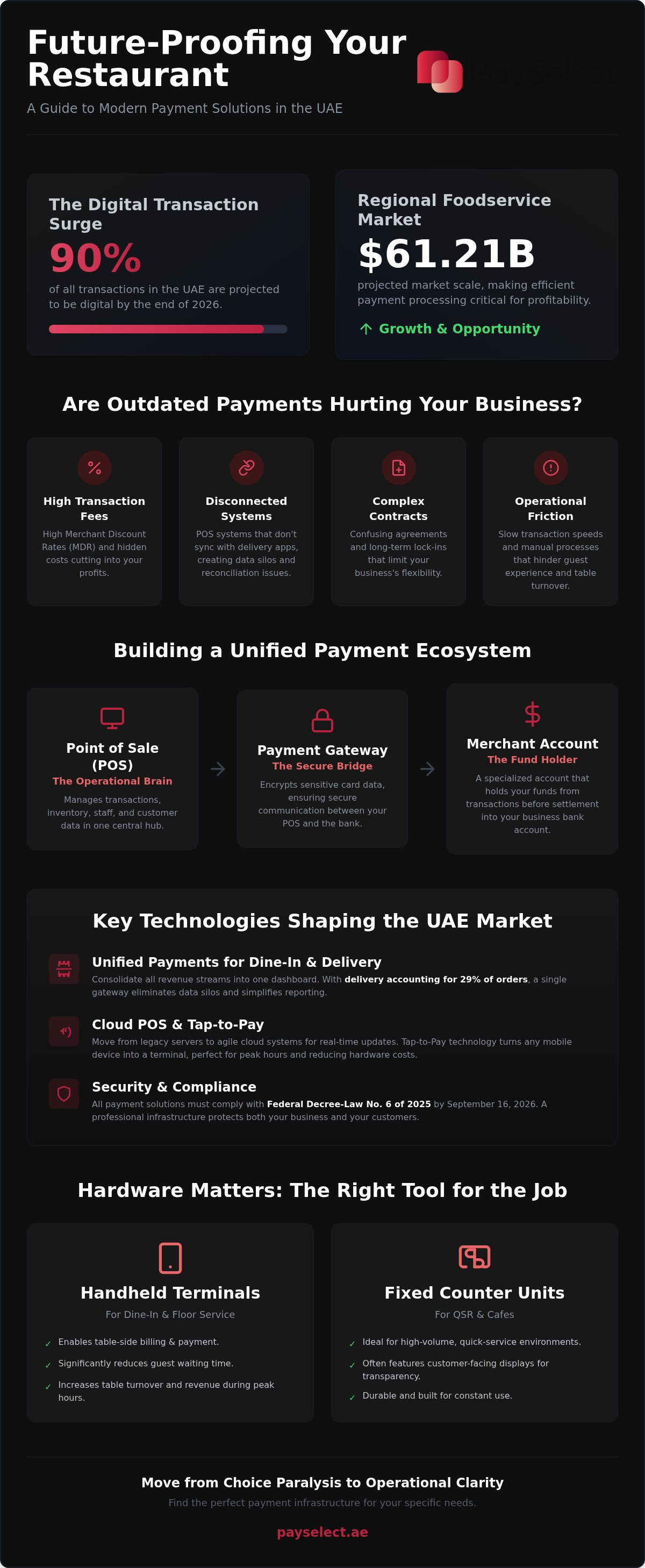
By the end of 2026, 90% of all transactions in the UAE will be digital. This shift means your infrastructure is no longer just a utility; it's a core driver of your profitability. As the regional foodservice market scales toward a projected $61.21 billion, selecting the right restaurant payment solutions dubai is critical for maintaining healthy margins. You've likely seen high merchant discount rates cut into your earnings or felt the frustration of POS systems that won't sync with delivery apps. Hidden fees and complex contracts only add to the friction, making it harder to focus on what matters: the guest experience.
You deserve a payment setup that is fast, connected, and transparent. This guide offers a professional framework to help you compare providers, reduce transaction costs, and achieve unified reporting for every order. We'll explore how to navigate new licensing regulations and use independent tools to find the perfect match for your specific needs. By focusing on fluid operations and cost optimization, you can turn your payment process into a strategic advantage that fuels expansion across the Emirates. It's time to move from choice paralysis to operational clarity.
Key Takeaways
• Master the synergy between POS hardware and secure gateways to create a unified ecosystem for both dine-in and delivery orders.
• Identify and eliminate hidden operational costs, including setup and maintenance fees, to protect your restaurant's profit margins.
• Apply a strategic framework to compare the most efficient restaurant payment solutions dubai that align with your specific service model and transaction volume.
• Utilize the "Take the Test" tool to remove choice paralysis and receive an independent, data-driven match for your payment infrastructure.
• Discover how cost-optimization audits can streamline your financial reporting and accelerate table turnover through advanced mobile payment options.
The Evolving Landscape of Restaurant Payment Solutions
Modern restaurant payment solutions dubai represent a unified ecosystem where hardware, software, and security protocols converge. It's no longer about a standalone card reader. It's about a Point of Sale (POS) system that acts as the operational brain, connected to a secure payment gateway and cloud-based processing software. This connectivity ensures that every transaction, whether at the table or through a mobile app, flows through a single, secure channel. When these components don't communicate, your business loses speed, data, and guest trust.
The UAE is aggressively pursuing a cashless economy, with a national target of 90% digital transactions by the end of 2026. This transition is powered by the rapid adoption of NFC, digital wallets, and QR-code based payments. Relying on a rigid, legacy setup leads to lost revenue. Modern diners expect speed. They want to tap their phone and leave, not wait for a dial-up terminal to process a receipt. A "one-size-fits-all" approach fails because it doesn't account for the specific flow of a high-volume Dubai kitchen or the nuances of international franchise accounting.
Security and compliance are the foundation of this evolution. All payment entities must comply with Federal Decree-Law No. 6 of 2025 by September 16, 2026. This regulation, alongside data residency requirements under Law No. 45 of 2021, ensures that sensitive financial data stays within the UAE. A professional infrastructure must meet these Central Bank standards to protect both the merchant and the consumer from emerging digital threats.
Dine-in vs. Online: The Need for Unified Payments
Managing separate providers for floor sales and delivery platforms is a recipe for operational friction. It creates data silos that make end-of-day reconciliation a nightmare for managers. Unified payment gateways bridge this gap. They consolidate all revenue streams into one dashboard, simplifying reporting and reducing human error. For phone orders or deposits, integrated payment links provide a professional, secure way to collect funds without requiring a physical presence. This fluidity is essential as delivery's share of restaurant orders reached 29% in early 2026.
Key Technologies Shaping the UAE Market in 2026
Mobile adoption is at an all-time high, driven by a consumer base that prioritizes efficiency. Tap-to-Pay technology now allows staff to turn any mobile device into a terminal, serving as a vital backup during peak hours. Legacy on-premise servers are disappearing, replaced by cloud-based POS machines that offer real-time updates and remote management. These tools ensure your business remains agile, scalable, and ready for the 18% rise in delivery volume recently reported in the sector. Moving to the cloud isn't just a trend; it's a requirement for staying competitive in a fast-moving digital economy.
Core Components of a Modern Restaurant Payment Stack
Building a high-performance restaurant payment stack requires a strategic alignment of hardware and software. The foundation of this stack is the Point of Sale (POS) system, which serves as the operational brain of your business. Beyond just processing transactions, modern restaurant POS systems manage inventory, staff scheduling, and customer data. When selecting restaurant payment solutions dubai, you must ensure this brain communicates perfectly with your payment gateway and merchant account. The gateway acts as a secure bridge, encrypting data between the customer and the bank, while the merchant account holds your funds until they are settled into your business bank account. Operational fluidity depends on these components working as a single, frictionless unit.
Choosing the Right POS Hardware
The physical touchpoint of your payment stack is the hardware. Your choice of terminal directly impacts the guest experience and operational speed. Handheld terminals allow for table-side billing, which significantly reduces the time guests spend waiting for a check. This efficiency leads to faster table turnover and increased revenue during peak hours. Fixed counter units are ideal for Quick Service Restaurants (QSR) and cafes, often featuring customer-facing displays to ensure order accuracy and transparency. Selecting the right device involves balancing durability with connectivity. You can explore POS machine options for your business to see which hardware best fits your floor plan and service style.
The Role of the Payment Gateway
A gateway is the invisible engine that keeps your revenue flowing, making it a cornerstone of effective restaurant payment solutions dubai. For high-volume restaurants, downtime is not an option. A reliable gateway ensures 99.9% uptime, even during the busiest weekend shifts. Security is equally paramount. Your infrastructure must adhere to PCI-DSS compliance and utilize 3D Secure 2.0 to protect against fraud and chargebacks. Different providers offer varying levels of integration and support, making it essential to compare payment gateways for UAE restaurants before committing to a contract. If you're feeling overwhelmed by the technical specifications, using a Payment Gateway Comparison Tool can simplify the selection process by highlighting the functional advantages of each provider without the sales pitch.
Analyzing Costs: MDR, Hidden Fees, and Optimization
Every percentage point shaved from your transaction costs goes directly to your bottom line. In a competitive market, understanding the financial mechanics of restaurant payment solutions dubai is essential for protecting your margins. The most visible cost is the Merchant Discount Rate (MDR), which is the fee charged by providers for processing card payments. For domestic credit cards, the Central Bank of the UAE has capped the MDR at 1.5% for most merchant categories. However, new businesses or those without optimized setups often face transaction fees ranging from 2.2% to 2.9%, plus fixed costs like AED 1.00 per transaction. High-volume restaurants must look beyond these standard rates to negotiate bespoke pricing tiers that reflect their scale.
Interchange fees represent the non-negotiable portion of your costs, set by card networks and paid to the issuing bank. While you can't change these, you can control the "markup" added by your provider. A fair setup is transparent about these layers. Hidden costs often lurk in the fine print, including setup fees, monthly maintenance charges, and statement fees. These small amounts accumulate, creating "fee creep" that erodes profitability over time. To stay competitive, merchants should align with the UAE's national payment ecosystem, which emphasizes digital transformation and more efficient processing structures.
How to Audit Your Current Payment Costs
A professional audit starts with calculating your "effective rate." Your effective rate is the total cost of all fees divided by your total transaction volume. If this number is significantly higher than your quoted MDR, you're likely paying for services or "add-ons" you don't need. You should also compare domestic versus international card processing rates. International cards usually carry higher fees, but an optimized gateway can help mitigate these costs through better routing. Identifying these discrepancies is the first step toward reclaiming lost revenue and ensuring your restaurant payment solutions dubai remain cost-effective as you grow.
The Benefits of Independent Advisory
Choosing a provider based on a sales pitch often leads to mismatched services and inflated costs. Independent advisory removes this bias, focusing strictly on your operational data and volume. Professional audits frequently uncover 10-20% savings in transaction fees by identifying redundant services and negotiating better terms with providers. For international restaurant groups, optimization is even more critical. Streamlining how you handle multiple currencies and cross-border settlements can significantly reduce overhead. You can Learn about cross-border payment solutions to understand how high-end infrastructure supports global expansion while keeping local costs manageable. This strategic approach ensures your payment stack is a catalyst for growth, not a financial burden.
Selection Framework: Matching Solutions to Your Business
Selecting from the available restaurant payment solutions dubai requires a logical process that prioritizes your specific operational needs over generic sales promises. The right choice isn't necessarily the most popular provider; it's the one that aligns with your service model and volume. To build a resilient payment infrastructure, follow this five-step framework:
Step 1: Define your service model.
A Quick Service Restaurant (QSR) values transaction speed and counter efficiency, while a fine-dining establishment requires elegant, table-side mobile terminals.
Step 2: Calculate your average monthly volume.
Your transaction data is your strongest leverage. High-volume merchants can negotiate lower MDR tiers, whereas smaller outlets should focus on minimizing fixed monthly fees.
Step 3: Map your required integrations.
Ensure your payment stack communicates with your accounting software, CRM, and inventory management tools to prevent manual data entry errors.
Step 4: Evaluate hardware durability.
Floor staff need lightweight, handheld units with long battery life to last through double shifts without interruption.
Step 5: Use a comparison tool.
Filter providers based on these criteria to remove the noise of marketing and focus on functional utility.
By applying these steps, you move from a reactive purchase to a strategic investment. You can compare POS machine options to see how specific hardware features match these operational steps.
Small Cafes and Startups
For smaller businesses, simplicity and low entry costs are paramount. Startups should prioritize "all-in-one" systems that combine the POS software, gateway, and hardware into a single package. This reduces the complexity of managing multiple contracts and ensures a faster setup. At this stage, low monthly fixed costs are often more beneficial than the lowest possible percentage rate, as they provide better cash flow predictability during the initial growth phase. Focus on systems that are intuitive enough for small teams to master in minutes.
Enterprise Groups and High-Volume Chains
Large-scale operations require a more sophisticated approach centered on data and scalability. Enterprise groups need robust API documentation to build custom integrations between their payment stack and proprietary internal systems. Multi-entity reporting is a non-negotiable requirement, allowing management to view performance across various outlets under a single umbrella. For these groups, aggregate volume provides the leverage needed for customized MDR negotiations. If your group operates across different regions, you should also match your cross-border payment solutions to ensure smooth fund settlements between international entities. Efficiency at this scale is measured by the removal of every possible operational barrier.
Ready to find your ideal match? Take the Test to filter the best payment providers for your restaurant in minutes.
Simplify the Search with PaySelect
Finding the right restaurant payment solutions dubai shouldn't feel like a high-pressure sales meeting. Most vendors push their own software as the only option, often ignoring your specific floor plan or delivery volume. PaySelect changes this dynamic. We remove the sales pitch by acting as an independent digital platform that filters the entire UAE market. Our goal is total transparency. We translate complex technical jargon into actionable business data, helping you identify which providers offer the best technical utility for your specific service model. This approach eliminates the friction often found in the merchant selection process and ensures you don't settle for a system that limits your growth.
Why Independence Matters in Payments
Traditional sales agents usually represent a single bank or processor. They are driven by commissions and monthly quotas, which often leads to merchants being pushed toward expensive, rigid contracts. Because PaySelect is an independent digital platform, we provide access to a wider range of providers than any single salesperson can offer. We cover all UAE national payment providers, ensuring your search is comprehensive and unbiased. We focus on your growth and operational fluidity. This independence ensures you find a partner that simplifies your transitions and removes operational barriers rather than creating new ones. You get a solution that serves your business, not the provider's bottom line.
Getting Started with Your Optimization Audit
Large restaurant groups with complex needs benefit from our bespoke advisory services and Payment Infrastructure Consulting. To begin a cost optimization audit, simply prepare your recent processing statements. We analyze these documents to uncover fee creep and identify where your current setup is underperforming. During a bespoke strategy consultation, you can expect a deep dive into your transaction flow, integration gaps, and potential savings. We look for hidden costs in contracts that eat into your margins, such as statement fees or inflated maintenance charges. Our team provides a clear comparison of POS machine options and gateway performance to ensure your stack is optimized for 2026 standards.
For those looking for a faster solution, the "Take the Test" matching tool provides a data-driven recommendation in minutes. It's an efficient way to bypass choice paralysis and move straight to implementation. The tool filters the market based on three critical factors:
• Your average monthly transaction volume.
• Your primary service model, from QSR to fine dining.
• Your specific integration needs for accounting and inventory.
Whether you are a single cafe or a national chain, we help you match with cross-border payment solutions or local gateways that fit your volume. PaySelect provides the data, while you retain total control over the final choice.
Optimize Your Payment Infrastructure for 2026
Success in the UAE's digital-first economy requires a payment stack that is as fluid as your kitchen's operations. You've learned that long-term profitability depends on more than just hardware; it's about the synergy between your POS system, secure gateways, and transparent fee structures. By auditing your effective rates and aligning your technology with your specific service model, you remove the operational barriers that hinder growth. This strategic clarity ensures your business remains competitive, compliant, and ready for expansion.
Choosing the right restaurant payment solutions dubai shouldn't be a gamble based on a salesperson's commission. PaySelect provides the independent and unbiased comparison you need to bypass complex jargon and high-pressure pitches. Used by leading UAE hospitality groups, our platform solves choice paralysis through expert advisory and infrastructure optimization. We've helped businesses across the Emirates reclaim their margins by identifying hidden fees and matching them with providers that actually fit their transaction volume.
It's time to take control of your financial ecosystem and stop letting high MDR rates eat your profits. Take the test and find your perfect restaurant payment match today to streamline your reporting and accelerate your table turnover. Your journey toward a more efficient, cost-optimized restaurant starts with a single, data-driven decision.
Frequently Asked Questions
What is the average MDR for restaurants in the UAE?
The average Merchant Discount Rate (MDR) for domestic credit cards is currently capped at 1.5% by the Central Bank of the UAE. However, new establishments often encounter transaction fees ranging from 2.2% to 2.9%, along with a fixed fee of approximately AED 1.00 per transaction. These rates fluctuate based on your business category and monthly volume. High-risk sectors or businesses with low transaction counts may face rates up to 5%.
Can I use one payment solution for both my physical restaurant and my website?
Yes, modern restaurant payment solutions dubai allow you to integrate dine-in and online transactions through a single provider. Using a unified payment gateway ensures that all revenue from your physical floor and your delivery website flows into one dashboard. This setup simplifies end-of-day reconciliation and provides a single source of truth for your financial reporting. It also creates a seamless experience for customers who interact with your brand across multiple channels.
Do I need a separate bank account to set up a payment gateway?
You don't need a separate bank account, but you must have a corporate bank account registered in the UAE to receive settlements. The payment gateway provider sets up a merchant account, which acts as a holding area for funds before they are transferred to your business bank account. Ensuring your current account is compatible with the provider's settlement schedule is vital for maintaining healthy cash flow. PaySelect helps you verify these requirements.
How long does it typically take to switch to a new POS provider?
Switching to a new POS provider typically takes between two to four weeks, depending on the complexity of your operations. This timeline includes hardware delivery, menu configuration, and staff training. Cloud-based systems often allow for faster implementation compared to legacy on-premise servers. To ensure a smooth transition without downtime, it's best to run the new system in parallel with your old one for a few days during a low-volume period.
What are the most common hidden fees in restaurant payment contracts?
Hidden costs often include setup fees, monthly maintenance charges, and statement fees that aren't always highlighted in the initial sales pitch. You might also encounter PCI-DSS compliance fees or charges for accessing detailed reporting dashboards. Some providers apply minimum monthly processing fees if your transaction volume falls below a specific threshold. Auditing your contract for these line items is essential to calculate your true effective rate and protect your restaurant's profit margins.
Is it possible to accept international digital wallets like WeChat Pay or Alipay?
Yes, many UAE payment providers now support international digital wallets like WeChat Pay and Alipay to cater to global tourists. Accepting these methods is a strategic advantage for restaurants located in high-traffic areas. These transactions are usually processed through your existing POS hardware if it is NFC-enabled or supports QR-code scanning. You should compare different restaurant payment solutions dubai to see which providers offer the best rates for these international payment methods.
What security certifications should I look for in a payment provider?
Your provider must be PCI-DSS compliant to ensure the highest standards of data encryption and protection. Additionally, look for support for 3D Secure 2.0, which adds an essential layer of authentication to prevent online fraud. In the UAE, all entities must be licensed and compliant with Federal Decree-Law No. 6 of 2025 by September 16, 2026. Verifying these credentials ensures that your guest's sensitive financial data is stored securely and follows national data residency laws.
How does a payment cost optimization audit actually work?
A payment cost optimization audit begins with a detailed review of your recent processing statements to identify fee creep and hidden markups. We analyze your transaction volume, average ticket size, and card types to pinpoint where you are overpaying. PaySelect then provides a data-driven report comparing your current costs against market benchmarks. This process gives you the leverage to negotiate better terms or switch to a provider that offers a more efficient structure.
Disclaimer
This content is for informational purposes only and should not be considered financial, legal, or regulatory advice. Payment provider availability, pricing, and approval processes vary depending on individual business circumstances. PaySelect does not guarantee provider acceptance or specific outcomes. Businesses should conduct their own due diligence before entering into any agreements.
Empowering businesses to achieve greater growth