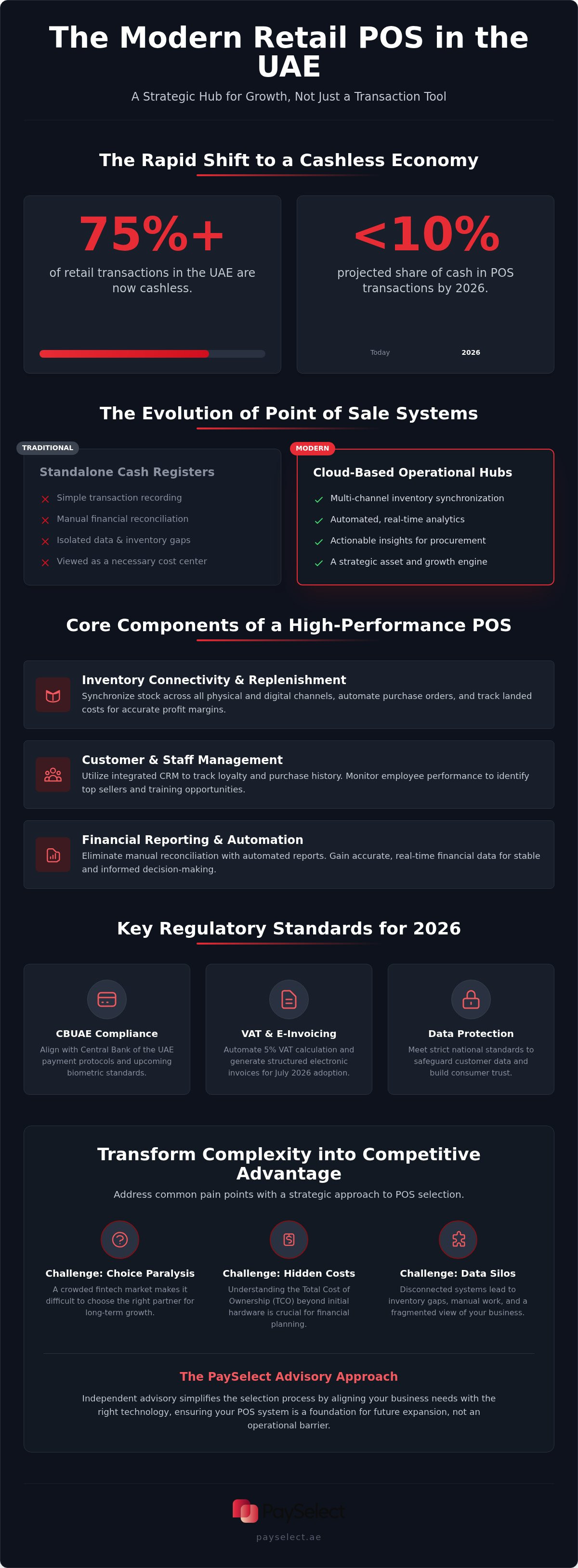
Over 75% of retail transactions in the UAE are now cashless, and by the end of 2026, cash is projected to account for less than 10% of all point-of-sale activity. This rapid digital acceleration means your choice of a retail pos system uae is no longer a simple hardware purchase. It's a strategic decision that defines your operational fluidity, technical connectivity, and capacity for expansion.
It's frustrating to handle manual reconciliations between bank statements and sales reports while facing choice paralysis from a crowded fintech market. You deserve a system that eliminates multi-channel inventory gaps and simplifies your daily operations. This guide helps you master the UAE retail landscape by selecting a POS system that integrates seamlessly with your payment infrastructure and national regulatory requirements. We'll explore how to unlock real-time inventory visibility, automate your financial reporting, and establish frictionless connectivity with your existing payment gateways. By the end of this guide, you'll have the clarity needed to transform your technical utility into a competitive advantage.
Key Takeaways
• Learn how modern POS systems function as operational hubs that unify multi-channel inventory and automate your financial reporting.
• Discover why a cloud-based retail pos system uae is essential for maintaining real-time visibility and meeting national regulatory standards.
• Understand how to calculate the Total Cost of Ownership to avoid hidden fees and ensure your tech stack supports long-term expansion.
• Identify the essential hardware and software components needed to build a high-performance, future-proof retail infrastructure.
• Explore how independent advisory tools can simplify the selection process by removing operational barriers and choice paralysis.
The Evolution of Retail POS Systems in the UAE
The UAE retail sector has moved past the era of simple cash handling. A modern Point of Sale (POS) is no longer just a terminal for swiping cards; it's a multi-channel operational hub. This shift from standalone registers to cloud-based ecosystems allows merchants to synchronise physical stores with digital storefronts instantly. Consumer behaviour in the Emirates demands this fluidity. With over 75% of transactions already being cashless, shoppers expect speed, security, and choice. This transition supports the national push toward a fully digital economy, where cash is projected to drop below 10% of POS transactions by 2026. It's a fundamental change that turns a cost centre into a growth engine.
From Transactional to Strategic Data
Modern systems turn every swipe into a data point. Retailers now use POS data to refine inventory levels, manage stock transfers, and predict procurement needs. Instead of manual counting, businesses rely on real-time analytics for multi-store management. This technical connectivity ensures that a sale in one branch immediately updates the stock availability across the entire network. It removes the friction of manual reconciliation and reduces the risk of human error. A retail pos system uae serves as the central intelligence unit, transforming raw transaction logs into actionable insights for sustainable business expansion. High-performing retailers use these insights to optimise their supply chains and improve customer retention through personalised engagement.
National Regulatory Standards for 2026
Compliance is non-negotiable for institutional stability. In 2026, systems must align with the Central Bank of the UAE (CBUAE) payment protocols, including the latest biometric proof-of-concept standards. VAT compliance remains a core pillar. Your system must handle the 5% standard rate while generating structured electronic invoices. This is critical as voluntary e-invoicing adoption begins in July 2026. Merchants must also ensure their infrastructure meets strict data protection standards to safeguard customer information. Selecting the right pos machines ensures these regulatory hurdles become automated processes rather than operational barriers. It's about building a rock-solid foundation that inspires confidence in your customers and partners alike. Systems that fail to meet these standards risk penalties and, more importantly, loss of consumer trust in a fast-moving digital market.
Core Components of a High-Performance Retail POS
A high-performance retail pos system uae must do more than record sales. It needs to act as a unified command centre. This involves integrating inventory, customer relations, and staff performance into a single, fluid interface. For businesses scaling across multiple locations, technical utility becomes a strategic advantage. It removes operational barriers and ensures that every branch operates with the same level of precision. Modern systems provide absolute confidence by unifying online and in-store stock visibility, ensuring you never miss a sale due to data silos.
Inventory Connectivity and Replenishment
Managing stock in the Emirates often involves complex logistics and imported goods. Your system should automate purchase orders based on real-time demand rather than guesswork. This includes tracking landed costs, incorporating shipping and duties, to ensure accurate pricing and profit margins. Fluidity in multi-store stock transfers is vital. You shouldn't need manual reconciliation to move items between branches. Instead, the system should update stock levels instantly, maintaining total visibility across all physical and digital channels. This approach aligns with broader eCommerce trends in the UAE, where shoppers expect consistent availability regardless of how they choose to browse. If you're looking to streamline this setup, you can compare various pos machines to find hardware that supports high-volume inventory scanning.
Staff and customer management are equally critical. Integrated CRM modules track loyalty points and purchase history, allowing for personalised marketing programmes that drive repeat business. At the same time, employee performance tracking highlights your top sellers and identifies training needs directly within the interface. This creates a sense of completeness and momentum within your operational team, as every action is measured and optimised for growth. It's about turning technical utility into a strategic tool for business transformation.
Financial Reporting and Reconciliation
Financial accuracy is the backbone of institutional stability. Modern POS systems facilitate automatic reconciliation between sales data and bank statements, which is essential for error-free auditing and VAT reporting. You can generate multi-store P&L reports by brand or category with a few clicks. This level of structural clarity allows you to manage promotions and trade discounts centrally, ensuring price consistency across your entire network. It transforms complex financial data into simple, manageable reports that are ready for implementation by your accounting team. By automating these reconciliations, you remove the risk of human error and free up your staff for higher-value strategic tasks.
Hardware vs. Software: Building Your Tech Stack
Building a resilient tech stack requires a precise balance between durable physical components and agile software. For any retail pos system uae, the choice between cloud-based and on-premise software defines your operational speed. Cloud ecosystems offer superior scalability and security, allowing you to manage multi-store data from a single dashboard. While on-premise systems provide offline stability, they often lack the technical connectivity needed for real-time inventory updates. Most modern retailers now favour cloud solutions to ensure their data remains accessible and synchronised across all physical and digital touchpoints.
Your hardware must be as sophisticated as your software. Essential components include high-speed terminals, ergonomic scanners, and reliable receipt printers. With mobile payments accounting for 21% of transactions in the Emirates, "Tap-to-Pay" and mobile POS solutions for floor staff are now mandatory. These mobile pos machines allow employees to process transactions anywhere on the shop floor, reducing queue friction and enhancing the customer experience. It's critical to ensure all hardware is fully compatible with your chosen payment gateways to avoid technical bottlenecks or unexpected processing delays.
Evaluating POS Hardware Durability
High-volume retail environments demand hardware that withstands constant use. Scanners and terminals must be robust enough to handle thousands of interactions daily without performance degradation. Access to local technical support is a vital consideration; hardware failure shouldn't lead to prolonged downtime. As the Central Bank of the UAE introduces biometric payment proof-of-concepts, investing in NFC-enabled and biometric-ready peripherals is a strategic move. This ensures your physical infrastructure is ready for the next wave of payment innovation, providing a rock-solid foundation for business expansion.
Software Integration and API Fluidity
The true power of a modern POS lies in its ability to communicate with other systems. Open APIs serve as the bridge between your sales terminal and third-party applications, such as accounting software, delivery platforms, or CRM tools. This connectivity removes operational barriers by automating data flow, ensuring that a sale in-store immediately reflects in your financial reports. Future-proofing your tech stack for 2026 requires software that can adapt to upcoming regulatory shifts, such as the voluntary e-invoicing phase beginning in July 2026. By choosing a system with high API fluidity, you turn technical utility into a strategic tool for long-term transformation.
Strategic Framework for Selecting a POS Partner
Choosing a retail pos system uae is a high-stakes decision that dictates your brand's operational rhythm for years. Many merchants fall into the trap of selecting a provider based solely on the initial hardware cost, ignoring the long-term Total Cost of Ownership (TCO). In the UAE market, setup fees can range from د.إ500 to د.إ6,000, while monthly subscriptions vary between د.إ99 and د.إ2,500. A truly strategic partner offers more than just a terminal; they provide a roadmap for innovation that aligns with the Emirates' fast-moving digital landscape. You must evaluate whether the provider’s technical roadmap includes upcoming mandates like mandatory e-invoicing or biometric payment integration.
Assessing the scalability of your POS machines is equally vital. As your business expands from a single boutique to a national chain, your hardware must support high-volume transactions and complex inventory transfers without lag. National customer support and dedicated account management are the lifelines of your retail operation. When a terminal fails during a peak shopping period, you need a partner with a rock-solid local presence to ensure immediate resolution. This structural clarity ensures that your technical solutions remain a catalyst for growth rather than a bottleneck.
The 5-Point Evaluation Framework
To ensure absolute confidence in your choice, apply this weighted framework to every potential provider:
Technical Compatibility
Does the system integrate with national payment infrastructures and local banking protocols?
Operational Intuition
Can your retail staff master the interface with minimal training to reduce checkout friction?
Analytical Depth
Does the dashboard provide real-time visibility into stock levels, VAT reporting, and sales trends?
Market Stability
Does the provider have a proven track record within the MENA region's regulatory environment?
Cost Fluidity
Are transaction fees, processing charges, and hidden costs clearly defined to prevent budget overruns?
Mitigating Implementation Risks
Transitioning to a new system shouldn't disrupt your existing sales momentum. Data migration from legacy systems is often the most significant operational barrier. You need a clear plan for transferring product SKUs, customer databases, and historical sales records without data loss. Setting clear KPIs for the first 90 days, such as reduced reconciliation time or faster checkout speeds, allows you to measure the new system's performance objectively. Ensuring business continuity requires a phased rollout or an "always-on" backup plan during the switchover. To simplify this complex decision, you can compare POS machines and software ecosystems using independent tools that remove choice paralysis.
Removing Complexity with PaySelect Advisory
The UAE fintech market is currently saturated with hundreds of providers, each claiming to offer the ultimate solution. This abundance often leads to choice paralysis for merchants who simply want to focus on their customers. PaySelect acts as an independent bridge, removing operational barriers through objective, data-driven comparison. By using a platform-neutral approach, you ensure your retail pos system uae aligns perfectly with your specific transaction volume and technical requirements. It's about finding absolute clarity in a complex landscape to ensure your infrastructure remains fluid and ready for rapid expansion.
The "Take the Test" Matching Tool
Researching dozens of POS providers is a time-consuming process that takes you away from your core operations. The "Take the Test" tool is designed to simplify this journey by matching your retail business with suitable providers based on your industry type and functional needs. This reduces weeks of manual research into a few minutes of structured, logical analysis. You gain immediate transparency regarding merchant discount rates, monthly subscription costs, and those hidden processing fees that aren't always visible in standard marketing brochures. It's a fast-paced way to lead your business toward a clear decision point without hesitation or doubt.
Many businesses struggle with the manual reconciliation of bank statements or the complexity of managing multi-channel inventory. PaySelect helps identify these specific pain points and suggests solutions that automate your financial reporting. By focusing on the ultimate business outcome rather than just the software features, the tool ensures that your chosen system simplifies your daily workload. This structural clarity ensures that complex technical solutions are presented as manageable and ready for immediate implementation.
Enterprise-Scale Infrastructure Audits
Large-scale retail groups and hotel chains require a level of sophistication that generic tools cannot provide. PaySelect offers bespoke advisory and in-depth infrastructure audits to optimise your entire payment stack. These professional audits identify operational redundancies and high transaction costs that quietly drain your profit margins. By refining your cross-border payments, you can facilitate international ambition and reach new markets without technical friction. It's a strategic move that turns your payment setup into a catalyst for growth.
Independent advisory ensures that your technical utility becomes a strategic tool for business transformation. You don't just get a new system; you get a rock-solid institutional partner that values your time and security. This elite facilitation of commerce allows you to scale across the Emirates and beyond with absolute confidence. By removing the barriers to entry and operation, PaySelect empowers modern entrepreneurs to lead in the digital economy with speed and efficiency. Ultimately, this approach ensures that your retail pos system uae remains a strategic asset rather than a technical burden.
Empowering Your Retail Expansion in 2026
The shift toward a cashless economy requires more than just a terminal. It demands a retail pos system uae that acts as a central nervous system for your business. You've seen how unifying multi-channel inventory and aligning with CBUAE regulations creates a foundation for rock-solid institutional stability. By selecting hardware and software that communicate with fluid technical connectivity, you remove operational barriers and focus on what matters most: your customers.
PaySelect provides the bridge between these complex tech stacks and your intuitive business needs. Our platform offers an independent and unbiased comparison of the market's leading solutions. Whether you're an SME or a large-scale enterprise, our expert UAE-based advisory delivers tailored matching to optimise your costs and infrastructure. We ensure your technical utility becomes a strategic tool for business transformation rather than a source of complexity.
Don't let choice paralysis or manual reconciliation slow your momentum. Find the ideal POS and payment partner for your retail business with PaySelect and transform your operation into a high-performance digital hub. Your path to a frictionless retail future starts with a single, informed decision. We're here to help you lead with absolute confidence.
Frequently Asked Questions
What is the average cost of a retail POS system in the UAE?
The cost of a retail pos system uae depends on your business size and hardware needs. Setup fees range from د.إ500 to د.إ6,000, while monthly subscriptions vary between د.إ99 and د.إ2,500. You should also account for transaction fees, typically between 1.5% and 4.5% per sale. These figures vary based on industry and volume, making a total cost of ownership audit essential before signing a contract to avoid hidden expenses.
Are POS systems in the UAE required to be VAT compliant?
Yes, all POS systems used by VAT-registered businesses must comply with Federal Tax Authority requirements. Your system needs to calculate the standard 5% VAT rate and generate structured electronic invoices. This is critical as voluntary e-invoicing adoption begins in July 2026. A compliant system automates your reporting, reducing the risk of a د.إ10,000 penalty for late registration or incorrect filing, ensuring your business remains in good standing with national regulators.
Can I integrate my existing payment gateway with a new POS system?
Most modern systems allow integration with existing payment gateways through open APIs, but compatibility isn't guaranteed. You must verify that your hardware can communicate with your current provider's processing protocols. Seamless integration prevents manual data entry and reduces reconciliation errors between your sales terminal and bank account. If your current gateway doesn't align with your new POS, it's an opportune time to compare different providers to find a better technical and financial fit.
What is the difference between a cloud-based and an on-premise POS?
Cloud-based systems store data on remote servers, offering real-time visibility and easier scalability for multi-store operations. They require a stable internet connection but provide superior technical connectivity. On-premise systems store data locally, offering stability during internet outages but lacking the fluidity of remote access. Most merchants now prefer cloud ecosystems because they simplify software updates and ensure your business data is accessible from any location at any time, supporting ambitious expansion plans.
Do retail POS systems in the UAE support NFC and mobile payments?
Yes, high-performance systems in the Emirates support NFC and mobile payments as standard. With over 75% of retail transactions being cashless, providing "Tap-to-Pay" options is vital for a fast checkout experience. Mobile payments now account for 21% of transactions locally. Ensuring your hardware is NFC-enabled allows you to accept digital wallets and even biometric payments, which the Central Bank of the UAE is currently testing for secure, forward-thinking in-person transactions.
How does a POS system help with inventory management across multiple stores?
A retail pos system uae provides a unified view of your entire inventory, allowing you to track stock levels, transfers, and adjustments in real-time. When a sale occurs at one branch, the system immediately updates the central database. This prevents stockouts and allows for automated replenishment based on actual demand. You can manage multi-store transfers without manual reconciliation, ensuring your technical utility supports your expansion goals by removing operational barriers across different physical locations.
Is it possible to manage online and in-store sales through a single POS?
Omnichannel capabilities allow you to unify your physical and digital storefronts through a single interface. This ensures stock levels are always accurate, whether a customer buys in-store or online. It removes the risk of overselling and simplifies fulfillment for "click and collect" orders. Managing everything in one place provides structural clarity for your financial reporting and ensures a consistent experience for your customers across all shopping channels, which is a key retail trend.
Why should I use an independent advisor like PaySelect to choose my POS?
PaySelect offers independent and unbiased guidance in a crowded fintech landscape, helping you avoid choice paralysis. Our "Take the Test" tool matches your business needs with suitable providers, saving you weeks of manual research. We act as a bridge between complex technical stacks and your intuitive operational needs. For larger organisations, our bespoke advisory services provide infrastructure audits that identify hidden fees and optimise your transaction costs, ensuring your technology acts as a catalyst for growth.
Disclaimer
This content is for informational purposes only and should not be considered financial, legal, or regulatory advice. Payment provider availability, pricing, and approval processes vary depending on individual business circumstances. PaySelect does not guarantee provider acceptance or specific outcomes. Businesses should conduct their own due diligence before entering into any agreements.
Empowering businesses to achieve greater growth