
What if the checkout page is only one part of your payment security? Secure payment processing for ecommerce means protecting payment information throughout the transaction, from entry and transmission to processing. For businesses in the UAE, choosing a suitable setup means understanding those stages, not just choosing a checkout that looks secure.
Strong protection should not create unnecessary obstacles for customers. Yet provider claims can be difficult to compare, and the right capabilities depend on your business, payment methods, transaction volume and international needs. This guide explains where payment information needs protection, what to assess when comparing providers, and how to balance security with a smooth checkout experience.
PaySelect helps bring those business requirements into the comparison process. Its free questionnaire takes less than two minutes, and no registration is required. Your business data is shared only with providers matched to your requirements, and only after your explicit consent. PaySelect compares and refers merchants to licensed providers. The selected provider handles onboarding, payment processing and the ongoing merchant relationship.
Key Takeaways
• Secure payment processing for ecommerce protects payment information across the transaction journey, not just at checkout.
• Understand how the gateway, processor, customer bank and merchant contribute to moving a payment.
• Compare payment options against your business needs, supported payment methods, checkout experience and international requirements.
• Map your payment flow, responsibilities and escalation routes so your team can review how the setup works.
• Use PaySelect to match your business requirements with relevant payment provider options.
What Secure Payment Processing for Ecommerce Actually Covers
Secure payment processing for ecommerce protects payment information and supports a controlled transaction from checkout through authorization and the merchant’s payment records. It is not a single feature, nor does it guarantee that every payment is safe or approved. It involves safeguards across connected stages, with responsibilities shared between the merchant and the businesses handling the payment.
A secure-looking checkout page is only one part of the picture. A website’s general security helps protect the site, its accounts and its content. Payment security focuses on how payment details are collected, transmitted, handled and used during a transaction. These areas connect, but neither one alone ensures that the entire process is secure. The specific safeguards and responsibilities depend on the provider and the merchant’s setup.
What does secure ecommerce payment processing mean?
When a customer enters payment details, the checkout sends the information into a payment flow. The relevant payment systems use it to request an authorization decision, such as whether the transaction can proceed. Secure handling aims to protect sensitive information as it moves and limit unnecessary exposure along the way.
Safeguards can include protected data transmission, controlled access and methods that reduce how often a business needs to handle raw card details. For example, Payment Tokenization describes replacing sensitive payment information with a token that can be used in its place in certain processes. Which safeguards apply, and who manages them, varies by provider arrangement and merchant setup. Assess broad security claims in the context of the actual payment flow.
Consider the checkout experience as well as the handling of payment details. A customer may need to correct an entry, try another payment method or seek help when a transaction cannot proceed. Clear messages should explain what happened and what the customer can do next, without promising that a payment will be approved.
Why does payment security matter to an online business?
Customers need a checkout that feels clear and dependable. Confusing steps or unexplained errors can undermine confidence, while a straightforward experience helps customers understand what information is being requested and what to do next. Consider security and usability together. Extra friction is not, by itself, proof of stronger protection.
Payment outcomes also affect daily operations. An unclear decline can leave a customer unsure whether to retry or contact the business. Disputes can take staff time to review and respond to, while an interruption in the payment flow can make it harder to complete sales and reconcile activity. These issues have different causes, so payment data protection should not be confused with approval decisions, dispute handling or service continuity.
In practice, secure payment processing means assessing customer data, transaction decisions and checkout continuity as connected concerns. It can reduce exposure and support a more confident payment experience, but it cannot remove every risk, prevent every dispute or ensure that every transaction is approved. The goal is a well-understood setup, with safeguards and responsibilities that fit how your business accepts payments.
How Secure Ecommerce Payment Processing Moves a Transaction
A customer’s payment travels through several connected systems before the merchant sees a result. Understanding each handoff helps a business see where payment data moves, who makes the authorization decision and why an approval is not the same as receiving funds.
From checkout submission to authorization response
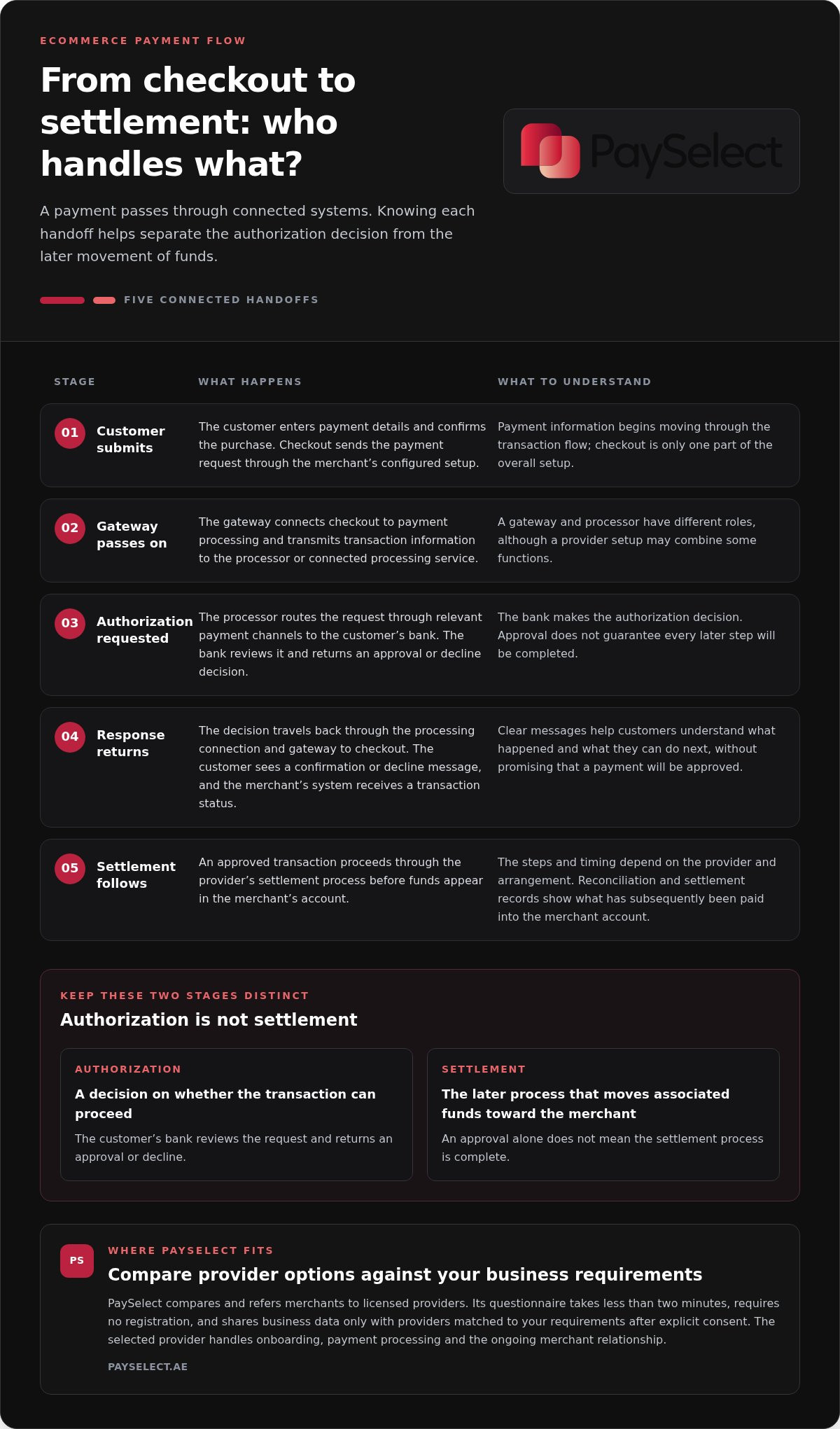
The exact setup varies, but an online card transaction commonly follows this sequence:
The customer submits payment details.
At checkout, the customer enters their information and confirms the purchase. The checkout sends the payment request through the merchant’s configured payment setup.
The gateway passes on the request.
The payment gateway provides a connection between checkout and payment processing. It transmits the transaction information to the processor or connected processing service. A gateway and processor have different roles, although a provider’s setup may combine some functions.
The processor requests authorization.
The processor routes the request through the relevant payment channels to the customer’s bank, which reviews it and returns an approval or decline decision. An approval does not guarantee that every later step will be completed.
The response returns to checkout.
The decision travels back through the processing connection and gateway to the merchant’s checkout. The customer sees a confirmation or decline message, and the merchant’s system receives a corresponding transaction status.
The approved transaction proceeds to settlement.
An approved payment still needs to move through the provider’s settlement process before funds appear in the merchant’s account. The steps and timing depend on the provider and arrangement.
Authorization is a decision to approve a transaction; settlement is the later process that moves the associated funds toward the merchant. Keeping these stages distinct helps teams explain payment status accurately. A checkout confirmation may indicate approval, while reconciliation and settlement records show what has subsequently been paid into the merchant account.
Where security responsibilities meet in the payment flow
Each handoff is a point where roles and safeguards matter. Protected transmission helps reduce the risk of payment information being exposed as it moves between checkout and payment systems. The merchant’s website and integration also affect how the request enters the flow. Do not assume that one party’s role covers every stage.
For a practical review, map the flow and record who is responsible for each step:
• Where customers enter payment details and what the checkout shows them.
• Which party provides the gateway connection and which handles processing.
• How authorization results return to the merchant’s website or sales system.
• Where the merchant views payment status, settlement information and unresolved issues.
Clear boundaries help teams direct questions to the right place when a transaction is declined, a status is unclear or settlement records need review. The controls depend on the selected provider and the merchant’s implementation, so compare gateway options against your actual payment flow. PaySelect’s payment gateway comparison helps bring business requirements into that decision.
How to Compare Secure Payment Processing Without Relying on Claims
Security statements can sound similar while describing different parts of a payment setup. Compare them in context: how payment information moves, what customers experience, which party is responsible at each stage, and whether the arrangement fits your business. Focus on relevant details instead of treating broad claims as proof that different options provide the same protection.
Which security and checkout questions should merchants compare?
Use a consistent set of questions to assess each option. Consider how security, payment methods and day-to-day responsibilities connect, rather than evaluating one feature in isolation.
| Merchant question | Why it matters | What to compare |
|---|---|---|
| How is payment information handled from checkout through authorization? | It helps clarify where sensitive details travel and which parties handle them. | The described payment flow, data handling approach and responsibilities at each handoff. |
| What customer authentication steps may be part of checkout? | Verification can affect both the payment journey and the customer’s experience. | How authentication is described, when customers may see extra steps, and how those steps fit the checkout. |
| Which payment methods does the setup support? | Customers need a way to pay that suits their preferences and purchasing context. | Whether the methods relevant to your customers are supported and how they appear at checkout. |
| Who handles payment issues and operational questions? | Clear ownership helps staff respond to declines, interruptions and status queries. | Responsibilities, support arrangements and the route for escalating unresolved issues. |
| How does the setup address international sales? | Cross-border needs can affect the payment flow and customer experience. | Relevant markets, payment methods and operational requirements for your business. |
Compare security claims against the actual flow and the merchant’s responsibilities. A statement about protected data transmission, for example, does not automatically explain how customer authentication, transaction monitoring or issue handling works. Assess secure payment processing for ecommerce as a connected setup, not a checklist of impressive-sounding terms.
How business requirements change the right provider fit
The same payment arrangement may not suit businesses with different industries, transaction volumes, customer payment methods or international needs. A provider threshold of AED 1M+ in monthly processing could be relevant to one business’s eligibility, for example, but it is only an illustration, not a general market rule. Volume alone does not determine fit.
PaySelect’s matching process uses merchant answers about factors such as industry, transaction volume, payment methods and international requirements, alongside partner data. The comparison relates business needs to available options; it does not guarantee a particular security outcome. PaySelect shares business data only with matched providers after explicit merchant consent, and its data handling complies with UAE data-protection regulations. To explore options in context, review the available payment gateway options.
Practical Steps to Improve Ecommerce Payment Security
A useful security review starts with a clear picture of how customers pay, how payment information moves and who manages each part of the process. Work through these steps to identify gaps, clarify responsibilities and keep the checkout experience straightforward.
Map the payment journey.
Record what happens from the moment a customer selects a payment method to the point they see a success or decline message. Note where payment information is entered, which systems receive it and where the customer is sent during the process. Include third-party pages and handoffs so your team can see the full journey, not only the part displayed on your website.
Review checkout as a customer.
Walk through the payment process using the methods your business presents. Check that instructions are clear, customers can tell whether a payment went through, and decline messages explain what to do next without revealing sensitive information. Make sure staff do not ask customers to send payment details through an unintended channel, such as ordinary email or chat.
Write down who owns each task.
Identify the person or team responsible for provider communication, account settings, payment-related website changes, customer queries and escalating suspected issues. If a question falls between teams, assign a clear route for resolving it. Distinguish the merchant’s responsibilities from the controls operated by the payment provider.
Align procedures with provider guidance.
Keep internal instructions and business records consistent with the selected provider’s guidance and your payment setup. Review them when the provider changes its instructions, your checkout changes, or the business adds payment methods or markets. Do not rely on a procedure that no longer reflects the live customer journey.
Check how issues are handled.
Document what staff should do if payment status is unclear, checkout stops working or a customer reports a concern. Include what information to record, who is responsible for escalation and how the customer will receive an update. A defined process helps teams respond consistently while leaving technical investigation to the appropriate party.
A sound security review covers data handling, checkout design and operational ownership together. This joined-up view matters because a change to the customer journey can affect staff instructions, records and handoffs between the merchant and provider. Revisit the map after meaningful business or setup changes instead of assuming an old review still reflects current operations.
Keep the record practical: a simple flow description, named responsibilities, customer-facing messages and escalation steps can give staff a shared reference. For secure payment processing for ecommerce, clarity is an operational safeguard. It helps the business notice when the real payment journey no longer matches its documented process, without suggesting that any setup removes all risk.
Use your business requirements to inform the payment setup as well as its review. Compare payment gateway options to bring your needs into the decision.
Find a Secure Ecommerce Payment Provider Match with PaySelect
After mapping your payment journey and deciding what matters in a provider, narrow the options to those that fit your business. PaySelect helps merchants across the UAE bring practical requirements into that comparison. It is an independent comparison and referral platform, not a licensed payment service provider or payment processor. It does not route transactions or handle payments.
How PaySelect matches merchants with payment providers
PaySelect’s Take the Test questionnaire matches merchants using information such as industry, transaction volume, payment methods and international requirements. The test is free, takes less than two minutes and does not require registration. These details help connect your needs with relevant provider options, rather than assuming the same setup suits every business.
For example, a business selling only in the UAE may have different payment requirements from one serving customers across borders. If international payments are part of your plans, consider which markets and payment needs matter to your business, and explore relevant cross-border payment solutions as part of the comparison.
A match is a starting point for an informed decision, not a promise that a provider will deliver a particular security result or business outcome. PaySelect compares and refers merchants to licensed providers. The selected provider is responsible for its service, onboarding and payment processing. PaySelect can assist with collecting initial KYC documents, but the provider completes onboarding.
What happens to merchant information after the test?
Your business information is shared only with providers matched to your requirements, and only after you give explicit consent. PaySelect’s data handling complies with UAE data-protection regulations. You remain in control of whether your information is shared for a referral.
Completing a comparison or receiving a referral does not establish a payment-processing relationship. If you choose to proceed, the selected provider handles full onboarding and the ongoing merchant relationship. The provider also manages payment processing, settlement and its ongoing support. PaySelect helps with the comparison and referral; it does not take over those responsibilities.
Use the comparison to bring your priorities together: the payment journey you have reviewed, the methods customers use, your operating needs and any plans to sell internationally. This can make a complex decision easier to assess without treating marketing language as proof of security. Secure payment processing for ecommerce depends on a suitable provider arrangement and a clear understanding of who does what.
If you are ready to explore a match, use PaySelect’s questionnaire to share your requirements and review relevant provider options. There is no obligation to proceed with a referral.
Make Your Next Payment Decision with Clarity
Your payment setup should keep pace with your business. As products, customer needs and sales plans evolve, revisit whether your current arrangement still supports the way you want to operate. A clear set of priorities can help you focus on what matters, from checkout usability to the payment capabilities needed for future growth.
Use those priorities to shape your next decision. Decide which requirements are essential, which are preferences and where you need a clearer explanation before moving forward. This makes secure payment processing for ecommerce an ongoing business consideration, not a technical choice made once and forgotten.
When you are ready to explore a provider match based on your business needs, take the payment provider matching test. The free test takes less than two minutes and requires no registration.
Frequently Asked Questions
Is secure payment processing for ecommerce completely risk-free?
No. Even a payment that receives approval could later be disputed, and a checkout may still experience interruptions. Businesses can prepare by keeping transaction records organised, deciding who reviews unusual activity and having a clear way to respond to customer concerns. These steps support better day-to-day oversight, but they cannot remove every risk or guarantee that all transactions will be approved.
Can an ecommerce business accept payments securely without building its own payment system?
Yes. A business can use a provider’s payment infrastructure and focus its review on how the chosen setup fits its operations. Before launch, decide who will manage checkout settings, review transaction reports and respond to payment questions. Clarifying these tasks helps prevent gaps between technical configuration and customer service, even when the business does not build the underlying payment system itself.
Does HTTPS alone make an ecommerce checkout secure?
No. HTTPS protects information sent between a browser and a website, but it does not tell you how a third-party payment page works or how payment status is recorded. When reviewing your checkout, distinguish the visible website connection from the systems that receive a payment request. A secure connection is useful, but it is not a complete assessment of the payment arrangement.
What happens when an ecommerce payment is declined?
A decline means the authorization request was not approved. Depending on the response, the customer may need to check their details, use another available payment method or speak with their bank. Avoid encouraging repeated attempts without guidance, since the customer may not know why the first attempt failed. Clear, calm instructions can help them decide what to do next without exposing private transaction information.
Can a merchant’s payment data be shared with providers through PaySelect?
PaySelect shares a merchant’s business information only with providers matched to the merchant’s requirements, and only after the merchant gives explicit consent. This information describes the business’s needs, such as its industry or payment requirements; it is not the customer’s card information moving through checkout. PaySelect’s data handling complies with UAE data-protection regulations.
Does PaySelect guarantee that a matched provider will prevent fraud?
No. A provider match can help narrow the options, but it cannot promise that fraud or security incidents will be prevented. After choosing a provider, a merchant should understand the provider’s operating guidance and establish an internal process for reviewing concerns, recording relevant details and escalating issues. This helps the business respond without treating a match as a substitute for its own oversight.
Disclaimer
This content is for informational purposes only and should not be considered financial, legal, or regulatory advice. Payment provider availability, pricing, and approval processes vary depending on individual business circumstances. PaySelect does not guarantee provider acceptance or specific outcomes. Businesses should conduct their own due diligence before entering into any agreements.
Empowering businesses to achieve greater growth