Stripe vs Checkout.com UAE: Choosing the Right Payment Gateway for 2026

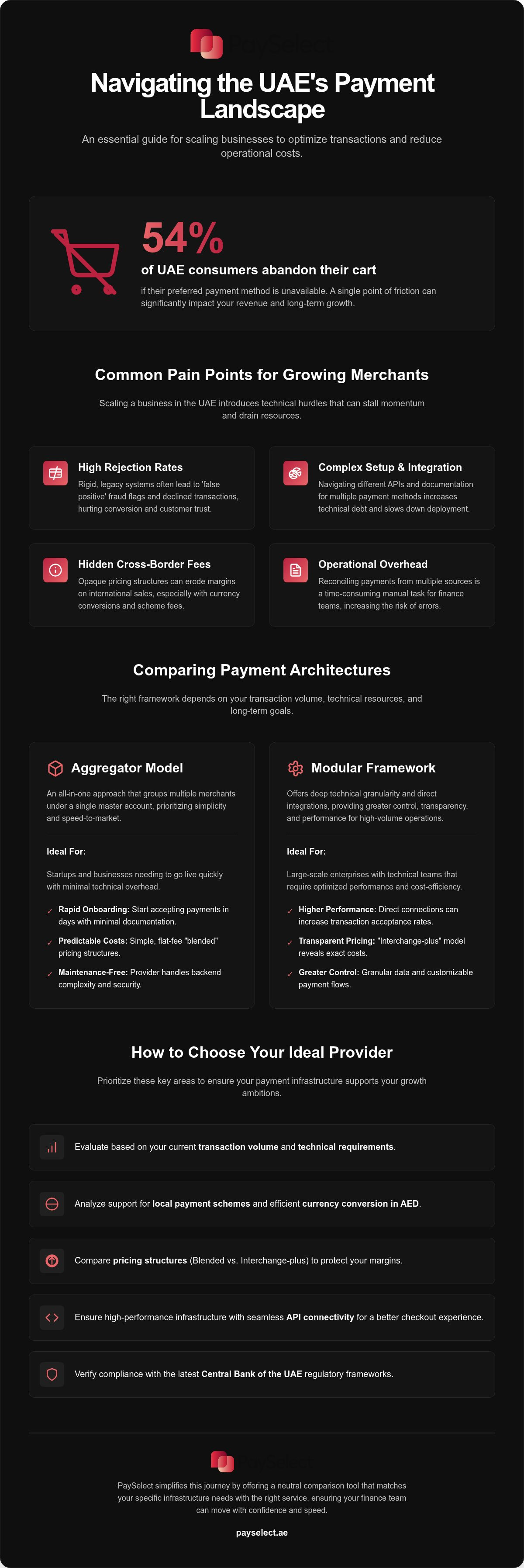
Could a single checkout friction point be costing you more than half of your potential revenue? Recent data indicates that 54% of UAE consumers will abandon their cart if they can't access their preferred payment method. For businesses scaling in the region, evaluating stripe vs checkout.com uae is a critical step toward securing long-term growth for 2026. You're likely navigating the pain of high transaction rejection rates, complex setup processes, and the sting of hidden fees on cross-border sales. It's frustrating when technical barriers stand in the way of your international ambition.
We've designed this independent analysis to provide clarity on the two leading payment architectures. You'll learn the fundamental differences between aggregator and modular models to help you optimize transaction performance and reduce operational overhead. We'll show you how to achieve higher acceptance rates while keeping costs efficient in AED and staying compliant with evolving Central Bank regulations. PaySelect simplifies this journey by offering a neutral comparison tool that matches your specific infrastructure needs with the right service. This overview of the modern payment landscape ensures your finance team can move with confidence and speed.
Key Takeaways
• Distinguish between aggregator and modular payment architectures to determine which model best supports your current transaction volume and technical requirements.
• Evaluate the stripe vs checkout.com uae landscape by comparing how different architectures handle local payment schemes and currency conversion in AED.
• Identify hidden operational costs by analyzing the differences between blended pricing and transparent interchange-plus structures to protect your business margins.
• Prioritize high-performance infrastructure with seamless API connectivity to reduce transaction rejection rates and enhance the customer checkout experience.
• Leverage independent comparison tools to simplify your selection process and ensure compliance with the latest Central Bank of the UAE regulatory frameworks.
The Modern Payment Landscape in the United Arab Emirates
High-performance digital commerce has transitioned from a competitive advantage to a baseline requirement across the nation. As the digital economy expands, the choice of a payment gateway becomes a critical strategic growth lever. It's no longer just about accepting money; it's about optimizing every millisecond of the transaction flow to prevent revenue leakage. For many scaling enterprises, the decision often centers on stripe vs checkout.com uae, as these two architectures represent the pinnacle of modern processing.
Consumer expectations have reached a peak where even a minor friction point leads to immediate cart abandonment. Data shows that 54% of UAE shoppers will walk away if their preferred payment method isn't available. Simultaneously, the Central Bank of the UAE has tightened the regulatory framework to enhance security, with new compliance deadlines like the Federal Decree-Law No. 6 of 2025 setting a high bar for operational excellence. This shift ensures that only robust, compliant infrastructures can survive the fast-moving digital landscape.
National Trends in Digital Transactions
The UAE is witnessing a definitive move away from cash-on-delivery. Consumers now favor the speed of card-on-file and digital wallets. This evolution is fueled by a 42% preference for digital payments over cash in the wider region. Merchants are also looking beyond borders, as cross-border e-commerce originating from the nation continues to climb. Success in this environment requires deep support for local card schemes, ensuring that every transaction, whether domestic or international, is processed with maximum efficiency and minimal fees in AED.
Common Pain Points for Growing Merchants
Scaling a business brings technical hurdles that can stall momentum. High transaction rejection rates and 'false positive' fraud flags are among the most persistent issues, often caused by rigid legacy systems that don't understand local nuances. Managing these failures becomes a drain on resources, while reconciling multiple payment methods often leads to significant operational overhead for finance teams. When deciding between stripe vs checkout.com uae, businesses must consider how each platform mitigates these risks without increasing technical debt.
PaySelect serves as a neutral facilitator in this complex environment. By offering a payment gateway comparison tool, we help merchants identify which infrastructure aligns with their specific scale and technical needs. Whether you're a startup or a national retailer, choosing the right partner is about removing operational barriers and focusing on what matters: expansion and customer satisfaction.
Comparing the Global Aggregator and Modular Frameworks
The debate surrounding stripe vs checkout.com uae is actually a choice between two distinct engineering philosophies. On one side, you have the aggregator model, which prioritizes rapid market entry. On the other, the modular framework offers deep technical granularity. Understanding these architectures is essential for any merchant contributing to the UAE digital market analysis and seeking to scale efficiently across the region.
Each framework moves money differently from the customer's wallet to your business account. The right choice depends entirely on your current transaction volume, your technical resources, and your long-term expansion goals. Selecting a model that doesn't align with your scale can lead to unnecessary technical debt or inflated operational costs.
The Aggregator Approach: All-in-One Simplicity
The aggregator model functions by grouping multiple merchants under a single master merchant account. This setup is ideal for national startups that need to go live within days rather than weeks. It offers a unified experience with pre-built checkout components that drastically reduce technical overhead for your development team.
Key benefits include:
Rapid Onboarding
Start accepting payments quickly with minimal documentation.
Predictable Costs
Simple, flat-fee structures usually quoted in AED.
Maintenance-Free
The provider handles most of the back-end complexity and security updates.
This simplicity often comes with a trade-off in transparency. Because the pricing is typically blended, it's often difficult to see exactly how much you're paying for individual card scheme fees or interchange costs. This can lead to higher long-term expenses as your volume grows.
The Modular Framework: Granular Control
For high-volume enterprises, the modular framework is the logical progression. This model allows businesses to build direct relationships with acquiring banks, providing a level of stability and control that aggregators cannot match. It's designed for those who need to toggle specific payment features on or off based on their unique transaction profile.
High-performance retailers often prefer this model because:
Bespoke Pricing
Access to transparent Interchange-Plus (IC+) pricing models.
Enhanced Stability
Direct bank connections reduce the risk of account freezes or delays.
Technical Flexibility
Robust APIs allow for deep customization of the entire payment journey.
This path requires more significant initial technical investment but pays dividends in reduced operational costs as your volume scales. If you're unsure which architecture fits your current scale, you can compare payment gateways through our independent matching tool to find the most efficient path forward.
Technical Performance and Local Market Compatibility
Technical performance in the Emirates isn't just about clean code. It's about how that code interacts with local banking networks to ensure every transaction settles without friction. When evaluating stripe vs checkout.com uae, the focus shifts toward infrastructure uptime and regional compatibility. High-uptime systems are non-negotiable for national retailers handling thousands of concurrent sessions during peak periods. Beyond basic PCI DSS compliance, modern providers must align with the Central Bank of the UAE's latest security protocols to ensure total data integrity and consumer trust.
Integrating local payment methods is another critical factor for success. National consumers increasingly favor digital wallets like Apple Pay and Samsung Pay over traditional card entries. A high-performance gateway must support these methods natively while maintaining a fast, responsive interface. This technical fluidity directly impacts your bottom line by removing operational barriers at the most sensitive stage of the customer journey.
Integration and Scalability
Startups often prefer hosted checkout pages to minimize development time and go live quickly. Enterprise-level entities, however, usually require custom API integrations to maintain complete control over the user experience and data flow. Your tech stack must handle sudden spikes in transaction volume without latency or system timeouts. Support for recurring billing and subscription models is also vital as these business frameworks gain traction across the nation. A flexible API allows you to scale your infrastructure without accumulating technical debt as your transaction volume grows.
Optimising Acceptance Rates in the UAE
A primary pain point for growing merchants is the 'lost' transaction. This often happens because global gateways route payments through international networks, which can trigger 'false positive' fraud alerts at local banks. Local acquiring-processing payments through banks based within the country-significantly boosts acceptance rates and ensures payments are processed in AED without unnecessary conversion steps. Smart routing technology enhances this by automatically directing each payment through the most successful path in real-time.
Leveraging AI for intelligent acceptance helps businesses distinguish between legitimate customers and actual threats. This proactive approach to fraud prevention reduces the manual workload for finance teams and protects your margins. If you're feeling overwhelmed by these technical choices, using a payment gateway comparison tool is the logical next step to identify which infrastructure aligns with your specific performance requirements. Finding the right balance between global reach and local precision is the key to sustainable growth in 2026.
Analysing Transaction Costs and Operational Efficiency
Understanding the economics of your payment stack is vital for maintaining healthy margins. While many focus solely on the headline percentage, the true cost of processing involves several moving parts. In the context of stripe vs checkout.com uae, the distinction usually lies between simplified blended pricing and the more granular interchange-plus-plus (IC++) models. Every dirham saved in processing fees is a dirham added to your bottom line, making a periodic payment cost optimization audit a necessity for high-growth firms.
Operational efficiency also extends to how quickly funds reach your business account. Settlement delays and rolling reserves can trap liquidity, creating unnecessary friction for finance teams. By analyzing the total cost of ownership, including fixed fees and variable surcharges, you can transform your payment infrastructure from a standard utility into a strategic growth lever.
Fee Structures Explained
The Merchant Discount Rate (MDR) is the primary figure most business owners see. However, this percentage is actually a combination of three distinct components. Understanding these helps you identify where potential savings exist during a scale-up phase.
Interchange Fees
The cost paid directly to the customer's bank.
Scheme Fees
The amount charged by card networks like Visa or Mastercard.
Provider Markup
The fee kept by the gateway for facilitating the transaction.
Blended pricing groups these into one predictable rate, which is excellent for startups seeking simplicity. Conversely, the IC++ model provides full transparency, allowing enterprise-scale merchants to see the exact breakdown of every transaction. Beyond the percentage, you must account for fixed per-transaction costs, which in the UAE often include a flat fee of AED 1.00 or more. Hidden costs like AED 45 wire fees for settlements or AED 90 chargeback fees can significantly impact your monthly reconciliation if not managed correctly.
Cross-Border and Multi-Currency Efficiency
If your business serves customers outside the Emirates, cross-border fees become a major factor. International cards typically attract a surcharge, often around 1.5% above the domestic rate. When you add currency conversion fees, usually around 1%, the cost of a single sale can escalate quickly. Utilizing high-performance cross-border payment solutions ensures you minimize foreign exchange (FX) markups and maintain regional competitiveness.
Reducing friction for GCC-wide processing requires a gateway that understands local nuances. Settlement delays can stifle your cash flow, creating operational barriers that prevent you from reinvesting in growth. To find the most efficient structure for your specific volume, you should compare payment pricing using independent data to ensure your infrastructure remains a strategic asset rather than a cost center.
Selecting Your Ideal Provider with PaySelect Advisory
Choosing a partner in the stripe vs checkout.com uae landscape requires more than a surface-level feature check. For national enterprises, a one-size-fits-all approach inevitably fails because it ignores the unique transaction patterns of your specific industry. One company might struggle with cross-border FX markups, while another faces high rejection rates on domestic debit cards. Independent, unbiased payment consulting provides the clarity needed to navigate these variables without being tied to a single provider's ecosystem.
Data is your most powerful lever when establishing a new processing agreement. By understanding your exact volume and failure points, you can negotiate rates that reflect your true risk profile. Auditing your current payment stack for 2026 is the first step toward reclaiming lost revenue and ensuring your finance team operates with absolute efficiency. This proactive approach transforms your payment infrastructure from a technical necessity into a strategic growth facilitator.
Simplify the Search with PaySelect
Our platform removes the guesswork from infrastructure selection. By using our 'Take the Test' tool, you can compare UAE payment gateways based on verified performance metrics rather than marketing claims. We match providers to your specific industry and transaction volume, ensuring the technical fit is seamless from day one. For large-scale organizations, we offer bespoke infrastructure audits that dive deep into your current cost structures to find hidden efficiencies and optimization opportunities.
Future-Proofing Your Payments
The digital economy moves fast, and your infrastructure must keep pace. Preparing for the next wave of digital wallet adoption is essential as consumers move further away from traditional card entries. Building a resilient, multi-processor payment strategy protects your business against localized downtime and provides the flexibility to route transactions through the most cost-effective path. This level of technical agility is what defines market leaders in the modern landscape. Start your independent comparison today to secure your competitive advantage and optimize your performance for the years ahead.
Optimizing Your Payment Architecture for 2026
The choice between stripe vs checkout.com uae isn't merely about brand preference; it's a strategic decision between simplified aggregation and modular enterprise control. As the national digital landscape evolves, your infrastructure must prioritize high uptime, local card scheme support, and transparent cost structures in AED. Success requires moving beyond generic setups to find a system that aligns with your specific transaction volume and technical maturity.
PaySelect acts as your neutral facilitator in this complex market. We provide an independent and unbiased analysis that is trusted by UAE enterprises seeking specialist MENA region expertise. Our platform removes operational barriers, allowing you to focus on expansion rather than technical debt. Whether you need a rapid deployment or a bespoke audit, the right data makes all the difference.
Take the Test to find your perfect payment gateway match and ensure your business is ready for the future of digital commerce. Your journey toward frictionless payments starts with a single, informed decision.
Frequently Asked Questions
What is the main difference between an aggregator and a modular payment gateway?
An aggregator model groups multiple merchants under one master account for rapid deployment and unified pricing. This is ideal for startups needing speed and simplicity. A modular framework provides a direct connection to acquiring banks, offering granular control over payment features and greater stability. When analyzing stripe vs checkout.com uae, businesses must decide if they value the convenience of an all-in-one solution or the technical flexibility of a bespoke enterprise architecture.
How do payment gateway fees typically work for businesses in the UAE?
Fees usually consist of a percentage-based Merchant Discount Rate and a fixed cost per transaction, such as AED 1.00. You'll encounter two main structures: blended pricing and Interchange-Plus. Blended pricing offers a simple flat rate for all cards. Interchange-Plus breaks down the bank fee, card network fee, and provider markup separately. Additional costs like AED 90 chargeback fees or AED 45 settlement wire fees should also be factored into your operational budget.
Can I use multiple payment gateways for my national business?
Yes, using multiple processors is a strategic move for national enterprises. This approach, often called multi-processor redundancy, ensures your business stays online if one provider faces a technical outage. It also allows for smart routing, where transactions are sent to the gateway with the highest success rate or lowest cost for that specific card type. This reduces transaction rejection rates and optimizes your overall operational efficiency across the nation.
What is Interchange-Plus pricing and is it better for my scale?
Interchange-Plus-Plus (IC++) is a transparent pricing model where the merchant pays the exact interchange rate set by the card issuer, plus card scheme fees and a fixed provider markup. This is typically better for high-volume merchants processing over AED 500,000 monthly. It allows you to benefit from lower rates on specific card types rather than paying a high blended average. PaySelect can help you determine if your volume justifies moving to this granular structure.
How long does it typically take to integrate a new payment gateway?
Integration timelines depend heavily on the chosen architecture. Aggregator models can often be live within a few business days due to streamlined onboarding and pre-built components. Modular enterprise solutions typically take several weeks or even months. This longer period is required for deeper technical integration and the rigorous KYC processes involved in establishing direct relationships with local acquiring banks. Planning your technical roadmap early helps avoid unnecessary delays in your launch schedule.
Do these providers support local UAE payment schemes?
Leading providers in the region prioritize support for local card schemes and digital wallets. This includes processing domestic Visa and Mastercard transactions efficiently in AED. Support for popular digital wallets like Apple Pay and Samsung Pay is also standard, as these methods now represent a significant portion of the national digital economy. Ensuring your gateway understands these local nuances is vital for maintaining high acceptance rates and meeting rising consumer expectations for a frictionless checkout.
How does PaySelect maintain independence when comparing providers?
PaySelect maintains its position as a neutral facilitator by providing transparent, data-driven comparison data across the entire market. While we earn success-based referral fees from various providers, our recommendations are generated by the 'Take the Test' matching tool based on your specific business requirements. For large-scale organizations, we offer fixed-fee advisory services. This ensures our consulting remains focused on optimizing your infrastructure and reducing costs rather than favoring any specific payment processor.
What should I look for in a payment gateway if I have high cross-border volume?
For high cross-border volume, you should prioritize gateways that offer regional acquiring and competitive foreign exchange markups. Look for providers that allow you to settle in multiple currencies to avoid unnecessary conversion fees, which often cost around 1% per transaction. High-performance cross-border payment solution matching helps you find a partner that minimizes international surcharges. This ensures your margins remain protected as you expand your reach from the UAE into the global marketplace.
Disclaimer
This content is for informational purposes only and should not be considered financial, legal, or regulatory advice. Payment provider availability, pricing, and approval processes vary depending on individual business circumstances. PaySelect does not guarantee provider acceptance or specific outcomes. Businesses should conduct their own due diligence before entering into any agreements.
Empowering businesses to achieve greater growth