
Strong Customer Authentication (SCA) requires at least two authentication factors for certain European online account access and electronic payments. If you’re asking, “What is strong customer authentication (SCA)?” the practical answer is a verification process designed to confirm a customer’s identity before a covered action proceeds. These European rules don’t automatically apply to every payment made by a UAE business.
For merchants, the practical challenge is fitting authentication into checkout without creating unnecessary friction. 3D Secure supports online card authentication, sometimes with a one-time code or biometric check. The bank and transaction determine how the verification flow works.
This article explains how SCA factors work, what PSD2 requires, and how 3D Secure supports online payments. It also covers what UAE merchants handling international card payments should understand when planning a clear checkout experience.
Key Takeaways
• Strong Customer Authentication uses at least two different factors to verify a customer during covered payments or account access.
• Knowledge, possession and inherence are the three factor categories; dynamic linking can connect authentication to the payment amount and payee.
• PSD2 sets SCA requirements for relevant European payment service providers, while UAE merchants should consider them when accepting payments from European customers.
• 3D Secure can support authentication at online checkout, and comparing payment gateway options can help businesses assess how payment flows meet their needs.
What is Strong Customer Authentication?
Strong Customer Authentication (SCA) is a European requirement for certain online account access and electronic payments. It uses at least two authentication factors to verify a customer’s identity.
If a payment requires SCA and authentication fails, the bank can decline it. The customer must complete the requested verification before trying again.
Payment Security and Checkout Friction
Payment security and checkout friction need to be balanced: verify the customer’s identity while keeping payment steps manageable. An extra screen can interrupt a customer who is ready to pay, so clear instructions and a smooth authentication flow matter.
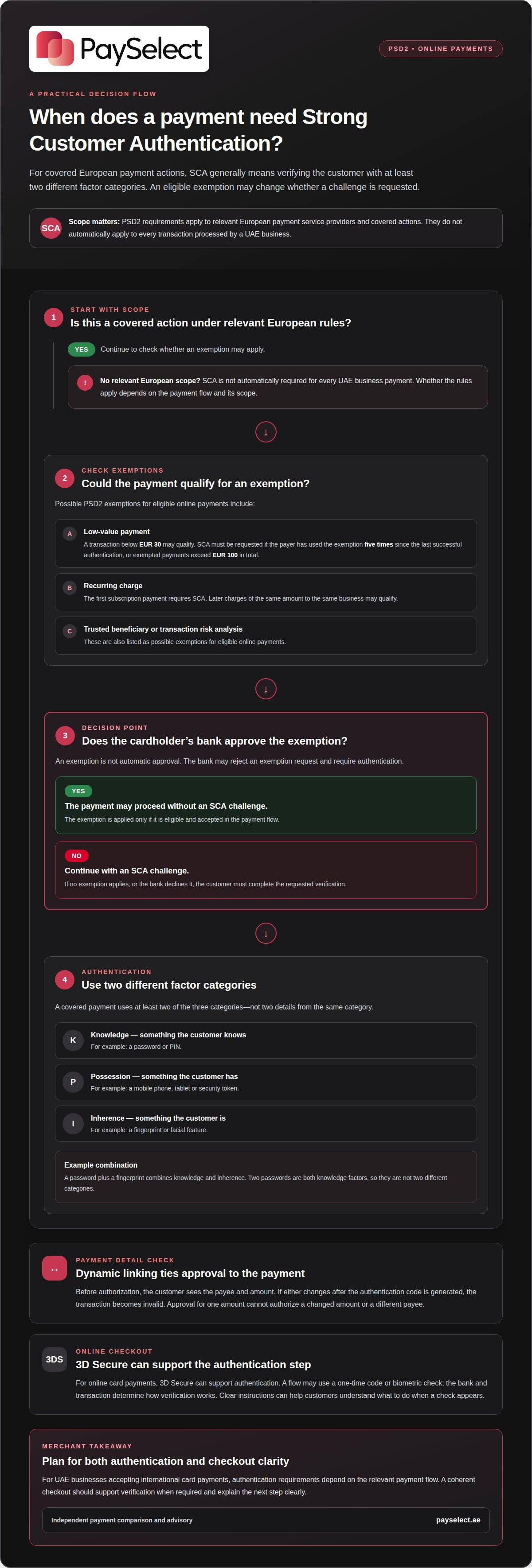
Under the revised Payment Services Directive, SCA requires two of three authentication factors, rather than a password alone. A bank may accept an eligible exemption, but the cardholder’s bank decides whether to approve it. For example, a shopper might need to complete an additional identity check only when the transaction requires one. This approach can help protect payments while limiting unnecessary checkout steps.
For UAE businesses selling online, authentication is also a customer experience decision. A clear flow can explain why a verification step appears and what the customer needs to do next. A well-integrated online payment gateway can support a coherent checkout flow.
SCA for Accounts and Electronic Payments
SCA applies to specified online account access and electronic payment actions under European rules. Article 97(1) of the EU Revised Directive on Payment Services requires payment service providers to use SCA when a payer accesses a payment account online, initiates an electronic payment, or takes certain actions remotely.
SCA definition and authentication factors
Strong Customer Authentication uses three categories of factors to verify a consumer’s identity. For a covered transaction, it combines at least two categories. To understand SCA, consider how these factors work together.
The Three Authentication Factors
The categories are knowledge, possession and inherence. Knowledge is something the consumer knows, such as a password or PIN. Possession is something they have, such as a mobile phone, tablet or security token. Inherence is something they are, such as a fingerprint or facial feature.
For example, a banking app might pair a password with a fingerprint. The password is a knowledge factor; the fingerprint is an inherence factor. These categories are different from separate details within one category: two passwords are both knowledge factors, not two different categories. Simply asking for extra information therefore may not amount to two-factor authentication.
Two-Factor Authentication
Two-factor authentication combines evidence from two different categories to verify a payment. A consumer might enter a password and approve a prompt on a registered mobile phone. The first step uses knowledge; the second uses possession. Together, they help a payment service verify both that the customer knows the account details and that they control the registered device.
Dynamic linking connects authentication to the payment being approved. Before authorization, the user sees the payee and amount. If either changes after the authentication code is generated, the transaction becomes invalid. For example, approval for one amount cannot authorize a changed amount or different payee. In practice, this means verification is tied to distinct factors and specific payment details, not just an account login.
PSD2 strong customer authentication requirement
PSD2, Directive 2015/2366, sets strong customer authentication requirements for relevant electronic payments. The rules apply in the European Economic Area, subject to scope and exemptions.
SCA Purpose Under PSD2
PSD2 requires payment service providers to use SCA for covered payment and account-access actions. Its purpose is to strengthen checks against payment fraud while keeping legitimate electronic payments usable.
For merchants, it is important to distinguish European requirements from UAE operations. A UAE business processing a payment connected to the EEA may encounter an authentication step in its checkout flow. The cardholder’s bank assesses the transaction and can request verification when required. Payment systems should therefore support authentication rather than assume every payment follows the same path.
Exemptions for Online Payments
PSD2 exemptions let eligible online payments proceed without an SCA challenge, but they do not remove the general requirement. Possible exemptions include low-value payments, recurring charges after the first payment, trusted beneficiaries and transaction risk analysis.
For low-value payments, transactions below EUR 30 may qualify. The provider must request SCA if the payer has used the exemption five times since the last successful authentication, or exempted payments exceed EUR 100 in total. These checks can bring authentication back into a later purchase.
For a recurring subscription, the first payment requires SCA. Subsequent charges of the same amount to the same business may qualify for an exemption, but a bank can reject the exemption request and require authentication. Contactless payments have separate exemption rules in some European contexts, so merchants should distinguish those from online checkout requirements. An exemption is not automatic approval; the payment flow must be able to respond to the bank’s decision.
3D Secure authentication
3D Secure (3DS) adds an authentication step to online card payments. It helps merchants and cardholder banks support Strong Customer Authentication in e-commerce. With a password, one-time code or biometric check, the cardholder can confirm a payment after checkout. The bank may also assess transaction information to decide whether to request an active challenge.
For example, a customer enters card details and submits an order. The merchant’s payment flow sends the transaction for authentication. The cardholder’s bank may approve it without another visible action or request a code or fingerprint. The customer completes the requested check before authorization continues. If authentication is required but fails, the bank can decline the payment.
3D Secure 2, also known as EMV 3DS, is designed for modern online commerce, including mobile devices. It can provide transaction data to support the bank’s assessment, but using 3DS alone does not mean every payment meets SCA requirements. The authentication flow must satisfy the relevant regulatory criteria, including the required factors and payment-specific controls.
For European transactions, PSD2’s SCA requirement took effect on 14 September 2019. Phased implementation in several EEA countries was allowed, with the final deadline set for 31 December 2020. Whether the requirement applies depends on the payment’s scope and the locations involved. A UAE merchant selling to European cardholders should account for authentication in its checkout design. Clear prompts, mobile-friendly steps and a usable fallback help customers understand the required action without confusion.
EMV 3DS 2.0 can gather up to 150 data points per transaction and is more suited to mobile devices. Solutions should meet PSD2 SCA and 3DS v2.2 requirements, including two-factor authentication and dynamic linking.
PaySelect
PaySelect helps UAE businesses compare payment options and assess how they fit their operations. When reviewing Strong Customer Authentication, consider how checkout, customer authentication and provider capabilities work together. Comparing solutions can help clarify what to ask before changing or expanding a payment arrangement.
PaySelect helps businesses compare payment gateway options for their checkout needs. Merchants can assess how a gateway may support their payment flow, customer experience and international acceptance requirements. This is useful when considering how authentication steps fit into an e-commerce journey, but comparing gateways does not replace meeting applicable regulatory requirements.
For in-person sales, PaySelect helps businesses compare POS options against their retail or hospitality needs. Businesses that accept payments both online and in-store can assess each channel separately, then consider how they fit into wider payment operations. The relevant options depend on the business model and how customers pay.
Businesses with international payment needs can compare cross-border payment options for collections and payouts with PaySelect. This helps merchants assess their payment setup across markets, including where card acceptance and customer authentication requirements may differ. PaySelect provides comparisons, not payment processing.
Payment pricing is another part of the decision. Compare pricing alongside operational needs, payment channels and international requirements instead of choosing on a single feature alone. Businesses with an existing provider can also use PaySelect’s payment advisory services to review their setup and consider whether an adjustment or a change makes sense.
For tailored guidance on payment options, contact PaySelect to discuss your business requirements.
Frequently Asked Questions
How to Achieve SCA Compliance?
Practical preparation starts with mapping checkout journeys that may include authentication. Test the customer experience on commonly used devices and note where users pause or leave. Review these patterns with the payment provider to identify integration or communication issues. This provides a useful operational view, but a successful test does not prove regulatory compliance.
SCA Payment Processing: What Businesses Need to Know?
When reviewing payment reports, distinguish completed payments from interrupted checkouts. A customer may leave before finishing a bank challenge, while another transaction may receive a payment response after verification. Tracking these outcomes separately helps teams identify recurring friction, improve support messages and assess whether a checkout change affected completion.
SCA governance and compliance: Who’s responsible?
PSD2 places formal SCA compliance responsibility on payment service providers. For day-to-day governance, a merchant and its payment partners should also define operational handoffs: who manages the checkout integration, who reviews recurring authentication issues, and how changes are communicated. Documenting these responsibilities helps teams respond consistently without assuming a merchant can override a bank’s authentication decision.
What does this mean for Businesses?
Prepare customer support teams to explain why a payment screen may request extra verification. A short, consistent explanation can help customers distinguish a bank security prompt from the merchant’s own checkout form. Teams can also review customer complaints alongside checkout analytics and refine instructions where users seem uncertain. Not every payment will follow the same path.
What does this mean for Issuers and Acquirers?
For issuers and acquirers, authentication outcomes affect how a transaction proceeds through the payment chain. The issuer’s response can determine whether payment continues, requires a customer challenge or stops. Acquiring arrangements should report these outcomes clearly, so merchants can identify patterns without confusing an authentication interruption with a general checkout or payment issue.
What is strong customer authentication (SCA)?
Strong Customer Authentication is the PSD2 security measure used to verify certain electronic payments and online account actions. Its defining feature is the use of more than one independent kind of evidence, rather than relying on a single credential. For a UAE business, the key practical point is that SCA is a European regulatory concept that may affect relevant cross-border payment journeys.
Disclaimer
This content is for informational purposes only and should not be considered financial, legal, or regulatory advice. Payment provider availability, pricing, and approval processes vary depending on individual business circumstances. PaySelect does not guarantee provider acceptance or specific outcomes. Businesses should conduct their own due diligence before entering into any agreements.
Empowering businesses to achieve greater growth