The Comprehensive Guide to Digital POS (DigiPOS) Solutions for UAE Businesses
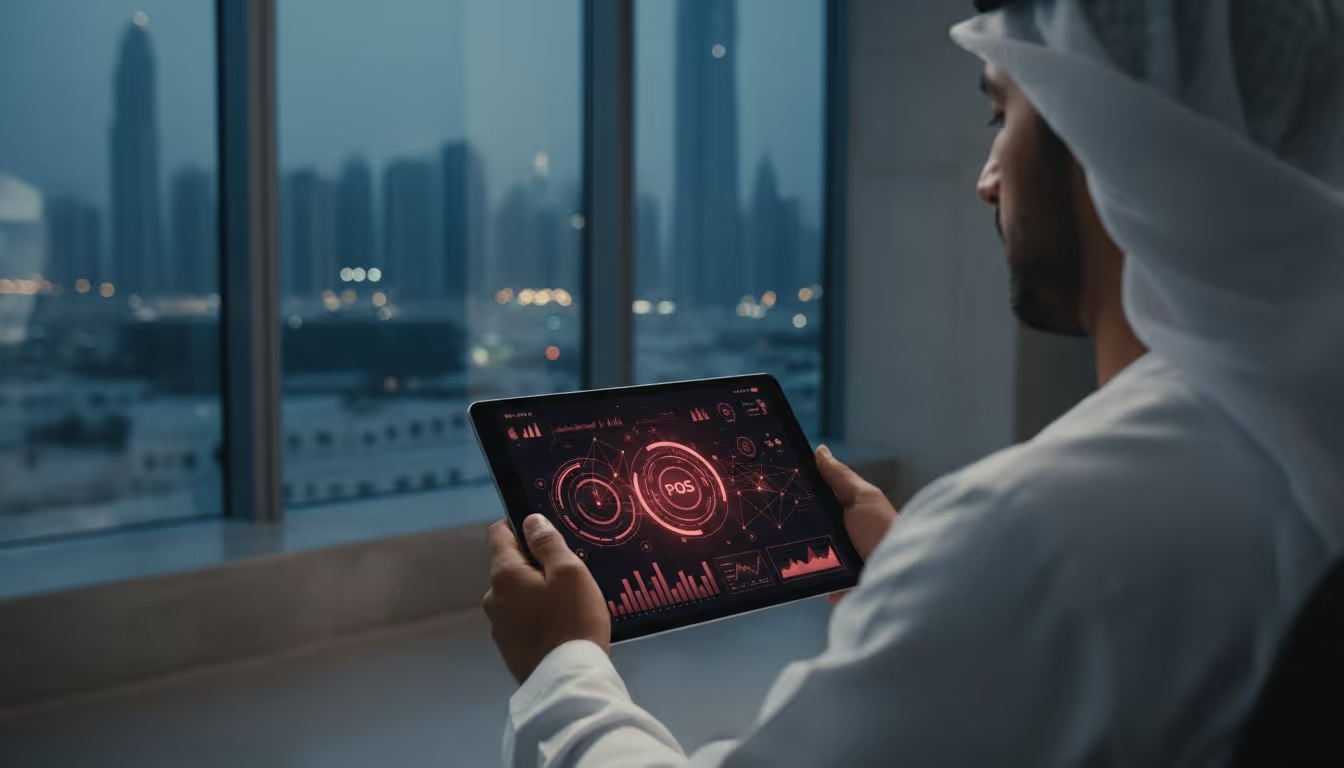
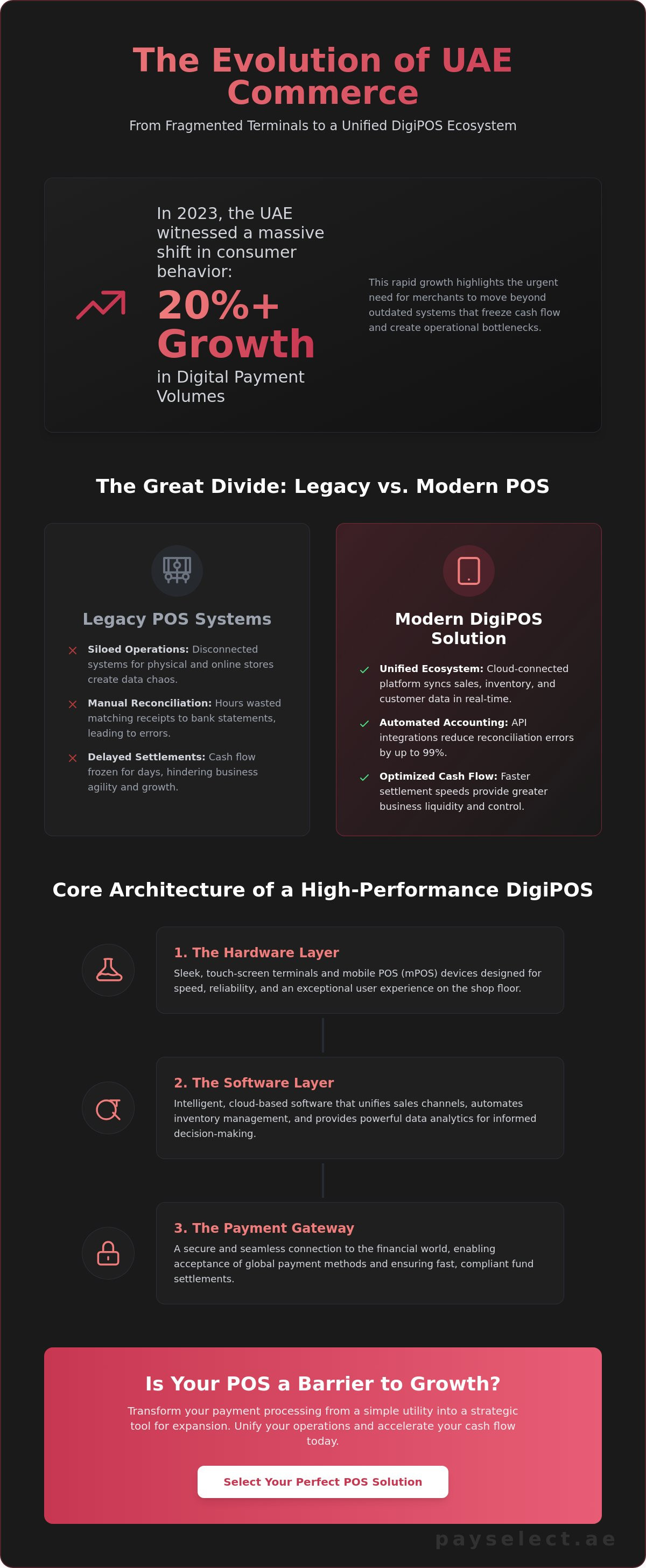
What if the technology you use to collect payments is actually the biggest barrier to your business growth? In 2023, digital payment volumes in the UAE grew by more than 20 percent, yet many merchants still struggle with a fragmented digipos solution that creates more work than it saves. You likely recognize the frustration of dealing with settlement delays that freeze your cash flow in AED (د.إ) or managing disconnected systems for your physical and online stores. It's difficult to scale when your sales data is scattered across multiple platforms and bank reconciliations take days to complete.
Mastering modern digital POS systems is the key to reclaiming your time and optimizing your transaction costs. This guide provides the clarity you need to unify your operations, lower your overhead, and deliver the faster checkout experience your customers expect. We will examine how to integrate your sales channels, navigate local settlement complexities, and choose a fintech partner that transforms your payment processing from a utility into a strategic tool for expansion across the Emirates.
Key Takeaways
• Navigate the UAE’s rapid shift toward digital-first commerce and learn how to transition your operations into a cloud-connected ecosystem by 2026.
• Identify the core technical layers of a high-performance digipos solution to ensure seamless integration and the ability to accept borderless global payments.
• Uncover the strategic link between settlement speeds and business liquidity to better manage your cash flow and optimize transaction costs in AED.
• Apply a professional comparison framework to evaluate providers, focusing on industry-specific features that drive efficiency for your unique business model.
• Leverage independent advisory and specialized tools to cut through market complexity and select the most effective payment stack for your growth.
The Evolution of Digital POS (DigiPOS) Solutions in the UAE
The UAE commerce landscape is undergoing a radical transformation. Traditional cash transactions are fading as the nation moves toward a digital-first economy by 2026. For local merchants, a digipos solution is no longer a luxury; it's a fundamental requirement for survival in a competitive market. Modern systems have moved beyond simple card swiping. They now function as cloud-connected ecosystems that unify sales, inventory, and customer data into a single, intuitive interface. This shift represents a move away from isolated hardware toward a philosophy of "seamless commerce," where every transaction is an opportunity to collect data and build loyalty.
From Cash Registers to Cloud-Based Ecosystems
Traditional Electronic Cash Registers (ECR) once dominated retail spaces across the Emirates. These legacy machines operated in silos, forcing business owners to manually reconcile accounts at the end of every shift. A digital-first Point of Sale (POS) system eliminates these bottlenecks. Cloud connectivity allows for real-time data synchronization across multiple branches. Whether you manage a boutique in Dubai Mall or a warehouse in Kizad, you can monitor performance remotely and make informed decisions instantly. This visibility helps businesses optimize stock levels, reduce waste, and accelerate checkout speeds. Modern pos machines offer the mobility and flexibility required to serve customers anywhere on the floor, breaking the tether to a fixed counter.
Legacy systems often fail to meet the demands of modern, multi-channel businesses. If a customer buys a product through an Instagram shop but wants to return it at a physical storefront in Abu Dhabi, old-school registers struggle to bridge the gap. A modern digipos solution integrates these channels, ensuring that inventory counts and financial records remain accurate regardless of where the sale happens. This integration streamlines operations, improves accuracy, and empowers staff to focus on the customer experience rather than manual data entry.
The Role of Digital POS in the National Fintech Vision
The adoption of advanced payment technology aligns with the UAE's broader fintech ambitions. The government aims to position the country as a global hub for the digital economy, encouraging businesses to ditch paper-based processes. Merchants must now navigate local financial regulations and data security standards to maintain compliance while scaling their operations. A digital POS solution is the intersection of hardware, software, and financial connectivity. By integrating these three pillars, entrepreneurs can protect their revenue and meet the high expectations of a tech-savvy population. High-end fintech tools provide the calm assurance that transactions are secure, settlements are fast, and the business is ready for global reach.
Core Architecture: How a Modern Digital POS Solution Streamlines Operations
A high-performance digipos solution operates through three distinct layers: robust hardware, intelligent software, and a secure payment gateway. These components work in unison to transform a simple transaction into a strategic data point. Modern systems are designed to be borderless. They allow UAE merchants to accept global payment methods, including international credit cards and digital wallets, without friction. This capability is vital as the UAE continues to lead in the digital economy and infrastructure, attracting millions of international tourists and investors annually.
The real power of a modern digipos solution lies in its ability to communicate. API integrations connect the POS directly to existing ERP or accounting software. This connectivity removes the need for manual data entry. It reduces reconciliation errors by 99% for accounting teams. Instead of spending hours matching receipts to bank statements, the system automates the process. Businesses can track every fil and Dirham in real-time. This level of transparency helps owners streamline their financial operations with absolute precision.
Hardware Versatility and User Experience
Modern hardware has shifted toward sleek, touch-screen terminals and mobile POS (mPOS) devices. These tools are built for speed. Ergonomic designs help staff navigate menus quickly, which reduces checkout queues during peak shopping hours. In the UAE market, "tap-to-pay" is no longer a luxury; it's a consumer expectation. NFC-enabled terminals accelerate the payment process, allowing customers to complete a transaction in under three seconds. This efficiency directly impacts the bottom line by increasing the volume of customers served per hour.
Software Intelligence and Backend Integration
The software layer manages the complexities of daily business. It handles everything from staff shift scheduling to complex loyalty programs. By using integrated POS systems, merchants gain access to unified reporting. This means a business owner can view sales data from a branch in Dubai and another in Abu Dhabi on a single dashboard. Security remains the top priority. These systems employ Level 1 PCI compliance to encrypt data and protect against fraud. This architecture ensures that sensitive merchant information stays safe while the business continues to scale. You can explore secure gateway options to find the right fit for your specific industry needs.
Identifying the Strategic Value of Integrated POS Systems
Many UAE business owners mistakenly view hardware as a commodity, assuming every terminal offers identical performance. This perspective overlooks how a sophisticated digipos solution functions as the operational heartbeat of a modern enterprise. Choosing a platform based solely on the lowest upfront cost often leads to higher long-term expenses through inefficient processing and fragmented data. Integrating these systems provides a strategic advantage of integrated POS systems for companies looking to scale within Dubai's fast-paced commercial ecosystem.
Settlement speed is a critical factor for maintaining healthy liquidity. While legacy systems might hold funds for three to five business days, advanced digital platforms accelerate this process. Accessing your capital in AED within 24 hours allows for faster inventory reinvestment and better payroll management. Beyond cash flow, the data generated at the point of sale optimizes stock levels. Businesses using real-time analytics frequently report a 15% reduction in inventory waste by identifying slow-moving items before they expire or become obsolete.
Personalization is the final pillar of strategic value. A digipos solution captures purchase history to build comprehensive customer profiles. Instead of generic promotions, merchants can send targeted offers based on specific buying habits, significantly increasing the probability of repeat visits and higher average transaction values.
Optimizing Transaction Costs and Settlement
Merchant Discount Rates (MDR) vary significantly between providers. Some offer flat-rate pricing, while others use tiered structures that change based on card type or volume. It's vital to choose a partner that provides a transparent breakdown to avoid unexpected "interchange" or "statement" fees that can quietly erode profit margins. Prioritize providers offering T+1 settlement windows. This ensures that Monday's sales are available in your bank account by Tuesday, providing the agility needed to respond to market demands without relying on expensive credit lines.
Enhancing the Customer Journey
The checkout experience defines a customer's final impression of your brand. Digital receipts sent via SMS or email reduce paper waste and provide a seamless way to collect contact information for loyalty programs. There is also a growing synergy between physical store data and your online payment gateway profiles. This unified view allows a customer to buy online and return in-store without friction. Additionally, implementing "Buy Now, Pay Later" (BNPL) options directly at the terminal caters to the 30% of UAE consumers who now prefer flexible installment plans for mid-to-high value purchases. This flexibility directly correlates with increased conversion rates at the till.
Comparison Framework: Choosing the Right Digital POS for Your Industry
Selecting the right digipos solution requires a structured methodology that moves beyond basic price comparisons. Your choice must align with your specific industry workflows, technical support needs, and long-term growth trajectory. A robust evaluation framework prioritizes three core pillars: functional fit, local reliability, and architectural scalability.
Business continuity in the UAE depends on 24/7 local technical support. When a hardware failure occurs during a busy weekend in Downtown Dubai, waiting for a remote ticket to be resolved in a different time zone isn't an option. You need a partner that provides on-the-ground assistance to ensure your registers never stop ringing. Additionally, assess how a platform handles national expansion. A solution that works for a single boutique in Jumeirah must be able to scale seamlessly as you open branches in Abu Dhabi or Sharjah, providing a unified view of your entire operation.
Evaluation Criteria for Retail and Trading
Retailers operating in SKU-heavy environments require high-volume transaction stability and precision. According to 2023 retail industry reports, inventory inaccuracies can lead to a 10% loss in annual revenue. Your POS must offer:
Instant Barcode Efficiency
Rapid scanning capabilities that prevent bottlenecks during peak hours or seasonal sales.
Real-Time Inventory Management
Automatic stock level updates across all sales channels to prevent overselling.
Cross-Store Visibility
The ability to check stock at a different branch instantly, ensuring you never lose a sale due to local stockouts.
These features streamline the backend while accelerating the checkout process for the customer.
Requirements for Hospitality and Service Sectors
The hospitality sector thrives on speed and guest experience. A versatile digipos solution empowers staff to focus on service rather than technical hurdles. Data from 2024 service trends suggests that mobile terminals can reduce table turnover time by 12 minutes on average, directly increasing daily revenue capacity.
Key requirements for this sector include integrated tip management, split-billing, and automated appointment scheduling. For businesses in tourism hubs, cross-border payment capabilities are essential. This allows international visitors to pay using their preferred home currency or digital wallets, removing friction at the point of sale and improving the overall guest experience. Whether it's a tableside payment or a mobile service "on-the-go," the hardware must be as mobile as your team.
Different providers offer varying levels of integration and fee structures. While some focus on low entry costs, others provide deeper analytical tools that help you optimize your margins. Focus on a partner that bridges the gap between complex financial infrastructure and your daily operational needs.
Optimizing Your Payment Stack with Independent Advisory
Selecting the right payment infrastructure shouldn't be a guessing game. PaySelect acts as the independent bridge between UAE merchants and a fragmented market of providers. We don't sell you a specific bank's agenda; we provide the clarity needed to scale. Our "Take the Test" tool simplifies this complex selection process by filtering dozens of variables into a single, actionable recommendation. It's the fastest way to identify which digipos solution aligns with your specific transaction volume and operational goals.
The PaySelect Advantage: Independence and Transparency
An unbiased comparison is essential in a market where fee structures and settlement times vary significantly. PaySelect analyzes industry-specific data to provide tailored recommendations that go beyond surface-level rates. For enterprise-scale operations, our advisory services uncover hidden cost-saving opportunities that standard audits often miss. We focus on three core pillars: transparency, efficiency, and growth. By examining your historical transaction data from 2023 and 2024, we identify patterns that help you negotiate better terms or switch to a more compatible provider. This data-driven approach ensures your digipos solution is a strategic asset rather than a recurring expense.
Next Steps for Business Transformation
The first step toward optimization is a thorough audit of your current transaction costs. Many UAE businesses lose thousands of AED annually to legacy fee structures and inefficient hardware. You need to evaluate your system performance against current market standards. If your settlement period exceeds 48 hours or your hardware lacks cloud integration, it's time for an upgrade. PaySelect provides a clear path to getting started with a more efficient infrastructure. You can explore our range of modern POS machines to see how updated hardware integrates with your existing software stack.
• Audit your current processing fees and identify hidden charges.
• Compare settlement speeds across different UAE providers.
• Test your current system for integration bottlenecks and downtime.
Empower your business to scale with the right payment technology. Take a strategic approach to your payment infrastructure today and eliminate the friction that holds your revenue back. The right choice doesn't just process payments; it accelerates your entire business cycle. It's time to move away from stagnant financial setups and embrace a system designed for the modern digital economy.
Accelerate Your Growth with a Strategic Payment Foundation
The UAE business landscape demands speed and precision. Selecting a modern digipos solution transforms your checkout from a simple utility into a strategic asset that streamlines operations and captures vital data. You've explored how integrated architecture removes friction and why a structured comparison framework is essential for navigating the local market. Don't let technical complexity or hidden fees stall your expansion. It's time to move beyond traditional limitations and embrace a system built for the digital economy.
PaySelect offers independent and unbiased comparisons to ensure you find the right fit without provider favoritism. Our expert advisory focuses on cost optimization, helping you protect your margins while scaling. We're already trusted by SMEs and enterprises across the region to navigate these critical decisions. Take the next step toward a seamless, borderless payment experience that empowers your team and satisfies your customers.
Find the perfect digital POS solution for your business with PaySelect
Your journey toward a more efficient and profitable operation starts with the right partner by your side.
Frequently Asked Questions
What exactly is a digital POS (DigiPOS) solution?
A digital POS (DigiPOS) solution is a cloud-based payment system that processes transactions through internet-connected devices rather than traditional phone lines. It transforms tablets, smartphones, or dedicated hardware into powerful hubs that manage sales, inventory, and customer data in real-time. This modern digipos solution empowers UAE merchants to accept diverse payment methods while syncing data across multiple branch locations instantly.
How much does a digital POS system typically cost for a business in the UAE?
Hardware costs for a digital POS in the UAE generally range from 1,500 AED to 4,500 AED per terminal depending on the device specifications. Monthly software subscriptions often start around 200 AED, while transaction fees typically vary between 1.5% and 2.5% based on your industry and volume. These costs are influenced by the Central Bank of the UAE regulations and the specific features required for your retail or F&B operations.
Can I integrate my digital POS with my existing online store?
Yes, most modern systems allow you to sync your physical shop with your e-commerce platform to create a unified inventory view. This integration ensures that when a product sells in your Dubai storefront, your online stock levels update automatically. It eliminates manual data entry, prevents overselling, and provides a seamless omnichannel experience for your customers across all sales touchpoints.
What is the difference between a standard POS and an integrated ECR solution?
A standard POS operates as a standalone terminal while an integrated Electronic Cash Register (ECR) communicates directly with your payment terminal to automate the checkout process. Integrated ECR solutions remove the need for manual amount entry, which reduces human error during the payment phase. This connectivity speeds up checkout lines, simplifies end-of-day reconciliation, and ensures your financial records remain perfectly accurate.
How long does it take to set up and go live with a new digital POS?
The timeline to go live typically spans 3 to 7 business days once your KYC documents are approved by the provider. This window includes terminal configuration, software installation, and staff training on the new interface. Choosing a streamlined digipos solution allows your business to transition from traditional cash handling to digital processing without long periods of operational downtime.
Is it possible to accept international cards and wallets through a local POS?
Local POS systems in the UAE are designed to accept global payment methods including Visa, Mastercard, and American Express from international travelers. You can also enable digital wallets like Apple Pay, Google Pay, and AliPay to cater to the 16 million tourists who visit Dubai annually. Providing these borderless payment options ensures you don't miss a sale due to currency or card type restrictions.
What security standards should I look for in a digital payment provider?
You must ensure your provider maintains PCI DSS Level 1 certification to guarantee the highest level of data protection for cardholder information. Look for systems that utilize end-to-end encryption and tokenization to secure every transaction from the terminal to the bank. These standards protect your business from fraud and ensure compliance with the strict financial regulations set by the UAE authorities.
How does PaySelect help me choose the best POS system?
PaySelect acts as a strategic partner that simplifies the complex landscape of payment providers by matching your specific needs with the right technology. We help you overcome common pain points like high transaction fees, slow settlement cycles, and integration hurdles. Our platform empowers you to compare options, optimize your payment stack, and scale your business with a focus on speed and reliability.
Disclaimer
This content is for informational purposes only and should not be considered financial, legal, or regulatory advice. Payment provider availability, pricing, and approval processes vary depending on individual business circumstances. PaySelect does not guarantee provider acceptance or specific outcomes. Businesses should conduct their own due diligence before entering into any agreements.
Empowering businesses to achieve greater growth