
How much revenue does your business lose when a slow checkout causes a customer to walk away? With the UAE digital payments market projected to exceed 155 billion AED in total transaction value by 2026, your pos system is the most critical link in your value chain. You've likely felt the sting of high transaction fees eating into your margins or the headache of trying to sync a global platform with a local bank account. These technical barriers shouldn't stall your expansion.
We understand that you want a tool that empowers your team rather than confusing them. This guide provides the blueprint to master point-of-sale technology and choose a system that streamlines your operations across the Emirates. You'll learn how to create a seamless checkout experience, gain real-time visibility across all sales channels, and optimize your payment infrastructure to lower costs. We'll break down the differences between payment providers to help you build a borderless, efficient, and highly profitable business.
Key Takeaways
• Understand how modern technology transforms your point-of-sale from a simple cash register into a central nervous system that empowers your business to scale across the UAE.
• Learn to navigate the architecture of high-performance setups by evaluating the strategic trade-offs between proprietary hardware and flexible tablet-based solutions.
• Ensure your business remains secure and compliant by mastering the local regulatory landscape and the critical impact of PCI DSS on your operations.
• Discover a step-by-step framework to select the ideal pos system by auditing your specific industry needs and evaluating seamless integration with your existing software.
• Optimize your financial infrastructure by leveraging independent audits and transparent insights to streamline complex, multi-provider payment environments.
Understanding the Modern POS System in 2026
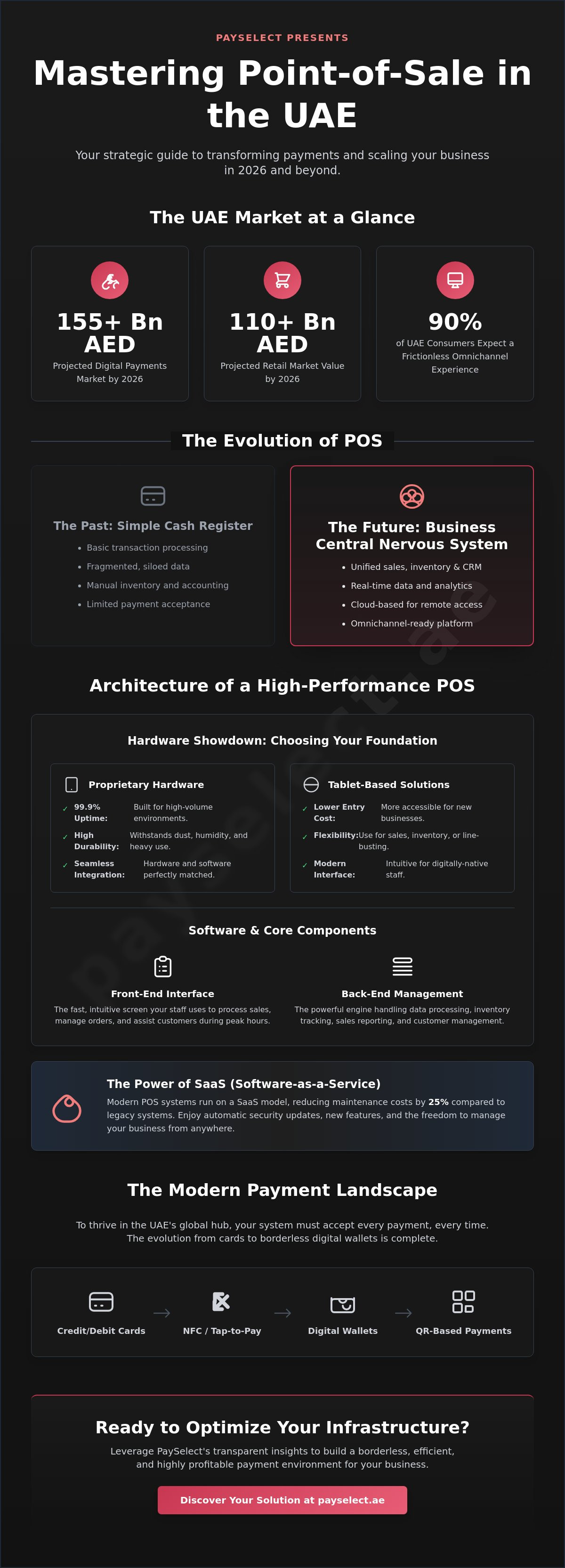
In 2026, the Modern POS System is no longer just a tool for processing payments. It acts as the central nervous system of your business, pulse-checking every transaction and inventory shift in real time. The UAE retail market is projected to reach over AED 110 billion by 2026, and staying competitive requires more than a simple cash register. Static hardware has been replaced by integrated cloud-based management platforms that unify operations.
Businesses in Dubai and Abu Dhabi now face a landscape where 90% of consumers expect a frictionless omnichannel experience. A robust pos system bridges the gap between your physical storefront and digital sales channels, ensuring that a product sold on your website is instantly removed from your boutique's shelf stock. This synchronization eliminates overselling and optimizes stock levels, which is vital for scaling in the UAE's high-velocity market. It's about turning a point of sale into a point of growth.
For entrepreneurs, the primary pain point is often fragmented data. When your sales, accounting, and inventory don't talk to each other, you lose hours on manual reconciliations. Modern pos machines solve this by consolidating every data point into a single dashboard. This level of integration empowers you to make decisions based on live analytics rather than last month's spreadsheets.
Core Components of a Point of Sale
A modern pos system consists of two distinct yet unified layers. The front-end interface is what your staff interacts with, designed for speed and intuitive navigation during peak hours. Behind the scenes, the back-end management module handles the heavy lifting of data processing and reporting. When a customer taps their phone to pay, data flows instantly from the terminal to your inventory and accounting modules without manual entry. A cloud-POS serves as a real-time data synchronizer that ensures inventory, sales, and customer profiles remain consistent across every touchpoint.
The Evolution of Payment Acceptance
Payment habits in the UAE have shifted rapidly. By 2026, credit cards are just one part of the equation. Your system must handle NFC, digital wallets, and QR-based payments to satisfy a tech-savvy population. With the UAE's status as a global tourism hub, borderless payment capabilities are essential for accepting international wallets without high conversion friction. Systems must prioritize tap-to-pay and mobile-first experiences to keep checkout lines moving. This evolution removes the traditional barriers to commerce, allowing you to capture every sale regardless of how the customer chooses to pay.
The Architecture of a High-Performance POS: Hardware and Software
Modern commerce demands a robust foundation. A high-performance The Architecture of a High-Performance POS integrates physical durability with cloud-based intelligence to ensure business continuity. Merchants in the UAE now face a choice between dedicated proprietary hardware and flexible tablet-based solutions. While tablets offer a lower entry cost, proprietary systems provide 99.9% uptime in high-volume settings. These machines are engineered to withstand the unique demands of the region; they handle the high humidity and dust levels common in outdoor markets or busy retail hubs better than consumer-grade electronics.
The shift toward Software-as-a-Service (SaaS) models has democratized access to elite tools. Small businesses can now scale without massive upfront capital. SaaS ensures that your pos system stays updated with the latest security protocols and feature sets automatically. This model reduces maintenance costs by 25% compared to legacy on-premise installations. It empowers entrepreneurs to manage their operations from anywhere, whether they're in a Dubai office or traveling abroad.
Essential Hardware for UAE Merchants
Efficiency at the checkout starts with the right tools. Smart terminals and handheld devices allow for line-busting in crowded malls. They enable tableside service in the hospitality sector, reducing wait times by up to 15 minutes during peak hours. You can explore different POS machine options to find the right fit for your floor plan. Professional setups often include:
Smart Terminals
Integrated chip, PIN, and contactless readers for seamless transactions.
Receipt Solutions
High-speed thermal printers for physical records or eco-friendly digital invoicing sent via SMS or email.
Scanning
High-precision barcode scanners and RFID integration for retailers managing over 5,000 SKUs.
Software Features that Drive Growth
Software is the brain of your operation. Advanced inventory management provides real-time visibility across multiple locations. Systems now include automated low-stock alerts that trigger reordering when levels hit a specific threshold. This prevents stockouts that cost retailers significant revenue each year. By automating these tasks, staff spend 30% less time on manual data entry.
Integrated Customer Relationship Management (CRM) tools capture data directly at the point of sale. This allows for personalized loyalty programs and targeted marketing campaigns based on actual purchase history. By centralizing these functions, merchants eliminate the friction of managing separate databases. If you're looking to streamline your operation, consider how an integrated pos system can transform your daily workflow.
Navigating the Payments Landscape: Compliance and Costs
Operating in the UAE requires strict adherence to the Central Bank’s Retail Payment Services and Card Schemes Regulation. These rules ensure every transaction processed through your pos system meets international safety standards. Compliance isn't a one-time task; it's a continuous commitment to protecting customer data. Many entrepreneurs face friction during the setup phase due to complex documentation or unexpected costs. PaySelect streamlines this transition by simplifying the integration process. Our platform acts as a bridge, helping you scale, optimize, and empower your operations without getting bogged down by technical debt.
Cash flow management depends heavily on settlement cycles. In the UAE market, standard cycles range from T+1 to T+3 business days. A delay of even 48 hours can disrupt inventory restocking or payroll for a growing SME. You should prioritize providers that offer transparent, predictable payouts. Fast settlements empower you to reinvest capital immediately, driving faster growth and higher efficiency.
Hidden fees often lurk in the fine print of service agreements. Watch out for monthly minimum processing fees, which penalize you during slow sales months. Other common costs include terminal maintenance fees or statement fees that can add 50 د.إ to 150 د.إ to your monthly overhead. Identifying these early allows for better budget optimization and prevents profit leakage.
Decoding Transaction Fees and MDR
Understanding the Merchant Discount Rate (MDR) is vital for protecting your margins. This fee usually ranges from 1.5% to 2.5% for credit cards in the UAE, depending on your industry. High-volume retailers often benefit from a fixed-fee model, while smaller boutiques might prefer a percentage-based approach to keep costs proportional to sales. Always ask about interchange fees. These are the base costs set by card networks like Visa or Mastercard that providers pass on to you. Transparent pricing helps you avoid the "hidden fee" trap where non-compliance penalties eat into your revenue.
Security and Data Protection Standards
Security is the foundation of digital commerce. Your pos system must utilize end-to-end encryption to render data useless to unauthorized parties. The UAE Personal Data Protection Law, Federal Decree-Law No. 45 of 2021, mandates strict controls over how consumer information is stored. Local data residency is now a priority for 85% of UAE businesses to ensure faster processing and legal compliance. Modern systems mitigate fraud risk by using real-time AI monitoring to flag suspicious patterns. This proactive approach saves your business from costly chargebacks and builds long-term customer loyalty.
Strategic Selection: How to Choose the Right POS for Your Business
Selecting a pos system is a pivotal decision that dictates your operational efficiency for years. In the UAE's competitive market, a generic solution won't suffice. You need a platform that aligns with your specific growth trajectory and local regulations. Follow these five strategic steps to ensure your choice empowers your expansion rather than limiting it.
Step 1: Audit your industry requirements.
Different sectors demand unique features. A high-volume restaurant in Downtown Dubai requires speed and table management, while a luxury retail boutique in Abu Dhabi needs deep inventory analytics.
Step 2: Evaluate integration capabilities.
Your POS shouldn't exist in a vacuum. Ensure it connects seamlessly with your existing accounting software and ERP systems to eliminate manual data entry.
Step 3: Assess support scalability.
Technical issues don't follow a schedule. Verify that your provider offers 24/7 local support to keep your checkout lines moving during peak hours.
Step 4: Compare Total Cost of Ownership (TCO).
Look beyond the initial hardware price. Calculate software subscriptions, transaction fees, and maintenance costs over a three-year period to find the true value.
Step 5: Utilize a neutral comparison tool.
Avoid brand bias by using objective tools to match your specific business metrics with the right provider capabilities.
Industry-Specific Functional Requirements
Hospitality businesses must prioritize table management and kitchen display systems (KDS). These tools streamline communication between the front-of-house and the kitchen, reducing order errors by up to 25% based on 2024 industry benchmarks. For retail chains, multi-location synchronization is non-negotiable. It allows you to track stock levels across Al Ain, Sharjah, and Dubai from a single dashboard. Service-based entrepreneurs, such as spa owners or consultants, benefit most from integrated booking and appointment scheduling that syncs directly with the payment terminal.
Integration and Connectivity
Modern businesses require open APIs to future-proof their payment stack. This flexibility allows you to add new features or third-party apps as your business evolves. Learn more about payment gateway integration to understand how your online and offline sales can merge into one unified stream. Connectivity is another critical factor. Ensure your pos system includes a robust offline mode. This feature prevents sales loss during internet outages, allowing you to process transactions securely and sync them once the connection returns. A 2024 survey of UAE SMEs revealed that 78% of businesses prioritize software integration over hardware aesthetics to reduce operational friction.
PaySelect simplifies this complex landscape by helping you identify the right partners without the usual setup headaches. We bridge the gap between complex financial infrastructure and your daily operational needs.
Optimizing Your Infrastructure with PaySelect
The UAE payment landscape is shifting rapidly. By 2026, digital transaction volumes in the Emirates are projected to exceed AED 100 billion. For a growing business, managing a pos system involves more than just swiping cards. It requires a lean, transparent infrastructure that eliminates hidden costs and technical bottlenecks. PaySelect provides the clarity you need in a market saturated with competing providers and complex fee structures.
Operational friction often stems from a lack of integration between your sales floor and your back-office finance. We solve this by designing infrastructure that prioritizes speed and reliability. Our expert-led approach ensures your hardware and software work in harmony. This reduces downtime and accelerates your settlement cycles, keeping your cash flow consistent.
Why Independence Matters in Payment Selection
Choosing a provider based on direct marketing is a common pitfall. Most businesses in Dubai and Abu Dhabi find themselves locked into contracts with 3 to 4 hidden fee layers that weren't clear at signing. PaySelect offers unbiased data to cut through the noise. We don't favor one provider over another. Instead, we give you the insights to compare different settlement terms and hardware capabilities objectively.
Transparency empowers you to negotiate better rates. When you understand the underlying costs of processing, you gain leverage. PaySelect acts as a bridge between tech and finance. We translate complex API requirements into clear financial outcomes, ensuring your pos system serves your bottom line as much as it serves your customers.
Continuous Optimization and Cost Reduction
Static payment setups lose efficiency over time. Industry data suggests that 65% of UAE enterprises pay higher interchange fees than necessary because they haven't audited their setup in over 24 months. You should conduct a payment infrastructure audit annually to identify savings and upgrade your security protocols. This proactive approach keeps your margins healthy as you scale.
Optimization isn't just about local sales. For businesses with international reach, optimizing cross-border payment solutions is essential to avoid excessive currency conversion fees. PaySelect helps you identify these leaks and plug them with better routing and smarter integration strategies. We focus on the ultimate business outcome: more profit and less administrative burden.
Finding the right fit doesn't have to be a guessing game. Use our "Take the Test" tool to filter through the noise and find your ideal match based on your specific industry needs, transaction volume, and growth targets. It's the fastest way to streamline your operations.
Scale Your UAE Operations With Precision
The UAE retail and hospitality landscape in 2026 demands a shift from legacy tools to integrated commerce hubs. Success now hinges on three critical pillars: hardware reliability, software agility, and total regulatory compliance. You'll find that navigating these requirements while managing merchant fees in AED requires a strategic approach that prioritizes long-term ROI. Businesses that don't modernize their stack risk falling behind in a market that values speed and frictionless service above all else.
Selecting the ideal pos system is a pivotal decision for any growing enterprise looking to secure a competitive edge. PaySelect simplifies this complex journey by providing an independent and unbiased comparison of top UAE providers. We leverage specialized expertise in the MENA payments landscape to help you streamline operations, accelerate transactions, and scale your reach. Our platform has a proven track record of optimizing costs for both SMEs and large-scale Enterprises, ensuring your financial infrastructure is built for global ambition.
Find the perfect POS system for your business with our comparison tool
The right technology partner makes a world of difference in a fast-moving digital economy. Take absolute control of your payment strategy today and build a foundation for limitless growth.
Frequently Asked Questions
What is the average cost of a POS system in the UAE?
A basic cloud-based pos system in the UAE typically costs between AED 2,000 and AED 5,000 for initial hardware. Monthly software subscriptions generally range from AED 150 to AED 600 per terminal. These figures vary based on your industry requirements and the number of integrated features like inventory management. PaySelect streamlines these costs by consolidating payment processes, which reduces the need for multiple expensive third-party integrations.
Can I use my own hardware with a new POS software provider?
You can often repurpose existing tablets or computers if they meet the software's operating system requirements. Most modern providers support standard iPad or Android devices, but proprietary hardware from legacy systems is usually locked. Check compatibility for receipt printers and card terminals, as these often require specific drivers. PaySelect helps businesses bridge these hardware gaps by offering flexible integration options that simplify the transition to a more efficient digital infrastructure.
How long does it take to set up a new POS system?
Standard setup typically takes between 24 hours and 7 days. If your inventory includes fewer than 500 items, you'll likely be operational within 48 hours. Larger enterprises with complex menu structures or thousands of SKUs may require a full week for data migration and staff training. PaySelect accelerates this timeline by providing intuitive interfaces that reduce the learning curve for your team, ensuring you start processing transactions without delay.
Do POS systems in the UAE work offline if the internet goes down?
Most leading pos system solutions include an offline mode that allows you to process cash transactions and queue card payments. Once your connection is restored, the system automatically syncs all data to the cloud to maintain accurate inventory and sales records. This feature is vital for UAE businesses to avoid service interruptions during peak hours. Our platform ensures these transitions are seamless, protecting your revenue even when connectivity fluctuates.
What is the difference between a POS system and a payment gateway?
A POS system is the software and hardware you use to manage sales and inventory, while a payment gateway is the secure technology that routes transaction data to the bank. Think of the POS as your digital storefront and the gateway as the invisible bridge for your funds. Many UAE merchants struggle with managing multiple providers for these services. PaySelect eliminates this friction by acting as a single point of contact for your payment needs, simplifying settlements and reporting.
Is it better to buy or lease POS hardware?
Buying hardware is generally more cost-effective for established businesses, as it eliminates recurring monthly rental fees that can exceed the device's value within 18 months. Leasing is a viable option for startups looking to preserve capital, as it lowers the initial entry cost to nearly zero. We empower businesses to scale by offering clear insights into these financial choices. Choosing the right path depends on your current cash flow and long-term expansion goals.
How do I switch POS providers without losing my sales data?
You can migrate your data by exporting your current inventory and sales history into CSV or Excel files for manual upload to the new system. Some modern platforms offer direct API integrations that automate this transfer in minutes. Data loss is a major pain point for growing companies, which is why PaySelect focuses on high-end integration tools. Our technology ensures your historical insights remain intact, allowing for a borderless transition between service providers.
Are there specific POS systems required for VAT compliance in the UAE?
The Federal Tax Authority (FTA) requires systems to generate valid Tax Invoices that include your TRN, the VAT rate, and the total tax amount. Since the 2018 VAT implementation, businesses must use software that accurately calculates the 5 percent levy and stores records for five years. Using a compliant system is non-negotiable for legal operations in the Emirates. PaySelect helps you navigate these regulatory requirements by ensuring every transaction meets local standards, providing peace of mind as you grow.
Disclaimer
This content is for informational purposes only and should not be considered financial, legal, or regulatory advice. Payment provider availability, pricing, and approval processes vary depending on individual business circumstances. PaySelect does not guarantee provider acceptance or specific outcomes. Businesses should conduct their own due diligence before entering into any agreements.
Empowering businesses to achieve greater growth