The Ultimate Guide to NFC Cards: Technology, Payments, and Business Growth in 2026
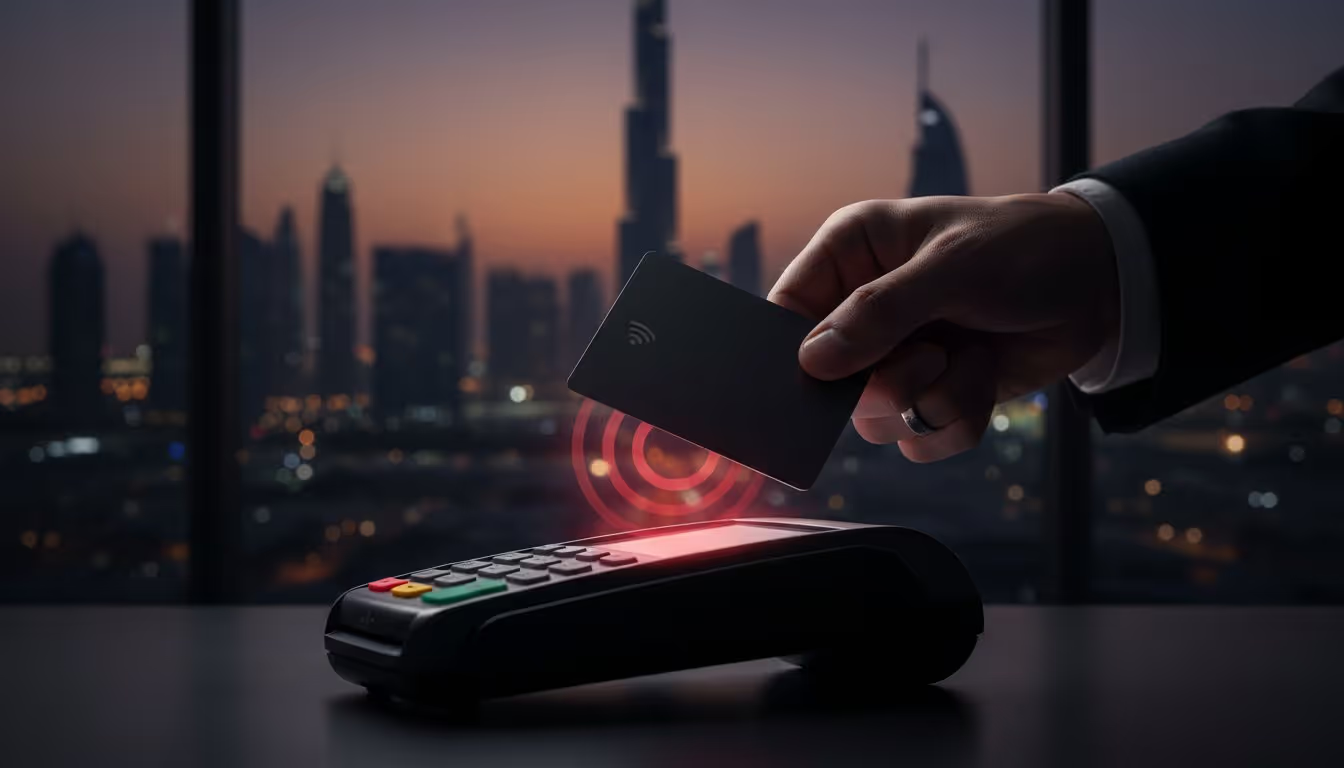
The physical wallet is becoming a relic in the UAE faster than most entrepreneurs realize. By 2026, market data suggests that nearly 90% of retail transactions in Dubai and Abu Dhabi will happen without a single card swipe. You've likely felt this shift as customers increasingly reach for their phone or an nfc card to complete a purchase in seconds. It's a transition that promises efficiency, yet many business owners still feel caught between technical jargon and concerns about data skimming.
We understand that choosing the right technology shouldn't feel like a gamble with your security or your customer's trust. This guide clarifies the essential differences between NFC and RFID, ensuring you can implement the right solutions to accelerate your growth. You'll discover how to streamline your operations, protect sensitive data, and create a frictionless experience that keeps your customers returning. We'll break down the specific steps to transition your business into a leader of the digital economy through smarter, faster, and more secure payment systems that empower your global reach.
Key Takeaways
• Master the fundamentals of Near Field Communication to streamline operations and provide the high-speed connectivity expected in the modern UAE market.
• Learn how to replace traditional paper stacks with a single digital solution that empowers your team to share professional details instantly with a simple tap.
• Discover how implementing an nfc card strategy can reduce checkout times by up to 60%, optimizing your daily transaction flow and customer experience.
• Identify the essential hardware upgrades and training protocols required to integrate contactless payments into your UAE infrastructure without friction.
• Unlock the potential of data-driven insights from digital transactions to accelerate your business growth and master the complexities of borderless commerce.
Table of Contents
• What is an NFC Card? Defining the Technology of Seamless Connectivity
• Secure Data Exchange: The Technical Architecture of Near Field Communication
• NFC Business Cards vs. Payment Cards: Choosing the Right Tool for Your Strategy
• Best Practices for Accepting NFC Payments: A Roadmap for UAE Businesses
• Beyond the Tap: Optimizing Your Payment Infrastructure for an NFC-First World
What is an NFC Card? Defining the Technology of Seamless Connectivity
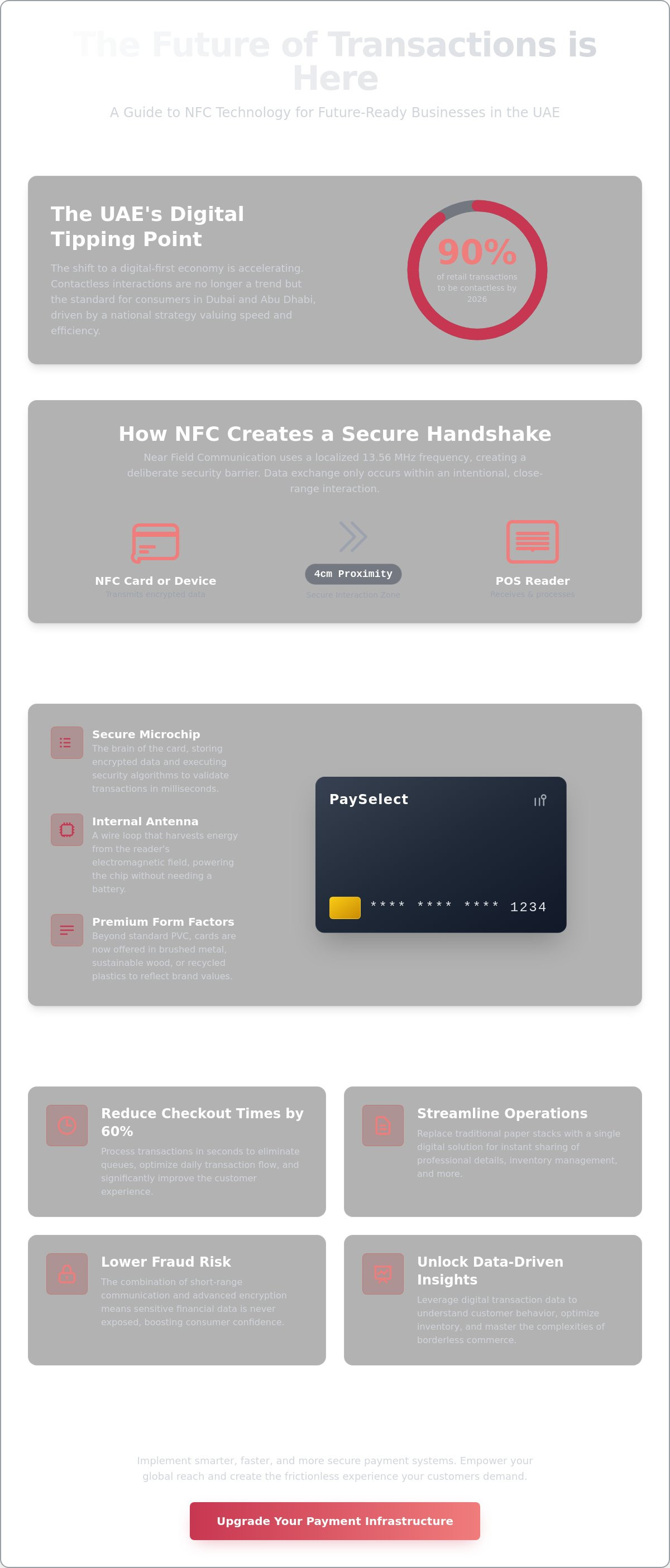
An nfc card is a sophisticated evolution of traditional payment and data tools. It utilizes a specialized subset of Radio Frequency Identification (RFID) technology to facilitate data exchange over very short distances. Most interactions occur within a 4cm radius. This short range is a deliberate security feature; it prevents accidental triggers or unauthorized data interception from a distance. While older magnetic stripe cards required a physical swipe and "dip" cards needed direct contact with a reader, an NFC card operates through proximity. It's a touchless process that eliminates mechanical wear and tear on both the card and the terminal.
In the United Arab Emirates, the shift toward this technology is part of a broader national strategy. The UAE government aims for the digital economy to contribute 20% to the non-oil GDP by 2031. This push has made contactless interactions the standard rather than the exception. For a business owner, adopting this technology isn't just about following a trend. It's about meeting the expectations of a market that values speed, security, and efficiency. By using Near-field communication (NFC), companies can process transactions in seconds, reducing queue times and improving the overall customer experience.
The Evolution of Contactless Interaction
Contactless technology has moved far beyond simple passive tags used for warehouse inventory. We've reached a stage where 2026 stands as a definitive tipping point for regional commerce. Digital-first consumers in Dubai and Abu Dhabi now expect every touchpoint to be instantaneous. This evolution is accelerated by the dual role of the smartphone. Modern mobile devices act as both readers for an nfc card and as emulated cards themselves. This creates a versatile ecosystem where hardware and software work in tandem to remove friction from the payment journey. Merchants who integrate advanced pos-machines can accept these various forms of payment through a single, unified interface.
Key Components of an NFC Card
The internal architecture of these cards is a marvel of modern engineering. Every card contains three primary elements that ensure it functions without an internal power source:
The Internal Antenna
This wire loop harvests energy from the electromagnetic field generated by the reader. It powers the chip the moment the card enters the 4cm range.
The Secure Microchip
This is the brain of the card. It stores encrypted data and executes security algorithms to validate transactions in milliseconds.
Physical Form Factors
While standard PVC is common, the UAE market is seeing a surge in premium materials. Businesses now offer cards made from brushed metal, sustainable wood, or recycled ocean plastics to reflect their brand values.
This combination of hardware and software allows for a secure, encrypted handshake between the card and the terminal. It ensures that sensitive financial information is never exposed in plain text. For the entrepreneur, this means lower fraud risk and higher consumer confidence. As the UAE continues its rapid digital transformation, understanding these core components is the first step toward scaling a modern, borderless business.
Secure Data Exchange: The Technical Architecture of Near Field Communication
NFC technology functions on a specific 13.56 MHz frequency. This localized frequency ensures that data exchange only happens when a user makes an intentional movement. The nfc card doesn't broadcast information to the entire room; it waits for a precise proximity of four centimeters or less. This short range isn't a technical limitation, but a deliberate security barrier designed to prevent accidental triggers or unauthorized interceptions. By requiring physical closeness, the architecture creates a natural perimeter of trust between the user and the merchant terminal.
The handshake is the immediate, encrypted authentication process that occurs when an NFC-enabled device and a reader verify each other's credentials within a four-centimeter range. This process happens in milliseconds, facilitating three distinct modes of operation:
Card Emulation
The device or card mimics a traditional smart card, allowing for seamless payments or transit access.
Peer-to-Peer
Two active devices exchange data directly, such as sharing digital business cards or contact details.
Reader/Writer
An active device, like a smartphone, extracts information from a passive NFC tag embedded in posters or product packaging.
Encryption and Tokenization Protocols
Modern fintech security has evolved far beyond the vulnerabilities of legacy "swipe and sign" methods. Modern systems utilize tokenization to replace sensitive 16-digit account numbers with unique, one-time digital identifiers. These tokens are useless if intercepted by a third party. The Secure Element (SE) acts as a hardware-based vault within the nfc card or smartphone, isolating payment credentials from the rest of the device's software. This architecture ensures that even if a mobile device is compromised by malware, the payment data remains locked away. Businesses exploring contactless payment options gain a significant advantage in fraud reduction, as industry data from 2023 shows that contactless fraud rates are substantially lower than magnetic stripe transactions.
Common Misconceptions About NFC Security
A frequent concern involves "skimming," the idea that a thief can steal card data simply by standing near a victim. This is a myth in the modern era. Because NFC uses dynamic data, every transaction generates a unique cryptogram. Unlike the static data stored on a magnetic stripe, this code cannot be reused for a second purchase. Global reliability is anchored by the ISO/IEC 14443 standard, which dictates the communication protocols used by millions of terminals across the UAE. This standardization ensures that a payment made in a Dubai retail hub follows the same rigorous security logic as one in any other global financial center. For businesses ready to modernize their checkout experience, implementing advanced POS machines can streamline operations and secure every dirham processed.
NFC Business Cards vs. Payment Cards: Choosing the Right Tool for Your Strategy
The transition from traditional methods to a single
represents more than a simple tech upgrade. It's a strategic move for operational efficiency. In the UAE's high-velocity commercial centers like Dubai and Abu Dhabi, speed defines success. Contactless transactions reduce checkout times by up to 60 percent compared to traditional cash or contact chip methods. This efficiency allows retailers to process more customers during peak hours, directly impacting the bottom line without increasing staff headcount.
While both card types use the same proximity technology, their data structures differ. Business cards are data-rich, designed to transmit complex URLs, social media handles, and contact files. Payment cards are data-lean and highly encrypted, focusing on secure tokenization rather than bulk information transfer. This distinction is vital for maintaining security while ensuring functionality. Beyond speed, the environmental shift is undeniable. A single reusable nfc card replaces thousands of paper business cards, aligning with the UAE Green Agenda 2030 by significantly cutting paper waste in the corporate sector.
The Business Card Pivot
Networking has evolved into a trackable marketing channel. Modern executives use a single card to link directly to digital portfolios, LinkedIn profiles, and instant contact downloads. This eliminates the friction of manual data entry and ensures your details land in a lead's phone, not a desk drawer. You can track exactly when and where your card was tapped, providing clear analytics for lead generation that paper never could. In premium markets like the UAE, customization is a priority. High-end metal cards serve as a branding statement, projecting the same elite status as a luxury watch while delivering cutting-edge utility for high-level networking.
The Payment Card Powerhouse
Payment cards remain the backbone of the digital economy. These tools integrate seamlessly with digital wallets like Apple Pay and Google Pay, which have seen a massive surge in UAE adoption. Recent data suggests over 80 percent of consumers in the region now prefer contactless options for daily purchases. The "Tap-to-Pay" movement has turned smartphones into terminals, allowing businesses to accept payments without bulky hardware.
to ensure your setup is ready for this shift. By removing the barriers of physical cash and pin entry for small transactions, businesses empower their customers to spend with confidence and speed. PaySelect helps businesses overcome the common pain point of slow settlement times and complex hardware setups, providing a bridge to a more efficient, borderless payment environment.
Best Practices for Accepting NFC Payments: A Roadmap for UAE Businesses
The UAE is moving toward a cashless future at an accelerated pace. Data from the Central Bank of the UAE shows that digital payment volumes grew by more than 15% annually between 2018 and 2023. To thrive in this environment, your business needs more than just a terminal. You need a strategy that prioritizes speed and security. Accepting an nfc card payment should be a seamless experience that takes less than three seconds.
Staff training is the foundation of a fast checkout. Your team needs to handle contactless transactions with confidence. They should know that for payments under AED 500, customers usually don't need to enter a PIN. For amounts exceeding this threshold, a PIN is mandatory for security. Clear communication here prevents confusion. You should also use high-visibility signage. Placing contactless icons at eye level encourages customers to prepare their devices early. This simple step can increase your hourly transaction capacity significantly during busy periods.
Selecting the Right POS Infrastructure
Reliable connectivity is non-negotiable. While Wi-Fi is standard, 5G-enabled mobile terminals provide a critical failover if your local network goes down. This ensures your business never misses a sale. Integration is the next step. Your POS software must talk to your inventory system. When a customer taps their nfc card, your stock levels should update automatically across all channels. This level of synchronization reduces administrative load and prevents overselling. Compare payment gateways for your online and offline sales to find a solution that bridges your entire operation.
Optimizing Transaction Costs
Every dirham counts when you're scaling. The Merchant Discount Rate (MDR) is the primary cost, but hidden fees can erode your margins. These might include PCI compliance charges or monthly maintenance costs. It's essential to audit your processing statements every quarter to identify unnecessary expenses. PaySelect helps UAE merchants navigate this complexity. We identify the most cost-effective NFC processing partners tailored to your specific transaction volume. Our goal is to remove financial barriers so you can focus on growth. We provide the clarity you need to choose providers that offer competitive rates without sacrificing service quality.
Ready to upgrade your payment experience? Explore high-performance POS machines for your business.
Beyond the Tap: Optimizing Your Payment Infrastructure for an NFC-First World
Every tap of an nfc card generates a data point that can accelerate your business growth. It's not just about the transaction. It's about the intelligence behind it. In the UAE, digital payment volume grew by 20% year-on-year in 2023, signaling a permanent shift in consumer behavior. To scale, you need a payment stack that translates these taps into actionable insights. Data-driven businesses use these metrics to identify peak shopping hours, optimize staffing levels, and refine inventory management.
Future-proofing your business means looking toward biometric NFC technology. This innovation allows for higher transaction limits by verifying the user's identity via a fingerprint sensor directly on the card. Wearable payment devices, including rings and watches, will account for over 170 billion AED in global transactions by 2026. Your infrastructure must be ready to support these diverse form factors today to remain competitive tomorrow.
Cross-Border Efficiency
International visitors spent over 100 billion AED in the UAE during 2023. Processing an international nfc card shouldn't be a cost burden. Many providers charge excessive currency conversion fees that silently drain your revenue. By optimizing your cross-border payment strategy, you can secure better exchange rates and faster settlement times. You must also ensure your stack aligns with the UAE Central Bank’s Retail Payment Services and Card Schemes Regulation to maintain full compliance.
The PaySelect Advantage
The payment landscape is crowded. Providers offer different rates, settlement windows, and hardware capabilities. PaySelect eliminates the confusion. Our comparison tool provides an objective analysis of the market without favoring one provider over another. We focus on what fits your specific business model, whether you are a boutique retailer in Dubai or a large-scale distributor in Abu Dhabi.
An independent audit of your current payment stack is the first step toward efficiency. These audits often reveal hidden savings of 15% or more on processing costs by identifying redundant fees or outdated hardware. PaySelect provides the expert advisory needed to navigate these complexities. We act as your bridge to a more profitable, borderless future.
Take the PaySelect test today to find your perfect payment partner and streamline your path to global expansion.
Master the Contactless Economy in the UAE
The transition to a digital-first market is moving at a rapid pace. By 2026, the nfc card will be the primary tool for secure data exchange and seamless customer transactions across Dubai and Abu Dhabi. Adopting this technology isn't just about following a trend; it's about building a robust infrastructure that supports global reach and borderless payments. With contactless payments now accounting for over 90% of face-to-face transactions in the region according to recent market data, the shift is undeniable. Many business owners face common hurdles like high transaction fees, delayed settlements, and complex integration processes. You need a strategy that removes these barriers and accelerates your growth.
PaySelect acts as your strategic partner in navigating the fintech landscape. We provide an independent and unbiased comparison of UAE payment providers to help you identify the most efficient solutions for your specific needs. Our comprehensive database includes the latest POS systems and payment gateways, backed by expert advisory to help you reduce operational costs. We focus on the ultimate business outcome: a frictionless experience for your customers and a scalable model for your enterprise. It's time to optimize your payment infrastructure and secure your competitive advantage.
Take the Test: Find the Best NFC-Ready Payment Provider for Your Business
Your journey toward a more efficient and profitable future starts with a single tap.
Frequently Asked Questions
Is an NFC card the same as a contactless card?
Yes, an nfc card is the technical engine behind what consumers call a contactless card. While "contactless" describes the user experience of tapping to pay, NFC refers to the specific Near Field Communication technology that enables the transaction. This standard allows two devices to exchange data securely within a 4-centimeter range, making it a requirement for 90% of modern retail environments in the UAE.
Can someone steal my information just by standing near my NFC card?
Digital theft via proximity is highly unlikely because your card only operates within a strict 4-centimeter radius. Every transaction generates a unique, one-time encrypted code, so your actual sensitive details are never exposed to the reader. According to industry security standards, this encryption makes unauthorized "skimming" nearly impossible compared to the older magnetic stripe technology used in previous decades.
Do I need a special app to read an NFC business card?
You don't need a dedicated app to read an NFC business card on most modern smartphones. Both iOS and Android devices manufactured after 2018 have integrated readers that automatically trigger an action when they detect a chip. This removes friction for your clients, allowing them to save your contact details or view your digital portfolio in less than two seconds.
What happens if I lose my NFC-enabled payment card?
You must freeze your card immediately through your mobile banking application if it's lost or stolen. While tap-to-pay is convenient, unauthorized users can make small purchases without a PIN up to certain limits. Most UAE financial institutions offer a "one-tap freeze" feature that stops all transactions instantly, protecting your funds while you arrange for a replacement through your provider.
Can I use my NFC card for international payments when traveling from the UAE?
Yes, your UAE-issued card works globally wherever contactless payments are accepted. Because NFC follows international ISO standards, you can use it seamlessly in over 200 countries at any compatible terminal. This borderless functionality eliminates the need to carry large amounts of cash, though you should check your specific provider's foreign transaction fees before you depart.
Are there transaction limits for tap-to-pay payments in the UAE?
The Central Bank of the UAE currently sets the limit for contactless transactions without a PIN at AED 500. For any purchase exceeding this amount, you'll need to enter your secure PIN at the terminal to authorize the payment. This balance between speed and security helps prevent significant fraud while keeping daily micro-payments fast and efficient for both merchants and consumers.
What is the difference between NFC and RFID?
NFC is a specialized branch of RFID technology designed specifically for secure, two-way communication at very close range. While RFID can track items from several meters away, an nfc card is restricted to 4 centimeters to ensure privacy and intentional interaction. This shorter distance is exactly what makes the technology the ideal tool for secure financial exchanges and sensitive data sharing in a business environment.
How do I know if my business POS machine supports NFC cards?
You can identify NFC compatibility by looking for the universal contactless symbol, which resembles a sideways Wi-Fi icon, on your POS terminal's screen or casing. Most hardware deployed in the UAE since 2020 includes this feature by default to accommodate modern payment habits. If your current setup lacks this, you're likely missing out on the 80% of urban consumers who prefer tapping over inserting a card.
Article by
Sissel Nielsen
Sissel Nielsen is a payments expert and the Founder of PaySelect, a platform designed to simplify how businesses choose and integrate payment solutions globally. With over a decade of experience in fintech and financial services, she works closely with merchants and providers across the UAE, Europe, Africa, and Asia. Her expertise spans cross-border payments and payment infrastructure, helping businesses build scalable and efficient payment setups across multiple markets.
Disclaimer
This content is for informational purposes only and should not be considered financial, legal, or regulatory advice. Payment provider availability, pricing, and approval processes vary depending on individual business circumstances. PaySelect does not guarantee provider acceptance or specific outcomes. Businesses should conduct their own due diligence before entering into any agreements.
Empowering businesses to achieve greater growth