
Did you know that by September 16, 2026, all payment service providers in the Emirates must hold a specific Central Bank of the UAE license to remain compliant? For marketplace operators, this regulatory shift adds another layer of complexity to an already challenging environment. Selecting the right payment solutions for b2b marketplaces uae requires more than just comparing transaction fees. It's about building a stack that handles multi-vendor split payments, manages escrow requirements, and scales as your volume grows.
We understand that managing high-volume B2B transactions often feels like a balancing act between operational efficiency and regulatory safety. You need clear visibility on vendor payouts and the ability to process cross-border payments without losing your margin to hidden costs. This 2026 guide simplifies the selection process by breaking down the essential infrastructure your platform needs to thrive. You'll discover how to optimize your payment stack for cost, ensure full compliance with local regulations, and implement seamless cross-border capabilities that drive international expansion.
Key Takeaways
• Learn why standard e-commerce payment setups don't support multi-vendor requirements and how to handle the complex relationship between buyers, sellers, and your platform.
• Identify the ideal payment solutions for b2b marketplaces uae to automate split payouts, eliminate manual accounting errors, and accelerate vendor onboarding.
• Uncover strategic ways to optimize transaction costs and shield your marketplace margins from high-volume fees and international currency conversion markups.
• Discover how independent infrastructure matching tools remove operational barriers by connecting your business with the right technology partners.
The Evolution of B2B Marketplace Payments in the UAE
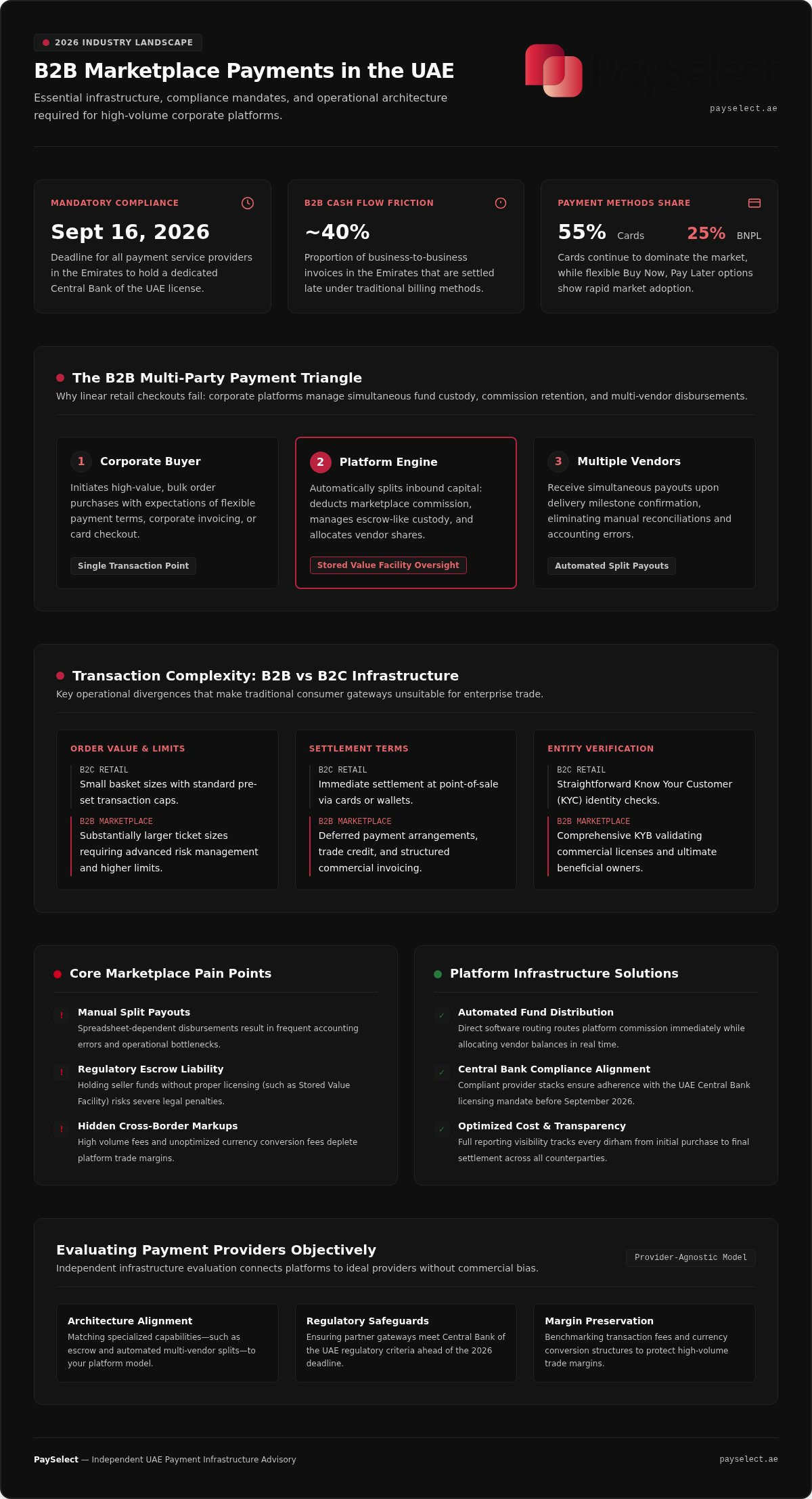
Digital commerce requires a complete rethinking of corporate transaction architecture. Traditional business trade relied on manual invoicing, delayed bank transfers, and paper-based reconciliation. Modern commercial platforms operate within a complex payment triangle consisting of the buyer, the seller, and the marketplace platform itself. Managing this three-sided relationship demands specialized technology that a standard retail payment gateway simply cannot provide. While a traditional gateway processes linear transactions from one buyer to one merchant, digital marketplaces must split funds, hold balances, and distribute payouts to multiple vendors simultaneously.
The regulatory environment in the Emirates has evolved rapidly to support this digital transition. The Central Bank of the UAE actively expands its oversight to ensure transparency, security, and systemic stability. Marketplace operators face strict compliance deadlines regarding fund holding and digital security. For instance, payment service providers must secure specific central bank licensing by September 16, 2026. This shifting regulatory framework means that choosing the right payment solutions for b2b marketplaces uae is no longer just an operational decision; it is a critical compliance mandate. Platforms must transition away from slow, legacy banking networks toward automated, real-time infrastructure to keep corporate buyers and sellers satisfied.
The Role of Split Payments and Escrow-like Features
Automated split payments are the foundation of any scalable marketplace architecture. When a corporate buyer purchases goods from multiple suppliers in a single transaction, the underlying software must instantly divide the funds. It routes the platform's commission to the marketplace account while directing the remaining balances to the respective sellers. This automation eliminates manual accounting and reduces operational friction.
Secure fund holding is equally vital. Because B2B orders often involve production lead times or bulk shipping, platforms frequently require escrow-like features to hold funds securely until delivery confirmation. However, holding client funds triggers strict Central Bank of the UAE regulations. Marketplace operators must ensure their chosen providers possess the correct infrastructure or licensing, such as a Stored Value Facility license for handling client balances, to avoid severe legal penalties.
B2B vs B2C: Why Transaction Complexity Matters
Corporate transactions present unique challenges that retail payment systems cannot handle. The differences lie in size, terms, and verification requirements:
Ticket Sizes
Average B2B order values are substantially larger than B2C purchases, requiring robust risk management and higher transaction limits.
Flexible Payment Terms
Corporate buyers expect deferred payment options, trade credit, or structured invoicing rather than immediate point-of-sale settlement.
Entity Verification
While B2C platforms use simple Know Your Customer (KYC) checks for individuals, B2B marketplaces must execute comprehensive Know Your Business (KYB) onboarding to verify corporate entities, commercial licenses, and ultimate beneficial owners.
Navigating these differences requires an optimized approach. Businesses can use independent comparison services like PaySelect to evaluate different payment infrastructure options without favoring any single provider. This helps platforms find the right balance between operational flexibility and regulatory compliance.
Key Features Every B2B Marketplace Solution Needs
Building a successful platform requires more than just processing transactions. You need a robust engine that manages complex financial flows while maintaining absolute compliance. The right payment solutions for b2b marketplaces uae must automate the most labor-intensive tasks: payout distribution, tax reconciliation, and seller verification. Without these features, your operations will eventually stall under the weight of manual spreadsheets and administrative errors.
Visibility is the ultimate strategic advantage. Advanced reporting tools should provide real-time data on platform-wide health, allowing you to track every dirham from the moment of purchase to the final settlement. Current B2B payment practices trends suggest that nearly 40% of invoices in the Emirates are settled late. A sophisticated system helps mitigate this by offering diverse payment methods that fit your clients' needs. While credit and debit cards represent 55% of the market in 2026, the rapid rise of Buy Now, Pay Later (BNPL) to a 25% share shows that flexibility is now a requirement, not a luxury.
Automated Vendor Onboarding and Verification
Speed to market defines your competitive edge. A seamless Know Your Business (KYB) process allows you to verify sellers quickly by collecting trade licenses and corporate documents through digital portals. By integrating with national identity systems like the UAE Pass, you reduce friction for new vendors while ensuring you meet the Central Bank's stringent anti-money laundering standards. It's also vital to note that as of March 2026, the ban on SMS OTPs requires your onboarding flow to support biometric or app-based authentication. This automation protects your platform from regulatory risks without slowing down your growth.
Flexible Commission and Fee Management
Your revenue model shouldn't be limited by your technology. Effective marketplace infrastructure allows you to set dynamic commission rates based on product categories or vendor performance. It also manages the complexity of VAT requirements, ensuring that tax is correctly calculated and reported for every party in the triangle. If you're unsure which infrastructure supports these specific needs, you can compare payment gateways to see how different providers handle multi-party fee structures.
Handling refunds and chargebacks in a multi-vendor environment is a significant pain point for many operators. A high-end solution provides a clear path for reversing transactions without disrupting the entire settlement cycle. Finding a partner that balances these technical requirements with cost-efficiency is much easier when you use an independent selection tool to audit your options and remove operational barriers.
Evaluating the Best Payment Infrastructure for Your Platform
Infrastructure is the silent engine of your marketplace. Choosing between an API-first approach or ready-made plugins depends on your internal technical resources and time-to-market goals. API-first solutions offer total customization for complex checkout flows, while ready-made plugins allow for rapid deployment on popular platforms. As your platform expands to include international sellers, your payment solutions for b2b marketplaces uae must scale without performance degradation. The UAE's fintech revolution has created a landscape where global reliability meets local regulatory expertise. You need to decide whether a global giant's reach outweighs a local provider's deep integration with the Central Bank's instant payment systems. Security protocols are equally vital, as protecting high-value B2B transaction data requires encryption standards that go beyond basic retail requirements.
Integration Architecture and Developer Support
Developers need high-quality documentation and robust sandboxing environments to build safely. A sandbox allows your team to test complex multi-vendor scenarios, such as split payments and partial refunds, without risking live capital. Webhooks are essential in this architecture, providing real-time order status updates that keep your frontend synchronized with the actual movement of funds. When you compare payment gateways, look for providers that offer comprehensive technical support and clear API versioning. This technical compatibility ensures your stack remains resilient as you add new features or vendors. Poor integration leads to operational bottlenecks that can frustrate both your technical team and your corporate clients.
Reliability and Uptime in the MENA Region
Uptime is not just a technical metric; it's the foundation of vendor trust. In the UAE, local server presence often results in higher transaction success rates by reducing latency between the gateway and local issuing banks. Redundancy is non-negotiable for high-volume B2B trade. If a provider's primary infrastructure fails, a secondary failover must take over instantly to prevent lost sales and data gaps. System downtime doesn't just halt immediate revenue. It damages your marketplace's reputation and causes significant friction with sellers who rely on consistent payout schedules to manage their own cash flow. PaySelect helps businesses identify providers with proven track records for regional stability, ensuring your platform remains operational even during peak demand periods.
Optimizing Transaction Costs and Cross-Border Efficiency
Profitability in high-volume trade relies on relentless cost optimization. While retail platforms focus on conversion, B2B marketplaces must prioritize the efficiency of their Merchant Discount Rate (MDR). Small percentage differences on high-value AED transactions quickly compound into substantial operational costs. When evaluating payment solutions for b2b marketplaces uae, look for infrastructure that eliminates hidden markups in currency conversion. Multi-currency settlement options provide a distinct strategic advantage. They allow you to retain control over the exchange process, protecting your platform's margins and your vendors' earnings from unnecessary erosion.
Managing Cross-Border Payouts for Global Sellers
Global expansion introduces the friction of international banking networks. Intermediary bank fees can significantly reduce the final amount a seller receives, creating tension in your vendor relationships. Implementing dedicated cross-border payment solutions allows your marketplace to bypass these legacy hurdles. You can offer faster settlement times, transparent fee structures, and local currency payouts. Speed is a competitive differentiator. Sellers gravitate toward platforms that respect their cash flow by delivering funds quickly, reliably, and without unexpected deductions.
Negotiating Rates for High-Ticket B2B Transactions
Standard flat-rate pricing is rarely the best fit for large-scale B2B operations. As your transaction volume grows, transitioning to an interchange-plus model often yields better results. This model provides granular visibility into the actual costs of processing, allowing you to negotiate from a position of data-driven strength. High-ticket orders require a specialized approach to risk and pricing that generic gateways often overlook. Using independent audits helps you identify where your current provider's fees are out of sync with your volume. You gain the clarity needed to optimize your stack, reduce overhead, and increase net revenue.
Book a payment infrastructure consultation to identify hidden costs and optimize your marketplace's transaction efficiency.
Simplifying Your Selection with PaySelect Advisory
Selecting the ideal infrastructure requires precision, not guesswork. In a landscape defined by rapid regulatory shifts and technical complexity, businesses need a partner that offers absolute clarity. PaySelect functions as an independent, unbiased facilitator for modern commerce. We don't process payments; we provide the strategic roadmap to ensure your platform remains resilient, compliant, and cost-optimized. We remove operational barriers, streamline technical transitions, and accelerate your path to market.
The "Take the Test" tool is the first step in this journey. It simplifies the discovery process by matching your specific requirements with the most suitable providers in the UAE. This digital platform brings transparency to a complex industry, ensuring you don't overpay for features you don't need or lack the infrastructure required for high-volume trade. By using this tool, you gain immediate access to a curated list of providers that align with your business model.
The PaySelect Matching Methodology
Effective matching requires a deep understanding of your unique business profile. Our methodology analyzes three critical pillars to ensure a perfect fit:
Transaction Dynamics
We evaluate your typical ticket sizes, monthly AED volumes, and the complexity of your multi-vendor split requirements.
Industry Specifics
We align your platform with providers that understand the regulatory nuances of your specific sector in the Emirates.
Scaling Strategy
We ensure your chosen payment solutions for b2b marketplaces uae can handle international expansion and a growing number of global sellers.
This independent perspective is vital in the UAE market. Because we are not tied to any specific processor, our guidance remains focused solely on your ultimate business outcome. We prioritize your platform's long-term stability over short-term vendor interests.
From Audit to Implementation: Strategic Support
For enterprise-scale platforms, a simple match is just the beginning. You need bespoke infrastructure audits to identify hidden inefficiencies in your current stack. Our advisory services provide the technical expertise needed to optimize Merchant Discount Rates, reduce FX markups, and streamline vendor onboarding. We bridge the gap between complex global systems and the intuitive needs of modern entrepreneurs.
This strategic support significantly reduces your time-to-market. Instead of spending months navigating the intricacies of Central Bank regulations or comparing technical documentation, you can leverage our specialized knowledge to make a decisive choice. You gain a scalable, rock-solid payment stack that inspires confidence in your vendors and buyers alike. Ready to remove the barriers to your growth? Start your payment gateway comparison today to find the perfect fit for your platform.
Future-Proof Your Marketplace Infrastructure
The transition toward digital trade in the Emirates is no longer a choice but a necessity for competitive survival. Success requires a platform-first strategy that automates complex vendor payouts, ensures absolute regulatory compliance, and optimizes every transaction for maximum margin. By prioritizing infrastructure that handles high-ticket volumes and multi-currency settlements, you remove the operational barriers that stall international expansion.
Selecting the right payment solutions for b2b marketplaces uae doesn't have to be a manual, spreadsheet-driven ordeal. PaySelect provides the independent and unbiased comparison you need to navigate this crowded landscape with confidence. Our expert advisory services and deep local UAE market expertise ensure your payment stack is both scalable and cost-effective. We act as your strategic tech partner, bridging the gap between sophisticated global protocols and your platform's specific operational needs.
Take control of your financial architecture and eliminate hidden inefficiencies before they impact your bottom line. Match your marketplace with the right payment provider today and build a foundation for limitless growth. The future of B2B commerce is efficient, secure, and ready for implementation.
Frequently Asked Questions
What is the best payment gateway for a B2B marketplace in the UAE?
There isn't a single best gateway for every platform since the ideal choice depends on your specific transaction volume, technical stack, and vendor payout requirements. Different providers specialize in multi-vendor split payments while others focus on high-ticket processing or international reach. You should evaluate options based on their ability to handle complex B2B logic rather than just retail features. PaySelect helps you compare these differences through independent data.
How do split payments work for marketplace platforms?
Split payments automatically divide a single customer transaction into multiple parts at the point of sale. The system routes the marketplace's commission to your corporate account while simultaneously directing the remaining balance to the individual vendors involved in the order. This automation removes the need for manual bank transfers and reconciliation. It ensures that every party receives their funds efficiently while maintaining a clear audit trail for tax purposes.
Do I need a special license to hold funds for vendors in the UAE?
Yes, marketplaces that hold client funds or act as intermediaries usually require specific regulatory approval from the Central Bank of the UAE. Under current frameworks, entities holding significant client balances may need a Stored Value Facility (SVF) license. Compliance deadlines for payment service providers are set for September 16, 2026. Operating without the correct licensing can lead to severe legal penalties, so it's vital to choose infrastructure that manages these funds compliantly.
Can a UAE marketplace accept payments from international buyers?
Yes, modern payment solutions for b2b marketplaces uae are designed to facilitate global trade through multi-currency acceptance. You can accept payments in major global currencies and settle them in UAE Dirham (AED) or the original currency. To maintain profitability, you should look for providers that offer competitive foreign exchange rates and minimize intermediary bank fees. This capability is essential for platforms aiming to scale their seller base beyond the MENA region.
What are the typical fees for B2B payment solutions in the region?
Fees generally include a combination of setup costs, monthly maintenance, and a Merchant Discount Rate (MDR) per transaction. For high-volume B2B trade, many businesses move away from flat-rate pricing toward interchange-plus models to gain better transparency. You may also encounter specific costs for cross-border transfers and currency conversion. Because these rates vary significantly between providers based on your industry and volume, using an independent comparison tool is the most efficient way to optimize costs.
How long does it take to integrate a marketplace payment solution?
Integration timelines vary based on the complexity of your platform and the provider's technical architecture. A standard plugin-based setup for common platforms can take a few days, whereas a custom API-first integration for a complex B2B marketplace might take several weeks. The process includes technical development, sandboxing for multi-vendor scenarios, and the Know Your Business (KYB) verification phase. Leveraging expert advisory can significantly reduce this time-to-market by identifying the most compatible infrastructure early.
What is the difference between a payment gateway and a marketplace payment platform?
A standard payment gateway facilitates linear transactions between one buyer and one merchant. In contrast, a marketplace payment platform manages a complex triangle of funds involving a buyer, multiple sellers, and the platform operator. Marketplace solutions include specialized features like automated vendor payouts, split-fee management, and robust seller onboarding tools. While a gateway is a single component, a marketplace platform is a comprehensive infrastructure designed to handle multi-party financial flows and regulatory requirements.
How does PaySelect help marketplaces choose a provider?
PaySelect acts as an independent comparison platform that matches your business with the most suitable payment solutions for b2b marketplaces uae. Through our Take the Test tool, we analyze your transaction volume, industry needs, and international goals to provide unbiased recommendations. We also offer bespoke advisory services for enterprise-scale organizations to audit their existing stacks and optimize costs. Our goal is to remove operational barriers by providing transparency in a crowded market.
Disclaimer
This content is for informational purposes only and should not be considered financial, legal, or regulatory advice. Payment provider availability, pricing, and approval processes vary depending on individual business circumstances. PaySelect does not guarantee provider acceptance or specific outcomes. Businesses should conduct their own due diligence before entering into any agreements.
Empowering businesses to achieve greater growth