
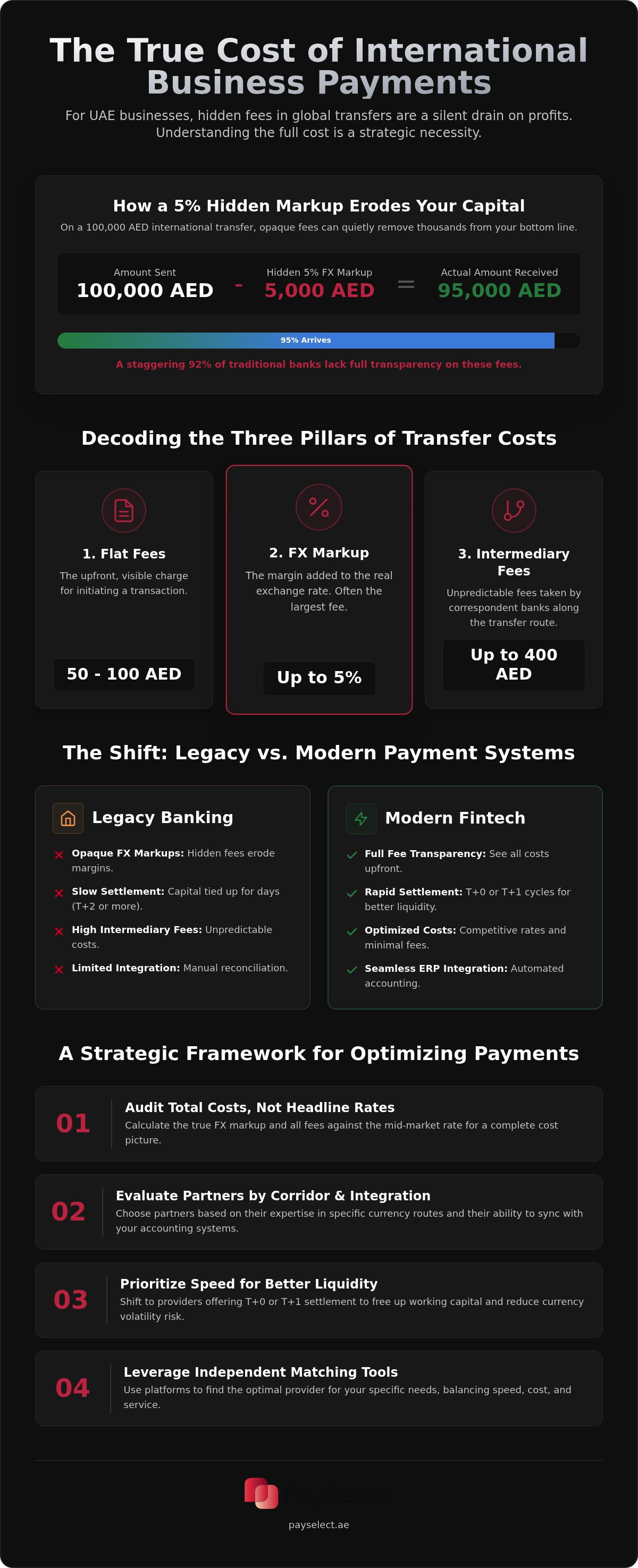
Did you know that 92% of traditional banks fail to provide full transparency on their currency conversion fees? For a UAE business moving 100,000 AED abroad, a hidden 5% markup quietly drains 5,000 AED from your bottom line. Understanding international money transfer fees for business uae is no longer just about accounting; it's a strategic necessity for maintaining operational liquidity in a competitive digital economy.
It's frustrating to watch your margins erode through opaque FX markups and unpredictable intermediary charges that can reach 400 AED per transaction. You need faster settlement and seamless ERP integration, yet legacy systems often leave your capital in limbo. This 2026 guide simplifies this complex landscape, helping you optimize every dirham you send across borders. We will explore the latest CBUAE regulatory updates, compare modern fintech agility against institutional stability, and show how using PaySelect's "Take the Test" tool acts as your bridge to full fee transparency and T+0 settlement cycles.
Key Takeaways
• Identify the three pillars of transfer costs, including flat fees, FX markups, and intermediary charges, to eliminate hidden operational drains.
• Evaluate potential partners based on specific corridor expertise and their capacity for seamless integration with your existing accounting systems.
• Master a step-by-step framework to calculate the total cost of international money transfer fees for business uae, moving beyond deceptive headline rates.
• Shift from slow legacy systems to high-performance providers offering T+0 or T+1 settlement cycles for significantly better liquidity management.
• Discover how independent matching tools can bridge the gap between complex global infrastructure and your specific UAE business requirements.
Navigating the Landscape of International Money Transfer Fees
By 2026, the UAE has solidified its status as a premier global hub for capital movement. For any local entrepreneur, managing international money transfer fees for business uae is no longer just a back-office task. It's a strategic lever. A transfer involves more than a simple transaction charge. It includes hidden FX markups, correspondent bank fees, and the cost of capital tied up in slow settlement cycles. Transitioning from legacy systems to modern digital rails allows your business to optimize, integrate, and expand with precision.
The industry has evolved rapidly. While SWIFT remains a foundational standard, the shift toward ISO 20022 and real-time payment systems has redefined expectations. Traditional institutions often struggle with these transitions, leading many UAE enterprises to seek specialist facilitators. These modern partners offer three distinct advantages: full fee transparency, faster settlement cycles, and direct system connectivity. This shift isn't just about saving a few dirhams; it's about building a friction-free financial infrastructure that is transparent, rapid, and secure.
The Mechanics of International Capital Movement
Most businesses begin by understanding wire transfers through the lens of the traditional correspondent banking network. This system often involves multiple intermediary banks, each of which can deduct charges as high as 400 AED before the funds reach your beneficiary. Liquidity providers now play a crucial role by offering real-time exchange rates that are far closer to the mid-market rate than what traditional banks provide. In a high-speed market, transaction speed is a competitive advantage. Moving funds in T+0 or T+1 ensures your operational liquidity remains high and your supplier relationships stay strong.
The Shift Toward Independent Comparison
Relying on a single banking partner for all global needs is a limitation. No single institution offers the best rates across every currency corridor. One provider might be elite for AED to GBP transfers, while another offers superior value for Southeast Asian routes. Digital platforms have brought much-needed transparency to this historically opaque market. They allow you to compare performance, analyze costs, and select partners based on data rather than habit.
PaySelect serves as an independent bridge between complex global infrastructures and UAE entrepreneurs. Through our cross-border payment solution matching tool, we help you identify the most efficient partners for your specific needs. The "Take the Test" tool acts as a friction-free starting point for fee optimization. It simplifies the selection process, ensuring you find a partner that offers the right balance of speed, cost, and technical integration.
Decoding the Three Pillars of International Transfer Costs
Calculating the total international money transfer fees for business uae requires looking past the headline price. Most providers present a simple transaction fee, but the true cost of ownership is built on three distinct pillars: the flat fee, the FX markup, and intermediary charges. Understanding these components is the only way to protect your margins from silent erosion. While a flat fee of 50 AED to 100 AED for a SWIFT transfer seems manageable, the hidden layers often multiply this cost by a factor of five or more.
Currency volatility adds another layer of risk to high-value transactions. For a UAE business moving 500,000 AED, a minor 1% shift in the exchange rate during a slow settlement cycle results in a 5,000 AED loss. This makes the speed of global payment systems a critical factor in cost control. Rapid execution isn't just a convenience; it's a hedge against market instability.
Auditing the Foreign Exchange Markup
The FX markup is the percentage difference between the interbank rate and the customer rate. This is where traditional banks often hide their largest margins, sometimes reaching as high as 5% of the total transaction value. To audit your provider, you must identify the mid-market rate, which is the real-time midpoint between the buy and sell prices of a currency. Comparing your quoted rate against this benchmark reveals the true margin you're paying. Some providers offer fixed pricing models for predictability, while others use dynamic models that fluctuate with market liquidity. Choosing the right one depends on your transaction frequency and volume.
Managing Secondary and Hidden Charges
Intermediary or "landing" fees are the most unpredictable part of the process. Because the UAE uses a correspondent banking network for many global routes, third-party banks often deduct fees before the capital reaches its destination. These charges can reach 400 AED per transaction, often leaving your beneficiary with less than the invoiced amount. Failed transfers due to data entry errors also carry heavy penalties and administrative costs. You can minimize these risks by choosing providers with automated validation tools and negotiating volume-based discounts as your business scales.
Identifying the most efficient partner for your specific currency corridors doesn't have to be a manual burden. You can start optimizing your costs today by comparing cross-border payment solutions through an independent lens. This data-driven approach ensures you select a partner based on total cost transparency rather than just the visible flat fee.
Key Criteria for Evaluating Cross-Border Payment Partners
Selecting a partner to manage your international money transfer fees for business uae requires a balance between technical capability and regional expertise. A provider that excels in European corridors might lack the liquidity or local clearing access needed for efficient transfers into emerging markets. You must evaluate partners based on their ability to integrate with your existing financial stack, their adherence to evolving local regulations, and their capacity to scale as your transaction volume grows. Efficiency in 2026 is defined by how well a provider removes operational friction while maintaining total cost transparency.
Compliance is a critical pillar of this evaluation. The Central Bank of the UAE (CBUAE) issued updated guidance on anti-money laundering (AML) and combating the financing of terrorism (CFT) on April 16, 2026. This requires licensed financial institutions to adopt a technology-driven, risk-based approach to transaction monitoring. Partnering with a provider that stays ahead of these UAE banking and payment systems requirements protects your business from administrative fines, which can be severe. Reliability isn't just about moving money; it's about moving it within the legal frameworks that govern the UAE's digital economy.
Matching Infrastructure to Regional Requirements
Your business model dictates your infrastructure needs. High-frequency e-commerce enterprises require providers with low latency and automated settlement, whereas wholesale businesses prioritize deep liquidity and volume-based discounts for large B2B transfers. Multi-currency accounts are an essential tool for many UAE-registered firms. These accounts allow you to hold and hedge funds in various currencies, reducing the need for constant conversions and protecting your margins from daily market fluctuations. Quality local support ensures that if a delay occurs, you have a partner who understands the local banking landscape and can resolve issues in your time zone.
Security and Institutional Reliability
Security protocols must be world-class to handle modern financial data. Ensure your partner maintains PCI-DSS compliance and utilizes high-level encryption for all data transmissions. Modern providers now manage complex KYC requirements using real-time verification tools that prevent funds from being delayed unnecessarily. Secure APIs play a vital role here, allowing for the "fluid" movement of data between your accounting software and the payment provider. This connectivity ensures that your financial records remain accurate and your data integrity is never compromised. Using the cross-border payment matching tool can help you filter providers based on these specific security and integration standards.
Strategic Selection: A Framework for UAE Businesses
Optimizing your international money transfer fees for business uae requires more than a casual price check. It demands a structured methodology designed for precision and speed. Start by mapping your primary currency corridors and monthly transaction volumes. A business sending 200,000 AED to India monthly has vastly different infrastructure needs than a firm sending 50,000 AED to Germany. Once your data is clear, calculate the Total Cost of Ownership for your current provider by totaling flat fees, FX markups, and intermediary deductions over the last quarter.
Next, utilize independent tools to compare the national market neutrally. This prevents the bias often found in direct provider marketing and ensures you see the full spectrum of available rates. Finally, execute a pilot program with a shortlist of two or three candidates. This allows you to verify settlement speed and support quality in a live environment before committing your entire payables workflow to a new system. Transitioning to a high-performance partner should be a calculated move, not a leap of faith.
The Audit: Identifying Cost Leakage
Perform a retrospective audit on your last six months of transfers to uncover hidden inefficiencies. Look for patterns where intermediary banks consistently deduct 100 AED to 300 AED per transaction or where exchange rate markups exceed 2% of the mid-market rate. Identifying these bottlenecks in your current international payables workflow is the first step toward recovery. Determining the ROI of switching to a specialized cross-border provider often reveals that the technical migration pays for itself within the first three months of optimized transactions. It's about reclaiming lost margin and reinvesting it into your core operations.
The Pilot Phase: Testing for Operational Fluidity
The pilot phase is your insurance policy against integration friction. Set clear key performance indicators (KPIs) for your new payment partner, focusing on settlement times (aim for T+0 or T+1) and the accuracy of landing amounts. Test the ease of reconciliation within your financial reporting tools to ensure your accounting team isn't manually fixing data entry errors. Finally, verify the responsiveness of the partner's account management team. A high-performance provider should act as an extension of your finance department, providing quick resolutions to any compliance or routing queries. Fluidity in communication is just as vital as fluidity in capital movement.
To start your transition with data-driven confidence, take the PaySelect matching test to find the ideal partner for your specific business corridors.
Optimizing Your Global Infrastructure with PaySelect
PaySelect operates as a critical intelligence layer in the UAE financial ecosystem. We don't process your transactions; we empower you to select the partners that do. With the September 16, 2026, compliance deadline for new CBUAE provisions approaching, businesses need partners that offer more than just a transfer portal. Our independent platform provides the clarity required to master international money transfer fees for business uae. We act as a bridge between complex global infrastructures and your specific operational needs, ensuring that every dirham moved is optimized for speed and cost. This independence is our core strength, allowing us to provide a neutral perspective that traditional providers simply cannot offer.
Data-Driven Matching for Modern Merchants
Modern merchants require more than a generic list of providers. They need infrastructure that aligns with their specific industry vertical and transaction volume. Our "Take the Test" tool utilizes a data-driven approach to filter the market, delivering unbiased recommendations from payment experts who understand the nuances of the UAE landscape. By analyzing your unique requirements, we remove the guesswork from the selection process. We evaluate providers based on their corridor expertise, settlement speeds, and technical integration. You can Take the Test today to match with your ideal provider and begin reducing your total cost of ownership immediately. It's a friction-free starting point for any business looking to move away from legacy banking limitations.
Bespoke Advisory for High-Scale Organizations
For high-scale organizations like hotel groups or large corporations, fee leakage often occurs at the intersection of complex payment stacks. Specialist fintech platforms can reduce the total cost of transfers to between 0.4% and 0.8%, yet many firms remain stuck with traditional rates as high as 7%. Our enterprise-level consulting offers bespoke audits designed to identify these hidden drains. We provide strategic guidance on integrating POS systems and gateway solutions globally, ensuring your physical and digital presence remains synchronized. These audits analyze system connectivity, performance enhancement, and the removal of operational barriers. To gain a complete view of your potential infrastructure, explore our payment gateway comparison. This holistic approach ensures your business is prepared for future digital payment initiatives, allowing you to focus on international business expansion with absolute confidence.
Future-Proof Your Global Capital Movement
The landscape of global commerce in 2026 demands absolute clarity in every transaction. You've seen how hidden FX markups and unpredictable intermediary fees can silently drain your operational liquidity. By shifting your focus toward corridor expertise and technological integration, you move beyond legacy banking limitations. It's time to treat your payment infrastructure as a strategic tool for expansion rather than a fixed cost of doing business.
Optimizing international money transfer fees for business uae is the first step toward reclaiming your margins. As an independent UAE-based platform, PaySelect provides the zero-bias provider matching and expert-led infrastructure audits you need to scale with confidence. You don't have to navigate this complex terrain alone. Take the Test to find the most cost-effective cross-border partner for your business and start building a more fluid financial future. Audit your corridors, compare your options, and integrate with precision. Your business is ready for the global stage.
Frequently Asked Questions
What are the common fees for international business transfers in the UAE?
Business transfers in the UAE involve three primary costs: flat transaction fees, foreign exchange markups, and intermediary bank charges. While a standard SWIFT fee might range from 50 AED to 100 AED, the hidden costs in the exchange rate often represent the largest expense for local enterprises. Total costs are only clear when you account for every deduction made along the payment chain.
How long do cross-border business payments typically take to settle in 2026?
Settlement times now range from near-instant to 24 hours (T+1) for most major currency corridors. While traditional banking wires can still take 2 to 3 business days, modern digital rails and the UAE's local instant payment initiatives have significantly accelerated capital movement. High-performance providers prioritize these faster cycles to maintain your operational liquidity.
Is it cheaper to use a traditional bank or a fintech provider for transfers?
Fintech providers generally offer more competitive international money transfer fees for business uae than traditional institutions. Specialist platforms can lower total transaction costs to between 0.4% and 0.8% of the transfer value. In contrast, traditional banks often charge between 3% and 7% when all hidden markups and correspondent fees are included.
What is an FX markup and how can I calculate it for my business?
An FX markup is the difference between the mid-market exchange rate and the rate your provider offers you. To calculate this, compare your quoted rate against a live interbank rate found on neutral financial sites. The percentage difference reveals the hidden margin your provider is charging on top of their stated upfront fees.
What regulatory standards should a cross-border provider in the UAE meet?
A reliable provider must adhere to the Central Bank of the UAE's updated AML and CFT guidance issued in April 2026. They should also demonstrate compliance with Federal Decree-Law No. (6) of 2025. Meeting these standards ensures they are managing international money transfer fees for business uae within a secure, legally recognized framework.
Can I integrate international payment solutions with my existing accounting software?
Modern payment facilitators offer secure API integrations that connect directly with your ERP or accounting stack. This system connectivity allows for automated reconciliation, reduces manual data entry errors, and ensures that your financial reporting remains accurate across all global transactions. It transforms a manual task into a seamless, automated workflow.
How does PaySelect ensure its comparison data remains independent and unbiased?
PaySelect operates as a neutral digital platform that does not process payments or favor specific providers. We use a data-driven matching tool and expert-led infrastructure audits to identify solutions based solely on your industry needs. Our priority is matching your transaction volumes and specific currency corridors with the most efficient market options.
What are 'landing fees' and how do they affect the final amount received?
Landing fees are charges deducted by intermediary or recipient banks during the transfer process. These deductions can reach 400 AED per transaction, often meaning your beneficiary receives less than the original invoiced amount. Understanding these fees is vital for ensuring your suppliers are paid in full and your accounting records remain balanced.
Disclaimer
This content is for informational purposes only and should not be considered financial, legal, or regulatory advice. Payment provider availability, pricing, and approval processes vary depending on individual business circumstances. PaySelect does not guarantee provider acceptance or specific outcomes. Businesses should conduct their own due diligence before entering into any agreements.
Empowering businesses to achieve greater growth