
Did you know that nearly 79% of all UAE e-commerce orders are now completed on a smartphone? As the national digital economy accelerates toward a projected $12.30 billion valuation in 2026, your choice of financial infrastructure defines your competitive edge. Performing a thorough payment gateway integration comparison uae reveals that the wrong partner doesn't just cost you fees; it costs you momentum, trust, and growth.
You've likely experienced the frustration of hidden transaction costs, high MDRs, and settlement delays that stall your operational liquidity. It's a common challenge for merchants who need an independent bridge between complex global tech and the intuitive needs of local consumers. This guide promises to help you evaluate solutions based on technical compatibility, regulatory compliance, and long-term cost optimization. We will provide a clear framework to help you reduce overhead, secure your cash flow, and build a seamless checkout experience that scales with your ambition.
Key Takeaways
• Understand how a comprehensive payment gateway integration comparison uae allows you to balance technical ease with long-term commercial scalability.
• Compare the rapid deployment of hosted payment pages against the complete branding control offered by API-based integrations.
• Identify hidden operational costs beyond base transaction fees, including setup charges, monthly maintenance, and potential chargeback penalties.
• Establish high standards for your national operations by prioritizing fraud management tools and a minimum 99.9% uptime reliability.
• Simplify your decision-making process with the 'Take the Test' tool to find a provider match based on your unique business data.
The State of Payment Gateway Integration in the UAE
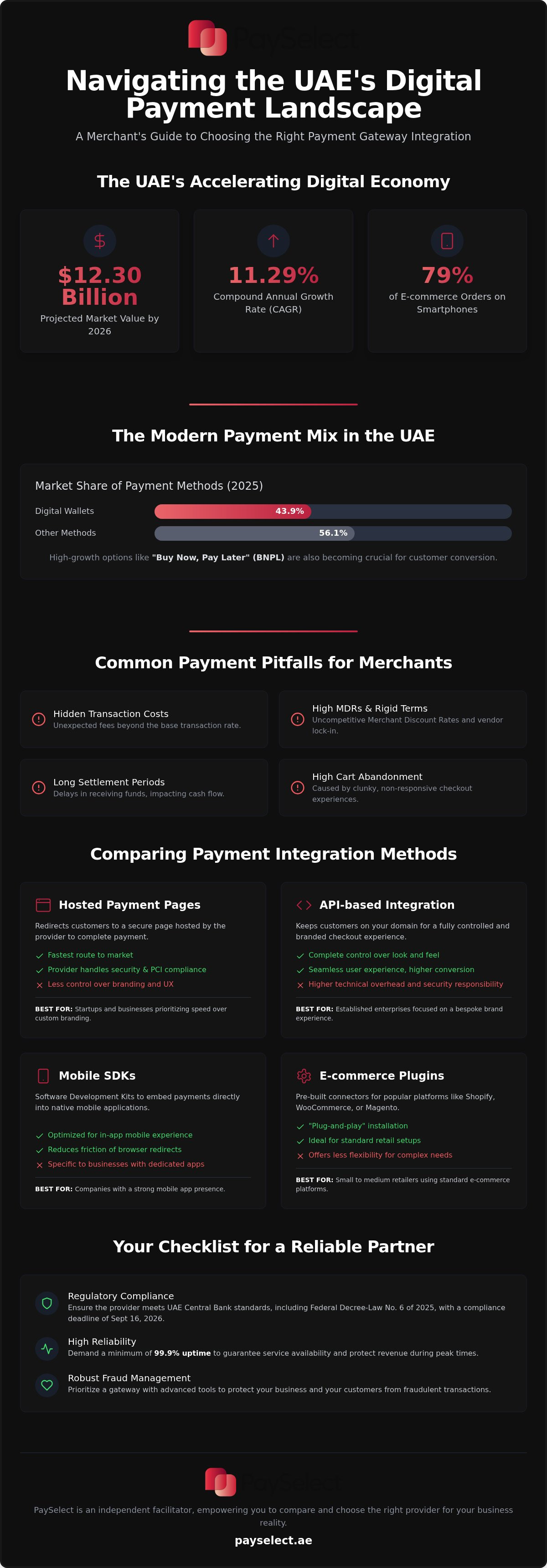
The UAE digital economy is no longer just growing; it's maturing at a rapid 11.29% CAGR, projected to reach $12.30 billion by the end of 2026. In this sophisticated environment, integration has evolved from a simple card-processing checkbox into a complex digital ecosystem. Modern businesses must now support a diverse range of methods, including digital wallets, which held a 43.92% market share in 2025, and high-growth "Buy Now, Pay Later" options. If you're asking What is a payment gateway? at its core, it's the secure bridge between your checkout and the banking network, but in 2026, it's also your primary tool for regulatory compliance.
Security is now mandated by local standards. The UAE Central Bank's Federal Decree-Law No. 6 of 2025 has expanded the scope of regulated activities to include open finance and virtual assets. With a critical compliance deadline of September 16, 2026, your choice of integration isn't just about functionality. It's about ensuring your infrastructure meets the latest national legal requirements to protect your business and your customers' data.
Why Integration is a Strategic Priority
User experience is your most potent competitive advantage. Since smartphones account for 78.67% of all UAE e-commerce orders, a clunky or non-responsive checkout directly triggers high cart abandonment rates. Performing a rigorous payment gateway integration comparison uae helps you identify which providers offer the fluid, mobile-first experience your customers expect. You must balance the speed of deploying a hosted solution against the deep branding control offered by direct API connections. A friction-filled payment process destroys trust instantly, while a seamless one acts as a catalyst for repeat business and international expansion.
The Role of Independent Comparison
Many merchants fall into the "vendor lock-in" trap, where they're stuck with high MDRs and rigid technical debt because they didn't evaluate the market objectively. This is where an independent facilitator adds immense value. By acting as a neutral bridge between complex financial infrastructure and your specific business needs, an independent platform ensures you select a partner based on performance rather than marketing promises.
Transparency in data leads to better commercial terms. At PaySelect, we help you overcome common setup pains like long settlement periods and hidden fees. Our Payment Gateways comparison tools and the "Take the Test" merchant matching tool provide the clarity needed to optimize your costs. We don't process your payments; we empower you to choose the provider that actually fits your operational reality.
Technical Frameworks: Comparing Integration Methods
Choosing your technical architecture is a high-stakes decision that dictates your operational speed and customer retention. A robust payment gateway integration comparison uae must weigh the simplicity of pre-built modules against the flexibility of custom code. Your choice impacts how you handle sensitive data and how much control you maintain over the final checkout screen. For many UAE businesses, the decision starts with one of four primary pathways: hosted pages, API integrations, mobile SDKs, or e-commerce plugins.
Hosted payment pages offer the fastest route to market. When a customer clicks "pay," they're redirected to a secure environment managed by the provider. This minimizes your technical overhead because the provider handles the security infrastructure. On the other end of the spectrum, API-based integration allows you to keep the customer on your own domain. This provides full control over the look and feel, ensuring a bespoke branding experience that can drive higher conversion rates for established national enterprises. If you're unsure which path fits your current scale, you can compare payment infrastructure options to see how different frameworks align with your business goals.
With smartphones accounting for 78.67% of all UAE e-commerce orders in 2025, mobile optimization isn't optional. Mobile SDKs (Software Development Kits) are essential for businesses with dedicated apps. These kits allow you to bake the payment process directly into the mobile interface, preventing the friction of browser redirects. For smaller retailers using standard platforms like Shopify, Magento, or WooCommerce, e-commerce plugins remain the most popular choice. These pre-built connectors offer a "plug-and-play" experience, though they sometimes offer less flexibility for complex, multi-method digital ecosystems.
Hosted vs. Self-Hosted: Security and Control
The trade-off between user experience and technical maintenance costs often comes down to PCI DSS compliance. Hosted solutions significantly reduce your compliance burden because card data never touches your servers. Self-hosted or API-based methods offer a superior, seamless user experience but require more rigorous security audits and higher developer maintenance. Startups often favor hosted pages to launch quickly, while national enterprises invest in API integrations to eliminate any friction that might cause cart abandonment.
Developer Experience and API Documentation
Your tech team's efficiency depends on "clean" code and robust sandbox environments. Poorly documented APIs lead to integration delays and buggy checkouts. When performing a payment gateway integration comparison uae, evaluate the quality of the provider's support documentation. Future-proof APIs are critical; they must support emerging payment methods like digital wallets and BNPL without requiring a total system overhaul. A well-structured developer portal ensures your payment infrastructure remains a strategic tool for growth rather than a technical bottleneck.
Commercial Comparison: Evaluating the Total Cost of Ownership
Understanding the financial impact of your infrastructure requires looking beyond the headline transaction fee. A payment gateway integration comparison uae must account for the Total Cost of Ownership (TCO) to prevent profit erosion. The Merchant Discount Rate (MDR) is the most visible cost, but it's rarely the only one. This rate combines card scheme fees, interchange fees, and processor margins into a single percentage. A low MDR can be easily offset by high fixed costs that quietly drain your monthly margins.
Hidden costs are a persistent pain point for UAE merchants. These often include significant setup fees, recurring monthly maintenance charges, and heavy penalties for chargebacks. If your business handles international customers, Foreign Exchange (FX) markups and international card surcharges can add another 1% to 1.5% to your transaction costs. These layers of expense make it essential to demand transparency before committing to a long-term contract. Without a clear audit of these variables, you risk choosing a partner that looks cost-effective on paper but becomes expensive at scale.
Structuring Fee Comparisons
Most providers in the national market offer either flat-rate pricing or interchange-plus models. Flat-rate pricing is simple and predictable, making it a strong choice for startups with lower transaction volumes. In contrast, interchange-plus models are more transparent for established businesses because they separate the actual cost of the transaction from the provider's markup. Choosing the wrong model can lead to thousands in unnecessary operational expenses. You can access a detailed payment gateway pricing comparison to see how these different structures impact your specific business model.
Settlement Speeds and Liquidity
Cash flow is the lifeblood of any growing operation. In the UAE, settlement cycles vary significantly between providers, typically ranging from T+1 to T+7. A T+7 cycle means your funds are held for a full week before being deposited into your business account. This delay can stifle growth for high-volume merchants who need immediate access to capital. Your integration type also plays a role; more sophisticated API setups often provide more granular data that can help speed up the verification process. Prioritizing providers with faster settlement speeds ensures you have the liquidity needed to reinvest in inventory and marketing without delay.
PaySelect acts as an independent bridge in this complex landscape. We don't process payments; we provide the tools to audit your current costs and find a more efficient partner. By focusing on cost optimization and transparency, we help you remove the operational barriers that prevent your business from reaching its full potential. Our platform ensures you find a solution that matches your volume and supports your ambition for international expansion.
Operational Comparison: Security, Reliability, and Support
Technical uptime and security protocols are the silent engines of your business. While a payment gateway integration comparison uae often focuses on fees, operational resilience determines your long-term survival. A gateway that offers 99.9% uptime is the bare minimum for national operations; anything less translates to immediate revenue loss and damaged brand reputation during peak shopping periods. Beyond simple availability, you must evaluate the sophistication of fraud management tools. Implementing 3D Secure 2.0 is no longer optional. It's a critical standard that balances rigorous authentication with a low-friction user experience, ensuring legitimate transactions aren't blocked by outdated security hurdles.
Support is another major differentiator in the UAE market. When a technical glitch stalls your checkout, waiting 24 hours for a global ticket response isn't feasible. Local, responsive technical assistance provides the agility needed to resolve issues in real-time. Additionally, businesses with a physical presence should prioritize omnichannel capabilities. Integrating your online gateway with your physical POS systems creates a unified data stream, simplifying your reconciliation and providing a consistent experience for customers who move between your digital and brick-and-mortar storefronts.
Compliance and Regulatory Standards
The regulatory landscape in the UAE has shifted significantly with Federal Decree-Law No. 6 of 2025. This law broadens the scope of regulated activities, and businesses have until the critical deadline of September 16, 2026, to ensure their payment infrastructure is fully compliant. Data residency is a recurring concern; choosing a partner that respects local hosting requirements for sensitive financial info is vital for risk mitigation. These security integrations don't just protect data; they build the institutional trust necessary to convert high-value customers who are increasingly wary of digital threats.
Support for Cross-Border Expansion
Growth-oriented businesses must look beyond national borders to the wider GCC and international markets. A robust integration should offer multi-currency support, allowing you to settle in AED while accepting payments in SAR, QAR, or USD. This flexibility removes operational barriers and reduces the friction of currency conversion for your global audience. Evaluating how different providers handle cross-border payment solutions is essential for any brand with international ambition. You can use our independent comparison tools to find a gateway that matches your specific expansion roadmap without the bias of a single provider.
Optimising Your Selection with PaySelect
Selecting the right infrastructure shouldn't be a guessing game based on marketing brochures. Conducting a comprehensive payment gateway integration comparison uae requires a partner that stands outside the processing loop. PaySelect provides this independence, acting as a digital facilitator that translates complex technical specs into clear business outcomes. We focus on removing the operational barriers that slow down your expansion, ensuring your payment stack remains a strategic asset rather than a cost center.
The PaySelect Advantage
Our platform is built on transparency and unbiased data. We understand the unique pressures of the MENA payments landscape, from shifting regulatory deadlines to the rising demand for digital wallets. By offering specialized expertise, we simplify the bridge between your existing technical stack and your long-term financial goals. We don't favor one provider over another; instead, we give you the insights to distinguish between fee structures, settlement cycles, and integration methods. This clarity allows you to make decisions with absolute confidence.
For businesses requiring deeper analysis, we provide enterprise-level payment audits and infrastructure consulting. These services are designed to identify hidden inefficiencies in your current setup, such as excessive FX markups, redundant monthly fees, or slow settlement cycles. Our goal is simple: cost reduction and performance enhancement. We act as a catalyst for growth by ensuring your financial architecture is as sophisticated as your business model.
Next Steps for Your Business
Moving from comparison to implementation is the final step in your 2026 roadmap. Start by auditing your current infrastructure to benchmark your existing rates against the national market. Many businesses find they're paying for features they don't use or are losing margin to outdated pricing models. Our "Take the Test" tool provides a fast, data-driven match that aligns with your specific volume, technical stack, and customer base. It's an efficient way to filter the noise and find the provider that actually fits your operational reality. By using our tools for a payment gateway integration comparison uae, you move beyond surface-level marketing to find genuine commercial value.
Don't let technical complexity or hidden fees stall your growth. Take control of your margins and build a checkout experience that inspires customer trust. You can Compare payment gateways with PaySelect today to start your transition toward a more efficient, cost-optimized future.
Future-Proof Your Payment Infrastructure
The transition toward a $12.30 billion digital economy requires more than just a functional checkout. It demands a strategic alignment between your technical framework and your commercial goals. By conducting a rigorous payment gateway integration comparison uae, you ensure that your business avoids the traps of vendor lock-in and high operational friction. You've learned that the right choice balances developer flexibility with the reality of hidden transaction costs and settlement liquidity.
PaySelect serves as an independent bridge in this fast-moving landscape, offering specialized UAE market expertise to help you navigate complex regulatory shifts. Our platform provides an unbiased comparison that puts your needs first, using a data-driven matching tool to simplify your selection process. We remove the operational barriers that stall growth, allowing you to focus on scaling your ambition across the GCC and beyond.
Take the test to find your perfect payment gateway match and secure a more efficient, cost-optimized future. Your growth in the 2026 landscape starts with a single, informed decision.
Frequently Asked Questions
What is the average payment gateway fee for businesses in the UAE?
Most providers charge a transaction fee ranging from 2.8% to 2.9% plus a fixed fee of AED 1 per transaction for local cards. However, rates can vary significantly based on your monthly volume and the specific pricing model you choose. Some models offer flat monthly fees for startups, while others use interchange-plus pricing for high-volume enterprises. It is vital to audit for hidden costs like setup fees or international card surcharges.
How long does it typically take to integrate a payment gateway?
Integration timelines typically range from a few hours for pre-built e-commerce plugins to several weeks for custom API developments. Hosted payment pages offer the fastest route to market with minimal technical overhead because the provider manages the security infrastructure. Bespoke API integrations require more extensive developer resources and testing but provide a seamless, branded checkout experience that can drive higher conversion rates for larger operations.
Do I need a local UAE bank account to integrate a payment gateway?
Yes, most payment providers in the UAE require a local bank account to settle your funds in AED. Having a local account ensures faster settlement cycles and avoids high foreign exchange markups that occur when moving money across borders. While some international providers allow settlement into foreign accounts, this often results in increased operational costs, longer payout delays, and potential reconciliation challenges for your finance team.
What is the difference between an API integration and a hosted payment page?
A hosted payment page redirects customers to a secure provider environment to complete their transaction, whereas an API integration keeps the user on your own website. Hosted pages are easier to implement and significantly reduce your PCI DSS compliance burden. API integrations offer total control over the user interface and branding but require more technical maintenance and rigorous security standards to protect sensitive customer data on your servers.
How does 3D Secure 2.0 affect my payment integration and conversion rate?
3D Secure 2.0 improves security by using data-rich authentication while maintaining high conversion rates through a smoother user experience. Unlike older versions, it reduces friction by allowing background verification for most transactions, only prompting for a password or OTP when a risk is detected. This balance of safety and speed is essential for building customer trust and complying with the latest national regulatory standards in the UAE.
Can I use one payment gateway for both my website and my mobile app?
You can use a single provider for both platforms by utilizing their API for the website and their Mobile SDK for the app. This creates a unified data stream for all transactions, which simplifies your financial reconciliation and reporting. Performing a payment gateway integration comparison uae helps you identify which providers offer the most robust cross-platform compatibility to ensure a fluid experience for your mobile-first customers.
How do I switch payment gateways without disrupting my business operations?
To switch gateways without downtime, you should run the new provider in a sandbox environment for testing before doing a parallel soft launch alongside your existing system. This approach allows you to verify technical stability and settlement accuracy without risking live revenue. Once the new integration is proven stable, you can gradually migrate your traffic and close the old account, ensuring a frictionless transition for your customers.
What are the compliance requirements for accepting online payments in the UAE?
Merchants must adhere to PCI DSS standards for data security and comply with the latest Central Bank of UAE regulations. Federal Decree-Law No. 6 of 2025 mandates specific licensing and approval for entities in the payment ecosystem, with a compliance deadline of September 16, 2026. These frameworks ensure that all digital transactions meet strict anti-money laundering (AML) and know-your-customer (KYC) requirements to protect the national digital economy.
Disclaimer
This content is for informational purposes only and should not be considered financial, legal, or regulatory advice. Payment provider availability, pricing, and approval processes vary depending on individual business circumstances. PaySelect does not guarantee provider acceptance or specific outcomes. Businesses should conduct their own due diligence before entering into any agreements.
Empowering businesses to achieve greater growth