


A lower interchange rate doesn’t automatically mean a lower total card-processing cost. In the UAE, merchants generally pay a merchant discount rate to their acquirer; interchange is part of the payment-cost chain, not a fee merchants pay directly. The structure introduced under CBUAE Notice 1998/2024 applies to domestic consumer debit and prepaid cards issued locally, for in-store and online transactions.
Understanding interchange fees in the UAE helps explain why card payment costs vary by card type, payment channel and merchant category. This article covers how interchange works, how UAE rules apply to different transactions, and how fees move between banks. It also distinguishes interchange from other parts of the merchant discount rate, so you can identify what drives your payment costs and when comparing payment pricing may help.
Key Takeaways
• Compare card fees by transaction type and merchant category; the applicable rate and cap can differ.
• Separate debit, prepaid and credit costs to understand how each card category affects your payment expenses.
• Trace interchange from the acquiring bank to the issuing bank, and distinguish it from other parts of your merchant discount rate.
• Assess your full payment setup, including in-store, online and cross-border needs, before comparing pricing.
• Use PaySelect’s Payment Gateway Comparison Tool and payment pricing comparison to evaluate options against your business requirements.
CBUAE interchange reimbursement fee changes
The UAE’s interchange reimbursement framework covers domestic consumer debit and prepaid transactions made with locally issued cards. Rates vary by payment channel and merchant category, so the applicable schedule depends on how each transaction is classified.
Central Bank Fee Changes
CBUAE Notice 1998/2024, issued on 17 April 2024, established the structure, with listed domestic rates taking effect on 01 October 2024. It applies to qualifying in-store and online transactions. The change matters because a merchant’s sector and sales channel can lead to different rates or caps, even within the same broad card category.
For example, listed domestic debit and prepaid rates include 0.50%, capped at د.إ 25.00, for Government and Utilities transactions. Education carries a listed rate of 0.65%, capped at د.إ 32.50. These are category-specific examples, not a single rate for every UAE purchase. The merchant category assigned to a transaction helps determine which schedule applies.
Some categories use a fixed fee rather than a percentage with a cap. Exchange Houses have a listed interchange fee of د.إ 2.00 per transaction. Charity transactions have a separate listed cap of د.إ 1.00 in a published schedule. Comparing these categories shows why merchants should review their own transaction classifications instead of applying one headline rate across all sales.
The structure also distinguishes online payments from in-person transactions. For example, qualifying domestic debit consumer card-not-present transactions on specified card products carry a listed rate of 1.00%, capped at د.إ 50.00. The card-not-present classification matters because an online transaction does not use the same channel treatment as a payment made at a physical terminal.
Interchange Fee Setting Roles
The Central Bank establishes the UAE’s regulatory framework, while card schedules set out rates and transaction categories. This distinction matters to merchants: regulation defines the structure, but the applicable rate still depends on the transaction’s classification and schedule.
Examples include a 0.50% rate capped at د.إ 25.00 for qualifying Government, Transport or Petrol categories in listed schedules, and a Real Estate cap of د.إ 32.50. Credit card rates remain unchanged under the new rules while the Central Bank monitors them. Merchants can use these distinctions to separate affected debit and prepaid transactions from credit payments when reviewing their costs.
Merchant discount rates and merchant costs
In the UAE, merchants pay a merchant discount rate to their acquirer, not interchange directly. To understand your processing costs, compare transaction records with card categories, sales channels and the fees in your agreement.
Interchange Fees in Merchant Costs
Interchange is transferred from the acquiring bank to the issuing bank, while the merchant pays the acquirer’s merchant discount rate. The distinction matters because interchange affects a merchant’s overall processing cost but is not paid directly to the customer’s bank by the merchant.
The merchant discount rate may include costs beyond interchange, such as acquiring and network-related charges. A business might see a percentage-based charge on card sales, while the underlying interchange depends on the card and transaction category. Separate these charges before comparing payment costs.
Understanding Card Processing Costs
Start by matching each charge to the transactions that generated it. Review your agreement alongside settlement statements, then compare card type, payment channel, merchant category and transaction value over the same period.
For example, separate online sales from in-person payments, then group transactions by debit, prepaid and credit card. UAE rules require acquirers to show fees for these card categories separately. This breakdown helps you distinguish charges driven by transaction type from a single uniform rate.
Identify fixed charges and percentage-based charges in your agreement. A fee based on transaction value works differently from a fixed fee per transaction. Reconcile the totals against sales and refunds to understand how each charge contributes to your overall merchant costs.
Reducing Merchant Processing Costs
Cost control starts with finding avoidable mismatches, not assuming every rate can be changed. Check that transactions are assigned to the correct card type, channel and merchant category. Accurate classification helps your cost analysis reflect the applicable UAE interchange treatment.
Next, compare the full pricing structure across payment options. Look beyond the headline rate and consider how percentage charges, fixed charges, network fees and acquiring costs affect your transaction mix. A business with mostly online sales may assess costs differently from one that mainly takes payments in person.
Use your findings to discuss pricing and setup with your acquirer. Reviewing transactions individually can show whether your current pricing structure suits your sales profile or whether another setup merits comparison. After a change, track the same transaction categories to assess its effect using actual data.
Separation of debit, prepaid and credit card fees
UAE acquirers must show debit, prepaid and credit card fees separately. Domestic rates depend on card category, payment channel and merchant segment, so a blended figure can hide important differences. The examples below illustrate how to read the categories, not a universal rate for every transaction.
For qualifying domestic debit consumer transactions on specified card products, the listed rate is 0.75%, capped at د.إ 37.50 for card-present payments. For qualifying card-not-present transactions on those products, it is 1.00%, capped at د.إ 50.00. The channel distinction matters: a sale made online may fall under a different rate and cap from a payment accepted in person.
Prepaid transactions have separate rates too. For UAE domestic prepaid consumer card-present transactions, the listed rate for all products in one published schedule is 1.00%, capped at د.إ 50.00. Another listed domestic cap for general consumer prepaid cards is also د.إ 50.00, at 1.00%. Merchants should therefore identify prepaid activity separately rather than treating it as debit or credit.
Credit card pricing follows a different pattern. The listed UAE credit consumer product rates include 1.15% for one product and 2.10% for another. These examples are product-specific, not one rate for all credit cards. Merchant category can also affect the schedule: the listed rate for credit consumer and all commercial cards in Supermarkets is 1.05%, while Transport carries 0.65% for those categories.
Credit rates remain unchanged under the new interchange fee rules, while the Central Bank monitors them. This distinction can help you identify whether a change in your statement relates to debit or prepaid transactions rather than credit payments. It also helps prevent comparisons between transactions with different pricing bases.
For a practical review, sort transaction records by card category, channel and merchant segment. Then compare each group with the fees shown separately in your acquiring statement. For instance, don’t compare an online debit transaction with an in-person prepaid payment and attribute the difference to the card alone. Both category and channel affect the applicable schedule.
Keep transaction groups consistent when assessing costs over time. If your share of online sales or your customers’ card mix changes, the balance of applicable rates may change too. Separating debit, prepaid and credit activity makes these shifts easier to spot and gives you a clearer basis for reviewing payment costs.
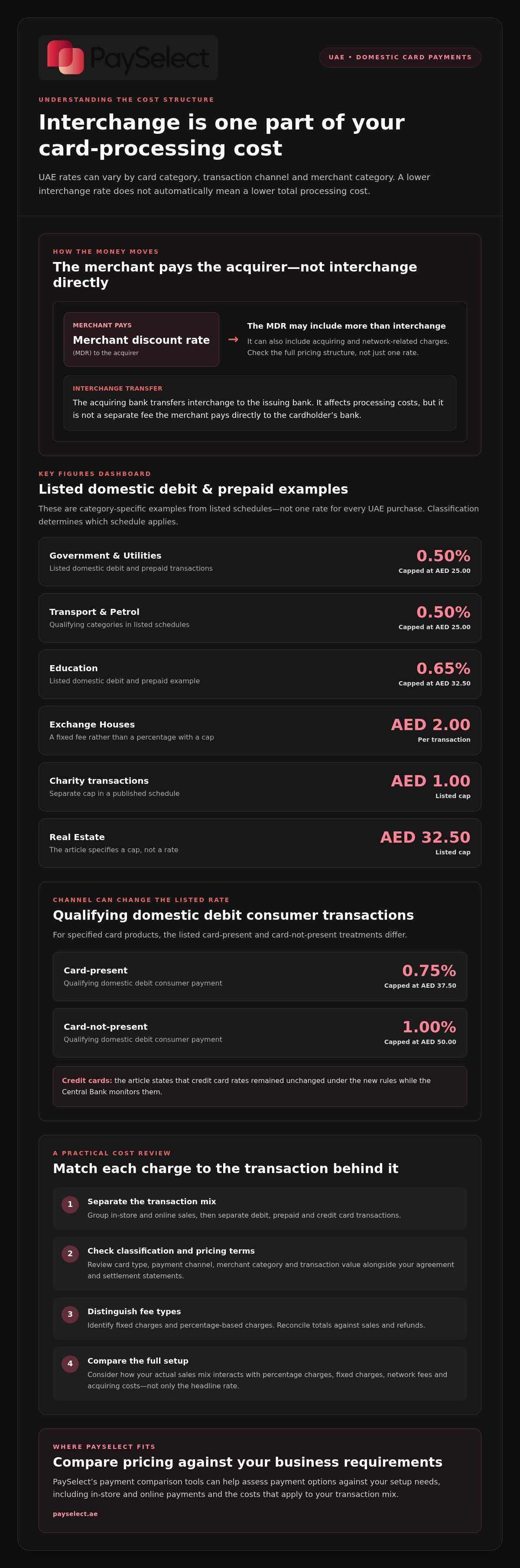
How interchange fees are allocated
Interchange moves between banks in the payment chain, while merchants pay their acquirer’s merchant discount rate. Understanding this flow helps UAE businesses distinguish bank-to-bank transfers from the charges shown on merchant statements.
For a UAE card transaction, the acquirer receives the payment and passes an interchange portion to the issuing bank through a payment technology company. The issuer is the bank that provided the customer’s card; the acquirer processes payments for the merchant. The merchant pays the acquirer, not the issuing bank directly.
This answers who receives interchange and how merchants encounter it: the issuing bank receives the transfer, while the merchant sees a merchant discount rate charged by its acquirer. That rate can include other components, so interchange and the total merchant charge are not interchangeable terms.
Payment technology companies also charge banks separate network or scheme fees. These are distinct from interchange. When reviewing a combined statement total, separate the merchant discount rate, interchange and network fees wherever they are identified. This makes the payment chain easier to interpret without treating every charge as the same fee.
Regional comparisons need the same basis: domestic or cross-border, debit or credit, and consumer or commercial cards. The UAE framework discussed here covers domestic consumer debit and prepaid cards issued locally. According to Európai Unió, since 2015 the EU has capped consumer debit interchange at 0.2% and consumer credit at 0.3%. Saudi Arabia and the UK require their own market and transaction categories for a meaningful comparison.
For UAE merchants and payment providers, practical risks include misclassifying transactions or combining debit, prepaid and credit charges in reports. Acquirers must show these card fees separately under UAE rules. Accurate transaction categories and clear statement breakdowns help businesses identify the applicable rate and distinguish interchange from other charges.
Use a simple review sequence to trace how charges are allocated:
• Match each transaction to its card type and payment channel.
• Identify the merchant discount rate charged by the acquirer.
• Separate interchange from any network or scheme fee shown.
• Compare the statement categories with the transaction records.
For example, don’t automatically group a locally issued domestic prepaid transaction with a credit card transaction. UAE rules treat card categories separately. Reviewing transaction records alongside acquiring statements can show how fees flow, which charges apply and where further pricing analysis could help.
Who sets interchange fees for UAE card payments: banks, Visa, Mastercard, or the Central Bank?
No single party determines every detail of interchange in the UAE. Card networks publish schedules, payment technology companies generally set default interchange rates between issuing and acquiring banks, and the Central Bank sets the local regulatory framework. Banks apply the relevant rates when issuing cards or processing merchant payments.
Each participant has a distinct role. The issuing bank provides the customer’s card and receives interchange. The acquiring bank processes the merchant’s card payments and charges the merchant under its pricing arrangement. Card networks connect the parties and publish schedules that distinguish transactions by factors such as card type, merchant category and payment channel.
The Central Bank’s role is to set the regulatory framework for the UAE market, rather than publish every network’s individual product rate. For example, CBUAE Notice 1998/2024 established the domestic consumer debit and prepaid structure. A merchant should therefore read the local rules alongside the schedule applicable to its transactions, rather than treating either as the only source of pricing detail.
Payment technology companies also help establish default rates for transfers between issuing and acquiring banks. This means the merchant’s acquirer is not the sole decision-maker for interchange. The acquirer sets the merchant’s overall pricing arrangement, which may include charges beyond interchange. This explains why a rate in a network schedule may differ from the total cost on a merchant statement.
For a meaningful comparison, keep transaction conditions consistent. Match the card category, channel and merchant segment before comparing schedules or acquiring offers. Comparing unlike transactions can make an option appear more or less expensive for reasons unrelated to the provider’s overall pricing structure.
When reviewing a payment setup, separate three questions: which local rules apply, which network schedule covers the transaction, and how the acquirer presents charges to the merchant. This makes pricing discussions more precise and helps you identify whether a difference comes from interchange or another part of the acquiring arrangement.
Businesses assessing gateway options can use a payment gateway comparison to compare pricing and fit against their transaction needs.
The Central Bank of the UAE introduced new regulations for Interchange Reimbursement Fees and Merchant Discount Rates effective October 1, 2024. Visa interchange reimbursement fees are transfer fees between issuers and acquirers, while merchants pay a merchant discount rate to their acquirer rather than paying interchange reimbursement fees directly. A separate tax question may arise: zero-rating is a possible UAE VAT treatment for services supplied by an issuing bank to a payment technology company generally located outside the UAE.
Network caps can also set limits on particular domestic transactions. From October 1, 2024, Mastercard’s domestic interchange fee cap for Government and Transport transactions in the UAE is AED 25. From October 1, 2024, Visa’s domestic interchange fee cap for Government, Transport, and Petrol transactions in the UAE is AED 25. From October 1, 2024, Visa’s domestic interchange fee cap for Charity transactions in the UAE is AED 1. These caps are category-specific, so check the transaction category and applicable network schedule when assessing interchange. The merchant’s own acquiring charges remain a separate part of its cost.
PaySelect: Payment Gateway Comparison Tool
PaySelect’s Payment Gateway Comparison Tool helps businesses compare payment options based on their transaction profile and operating needs. It can be useful when card costs are difficult to interpret or your current setup no longer fits your sales channels, customer mix or expansion plans.
Compare payment pricing alongside the features that matter to your business, rather than judging options by one rate alone. For in-person payments, PaySelect’s POS System Selection Tool supports a focused comparison. Businesses handling international transactions can use Cross-border Payment Solution Matching to assess options for those needs.
These comparison tools help turn interchange and merchant cost details into a clearer view of the wider payment setup. Contact PaySelect to explore the comparison options for your business.
Make Your Next Payment Decision With Clarity
Understanding interchange fees in the UAE can support better payment decisions, but those decisions should reflect how your business operates. As sales channels, customer expectations and cross-border needs evolve, review whether your payment setup still fits. Consider the channels you use, the transactions you handle and whether you can understand and manage the pricing structure.
PaySelect helps businesses compare payment options against their requirements. Use the comparison to consider fit, pricing and operational needs, then decide what warrants a closer review. The goal is not to focus on one fee in isolation, but to make an informed decision about your payment setup.
Contact PaySelect about payment costs to explore your next step. A thoughtful review can help you move forward with greater clarity and confidence.
Frequently Asked Questions
How does this impact merchants?
Interchange contributes to the underlying cost of accepting card payments and can affect a merchant’s overall processing expenses. The impact depends on the transaction mix, including card category, sales channel and merchant classification. For example, a retailer with substantial online sales may have a different cost pattern from a business that mainly accepts in-person payments. Reviewing costs by transaction group helps show which parts of the payment setup need attention.
What are interchange fees in the UAE and how do they work?
Interchange fees are transfers between the bank that issued a customer’s card and the bank that processes the merchant’s card payment. They are one part of card payment costs, not a separate bill paid by the customer at checkout. For UAE merchants, understanding interchange fees in the UAE means distinguishing this bank-to-bank transfer from acquiring charges and reviewing each cost in context.
How do UAE interchange fees differ for domestic, international, online, and in-person transactions?
The UAE interchange rules described here apply to domestic consumer debit and prepaid cards issued locally, whether used online or in person. International transactions may follow different pricing and classification arrangements. A UAE-issued card processed by a merchant outside the UAE may also incur a cross-border charge, even if billed in AED. When reviewing classifications, distinguish the transaction location, card origin and sales channel.
Are interchange fees in the UAE capped or regulated by the Central Bank?
Yes. The Central Bank of the UAE introduced a regulated interchange reimbursement structure for domestic consumer debit and prepaid card transactions, with caps for specified qualifying categories. The cap does not set one universal maximum for every card payment. Interpret it alongside the transaction’s card type, channel and merchant category. Credit card rates were unchanged under the new rules, while the Central Bank monitors them.
Disclaimer
This content is for informational purposes only and should not be considered financial, legal, or regulatory advice. Payment provider availability, pricing, and approval processes vary depending on individual business circumstances. PaySelect does not guarantee provider acceptance or specific outcomes. Businesses should conduct their own due diligence before entering into any agreements.
Empowering businesses to achieve greater growth
