
What if an extra checkout step isn’t required for every customer? That’s the idea behind modern 3-D Secure: it can assess payment risk in the background and ask for extra verification only when needed. If you’ve wondered “what is 3d secure authentication” after seeing a prompt during checkout, the distinction matters. The process can help verify who’s using the card, but it isn’t the same as authorizing the payment.
It’s reasonable to worry that another step could interrupt a purchase. In a frictionless flow, the customer doesn’t need to take additional action. In a challenge flow, they may be asked to confirm their identity, for example through a code or biometric check. The payment still needs authorization separately.
This guide explains how 3-D Secure works, what customers may experience, and what businesses in the UAE should ask when reviewing a payment setup. You’ll learn how authentication and authorization differ, what can shape the customer journey, and how to assess whether a payment gateway fits your business needs. PaySelect’s independent comparison and advisory services can help merchants review payment options as part of that assessment.
Key Takeaways
• Learn what is 3d secure authentication and how it adds an identity check to eligible online card payments.
• Understand the checkout flow and why the steps can differ by payment gateway and card issuer.
• See how frictionless and challenge flows affect customer effort, and what to consider when balancing verification with checkout experience.
• Use a practical checklist to review gateway support, transaction reporting, customer experience, and operational ownership.
• Assess 3-D Secure as one part of your wider payment setup, and compare gateway options against your business needs in the UAE.
What Is 3D Secure Authentication in an Online Card Payment?
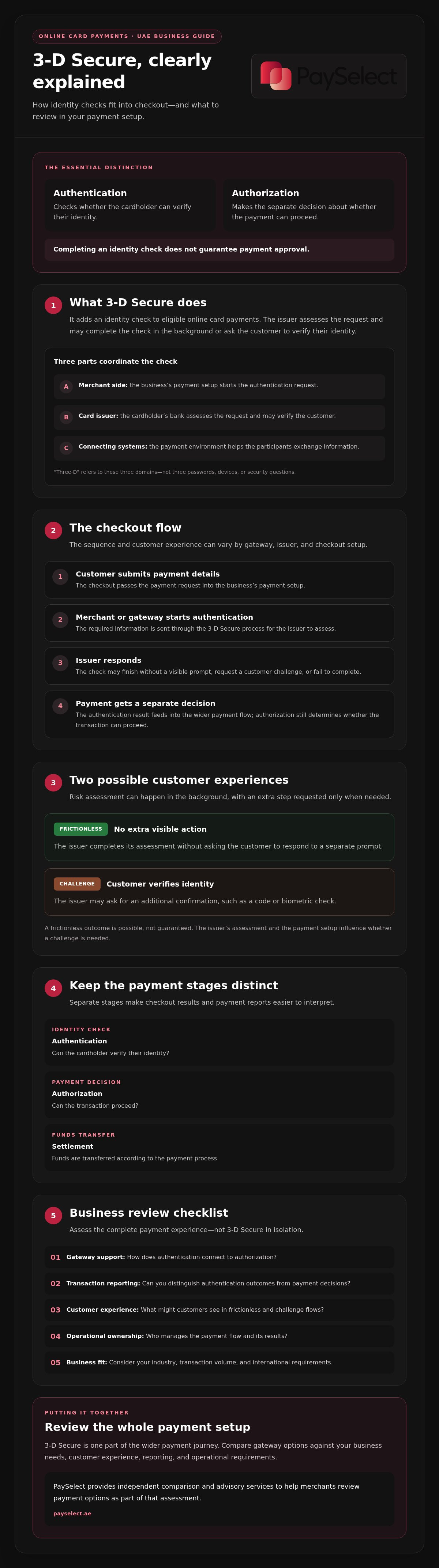
What is 3d secure authentication? It’s a process that adds an identity check to eligible online card payments. Before the payment decision is made, the card issuer may assess whether the person using the card can verify they’re the legitimate cardholder. Depending on the transaction, this check may happen in the background or require the customer to take an extra step.
In practical terms, the flow connects three parts of the payment environment: the merchant side, the card issuer, and the systems that let payment participants communicate. The merchant or its payment gateway starts authentication during checkout. The issuer reviews the available information and may verify the customer. The shared payment-system environment supports the exchange between participants.
What does the name 3-D Secure mean?
“Three-D” refers to three domains involved in the protocol, not three passwords, devices, or security questions. In formal descriptions, these are often called the acquirer, issuer, and interoperability domains. The acquirer domain represents the merchant’s side of the payment, the issuer domain represents the cardholder’s bank, and the interoperability domain helps connect the systems involved. The 3-D Secure protocol overview explains this model and its background.
For a business owner, the key point is that authentication isn’t handled by the customer and merchant alone. It involves coordination between the merchant’s payment setup and the issuer, with the payment environment supporting the exchange. The customer journey can vary by gateway and issuer.
How is authentication different from authorization?
Authentication checks whether the cardholder can verify their identity. Authorization is the separate decision about whether the transaction can proceed, based on the payment details and the parties involved in processing it.
Authentication checks identity; authorization decides whether a payment can proceed. A customer might complete an identity check at checkout, but the transaction could still be declined during authorization. An authorized payment also isn’t the same as settlement, when funds are transferred according to the payment process. Treating these as separate stages helps businesses interpret checkout results and payment reports accurately.
For merchants in the UAE reviewing their setup, ask how a gateway handles the hand-off between authentication and authorization, and how each outcome appears in transaction reporting. Comparing gateway capabilities against your industry, transaction volume, and international requirements can help clarify whether the overall payment flow fits your business. PaySelect offers an independent payment gateway comparison to support that assessment.
How Does 3-D Secure Work During Checkout?
3-D Secure runs within the payment journey, usually after a customer enters card details and submits an online order. The merchant or its payment gateway initiates authentication, then the issuer assesses the request and determines whether further verification is needed. The sequence and customer experience can vary by gateway, issuer, and checkout setup.
A typical flow looks like this:
The customer submits payment details.
The merchant’s checkout passes the payment request into its payment setup.
The merchant or gateway starts authentication.
It sends the required information through the 3-D Secure process for the issuer to assess.
The issuer responds.
Authentication may complete without a visible prompt, the issuer may request a customer challenge, or the check may not complete.
The payment proceeds to a separate decision.
The authentication result is used in the wider payment flow, but authorization still determines whether the transaction can proceed.
From checkout initiation to the issuer’s response, 3-D Secure checks identity and returns an authentication outcome; it doesn’t guarantee payment approval. Merchants should interpret the authentication result separately from the payment decision.
What happens in a frictionless authentication flow?
In a frictionless flow, the issuer completes its assessment without asking the customer to take an extra visible step. The customer can continue through checkout without responding to a separate prompt. This is a possible outcome, not a guarantee: the issuer’s assessment and the payment setup influence whether a challenge is needed. Check how your gateway reports the authentication outcome so you can interpret transaction records correctly.
When might a customer be asked to complete a challenge?
An issuer may request extra verification during checkout before returning its authentication response. The customer might see an issuer-provided prompt and be asked to follow its instructions. The method and screen depend on the issuer and the merchant’s payment setup, so don’t assume every customer will see the same experience. Test how the flow appears across the checkout journeys your business supports.
For merchants in the UAE, review more than whether 3-D Secure is available. Check how authentication starts, what customers see if a challenge is requested, and where outcomes appear in reporting. Gateway capabilities and configuration can differ, so compare options against your business needs and transaction profile. PaySelect’s payment gateway comparison can help structure that review.
Does 3-D Secure Add Checkout Friction or Help Manage Payment Risk?
It can do both. 3-D Secure supports cardholder verification during online payments, but a customer may need to complete an extra step if the issuer requests a challenge. Other transactions may be authenticated without a visible prompt. The result depends on factors such as the issuer’s assessment and how the merchant’s payment setup handles authentication.
For businesses, the question isn’t simply whether an extra step is good or bad. It’s about understanding the likely customer experience, how authentication outcomes are used in the payment flow, and what the gateway reports. 3-D Secure can support verification, but it doesn’t eliminate fraud, guarantee authorization, or ensure higher conversion.
Potential benefit
Supports an identity check during an online card payment, with outcomes that may inform how the payment is handled.
Potential trade-off
A visible challenge adds effort and may interrupt checkout, while a flow without a customer prompt can feel more seamless.
What can merchants gain from 3-D Secure?
The protocol gives the issuer an opportunity to assess whether the person using the card can verify their identity. That can add useful context to an online payment, where the cardholder isn’t physically present. How the outcome affects payment handling depends on the merchant’s setup. Ask your payment provider what each authentication outcome means for your transactions, how it appears in reporting, and which responsibilities remain with your business.
Authentication is one part of payment acceptance, not a complete fraud-management strategy. Understand what your gateway supports, what information it makes available, and how staff should respond when a payment doesn’t complete as expected.
Can authentication affect conversion or customer experience?
A challenge can add a pause at a sensitive point in checkout. If a customer doesn’t understand the prompt, can’t complete it, or leaves the payment screen, the extra effort may affect their experience. Authentication that completes without a visible challenge may let the customer continue with less interruption. Neither outcome applies to every transaction, so avoid assuming a universal conversion impact.
Review your own checkout data after enabling or changing the flow. Compare completion and abandonment patterns, and check whether customers encounter errors or have difficulty finishing verification. Consider the device and journey as well as the authentication result. For businesses in the UAE assessing gateways, PaySelect’s payment gateway comparison can help structure a provider-neutral review around business needs and payment setup.
What Should a Business Check Before Enabling 3-D Secure?
Before changing a live payment setup, confirm what your chosen gateway supports and how authentication will fit into checkout. Availability and configuration can depend on the gateway and other connected providers, so don’t assume every setup works the same way. If you’re asking what is 3d secure authentication in practical terms, this review is about more than a security setting. It also covers customer experience, reporting, and who manages the process.
Use this checklist to guide the conversation with your gateway provider:
Gateway support
Does the gateway support 3-D Secure, and how is the flow configured for your payment setup?
Customer experience
What might customers see if the issuer requests a challenge? Does the journey work clearly across your checkout channels?
Transaction reporting
Where can you see authentication outcomes, incomplete challenges, and payment results?
Operational ownership
Who in your business reviews issues, and what help is available from the gateway for testing and troubleshooting?
Questions to ask a payment gateway
Ask the provider to explain the authentication journey from checkout to issuer response in plain language. Find out how each outcome appears in merchant reporting, including cases where a customer doesn’t finish a challenge. Clarify what support is available for testing and resolving checkout issues, and which tasks your own team will need to manage. These answers set clear expectations before configuration changes.
How can a business review the customer journey?
Test representative journeys before making a change live. Include the checkout channels your business supports, and review the challenge experience on mobile and desktop where applicable. Check that customers can understand what to do and return to checkout smoothly. Then use the reporting available in your setup to monitor authentication and payment outcomes, rather than relying on assumptions about how the flow performs.
For businesses in the UAE, a structured review can also help compare gateway capabilities against your industry, transaction volume, and international requirements. PaySelect’s independent comparison tool can help you assess payment gateway options as part of that decision. Use the comparison to frame questions for providers, then confirm configuration details and operational responsibilities directly with the gateway you choose.
How Does 3-D Secure Fit Into Your Wider Payment Setup?
3-D Secure connects the merchant’s checkout and payment gateway with the card issuer, shaping what a customer may experience while an online card payment is being verified. But it’s one component of payment acceptance, not a complete fraud or payment strategy. Businesses still need to assess how their gateway supports their sales channels, how payment outcomes are reported, and whether the wider setup fits their operating needs.
If you’ve been asking what is 3d secure authentication, the practical takeaway is that it works within a broader chain: the merchant initiates the payment journey, the gateway supports authentication, the issuer responds, and the customer may or may not need to take an extra step. Reviewing these connections can help reveal whether your current setup remains suitable as your business changes.
When should a business review its payment setup?
Consider a review when your checkout needs, sales channels, or international requirements change. For example, adding a new online channel or serving customers in additional markets may prompt you to check gateway support, reporting, and the customer journey again. Compare providers against the same business requirements rather than assuming their capabilities are identical. If your business needs to accept payments across borders, assess whether available cross-border payment solutions fit those requirements.
A focused review can include questions such as:
• Does the gateway support the payment journeys and channels your business uses?
• Can your team access the authentication and payment reporting it needs?
• Does the customer experience work for the markets and devices you serve?
Where can merchants get neutral comparison support?
Comparing payment options can be challenging when each provider presents different capabilities and terms. PaySelect is an independent platform that matches businesses with providers based on factors including industry, transaction volume, and international requirements. Larger organizations can also consider its advisory support when reviewing payment infrastructure. This can help structure the evaluation, while the selected gateway remains responsible for its own payment services and setup.
For businesses in the UAE, the right setup depends on how you sell, the customers you serve, and the operational information your team needs. Explore independent payment guidance to compare relevant options and assess your wider payment infrastructure with greater clarity.
Make Your Payment Setup Work for Your Business
Understanding what is 3d secure authentication helps clarify why a customer may see an extra verification step during checkout. Authentication checks identity; authorization determines whether the payment can proceed. Depending on the issuer and setup, verification may happen without a visible challenge or require customer action.
Next, assess how the process fits your wider payment journey. Review gateway support, customer experience, reporting, and who in your business handles issues. Check the flow across the checkout channels you use, and revisit it as your business needs change.
Choosing a payment gateway involves more than one security feature. PaySelect provides independent payment solution comparisons, matching businesses with options based on industry, transaction volume, and international requirements. Explore PaySelect’s independent payment guidance to assess relevant options with greater clarity. With the right questions and a structured review, you can make informed choices that support your operations and your customers’ checkout experience.
Frequently Asked Questions
What is 3-D Secure authentication?
3-D Secure is a protocol used to help authenticate cardholders during online card payments. In practical terms, what is 3d secure authentication? It’s an identity check within the payment journey, involving the merchant’s payment flow and the card issuer. The check may happen without a visible prompt or may ask the customer to complete a challenge. Authentication is separate from authorization and doesn’t guarantee payment approval.
How does 3-D Secure authentication work?
The merchant or its payment gateway initiates authentication as part of checkout. The issuer assesses the transaction and may complete the check without asking the customer to act, or request an additional verification step. The result returns through the payment flow, but authorization remains a separate decision. The screens, configuration, and reporting available to the merchant depend on the gateway and other connected providers.
Is 3-D Secure the same as two-factor authentication?
No, they aren’t the same. 3-D Secure is a protocol for authenticating cardholders during online card payments. A challenge may ask the customer to complete an additional verification step, but some transactions can proceed through authentication without a visible prompt. The method depends on the payment setup, so don’t assume every flow requires a password or a second factor. Ask your gateway how its supported flow works.
Does 3-D Secure prevent all online payment fraud?
No, 3-D Secure shouldn’t be treated as a guarantee against fraud. It supports cardholder authentication during eligible online payment flows, but the outcome depends on the transaction, issuer, and implementation. It also doesn’t guarantee authorization. Ask your gateway how authentication results affect payment handling and reporting, and treat the protocol as one part of your wider payment setup rather than a complete fraud-management strategy.
Can 3-D Secure make checkout slower for customers?
It can add effort when the issuer requests a visible challenge, while other transactions may complete without a prompt. The experience depends on the issuer, gateway configuration, and customer journey. Test checkout on the devices and channels your business supports, including mobile and desktop where applicable. Then review your own payment and checkout data to understand how the flow affects customers instead of assuming the impact is universal.
Does every online card payment require 3-D Secure?
Not every online card payment follows the same authentication path or presents a customer challenge. Whether authentication is initiated, and whether the customer must act, depends on the merchant’s payment configuration and decisions made during the transaction. Requirements and gateway capabilities can vary. Confirm how your specific setup works with your payment gateway, and seek qualified guidance if you need advice about obligations that may apply to your business.
How can a business check whether its payment gateway supports 3-D Secure?
Ask the gateway whether it supports 3-D Secure, how the flow is configured, and how completed or incomplete authentication appears in merchant reporting. Confirm how to test checkout and where to get help troubleshooting issues. If comparing gateways, consider these points alongside your industry, transaction volume, sales channels, and international requirements. PaySelect’s independent comparison tool matches businesses with payment options using these kinds of business needs.
Disclaimer
This content is for informational purposes only and should not be considered financial, legal, or regulatory advice. Payment provider availability, pricing, and approval processes vary depending on individual business circumstances. PaySelect does not guarantee provider acceptance or specific outcomes. Businesses should conduct their own due diligence before entering into any agreements.
Empowering businesses to achieve greater growth