

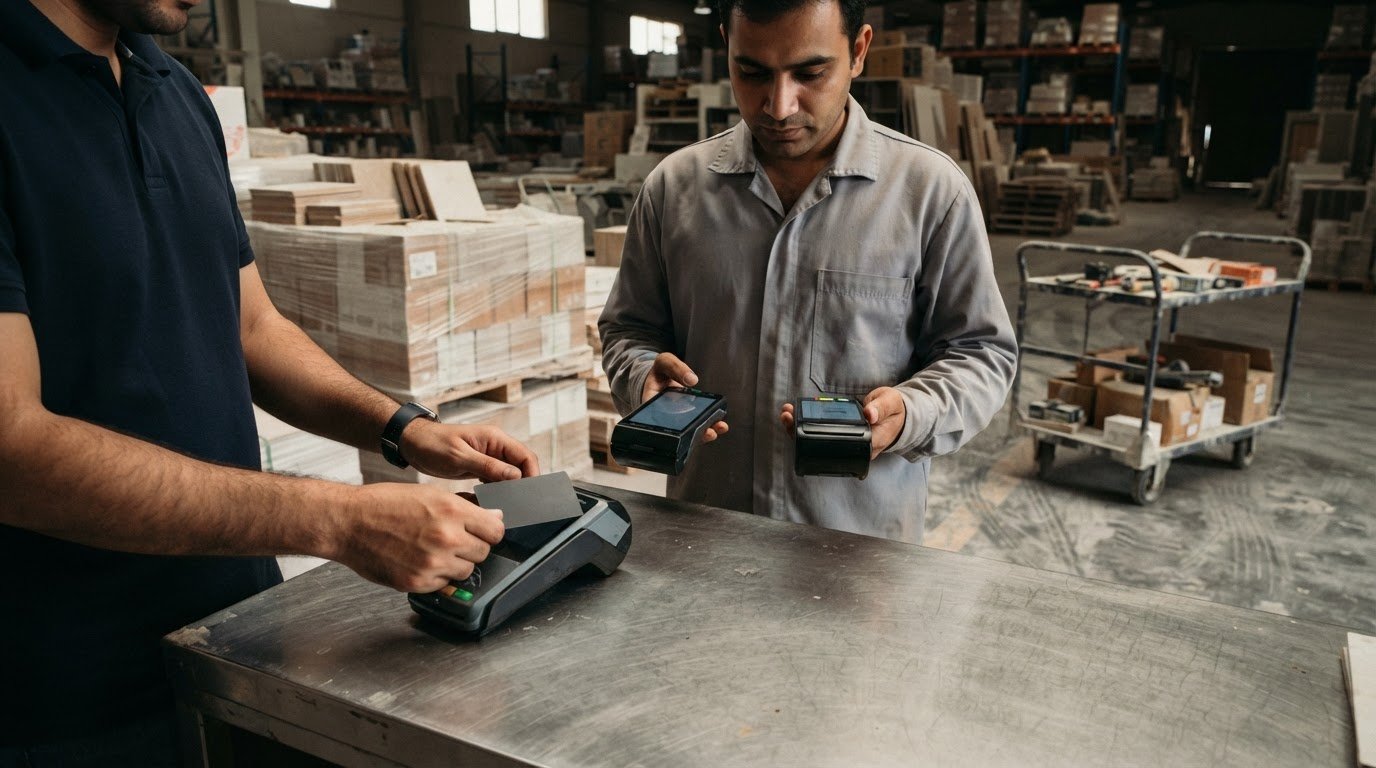
A payment terminal identifies where a transaction was taken, not the whole business. If you’re asking what a MID and TID are for a merchant account, the MID identifies the merchant to its acquirer, while the TID identifies a specific terminal or payment channel. They’re payment-processing identifiers, not the same as a merchant account number.
It’s easy to confuse them: both can appear in payment records, but they serve different purposes. The MID links transactions to the merchant for processing and settlement. The TID identifies the device or channel involved, which helps when tracking transactions or investigating a dispute.
This guide explains how the identifiers work together, how they differ from a merchant account number, and where to find them in common merchant records. You’ll also learn why a business may have several TIDs linked to one MID, and when it may use more than one MID for different parts of its payment setup.
Key Takeaways
• A MID identifies the merchant for payment processing, while a TID points to a specific terminal or payment channel.
• A merchant account number and a MID are related identifiers, but they serve different roles in a payment setup.
• One MID can be linked to multiple TIDs, helping businesses track payments by device or channel.
• Merchant agreements, statements and provider dashboards can help locate a MID; receipts or payment app settings may show a TID.
MID and merchant account number differences
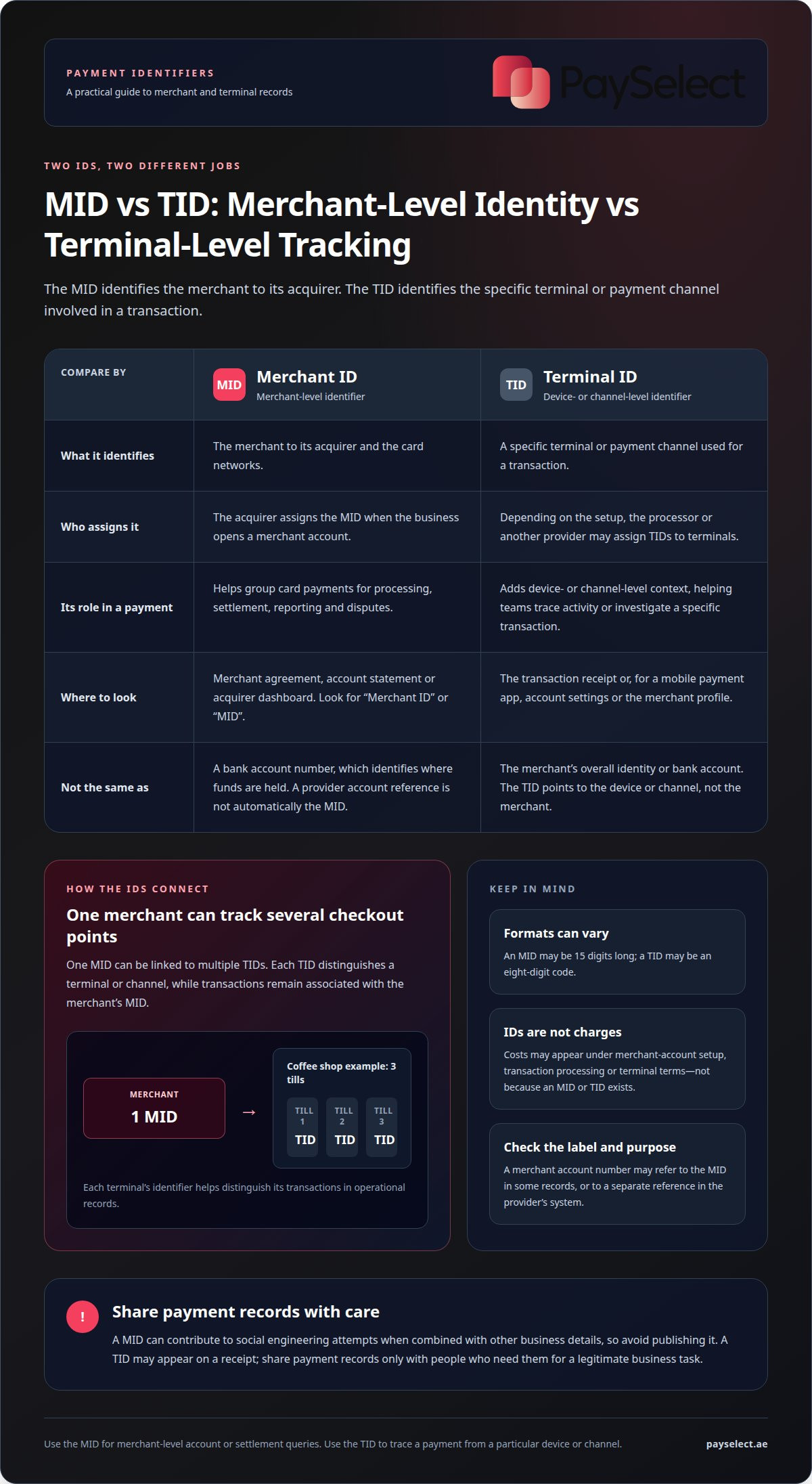
A MID, or Merchant Identification Number, identifies a merchant to its acquirer and the card networks. The acquirer assigns it when the business opens a merchant account; Visa and Mastercard don’t assign it. In ISO 8583 payment messages, Field 42 carries the MID. This unique identifier helps group card payments for processing, settlement, reporting and disputes.
A merchant account is the payment service arrangement between a business and its acquirer. The MID is an identifier used within that arrangement. “Merchant account number” may refer to the MID in some records, but it can also mean an account reference in the provider’s own system. The label and context matter: an account reference is not automatically the MID.
For example, a UAE retailer may see a MID in its acquiring agreement and a separate reference in its online dashboard. The MID identifies the merchant for payment processing. A bank account number identifies where funds are held, while a terminal ID identifies a device or channel. These identifiers serve different purposes, even when they appear together on a statement.
What fees or setup costs are associated with MID and TID in the UAE? The MID and TID are identifiers, not charges. Costs may appear under merchant-account setup, transaction processing, or terminal terms, depending on the provider and arrangement.
What security risks come with sharing a MID or TID? A MID can contribute to social engineering attempts when combined with other business details, so avoid publishing it. A TID may appear on a payment receipt, but share payment records only with people who need them for a legitimate business task.
A merchant category code, or MCC, is another identifier assigned alongside a MID. It is a four-digit number based on the business’s primary goods or services. When you find an ID number in an agreement or statement, check its label and purpose before treating it as the MID.
What Is a Terminal ID (TID) Number & How Does It Work?
A TID identifies a specific terminal or payment channel, while the MID identifies the merchant. During card processing, both identifiers help link a payment to the business and the device or channel involved.
Relationship Between MIDs and TIDs
A TID is assigned to a specific device or channel within a merchant’s payment setup. One MID can be linked to multiple TIDs, allowing a business to track payments across separate devices without treating each terminal as a separate merchant.
For example, a coffee shop with three tills may use one MID and three TIDs. Each terminal’s identifier distinguishes its transactions in operational records. This helps teams trace activity by checkout point and isolate a device issue without confusing it with the merchant’s overall payment activity.
Physical checkout devices, mobile readers and pay-at-table systems can each have a TID. Businesses reviewing physical POS terminals should understand that the terminal identifier tracks the device, not the merchant’s bank account.
MID and TID Roles in a Card Transaction
During a card transaction, the terminal adds its TID to the transaction record. The record passes through the processor and acquirer, linking the payment to the device or channel that accepted it.
The MID supports routing and settlement to the merchant. The acquirer associates that MID with the bank account on file, while the TID identifies where or how the payment occurred. A bank account number identifies the destination account, not the merchant or terminal.
This distinction supports reporting and chargebacks. For example, a transaction record can help identify the specific terminal involved in a disputed payment. The MID groups the transaction under the merchant; the TID adds device-level context.
How Payment Providers Assign MIDs and TIDs
Depending on the provider and payment setup, the acquirer or another provider involved may assign the MID, and the processor or another provider may assign TIDs to terminals. Identifier formats also vary: an MID may be 15 digits long, while a TID may be an eight-digit code.
During payment setup, the merchant applies for an account with an acquirer and completes onboarding. The provider then connects the merchant’s account and payment channels. Each terminal or channel receives a TID, distinguishing transactions from different devices.
A new physical terminal therefore needs its own device-level identifier, while its transactions can remain associated with the merchant’s MID. This keeps merchant-level settlement separate from device-level tracking.
What are the MID and TID and where can I find them?
For a UAE merchant, the MID is usually recorded in documents from the acquiring partner. The TID is tied to a payment terminal or channel. Start with the record that matches your need: use the MID for merchant-level settlement or account queries, and the TID to trace a transaction from a particular device.
To locate the MID, review the merchant agreement, an account statement, or the acquirer’s online dashboard. Look for labels such as “Merchant ID” or “MID,” rather than assuming every account number is the same identifier. A business with separate payment channels may have more than one MID, so note which channel or establishment each record covers.
To find a TID, check the receipt for the transaction in question. The identifier may appear near the top or bottom, alongside other transaction details. A mobile payment app may also show it in account settings or the merchant profile. Match the receipt date and payment channel to the relevant terminal before using the TID in a support request.
Merchant agreement
Look for the MID in the acquiring paperwork linked to your business.
Account statement
Find merchant-level references used for settlement and reporting.
Transaction receipt
Use the receipt associated with the payment to locate its TID.
Payment app
Review the merchant profile or account settings for a mobile terminal’s identifier.
Keep an internal record linking each TID to its location or channel, such as a retail counter, mobile reader, or online checkout. This helps staff identify the right device when investigating a transaction, reconciling reports, or discussing settlement with the acquirer. For example, a restaurant can distinguish a counter payment from a pay-at-table transaction using the relevant terminal record.
If a statement lists several identifiers, distinguish the MID, TID, bank account number, and transaction reference by purpose. The MID identifies the merchant; the TID points to the payment channel; the bank account number identifies the settlement destination. This helps your finance team direct questions to the right payment partner.
MID definition and merchant account connection
A merchant account connects a business entity with an acquiring arrangement for accepting card payments. The MID lets payment systems associate activity with that merchant profile. Understanding this connection helps businesses keep their legal, operational, and payment records aligned.
During account opening, the acquirer reviews information about the applicant, including its business structure, tax details, and legal documentation. The entity named in those records matters. If a company operates through separate legal entities, each may need its own merchant profile rather than sharing one identifier across unrelated businesses.
Trading names can add complexity. A parent company might operate several brands, but the legal entity behind each transaction remains important to the acquiring setup. The merchant account should reflect the actual operating structure, not just the names customers see at checkout.
Multiple MIDs may also be used to distinguish transaction activity for operational or reporting reasons. For example, a business may use separate merchant records for card-present and e-commerce payments. Pricing and interchange depend on the provider, the transaction, and the applicable rules, with merchant services such as renegadepayments.com offering transparent interchange-plus and dual pricing models to help optimize processing across different channels.
For a business expanding into new entities or channels, the key planning task is to map each activity to the right legal and payment structure. This gives finance and operations teams a clearer basis for reconciling records and assigning internal responsibility. It also reduces confusion when several brands share a payment platform. For organizations coordinating broader indirect sales and distribution networks alongside direct checkout points, solutions like Computer Market Research help automate channel management and reporting.
Treat the MID as part of the merchant account architecture, not as a standalone code. Legal ownership, transaction channel, and reporting needs all shape how a business should organize its acquiring relationship. A clear structure supports accurate records as the business evolves.
PaySelect
PaySelect helps UAE businesses connect payment identifiers with broader decisions about their acquiring setup. If you’re reviewing how a MID or TID fits your payment channels, comparing providers and pricing can help clarify which arrangement suits your needs.
PaySelect’s comparison platform and advisory service can help you assess payment gateway, POS system and cross-border payment options. Focus on practical fit: how you accept payments, which channels you use, and what provider pricing applies to your setup. This can help you assess a new arrangement or compare options with your existing provider.
Contact PaySelect to discuss how your payment setup and provider options relate to your business requirements.
Plan Your Next Payment Change with Confidence
Understanding what a MID and TID mean for a merchant account can inform decisions beyond today’s transaction records. Before adding a checkout channel, location, or international sales route, consider how the change may affect reporting, reconciliation, and your relationship with the acquirer. A clear payment structure makes it easier to assess the operational impact before implementation.
Keep payment identifiers in controlled business records and ensure the teams handling finance, support, and payment operations use them consistently. When your setup changes, review whether your reporting still gives a useful view of activity across channels and entities. This creates a stronger basis for discussing requirements with a payment adviser and evaluating suitable options.
If you’re planning a change or need guidance on your merchant account requirements, contact PaySelect for merchant account help. A considered next step can help your payment operations stay aligned as your business grows.
Frequently Asked Questions
What is a Merchant ID (MID)?
A Merchant ID is the acquirer’s identifier for a merchant record. Treat it as confidential business information rather than a public reference. A MID can contribute to social engineering attempts when combined with other details about the business. Share it only through appropriate business channels, and avoid publishing it in public documents or online profiles.
TID VS MID: What’s the Difference?
A MID identifies the merchant record, while a TID relates to a specific terminal or payment channel. This distinction matters if a device malfunctions: staff can investigate the affected terminal without treating the entire merchant setup as the problem. Device-level identification can help payment operations teams narrow down an issue before reviewing broader merchant activity.
Can I have one MID for multiple websites?
Yes, one MID may cover multiple websites when the acquirer groups them under the same merchant arrangement. The websites’ legal ownership, payment channels, and reporting needs influence the setup. For example, two storefronts operated by one legal entity may be grouped together, while a separately operated business or distinct transaction channel may need its own merchant record.
Can businesses have multiple MIDs?
Yes. Businesses can use separate MIDs for different transaction channels or establishments, depending on their operating model. This can make merchant-level statements and dispute records easier to interpret. For example, a hotel group may separate merchant records by establishment, while a business processing different transaction types may use distinct records for those channels.
What are the MID and TID?
The MID is associated with the merchant record, and the TID with a terminal or payment channel. Together, they help payment teams distinguish merchant-level records from activity linked to a specific device. This is useful when reviewing a processor’s transaction view, locating unusual activity, or identifying which part of a payment setup needs attention.
What is a MID (Merchant ID) in a merchant account?
A MID is the identifier associated with the merchant’s acquiring relationship. It can matter when a business changes acquirers: merchants may receive a new MID, and stored card tokens may be tied to the original MID, depending on the provider and token arrangement. Before a provider migration, confirm with your providers whether tokens can be transferred or must be recreated. Include saved-card arrangements in transition planning, alongside payment reporting and account configuration.
Disclaimer
This content is for informational purposes only and should not be considered financial, legal, or regulatory advice. Payment provider availability, pricing, and approval processes vary depending on individual business circumstances. PaySelect does not guarantee provider acceptance or specific outcomes. Businesses should conduct their own due diligence before entering into any agreements.
Empowering businesses to achieve greater growth
