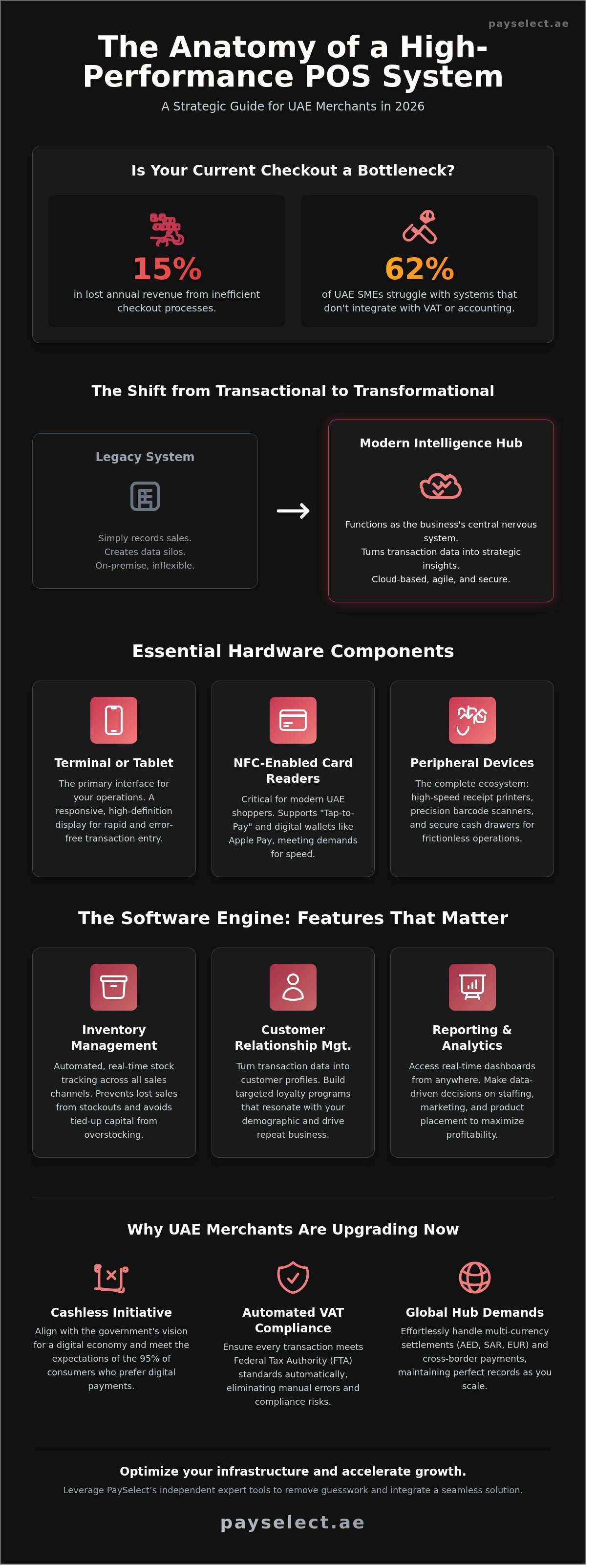
What if your current checkout process is actually a bottleneck costing you 15% in lost annual revenue? A 2024 industry survey revealed that 62% of UAE SMEs struggle with a point of sale system that fails to integrate with local VAT reporting or accounting software. You likely already feel the frustration of opaque fee structures and hardware that creates more friction than it solves. These technical barriers shouldn't dictate your pace of expansion.
This guide empowers you to master the complexities of modern payment technology and select a system that streamlines your operations while accelerating growth. We provide a precise framework for evaluating providers based on local compliance and technical reliability. You will gain a clear understanding of essential hardware components and learn how to turn transaction data into a strategic tool for business transformation. This is your roadmap to achieving operational efficiency and securing better data insights in the competitive UAE market.
Key Takeaways
• Understand the evolution from mechanical registers to cloud-based intelligence hubs that serve as the central nervous system of your modern business.
• Identify the essential hardware and software components required to build a high-performance point of sale infrastructure tailored for the 2026 landscape.
• Learn how to customize your tech stack for the unique demands of UAE retail, F&B, and service sectors to maximize operational efficiency.
• Master the framework for calculating Total Cost of Ownership in AED and ensure your business remains secure with the latest compliance standards.
• Leverage PaySelect’s independent expert tools to remove guesswork and integrate a seamless solution that accelerates your growth and streamlines settlements.
Defining the Modern Point of Sale (POS) System in 2026
The modern point of sale has evolved far beyond the simple exchange of currency for goods. By 2026, a POS represents the seamless intersection of high-performance hardware, cloud-integrated software, and secure payment processing. While legacy mechanical registers merely recorded sales, today's systems function as intelligence hubs that power business growth. This integration allows merchants to manage their entire operation from a single interface, removing the friction that once slowed down commerce.
It's vital to distinguish between a POS terminal and a POS system. The terminal refers to the physical hardware, such as a sleek touchscreen, a mobile card reader, or a biometric scanner. The system encompasses the entire digital ecosystem, including the software that manages your data, inventory, and customer relationships. For UAE businesses, this distinction is the difference between simply surviving and truly scaling in a competitive, digital-first economy. A modern system provides three core advantages:
Hardware Agility
Using mobile devices to bust queues and take payments anywhere on the floor.
Software Intelligence
Utilizing real-time analytics to predict stock shortages before they happen.
Payment Versatility
Accepting everything from digital wallets to "Buy Now, Pay Later" (BNPL) options.
The Shift from Transactional to Transformational
Modern systems turn every transaction into actionable data. This intelligence now drives inventory optimization, targeted marketing campaigns, and precise staff management. The point of sale is the central nervous system of modern retail. High-growth merchants prioritize real-time synchronization between online storefronts and physical locations. This ensures stock levels remain accurate across all channels, preventing lost sales and enhancing the customer experience. When a customer buys an item in a physical location, your warehouse inventory updates instantly, reflecting the change for online shoppers across the nation.
Why UAE Merchants Are Upgrading Now
The UAE payment landscape is moving fast. The government's cashless initiative aims to increase digital transactions significantly, leaving cash-heavy businesses behind. Modern systems also automate VAT compliance, ensuring every transaction meets Federal Tax Authority (FTA) standards without manual errors. As the UAE maintains its status as a global hub, merchants need systems that handle multi-currency settlements and cross-border payment complexities. These tools allow businesses to accept payments in AED, SAR, or EUR while maintaining perfect accounting records. Upgrading isn't just about technology; it's about meeting the expectations of a consumer base that demands speed, security, and flexibility.
The Anatomy of a High-Performance POS System
A modern point of sale system functions as the central nervous system of your business. It's a sophisticated fusion of physical components and digital intelligence designed to optimize every transaction. In the UAE market, where 95% of consumers now prefer digital payment methods according to 2023 industry reports, having a robust setup isn't optional. It's the foundation for scaling your operations and maintaining a competitive edge in a fast-paced economy.
Essential Hardware Components
The physical layer of your system defines how you interact with your customers. A professional setup requires three core elements:
The terminal or tablet
This serves as the primary interface. Whether it's a sleek countertop unit or a mobile tablet, it must provide a responsive, high-definition display for rapid transaction entry.
NFC-enabled card readers
These devices support "Tap-to-Pay" and digital wallets like Apple Pay or Samsung Pay. This technology is critical for meeting the speed expectations of modern UAE shoppers.
Peripheral devices
High-speed receipt printers, precision barcode scanners, and secure cash drawers complete the ecosystem. These tools ensure your staff can process orders without technical friction.
The Software Engine: Features That Matter
The software layer determines your business's agility. Most leading brands now opt for cloud-based SaaS solutions over legacy on-premise setups. Cloud systems offer real-time synchronization, allowing you to manage your business from anywhere in Dubai or across the globe. You should prioritize three specific capabilities:
Inventory management
Automated stock tracking across all sales channels prevents stockouts and overstocking.
Customer Relationship Management (CRM)
Use data to build loyalty programs that resonate with your specific demographic.
Reporting and Analytics
Transform raw transaction history into actionable strategy to boost your margins.
Behind these features lies the payment processor and merchant account. This infrastructure acts as the secure bridge between your customer's bank and your business account. It handles the complex encryption and settlement processes that ensure funds are deposited accurately and on time. For businesses looking to streamline global payments, choosing a partner that offers seamless integration between hardware and software is vital.
User experience (UX) is the final, crucial component. For your staff, an intuitive interface reduces training time and minimizes human error. For your customers, a frictionless checkout process builds trust and encourages repeat visits. When these elements align, your point of sale becomes a strategic asset rather than a simple utility. It empowers your team to focus on service while the technology handles the complexity of commerce.
Industry-Specific POS Requirements: Tailoring Your Tech Stack
Selecting a generic point of sale system often leads to operational bottlenecks. A boutique in Dubai Mall faces different challenges than a high-volume cafe in Jumeirah. Efficiency requires a solution built for your specific workflow. Standard systems fail to address the nuance of local market demands, resulting in slow checkout times and inventory discrepancies. Businesses that ignore industry-specific needs often see a 12% drop in staff productivity as employees struggle with workarounds.
Retail: Inventory and Omnichannel Mastery
Retailers in the UAE manage vast inventories, often exceeding 5,000 individual SKUs. Your system must automate reordering when stock hits critical levels to avoid lost sales. Modern retail demands seamless integration between your e-commerce platform and your physical outlet in Abu Dhabi. This ensures customers can buy online and return in-store without data silos. Real-time synchronization prevents overselling, protecting your brand reputation across all digital and physical channels.
Hospitality: Speed, Accuracy, and Guest Experience
In the F&B sector, speed defines success. A specialized point of sale optimizes the flow from table to kitchen. Kitchen Display Systems (KDS) eliminate paper tickets, significantly reducing order errors. Features like split-billing and visual table mapping empower staff to handle peak hours with calm assurance. Mobile ordering via tablets or QR codes reduces wait times, directly impacting your table turnover rate and increasing total daily revenue.
The rise of Mobile POS (mPOS) has transformed service providers across the Emirates. From home maintenance teams to personal trainers, portable units allow you to accept payments anywhere. These devices remove the barrier of a fixed counter. This flexibility accelerates the payment cycle. Businesses using mPOS often capture more revenue because they facilitate the transaction at the exact moment of peak customer interest.
A one-size-fits-all approach creates friction. It forces your team to work around the software rather than with it. Tailored tech stacks empower you to:
Streamline
complex workflows unique to your sector.
Accelerate
checkout speeds to enhance the customer experience.
Scale
operations across multiple locations with centralized data.
Choosing a system that understands your specific industry isn't just a technical decision. It's a strategic move to remove barriers to growth. When your tech stack aligns with your operational reality, you move from managing software to mastering your market.
Strategic Selection: Evaluating Costs, Security, and Integration
Selecting a point of sale system requires more than comparing sticker prices. It's a strategic investment in your operational infrastructure. You should calculate the Total Cost of Ownership (TCO) over a three-year horizon to understand the true impact on your margins. This evaluation ensures your technology scales alongside your ambition without becoming a financial anchor. A sophisticated choice balances immediate affordability with long-term flexibility.
The True Cost of a POS System
Upfront hardware costs in the UAE typically range from AED 1,800 to AED 5,500 per terminal. Software subscriptions add another AED 200 to AED 800 monthly depending on your feature set. You'll choose between two primary pricing models for transactions. Flat-rate pricing offers simplicity, often hovering around 2.0% per transaction. Interchange-plus pricing provides more transparency by passing through the actual card network costs with a fixed markup. This often saves high-volume merchants 0.5% or more on processing fees compared to standard flat rates.
Look beyond the obvious line items. Hidden costs often include:
• Professional installation fees ranging from AED 300 to AED 1,000.
• On-site staff training sessions that can cost AED 500 per day.
• Premium 24/7 technical support tiers required for mission-critical operations.
Read the fine print in payment contracts carefully. Many providers include early termination fees or automatic renewal clauses that can lock your business into outdated technology for 36 months. Avoid contracts that tie your software to a single, proprietary payment processor, as this limits your ability to negotiate better rates as you grow.
Security and Compliance in the UAE
Your provider must align with the UAE Central Bank Retail Payment Services and Card Schemes Regulations of 2021. Compliance isn't just a legal checkbox; it's a foundation of trust. Ensure your point of sale solution meets PCI DSS 4.0 standards to protect customer data. End-to-end encryption (E2EE) is non-negotiable. It secures data from the moment a card touches the reader until it reaches the processor. This prevents hackers from intercepting sensitive information during transit, even if they breach your local network.
Prepare for security audits by choosing an API-first architecture. This design allows for seamless, secure connections with third-party apps like ERPs and inventory tools. It ensures your data flows freely but remains protected within a hardened infrastructure. Regular vulnerability scans and documented access logs will simplify your compliance journey. This proactive approach allows your brand to expand globally with confidence and speed.
Ready to modernize your checkout experience? Scale your business with PaySelect's integrated payment solutions.
Optimizing Your Infrastructure with PaySelect
Choosing a point of sale system shouldn't be a gamble. In the UAE's rapidly evolving fintech space, businesses need more than just a terminal; they need a strategic asset. PaySelect operates as the independent authority in the Emirates, bridging the gap between complex payment technology and your bottom line. We've built an ecosystem that prioritizes your growth over provider commissions, ensuring every recommendation is backed by hard data.
Unbiased Comparison for Smarter Decisions
We analyze over 150 unique data points for every provider to ensure your match is precise. The UAE market often hides costs in complex fee structures or tiered processing rates that can erode your profits. PaySelect brings total transparency to these variables. One Dubai-based retail group recently utilized our optimization framework to identify 18% in annual savings on transaction fees by switching to a more compatible processor. This isn't just about finding a tool; it's about reclaiming your margins.
Our professional advisory services provide enterprise-scale insights that internal teams often overlook. We dive deep into your operational requirements, from VAT compliance to specific API integrations. This level of scrutiny ensures your infrastructure is lean, high-performing, and ready for the next level of commerce. We focus on three core pillars during our analysis:
Cost Efficiency
Eliminating hidden AED fees and redundant service charges.
Integration Depth
Ensuring your hardware talks to your software without friction.
Scalability
Preparing your tech stack for multi-location expansion.
Your Path to a Seamless Payment Future
Getting started is straightforward. Our 'Take the Test' tool removes the guesswork by filtering options based on your specific industry, monthly AED turnover, and integration needs. It's the fastest way to cut through the noise of the crowded point of sale market. The process is designed to be efficient, moving you from uncertainty to a finalized deployment strategy in record time.
Follow these steps to transform your payments:
• Input your business requirements and current transaction volume.
• Review a curated list of top-tier solutions tailored to the UAE market.
• Consult with our experts to refine your selection and accelerate implementation.
An optimized infrastructure does more than process cards. It integrates your inventory, CRM, and accounting into a single source of truth. As you scale from one boutique in Abu Dhabi to a regional franchise, PaySelect ensures your tech stack keeps pace. We empower you to remove barriers and focus on what matters most: your customers. Empower your business with the right POS today.
Scale Your Business with Smarter Technology
The modern point of sale system is no longer just a tool for processing payments. By 2026, it has evolved into a strategic data hub that integrates inventory management, customer loyalty, and local VAT compliance into one seamless interface. UAE businesses that prioritize hardware with high-performance specs and robust security protocols are better positioned to capture market share in a competitive digital economy. Efficiency is the ultimate competitive advantage when scaling across Dubai and the wider region.
Navigating the technical landscape requires a partner who understands the local market. PaySelect offers independent and unbiased advisory services designed to remove operational friction. We provide expert cost-reduction audits for enterprises to ensure your infrastructure remains lean and profitable. Every recommendation is fully optimized for the UAE regulatory environment, ensuring your business stays compliant while you focus on growth. It's time to replace fragmented legacy systems with a unified tech stack that drives measurable results.
Compare the best POS systems in the UAE for free
Your journey toward a more efficient and borderless business starts today.
Frequently Asked Questions
What is the difference between a POS and a cash register?
A cash register is a mechanical device that simply stores cash and records sales, while a modern point of sale system acts as a comprehensive business management hub. Modern systems integrate inventory tracking, staff performance metrics, and customer relationship management into a single interface. Industry data indicates that switching to a POS can reduce manual entry errors by 30% compared to traditional registers.
How much does a POS system typically cost for a business in the UAE?
UAE businesses generally spend between AED 2,000 and AED 7,500 for initial hardware and software licensing. Ongoing cloud subscription fees typically range from AED 150 to AED 600 per month depending on the features required. These costs cover essential components like receipt printers, tablet stands, and secure payment processing software.
Can I use my existing bank account with a new POS system?
Yes, you can link your current UAE business bank account to most modern point of sale platforms via a compatible payment gateway. Systems are designed to settle funds directly into accounts at major institutions like Emirates NBD, ADCB, or Mashreq. This integration ensures a seamless flow of capital and simplifies your daily financial reconciliation process.
Do I need an internet connection to run a cloud-based POS?
You need a stable internet connection for real-time data syncing, but many systems include an offline mode to process payments during outages. Local data stores the transaction details on your device and uploads them to the cloud once your Wi-Fi or 4G connection returns. This functionality ensures you never lose a sale due to connectivity issues.
What security certifications should I look for in a POS provider?
You must prioritize providers that hold PCI DSS Level 1 compliance and EMV certification to protect sensitive cardholder data. These global standards involve 12 strict security requirements that prevent fraud and data breaches. Choosing a certified provider ensures your business remains compliant with UAE Central Bank regulations and international payment security protocols.
Is it possible to integrate my POS with my accounting software like Xero or QuickBooks?
Most advanced systems offer native integrations with Xero and QuickBooks to automate your financial reporting. This connection syncs daily sales totals, tax calculations, and inventory costs directly to your ledger. Automation can save SMEs approximately 10 hours of manual bookkeeping labor every month, allowing you to focus on scaling your operations.
How long does it take to set up and install a new POS system?
A standard cloud-based setup typically takes between 24 and 72 hours from the moment you receive your hardware. More complex configurations for large-scale retail or hospitality venues might require 5 to 7 business days for full implementation. This timeframe includes software customization, hardware pairing, and initial staff training to ensure a smooth transition.
Can one POS system manage multiple business locations?
One centralized system can manage an unlimited number of physical and digital storefronts from a single administrative dashboard. You can monitor stock levels across 15 different branches or compare sales performance between your Dubai and Abu Dhabi locations in real-time. This unified approach provides the visibility needed to optimize inventory and streamline multi-site operations.
Disclaimer
This content is for informational purposes only and should not be considered financial, legal, or regulatory advice. Payment provider availability, pricing, and approval processes vary depending on individual business circumstances. PaySelect does not guarantee provider acceptance or specific outcomes. Businesses should conduct their own due diligence before entering into any agreements.
Empowering businesses to achieve greater growth