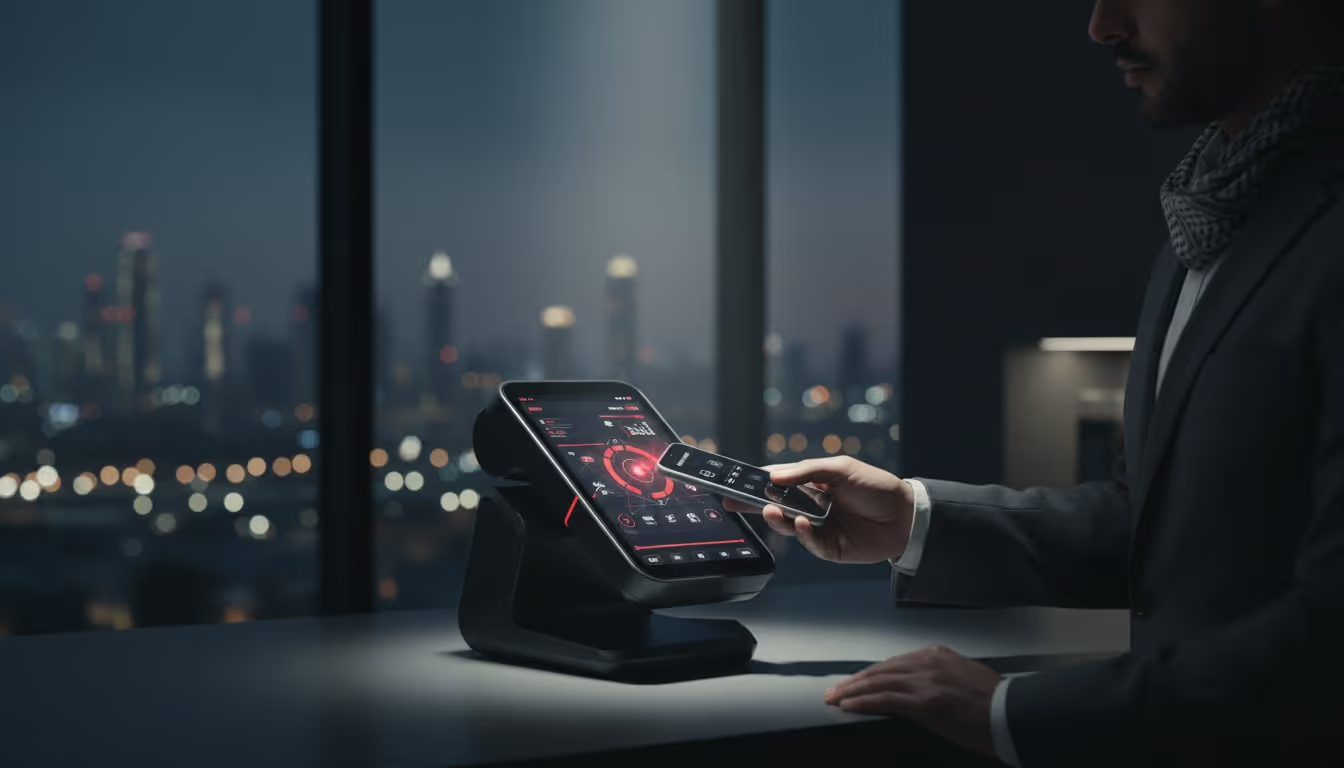
Over 90% of all face-to-face payments in the UAE are now contactless, signaling a permanent shift in how your customers expect to transact. As the nation accelerates toward its Cashless 2030 vision, your pos infrastructure must do more than just process sales; it must ensure compliance with the July 2026 e-invoicing mandate. You've likely encountered the hurdles of opaque provider pricing, difficult software integrations, or the fear of choosing a system that can't scale with your national expansion.
We believe that payment technology should empower your growth, not hinder it. This guide helps you master the essentials of Point of Sale technology and identify the most efficient system for your business operations. We'll provide a clear framework for evaluating providers, explain the core hardware components, and show you how to reduce transaction costs through optimized infrastructure. You're about to gain the clarity needed to streamline your workflows and scale your business with absolute confidence.
Key Takeaways
• Understand how the modern pos ecosystem has evolved from a simple cash register into a sophisticated, cloud-based business hub.
• Learn to distinguish between dynamic hardware and scalable software to build a high-performance system tailored to your specific industry.
• Discover how to identify and bypass hidden fee structures and technical friction that often erode profit margins.
• Apply a strategic framework based on total cost of ownership and regional scalability to ensure your infrastructure supports long-term expansion.
• Master the use of independent comparison tools to streamline your selection process and secure the most efficient payment solutions.
Defining the Modern Point of Sale (POS) Ecosystem
A modern pos system is the integrated hub where hardware and software converge to manage sales, track inventory, and sync customer data in real-time. While historical definitions of the Modern Point of Sale (POS) Ecosystem focused solely on the physical location of a transaction, the 2026 reality is significantly more expansive. It functions as the central nervous system of modern retail and hospitality, acting as the primary bridge between your physical storefront and your digital presence.
This integration creates a seamless loop where data flows without friction. When a customer makes a purchase, inventory levels update instantly across your warehouse, showroom, and e-commerce site. High-performance systems now utilize this data to provide actionable insights, transforming what was once a simple checkout tool into a strategic asset for business optimization and growth.
The Evolution of Checkout Technology
Traditional on-premise systems were static, tethered to local servers, and often required expensive manual updates. Modern cloud-hosted solutions have disrupted this model by offering borderless payment capabilities and real-time data access from any location. By 2026, the industry has pivoted toward mobile-first designs that prioritize the user experience for both staff and customers. These systems remove the friction of traditional counters; they allow sales associates to process transactions anywhere on the floor, which significantly reduces wait times and improves service speed.
Why UAE Businesses are Modernizing Their Infrastructure
The drive toward modernization is fueled by the UAE government's "Cashless 2030" vision. Digital transactions already accounted for over 70% of the retail market by 2024, making cash-heavy operations increasingly obsolete. Modernizing your infrastructure is now a requirement for regulatory compliance rather than just a technical upgrade. Starting July 2026, all B2B and B2G invoices must follow the PINT AE XML format. A sophisticated pos ensures you meet these standards while supporting diverse payment methods like NFC, digital wallets, and QR codes.
Selecting the right infrastructure is often complicated by opaque fee structures and integration hurdles. We help you navigate these challenges through our POS System Selection Tool, which identifies the most efficient hardware and software combinations for your specific model. By focusing on optimization rather than just processing, you can reduce transaction costs, eliminate technical barriers, and scale your operations with absolute confidence.
The Essential Components of a High-Performance POS System
A high-performance pos system functions as a unified ecosystem rather than a collection of isolated tools. It relies on a precise balance between dynamic hardware and scalable software. While the hardware provides the physical touchpoint for your customers, the software serves as the intelligent engine that drives your business decisions. These two layers are connected via APIs, which allow your system to communicate effortlessly with wider business tools like CRM platforms, inventory databases, and marketing suites. This connectivity ensures that your data isn't trapped in a silo; it moves where you need it most.
Reliability is a non-negotiable standard for UAE businesses operating in high-traffic environments. Modern systems must include robust offline-mode capabilities to ensure uninterrupted national operations. If your internet connection falters, a professional system continues to process transactions locally and syncs the data once the connection is restored. This prevents lost sales and maintains a frictionless experience for your customers, regardless of technical fluctuations.
The Hardware Stack: Beyond the Screen
Modern hardware must be as durable as it is aesthetic. The initial investment for high-end terminals typically ranges from AED 1,200 to AED 2,500, covering essential items like tablets, receipt printers, and integrated POS machines. For smaller enterprises or mobile vendors, "Tap-to-Phone" technology has emerged as a powerful alternative. This innovation allows SMEs to accept payments directly on a smartphone, removing the need for traditional bulky equipment. Choosing high-end, sleek hardware also reinforces your brand positioning, signaling to customers that your business is sophisticated and tech-forward.
The Software Layer: Intelligence and Integration
The software layer is where your business logic resides. It manages core functions such as real-time inventory tracking, customer relationship management, and automated reporting. A critical feature of 2026 systems is the seamless integration with payment gateways for unified reconciliation. This integration eliminates manual data entry and reduces the risk of human error. By adhering to global security standards, businesses can mitigate Common Payment Pain Points such as data breaches or compliance failures. High-performance software also automates VAT calculations and syncs with accounting platforms, ensuring you stay compliant with the July 2026 e-invoicing mandate without extra administrative effort.
Optimizing your setup starts with selecting the right infrastructure for your specific needs. If you're ready to upgrade, you can compare the latest POS hardware to find a solution that scales with your ambition.

Identifying and Overcoming Common Payment Pain Points
Opaque pricing structures remain the primary barrier for UAE entrepreneurs looking to scale. When your pos provider hides complex fee layers, your profit margins suffer before you've even closed for the day. Beyond the costs, poor technical support and frequent system downtime create significant friction. If a terminal fails during peak hours in a Dubai mall, the loss isn't just the immediate transaction; it's the long-term customer trust you've worked to build.
Fragmented data presents another critical challenge. Using different providers across multiple locations often results in disconnected reporting. This lack of a unified view makes it nearly impossible to track inventory or customer behavior accurately. Opaque contracts frequently lead to long-term lock-ins with outdated technology, preventing you from adopting more efficient solutions as your business grows. We specialize in removing these barriers through our POS System Selection Tool, ensuring your infrastructure remains agile and transparent.
Navigating the Hidden Costs of Transaction Processing
Understanding the total cost of ownership requires looking past the initial hardware investment, which typically ranges from AED 1,200 to AED 2,500. You must account for monthly software subscriptions between AED 199 and AED 499 per outlet. The Merchant Discount Rate (MDR) is where transparency often fails. In the UAE, credit card fees average 1.5% to 2.5%, while premium cards can reach 3.5%. Local debit cards are more affordable at 0.5% to 1.0%, but cross-border transactions often incur an additional 1% to 2% fee. Always audit the fine print for hidden "gate maintenance" or "statement fees" that can quietly erode your revenue.
The Burden of Manual Reconciliation
Matching daily sales to bank settlements manually is a massive drain on resources. This inefficiency delays financial reporting and increases the risk of accounting errors. Integrated systems accelerate your audit readiness by creating a single source of truth for all business data. When your checkout technology and payment gateways sync automatically, you gain immediate clarity on your cash flow. This automation provides the emotional relief of knowing your numbers are accurate, allowing you to focus on strategic expansion rather than administrative troubleshooting.
Eliminating these bottlenecks is the first step toward optimization. You can use our pricing comparison tool to identify where you might be overpaying on transaction fees today.
A Strategic Framework for Evaluating POS Providers
Selecting a pos provider is a high-stakes decision that dictates your operational efficiency for years. We recommend a rigorous, criteria-based approach centered on three strategic pillars: industry fit, scalability, and Total Cost of Ownership (TCO). In the UAE's high-speed retail environment, a generic solution often creates more problems than it solves. You need a partner that understands the nuances of local commerce while providing the technical depth to support your global ambitions.
Regional expansion requires borderless capabilities and a commitment to 24/7 localized support. National enterprises cannot afford system failures during critical periods like the Dubai Shopping Festival or major public holidays. Beyond the technical specifications, you must prioritize the user interface (UI) during your evaluation phase. Testing the interface firsthand is essential to ensure it is intuitive for your team; this directly minimizes staff training time and reduces costly checkout errors. A frictionless UI empowers your employees to focus on customer engagement rather than navigating complex software menus.
Industry-Specific Requirements
Different sectors demand distinct functional priorities. For retail businesses, the focus must remain on deep inventory management, barcode scanning efficiency, and real-time multi-store synchronization. These features ensure you maintain a single, accurate view of stock levels across all branches. In the hospitality sector, you should prioritize table management, kitchen display integration, and split-billing capabilities to accelerate table turnover. Service-based businesses require a different shift; they should look for integrated appointment scheduling and mobile payment flexibility to process transactions anywhere in the facility.
Future-Proofing Your Investment
Your technology must grow alongside your success. When evaluating providers, ask if their system can handle a 10x increase in transaction volume without performance lag. Examine their innovation roadmap and the frequency of their software updates. This ensures you won't be trapped with legacy technology that lacks modern security features. As you look toward international markets, consider the ease of adding cross-border payment modules to your existing setup. This foresight ensures your infrastructure remains a catalyst for growth rather than a technical bottleneck.
Choosing the right partner transforms your payment setup from a simple utility into a strategic advantage. You can use our POS System Selection Tool to identify which providers offer the specific scalability and industry features your business model demands today.
Streamline Your Decision with Independent Advisory
Direct provider pitches often focus on their specific software ecosystem rather than your actual business requirements. This creates a conflict of interest where the salesperson's primary goal is a signed contract, not necessarily your operational efficiency. Choosing an independent advisor allows you to bypass these biases and evaluate the pos market through a lens of pure utility and cost-effectiveness. PaySelect acts as a catalyst for growth by removing these selection barriers, ensuring you don't get locked into a system that restricts your national or international expansion. Our methodology replaces marketing hype with concrete data, allowing you to make decisions based on performance metrics and actual cost savings.
The PaySelect Advantage: Transparency and Independence
Unbiased guidance is essential in a financial landscape where digital transactions have grown by over 45% annually since 2024. We don't sell processing services; we provide the clarity needed to optimize your tech stack. By comparing different providers, you can identify which infrastructure offers the best balance of local debit card rates, which are typically between 0.5% and 1.0%, and premium credit card support. Our independent approach helps you reduce unnecessary overhead and streamline your settlements across multiple locations. We empower merchants with data-driven choices through our selection tool, which filters through complex variables to find your perfect match in minutes. This removes the selection fatigue that often leads business owners to choose the most visible provider rather than the most efficient one.
Next Steps: From Education to Implementation
Waiting until the July 2026 e-invoicing deadline is a risk your business shouldn't take. All B2B and B2G transactions must be compliant with the PINT AE XML format by that date, making an immediate system review mandatory for compliance. Start with an immediate audit of your current transaction fees and system performance to identify where your margins are being eroded. For enterprise-scale organizations with complex infrastructure, a professional consultation can reveal optimization opportunities that a standard sales pitch would miss. We position a payment audit not as a simple cost-cutting exercise, but as a strategic tool for business transformation. It's about building a foundation that supports borderless payments and seamless customer experiences. Optimize your payment infrastructure with PaySelect today.
Future-Proof Your Commerce Strategy
The transition toward a cashless economy is no longer a distant goal; it's the current reality for 70% of the UAE retail market. Your pos system must act as a strategic hub that integrates hardware, software, and compliance with the July 2026 e-invoicing mandate. By identifying hidden transaction fees and prioritizing scalable infrastructure, you transform a cost center into a powerful tool for business optimization. We've been simplifying the UAE payments landscape since 2023, providing the independent and unbiased comparisons you need to lead with confidence.
Don't let opaque pricing or technical silos hinder your global reach. Whether you're a boutique retailer or an enterprise-scale organization requiring expert advisory for infrastructure optimization, the right data makes all the difference. Our tools empower you to remove selection barriers and focus on what matters most: scaling your operations. Take the Test: Find the Perfect POS for Your Business. The future of your commerce is seamless, and it starts with a single, informed decision.
Frequently Asked Questions
What is the difference between a POS system and a payment gateway?
A pos system is the physical and digital hub for managing sales, inventory, and staff, whereas a payment gateway is the secure digital bridge that authorizes online transactions. While your checkout system records the item sold, the gateway encrypts the sensitive card data to communicate with the bank. Integrating these two ensures that in-store and online revenue data remain unified, providing a single source of truth for your business performance.
Can I use any POS hardware with any payment processing software?
Hardware and software compatibility is not universal; most systems require specific integrations or proprietary APIs to function together. Many providers use a locked ecosystem that forces you to use their specific terminals. To avoid this, look for hardware-agnostic software that offers flexible integration options. Our selection tool helps you identify which hardware components will work seamlessly with your preferred software layer to prevent technical friction during your daily operations.
How much does a typical POS system cost for a business in the UAE?
Initial hardware costs in the UAE typically range from AED 1,200 to AED 2,500 per terminal according to 2026 market data. Software follows a subscription model, with monthly fees between AED 199 and AED 499 per outlet. One-time license fees can start around AED 1,000 for specific industries. You must also account for transaction fees, which average 1.5% to 2.5% for credit cards and 0.5% to 1.0% for local debit cards.
Do modern POS systems work offline if the internet goes down?
High-performance systems include an offline mode that allows you to process transactions even when the internet connection fails. The system securely stores the encrypted transaction data on the local device and automatically syncs it with the cloud once connectivity is restored. This feature is critical for maintaining a frictionless customer experience in high-traffic retail environments where downtime directly translates to lost revenue and increased customer frustration.
Is it possible to integrate my POS with my existing accounting software?
Integration with accounting software is not only possible but essential for modern efficiency. Most systems use APIs to sync sales data, VAT calculations, and inventory levels directly with platforms like Xero or QuickBooks. This automation is vital for meeting the UAE's July 2026 mandate, which requires all B2B invoices to be in the PINT AE XML format. It eliminates manual data entry and ensures your financial reporting is always audit-ready.
What security standards should I look for in a POS provider?
PCI DSS (Payment Card Industry Data Security Standard) compliance is the mandatory global benchmark you must verify for any pos setup. In the UAE, you should also ensure the provider adheres to Federal Decree Law No. 6 of 2025 if you plan to accept digital assets or stablecoins. This law brings virtual asset ecosystems under UAE Central Bank supervision. Choosing a compliant provider protects your business from data breaches and ensures you meet national financial regulations.
How long does it typically take to set up a new POS system?
Standard setups for small to medium businesses usually take 1 to 3 business days, provided your inventory data is organized. Enterprise-scale organizations with complex multi-store requirements or custom API integrations may require 2 to 4 weeks for a full rollout. This timeline includes hardware installation, software configuration, and staff training. Using a structured selection framework can significantly accelerate this process by identifying the most compatible components before you commit to a purchase.
Can a POS system help me manage employee performance and shifts?
Modern software includes comprehensive staff management modules that track clock-in times, shift schedules, and individual sales performance. These tools allow you to identify your top-performing employees and optimize your labor costs based on peak transaction hours. By linking sales data to specific staff profiles, you gain the insights needed to create performance-based incentives and streamline your internal operations without requiring additional, fragmented management software.
Disclaimer
This content is for informational purposes only and should not be considered financial, legal, or regulatory advice. Payment provider availability, pricing, and approval processes vary depending on individual business circumstances. PaySelect does not guarantee provider acceptance or specific outcomes. Businesses should conduct their own due diligence before entering into any agreements.
Empowering businesses to achieve greater growth