
Did a card payment appear twice, even though you only paid once? If you’re asking what is an authorization hold on a credit card, the key distinction is simple: a pending hold reserves part of your available credit, but it isn’t proof of a second completed charge. It can still be frustrating when that credit isn’t available for another purchase.
A pending entry and a completed transaction can look similar on a statement. With a credit card, a hold can reduce available credit; with a debit card, it can temporarily make funds in your account unavailable. The merchant submits the final transaction for settlement, while the card issuer affects how quickly the reserved amount is released.
This guide explains why holds happen, how they differ from completed charges, and what to do if one remains unresolved. You’ll learn when to contact the merchant and when to speak with your card issuer. For UAE businesses, payment setup can also affect how clearly customers understand each stage. PaySelect helps merchants compare payment gateway options using their answers and partner data. Authorization and settlement remain with the merchant’s chosen licensed provider.
Key Takeaways
• Understand what is an authorization hold on a credit card and why a pending amount can reduce available credit without being a completed charge.
• Follow the payment stages to see how a merchant’s authorization request can create a temporary reservation.
• Check whether a transaction is pending or posted before treating it as a completed or duplicate payment.
• Know what information customers should review and what merchants can explain when a hold is still visible.
• See how payment setup affects customer communication, and how UAE businesses can compare gateway options through PaySelect.
What Is an Authorization Hold on a Credit Card?
An authorization hold is a temporary reservation of an approved amount against a cardholder’s available credit or funds. The merchant requests approval, and the card issuer may reserve the amount while the payment remains pending. That is the practical answer to what is an authorization hold on a credit card: it sets aside spending capacity without necessarily completing the payment.
A hold is a temporary authorization, not necessarily a final payment. The merchant may still need to complete the transaction before it becomes a finalized charge. With a credit card, the reservation can reduce available credit; with a debit card, it can make funds in the linked account temporarily unavailable. The basic distinction is outlined in What is an Authorization Hold?, but the way a pending item appears and clears can vary by issuer.
Why does a pending card transaction appear?
After a card is approved, the account may show the transaction as “pending.” In everyday terms, the payment is in progress: the issuer has approved the request and reserved the amount, but the final transaction may not yet appear as a posted charge. The cardholder may see less available credit or fewer available funds during this period.
For example, a customer paying for an online order might see a pending entry after approval. The merchant may complete the payment later, such as when the order is ready to ship. The final transaction could then appear separately, or the account display may update the pending entry. Banks and card issuers don’t all present these stages in the same way.
A pending entry can be unsettling, especially if the customer is waiting for an order or needs the reserved credit for another purchase. It does not, on its own, confirm that the merchant has received a settled payment. Checking the transaction’s status and details can help distinguish an in-progress authorization from a completed charge.
Is an authorization hold the same as a charge?
No. A hold reserves an amount; a completed charge is a transaction the merchant has finalized for payment. Until that happens, the pending amount may remain visible and affect what the customer can spend. The reservation and the eventual charge can look like separate entries, so a customer may mistake them for duplicate payments.
For instance, a pending reservation followed by a posted transaction for the same purchase may represent two stages of one payment, not necessarily two completed charges. Customers should compare the status, amount, merchant details, and posting information before concluding they were charged twice. If both entries appear completed, that is different from seeing one pending and one posted entry.
There isn’t one display or release process that applies to every issuer. A pending item may update, disappear, or be replaced as the transaction progresses, and the timing can depend on the merchant’s actions and the card issuer’s processing. For merchants, explaining the distinction clearly can reduce confusion: approval confirms authorization, while finalization is a later payment stage.
How Does a Credit Card Authorization Hold Work?
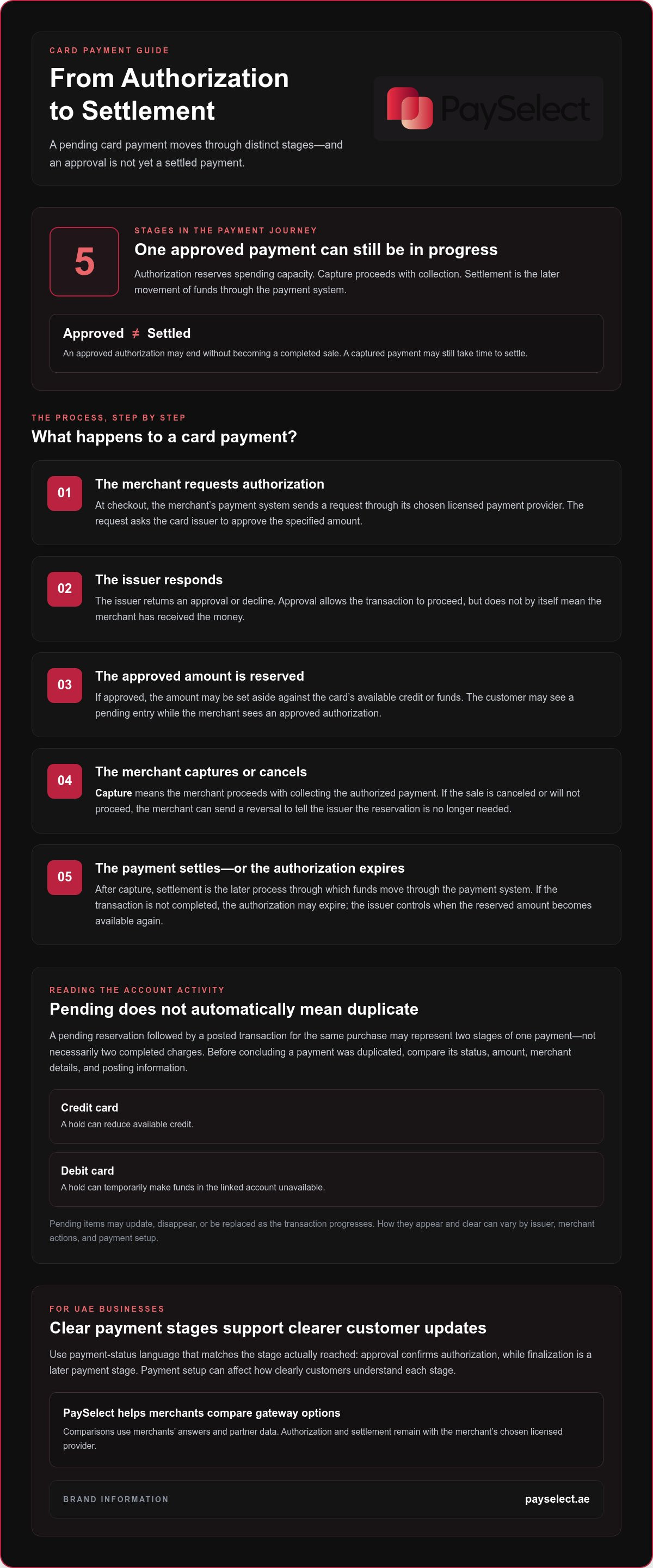
The process moves through distinct stages. Knowing what happens at each one helps merchants explain why an approved payment may not yet appear as completed, and why a reservation can change before funds are settled. The exact timing and account display depend on the payment setup and card issuer.
The merchant requests authorization.
At checkout, the merchant’s payment system sends a request through its chosen licensed payment provider. The request asks the card issuer to approve the transaction for a specified amount.
The issuer responds.
The issuer checks the request and returns an approval or decline. An approval allows the transaction to proceed, but it doesn’t by itself mean the merchant has received the money.
The approved amount is reserved.
If approved, the amount may be set aside against the card’s available credit or funds. The customer may see a pending entry, while the merchant sees that the authorization was approved.
The merchant captures the payment or cancels it.
Capture means the merchant proceeds with collecting the authorized payment. If the sale is canceled or won’t proceed, the merchant can send a reversal to tell the issuer the reservation is no longer needed.
The transaction settles, or the authorization expires.
After capture, the payment moves through settlement, the later process by which funds are transferred through the payment system. If it isn’t completed, the authorization may expire; the issuer then controls when the reserved amount becomes available again.
Authorization requests approval, capture proceeds with collection, and settlement moves funds through the payment process. These are related stages, not interchangeable terms. A captured payment may still take time to settle, and an approved authorization can end without becoming a completed sale.
What happens between authorization and settlement?
Think of authorization as permission to continue, capture as the merchant’s instruction to collect, and settlement as the subsequent movement of funds. The steps can be close together or separated, depending on the transaction and the merchant’s payment setup. This distinction matters for customer updates: “approved” doesn’t necessarily mean “settled.” Merchants should use payment-status language that matches the stage actually reached.
Why might the authorized and final amounts differ?
Some transactions have a final amount that can’t be known at the time of authorization. A service may take longer than first estimated, or an order may change before fulfillment. In those cases, the merchant may request authorization for an estimated amount and later submit the final amount. Other purchases have a fixed amount from the start, so an estimate isn’t needed. A changed amount can affect how the original authorization is completed or reversed, and how the customer sees the entries.
For UAE businesses reviewing how payment stages are managed, comparing payment gateway options can help clarify which setup fits their transaction flow. PaySelect compares options using merchant answers and partner data; the chosen licensed provider handles authorization and settlement.
Why Do Merchants Use Authorization Holds, and What Can Customers See?
A merchant may authorize a card before the final payment is ready to complete. This can help align the payment with the point when an order or service is confirmed, especially if fulfillment is delayed or the total may change. It isn’t necessary for every transaction, and the customer’s account display depends on the issuer and payment flow.
When might a merchant authorize a card before finalizing payment?
Two common situations explain the gap between authorization and completion:
The final total is still being determined.
A merchant may first authorize an estimated amount, then submit the final amount once the order or service is complete. A customer could see the initial amount pending before the final transaction appears.
Fulfillment happens later.
A merchant may authorize a payment when a customer places an order, then complete it at a later stage, such as when the order is ready to be sent. The customer may see a pending entry while waiting for confirmation or delivery.
These examples describe possible payment flows, not a rule for all merchants. Some transactions are completed immediately at checkout, while others separate approval from completion. If a customer asks why a payment appears pending, a useful first step for the merchant is to explain what stage the transaction has reached and whether the final amount has been submitted.
What can a hold change on a card account?
While an authorization is pending, the issuer may reduce the customer’s available credit or available funds by the reserved amount. The balance or account history may show a pending entry, but labels and layouts differ. Customers using a debit card may feel the impact directly because the reserved funds aren’t available for other spending during the hold.
A later posted transaction can appear alongside the earlier pending entry. At a glance, that may look like two payments for one purchase, even if one entry represents the authorization and the other the completed transaction. The customer should compare the status and transaction details before concluding that a duplicate charge has occurred.
More than one pending entry deserves a closer look. A repeated checkout attempt or another authorization request may result in multiple reservations, but the entries alone don’t establish why they appeared or whether more than one payment will be completed. The merchant can review its transaction records to explain its actions; the issuer can clarify how each authorization is affecting the account and what its current status means.
So, what is an authorization hold on a credit card from the customer’s point of view? It’s a temporary change in available credit that may accompany a purchase in progress, not automatic evidence of a second completed payment. The hold’s visibility, effect, and release timing depend on the issuer and payment flow. Clear status updates from merchants help customers understand what they’re seeing and decide whether they need to follow up.
What Should You Do About a Pending Authorization Hold?
A pending card entry can be confusing, particularly if the purchase seems complete or the same amount appears again. Before treating it as a completed or duplicate payment, check its status. Understanding what is an authorization hold on a credit card helps you choose the right next step: confirm the transaction details, then contact the party best placed to answer your question.
Check the account entry.
Look for a status such as pending or posted, and compare the merchant name, amount, and transaction date. Account displays vary, so focus on the details shown by your card issuer.
Review the purchase or cancellation.
Check your order confirmation, receipt, or cancellation message. This can help you identify whether the merchant has completed the sale or whether it may still be in progress.
Contact the merchant about the transaction.
Ask whether the payment was completed, canceled, or is still awaiting finalization. Keep any confirmation or reference details available.
Contact the issuer about account availability.
If you need to know why credit or funds remain unavailable, or when a hold may be released, the issuer can explain how it is being handled on your account.
How long can an authorization hold last?
There isn’t one duration that applies to every card and transaction. Release timing can depend on the issuer’s process, the transaction circumstances, and whether the merchant completes or cancels the payment. A merchant can explain what it has done, but shouldn’t promise a specific release time. If the pending amount remains and affects your available credit or funds, ask the issuer for account-specific guidance.
Who should you contact about a hold?
Contact the merchant first for questions about what you bought, the amount requested, or whether the order or sale was canceled. Contact the card issuer for questions about how the hold affects your account or when the reserved amount may become available. If you see multiple pending entries, share their dates, amounts, and merchant details with the issuer, and ask the merchant to clarify whether it made more than one authorization request.
Merchants can reduce confusion with a short, consistent status update. Explain whether the card was authorized, whether the final charge has been submitted, and whether the transaction was canceled. If a customer sees a pending entry, clarify that its display and release depend on the issuer and payment flow. Avoid describing an authorization as settled or promising when available credit or funds will return.
For UAE businesses reviewing whether their payment setup fits their transaction process, compare payment gateway options with PaySelect. Its comparison tool uses merchant answers and partner data to match businesses with relevant options.
How Can Businesses Explain Authorization Holds and Choose Payment Setup?
Clear payment messages depend on more than the wording at checkout. A business’s payment setup determines how transaction stages are handled and what status information is available to share with customers. The merchant’s chosen licensed payment provider handles payment processing, support, and settlement. PaySelect helps businesses compare gateway options; it doesn’t process payments or manage provider onboarding.
What should merchants communicate about a pending card payment?
Use straightforward status labels and keep them consistent across checkout messages, receipts, and customer support. Explain what has happened, what happens next, and what the customer can do if they have a question. For example, clarify that an authorization is approval to proceed, “pending” means the transaction is still in progress, and a completed payment is a finalized transaction.
For an approved authorization
Say that the card was authorized and that the transaction may still be pending.
For a canceled purchase
Confirm that the sale was canceled and explain that the issuer controls when any reserved amount becomes available again.
For a completed payment
State that the final payment was submitted, and distinguish it from an earlier pending entry if both appear in the account.
A pending authorization isn’t automatically a duplicate completed charge. If a customer is concerned, help them identify the transaction status and explain what your business has done. Keep updates consistent, especially if the order or service is still underway. Don’t promise a precise release time, since the card issuer and payment flow affect when a pending amount clears from the customer’s account.
How can a business compare payment gateway options?
Start with the way your business accepts payments. Compare options in light of your industry, transaction volume, payment methods, and any international requirements. Also consider how a setup supports the transaction stages you need to communicate, such as pending authorization, cancellation, and final payment. Provider capabilities and business needs differ, so a useful comparison looks at fit rather than assuming one provider or pricing model suits every merchant.
Payment gateway options can be compared through PaySelect’s matching tool, which uses your answers and partner data to identify relevant providers. The test is free, takes less than 2 minutes, and doesn’t require registration. Your business data is shared only with matched providers after you give explicit consent, and PaySelect’s data handling complies with UAE data-protection regulations.
For businesses unsure which payment setup aligns with their operations, PaySelect offers a practical starting point for comparing relevant options. Use the free matching tool to explore potential provider matches. It supports comparison and referrals only; the provider you select remains responsible for payment services and settlement.
Make Payment Clarity Part of Your Customer Experience
Clear payment communication is more than a support task. It helps customers understand what to expect and gives your business a consistent way to explain transaction status. If customers ask what is an authorization hold on a credit card, your response can help them distinguish an in-progress payment from a concern that needs follow-up.
For UAE businesses, reviewing payment setup is a practical next step as your transaction needs evolve. Compare gateway options against the way your business operates and the customer experience you want to deliver. PaySelect’s matching tool is free, takes less than 2 minutes, and requires no registration. Business data is shared only with matched providers after explicit consent.
Compare payment gateway options for your business and take a confident next step toward a payment experience that works for your customers and your operations.
Frequently Asked Questions
Can a merchant release an authorization hold?
A merchant can ask its chosen payment provider to reverse an authorization when a sale is canceled or the final amount is lower than the amount reserved. The merchant can confirm whether it has submitted that request, but it can’t control exactly when the issuer updates the cardholder’s account. For account-specific release timing, the cardholder should contact the card issuer.
What happens if an authorization hold appears twice?
Two pending entries can result from repeated authorization attempts, but they don’t automatically mean two payments were completed. Check whether both entries are pending or whether either has posted, then ask the merchant to confirm how many authorization requests it submitted. If the entries remain unclear or affect your available balance, contact the card issuer with the dates, amounts, and merchant details so it can review the account activity.
Can an authorization hold be higher than the final charge?
Yes. Some transactions use an estimated authorization before the final amount is known, so the reserved amount may exceed the completed charge. For example, a final invoice could be lower than the initial estimate. The merchant can explain the difference and whether it has asked its payment provider to reverse the unused amount. The issuer determines when the available credit or funds update, so ask it about your account if the amount remains unavailable.
Does an authorization hold reduce my credit limit?
A hold can reduce your available credit, but it doesn’t usually change the total credit limit set for your card. If part of your limit is reserved for a pending purchase, you may have less room for other transactions until the hold is removed or replaced by the completed charge. Check your account’s available credit figure, since issuers may display pending activity differently.
Is a pending authorization hold a reason to dispute a card transaction?
Not by itself. First check the transaction status and confirm with the merchant whether the purchase is still in progress, canceled, or completed. If you don’t recognize the transaction or believe it wasn’t authorized, contact your card issuer promptly and follow its instructions, even if the entry is still pending. The issuer can explain how to report suspicious activity and whether a formal dispute can be opened at that stage.
Do authorization holds work differently on debit and credit cards?
The reservation affects different account resources. On a credit card, it can reduce available credit; on a debit card, it can temporarily make money in the linked bank account unavailable for other spending. That difference can matter if you need those funds for upcoming expenses. The hold’s display and release timing depend on the card issuer and transaction, so check with the issuer about your specific account.
Disclaimer
This content is for informational purposes only and should not be considered financial, legal, or regulatory advice. Payment provider availability, pricing, and approval processes vary depending on individual business circumstances. PaySelect does not guarantee provider acceptance or specific outcomes. Businesses should conduct their own due diligence before entering into any agreements.
Empowering businesses to achieve greater growth