
Payment card security is an operational responsibility, not just a technical task. The payment card industry data security standard, or PCI DSS, sets requirements for protecting payment card information handled by businesses and service providers.
For UAE merchants, this means protecting cardholder data such as primary account numbers, cardholder names, expiry dates and service codes. PCI DSS also applies to organizations that store, process or transmit this data, or whose systems could affect the security of the cardholder data environment.
PCI DSS compliance can seem complex, but start by identifying what data your business handles and how your merchant level affects validation. This article explains what the standard protects, how merchant compliance levels work and how self-assessment questionnaires support compliance. It also covers how the requirements relate to payment operations, from online checkout to point-of-sale systems.
Key Takeaways
• Identify which cardholder and authentication data your systems store, process or transmit to understand the security scope.
• Use your transaction volume and payment setup to determine which compliance level and validation route apply.
• Match your payment integration to the relevant self-assessment questionnaire, and note any annual assessment or quarterly scan requirements.
• Compare payment solutions with their security and operational fit in mind; PaySelect can help assess gateways, POS systems, cross-border options and pricing.
What Is PCI DSS and Which Cardholder Data Does It Protect?
PCI DSS is a global security standard for organizations that store, process or transmit payment-card information. It protects cardholder data and sensitive authentication data across payment systems, including software, applications and paper records.
Requirements and control objectives
Technical and operational safeguards
Service-provider compliance
Service providers that store, process or transmit cardholder data fall within PCI DSS scope. Their role matters to merchants because a provider’s systems may form part of, or affect, the payment environment. Outsourcing a payment function does not remove the merchant’s responsibility to understand how card data flows through its setup.
Current standard version
PCI DSS version 4.0.1 is the current version. It was published in June 2024, and the stated compliance deadline was March 31, 2025. Using the applicable version helps organizations align assessments and security practices with the standard currently in effect.
Data protection purpose
PCI DSS aims to reduce the risk of payment-card data being exposed through breaches or misuse. Protected cardholder data includes primary account numbers, names, expiration dates and service codes. Sensitive authentication data is also covered, so businesses need to know what information their transactions collect and where it goes.
Cardholder data environments
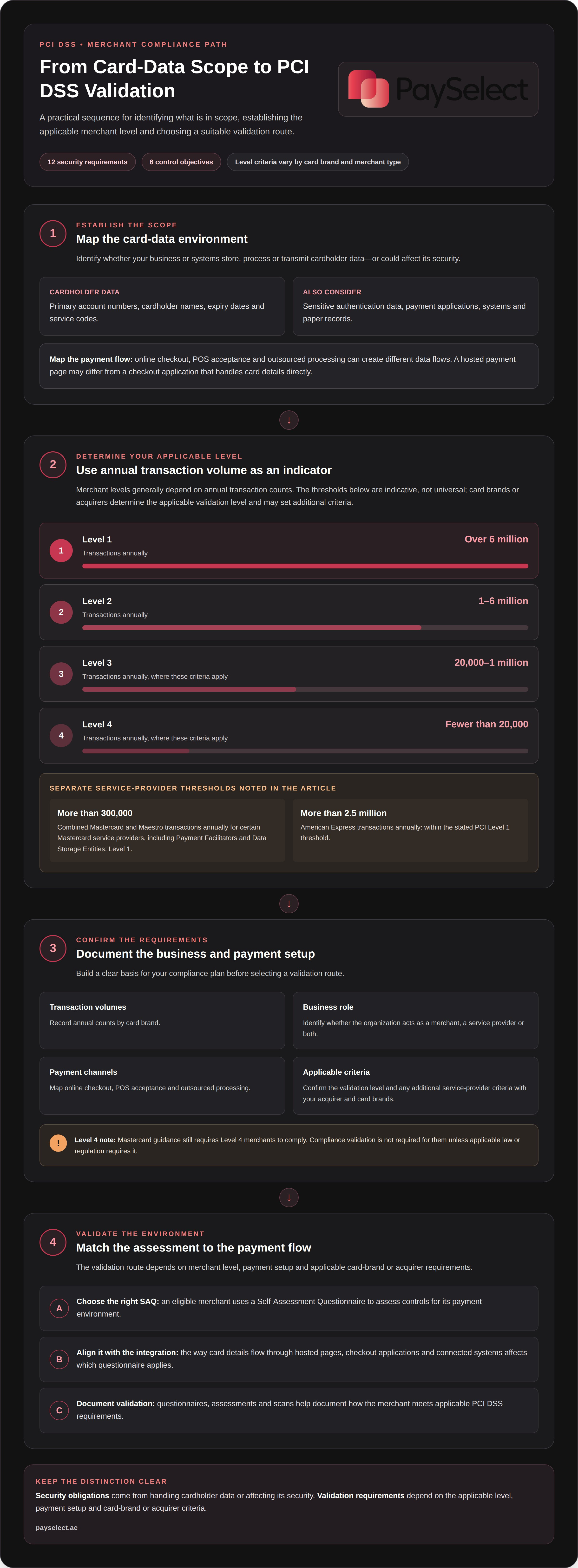
A cardholder data environment, or CDE, comprises systems that store, process or transmit cardholder data. Segmentation separates those systems from other networks and helps define which systems are in scope. Integration design matters too: a hosted payment page can create a different data flow from a checkout application that handles card details directly. These differences affect which self-assessment questionnaire applies, so map the payment flow before choosing an SAQ.
Merchant Compliance Levels and PCI DSS Requirements
PCI DSS compliance applies to merchants and service providers that handle payment-card data or can affect its security. Understanding what the payment card industry data security standard requires starts with identifying transaction volume, payment channels and the card brands accepted. Merchant validation levels generally depend on annual transaction counts, but criteria vary by card brand and merchant type. Card brands or acquirers determine the applicable validation level, and may set additional criteria.
The thresholds below are indicative, not universal. Applicable criteria and validation levels depend on card-brand and acquiring requirements:
Level 1
over six million transactions annually.
Level 2
between one and six million transactions annually.
Level 3
between 20,000 and one million transactions annually, where these criteria apply.
Level 4
fewer than 20,000 transactions annually, where these criteria apply.
Some service-provider categories have separate thresholds. Certain Mastercard service providers, including Payment Facilitators and Data Storage Entities, are Level 1 when processing more than 300,000 combined Mastercard and Maestro transactions annually. Organizations processing more than 2.5 million American Express transactions annually fall within the stated PCI Level 1 threshold.
Level 4 merchants still need to comply under Mastercard guidance. Compliance validation is not required for them unless applicable law or regulation requires it. Knowing what the payment card industry data security standard means for your business requires separating baseline security obligations from the validation route tied to your applicable level.
To establish your obligations, document annual transaction volumes by card brand and identify whether your business acts as a merchant, a service provider or both. Map payment channels and services, including online checkout, POS acceptance and outsourced processing. Confirm the applicable validation route with your acquirer and card brands, and record any additional service-provider criteria. This gives your compliance plan a clear basis for implementation.
How much does PCI DSS compliance cost? There is no single cost. The scope, assessment needs, network scans, remediation work and systems involved all affect the total. A segmented environment with limited payment channels may require different work from a complex setup spanning several channels.
How does PCI DSS apply to businesses in the UAE? UAE businesses that store, process or transmit cardholder data, or affect its security, fall within the standard’s scope. Transaction volume, payment setup, card brands and role in processing help determine applicable validation obligations.
How Merchants Validate PCI DSS Compliance
Validation documents how a merchant meets PCI DSS requirements through questionnaires, assessments and scans. The right route depends on the merchant’s level, payment setup and applicable card-brand or acquirer requirements.
Self-assessment questionnaire use
A Self-Assessment Questionnaire (SAQ) lets an eligible merchant assess its own controls against the requirements for its payment environment. The questionnaire must match the merchant’s actual cardholder-data flows, not simply its preferred payment method.
Whether a Level 2 merchant must complete an SAQ annually depends on the applicable requirements. For example, a merchant using an online checkout should account for how the payment application handles card details when determining the applicable questionnaire. An SAQ records whether relevant controls are in place and identifies gaps that need attention.
Annual assessments and network scans
Annual reporting and reporting after significant changes to the cardholder data environment may apply to merchants and service providers, depending on their circumstances and the relevant requirements. These reports create a recurring record of compliance where required, rather than treating validation as a one-time event. A major change to payment systems or data flows may therefore require another report.
Quarterly network scans through an Approved Scanning Vendor (ASV) may be required for Level 2 merchants, depending on the applicable requirements. The scan checks for vulnerabilities in externally accessible systems. It complements, but does not replace, the annual SAQ or other applicable validation.
A Qualified Security Assessor (QSA) is certified by the PCI Security Standards Council to validate another entity’s PCI DSS compliance. A QSA-led assessment differs from an internal review: internal security teams can maintain evidence, track control owners and address gaps, while the QSA performs the relevant external validation.
An ASV performs an external vulnerability scan where required. Keep scan results with your compliance records and coordinate remediation for identified issues. This creates a clear record of evidence across the assessment period.
Validation also depends on current documentation. Record system changes, questionnaire decisions, assessment results and scan outcomes together. If a payment provider or application changes how card data is handled, update the environment record and reassess the validation route. This connects your compliance program to actual payment operations.
How PaySelect Can Help
PaySelect helps UAE businesses compare payment options against their operating needs. Its independent comparison platform and advisory services can support merchants reviewing an existing setup, exploring a new sales channel or planning for expansion. The aim is to clarify options and commercial considerations so businesses can define their requirements before speaking with licensed payment providers.
For online sales, PaySelect helps businesses compare payment gateway options against their business model, transaction profile and international requirements. A payment gateway comparison can help merchants consider how checkout arrangements fit their sales channels and payment operations. That gives businesses a clearer basis for weighing provider options and discussing integration requirements.
For in-person card acceptance, PaySelect helps merchants compare POS options in the context of their operating model. A retailer with several checkout points may have different priorities from a business taking payments across multiple locations or service settings. The comparison focuses on the merchant’s needs instead of assuming one terminal setup suits every business.
Businesses handling international collections or supplier payments can discuss cross-border payment options with PaySelect, taking their payment corridors and operational needs into account. This helps decision-makers include cross-border activity in wider payment planning, alongside local card acceptance and online checkout.
PaySelect’s advisory services can help merchants review pricing structures against their transaction mix, channels and international activity. Businesses with an existing provider can review their arrangements without assuming that switching is the only option. Larger organizations can also assess how multiple acquirers, payment infrastructure and settlement processes fit their wider strategy.
These comparisons can inform provider and integration decisions. PCI DSS assessment and validation remain distinct parts of a business’s security program, based on its payment environment and applicable validation route. For payment requirements or a tailored discussion, contact PaySelect.
Frequently Asked Questions
How Do You Become PCI-Compliant?
Build a documented compliance program around how your business accepts payments. Assign named owners to payment systems, staff procedures and records, then coordinate the required validation with the relevant parties. For example, when a business changes its checkout flow, it should record the change, identify affected systems and update its compliance evidence. Keep decisions and supporting records organized for review.
What are the 12 requirements of PCI DSS?
The requirements cover secure networks and configurations, stored-data protection, transmission encryption, malware protection, secure software, access restrictions, unique identities, physical access, logging, testing and security policies. Businesses often coordinate these operational controls with technical service providers such as ITS Canada Inc to ensure daily user access, help desk protocols, and system maintenance align with security standards. Assign each requirement to a responsible team and connect it to evidence, such as configuration records or access reviews. This clarifies ownership and helps teams track remediation without treating the requirements as one technical project.
What are the 6 principles of PCI DSS?
The six control objectives are secure networks and systems, protected account data, vulnerability management, strong access controls, monitoring and testing, and an information security policy. Use these as management categories to organize related work. For example, a security lead can group technical testing and monitoring under the relevant objective, then report unresolved issues and ownership to decision-makers consistently.
What is the purpose of PCI DSS?
PCI DSS gives organizations a common framework for reducing exposure of payment-card information. In practice, it connects security decisions across technology, procedures and staff responsibilities. A business can use it to identify who handles payment information, clarify how controls are maintained and make security part of routine payment operations rather than an isolated project.
Why is it important to be PCI-compliant?
Compliance gives merchants a structured way to manage card-data security and demonstrate that security work is being addressed. It can also clarify responsibilities between a business and the service providers involved in its payment flow. For example, documenting which party manages a payment application helps teams coordinate system changes and keep operational records aligned with their actual roles.
What is the Payment Card Industry Data Security Standard (PCI DSS)?
PCI DSS is an industry security standard maintained by the Payment Card Industry Security Standards Council. It applies to organizations involved in handling payment-card data and provides a shared basis for protecting it. For merchants, the practical starting point is to map how payment information moves through sales channels and identify the internal teams or external providers involved.
Disclaimer
This content is for informational purposes only and should not be considered financial, legal, or regulatory advice. Payment provider availability, pricing, and approval processes vary depending on individual business circumstances. PaySelect does not guarantee provider acceptance or specific outcomes. Businesses should conduct their own due diligence before entering into any agreements.
Empowering businesses to achieve greater growth