

What Is Tokenization in Payment Processing and How Does It Protect Card Data?

A payment can be processed without passing a customer’s real card number through every system involved. In payment processing, tokenization replaces sensitive card details, such as a 16-digit primary account number, with a randomly created string of characters called a token. Understanding what tokenization in payment processing is helps explain how businesses can handle card payments while limiting exposure of the original data.
It’s natural to wonder what happens to card details after a customer taps a device or saves a card for later. A token can stand in for the original details during a transaction, while a secure service maps it back when needed to complete payment. Tokenization is used in NFC payments, including mobile wallets and contactless cards.
This guide explains how tokens work in contactless payments, how tokenization differs from encryption, and how it relates to PCI DSS. It also covers practical examples, from repeat purchases to subscriptions, to help you assess where tokenization may fit in your UAE business’s payment setup.
Key Takeaways
• A payment token stands in for sensitive card details, helping limit where the original number is exposed during a transaction.
• In contactless payments, a device or card can use a token while a secure service connects it to the payment information needed to process the transaction.
• Tokenization and encryption protect data in different ways: one substitutes a value, while the other encodes data that can be read with a decryption key.
• Tokenization can reduce how much card data a business stores, but it doesn’t remove the need to maintain and validate PCI DSS compliance.
• Saved-card payments, subscriptions and repeat purchases are practical examples of where tokens can support smoother payment flows.
How does tokenisation work for device-based contactless payment?
With NFC contactless payments, a token lets a mobile device or card share a substitute for sensitive card details. The merchant receives the token rather than the cardholder’s original primary account number.
Payment Tokenization Mechanics
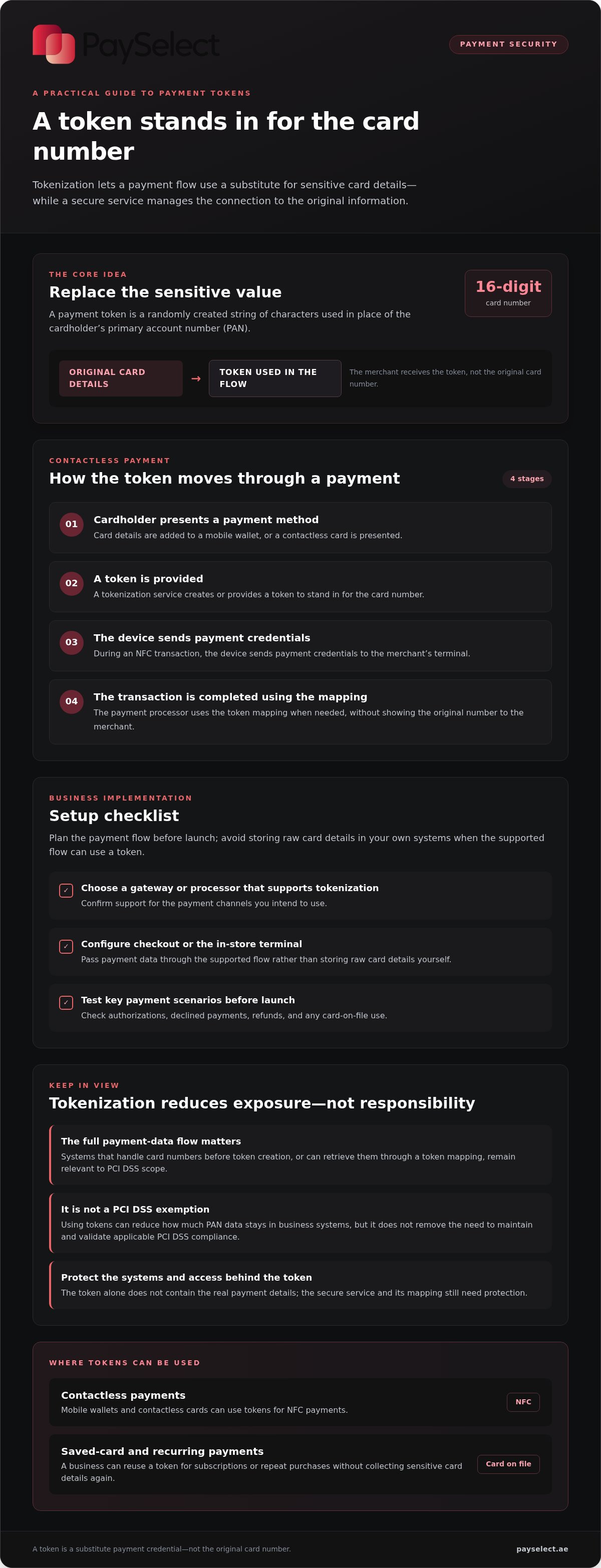
Payment tokenization replaces sensitive payment information with a randomly created string of characters. This allows a merchant to process a transaction without handling the cardholder’s original card number. For example, a mobile wallet can present a token during an NFC payment. A secure tokenization service maps that token to the original information when needed to complete the transaction.
The payment flow typically follows these steps:
• The cardholder adds card details to a mobile wallet or presents a contactless card.
• A tokenization service creates or provides a token to stand in for the card number.
• The device sends payment credentials to the merchant’s terminal during an NFC transaction.
• The payment processor uses the token mapping to complete the transaction without showing the original number to the merchant.
Digital wallets use tokenization for NFC payments. The token isn’t the card number: it represents the payment credential within the transaction flow.
For a UAE business, tokenization is a security measure, not a replacement for applicable PCI DSS responsibilities. PCI DSS applies to organizations that accept, transmit, or store cardholder data, and the business’s payment-data flows affect its obligations.
There is no single tokenization fee for every UAE payment setup. Provider charges depend on the gateway arrangement, transaction services, and how tokenization is used. Providers set any applicable fees through their pricing terms.
Card Data Replacement and Storage
A payment token replaces sensitive card details, including the cardholder’s primary account number, or PAN. A payment card typically has a 16-digit number, which tokenization substitutes with a randomly created value. This matters to a merchant because its systems can use the substitute instead of routinely handling the original card details. In the described process, the payment processor securely stores the original information, while the merchant uses the token.
The tokenization service maintains a secure mapping between the token and the original data. When a transaction needs that information, the authorized service can use the mapping to support completion. The token alone doesn’t contain the real payment details, but protection still depends on securing the systems and access that manage the mapping.
Tokenization reduces exposure, but it doesn’t remove every security risk or compliance duty. If a business mishandles card details before tokenization or leaves payment systems poorly controlled, tokenization cannot undo that exposure. A token also doesn’t remove the merchant’s obligation to maintain and validate PCI DSS compliance.
To implement tokenization, a business first selects a payment gateway or processor that supports it for the intended payment channels. It then configures the online checkout or in-store terminal to pass payment data through the supported flow, rather than storing raw card details itself. Before launch, test authorizations, declined payments, refunds, and any card-on-file use.
For mobile wallets, the device presents a token during contactless payment instead of exposing the original card number to the merchant. For recurring payments and card-on-file transactions, a business can reuse a token without collecting sensitive card details again. Subscriptions and repeat purchases are common examples.
Tokenization and PCI DSS compliance
PCI DSS applies to organizations that accept, transmit, or store cardholder data. The standard requires businesses to protect primary account number data, so replacing card numbers with tokens can reduce how much sensitive information stays inside business systems. For a UAE merchant, tokenization is a security measure within a payment setup, not a substitute for meeting relevant PCI DSS requirements.
The key compliance consideration is the full payment-data flow. A token may be used in a checkout or saved-card record, while a payment provider or processor maintains the connection to the original card data. Systems that handle card numbers before token creation, or can retrieve them through a token mapping, still matter when determining which systems and processes fall within the merchant’s PCI DSS scope.
That distinction makes tokenization valuable, but it isn’t a blanket exemption. Reducing the amount of PAN data stored in-house can reduce PCI DSS scope, but it doesn’t automatically remove every system, service, or business process from assessment. A token alone doesn’t contain the real payment details, but access to the tokenization service and its mapping remains important to security.
For example, an online merchant might route card details directly to its payment provider’s hosted checkout, then retain a token for repeat transactions. That differs from a setup where the merchant’s own systems first receive and store card numbers. The provider, checkout integration, storage practices, and access controls all affect how card data moves and which systems are involved.
The Payment Card Industry Security Standards Council published Tokenization Guidelines in 2011. The guidance helps explain tokenization’s role in protecting payment data, while PCI DSS remains the standard businesses must address when accepting card payments. In practice, compliance planning should map each point where card numbers enter, move through, or remain in business systems.
A practical review can trace the transaction from checkout through to storage:
• Identify where card numbers first enter the payment flow, including websites and in-store terminals.
• Record which systems receive card data before a token is created.
• Map where tokens are stored and which services can connect them to original card details.
• Review how staff and business systems access payment records and provider tools.
• Document the resulting data flow for PCI DSS assessment and ongoing validation.
These steps help distinguish systems that handle sensitive numbers from systems that use tokens. Businesses comparing gateway arrangements can use a payment gateway comparison to understand how payment flows differ. Tokenization supports PCI DSS compliance by limiting PAN exposure, but merchants still need to maintain and validate compliance for their own payment environment.
Tokenization compared with encryption
Tokenization and encryption protect sensitive data in different ways. Tokenization substitutes card numbers with a separate value, while encryption transforms data into unreadable text. For a subscription checkout, a merchant might store a token for future billing. An encrypted card number remains the original information, but a decryption key is needed to read it. The key difference is whether a system uses a substitute or transforms the original data.
Consider a card number entering an online payment flow. A tokenization system replaces it with a token and keeps a secure mapping to the original. A system using encryption instead applies an algorithm to encode the card data. Someone with the required decryption key can restore the readable information. Both methods protect data, but the token and encrypted value have different roles in a payment system.
Vault-based tokenization combines these approaches. The system stores sensitive card data in an encrypted vault and generates tokens for transactions. The merchant can use a token for a saved-card payment, while access to the original information remains within the controlled mapping process. Tokenization may use encryption to protect stored data, but encryption alone doesn’t replace the card number with a separate value.
Token formats can also differ. Some format-preserving schemes retain the last four digits of a card number, helping a business display a familiar reference for customer support. Other schemes retain the first six digits and last four digits. These visible digits don’t make the token identical to the card number; its format depends on the system design.
Tokenization
replaces card data with a substitute value, such as a saved-card token for a subscription.
Encryption
encodes the original card data, which requires a decryption key to read.
Vault-based tokenization
stores sensitive data in an encrypted vault and issues tokens for payment use.
For a merchant, the choice affects how payment systems store and use card data. A token may support repeat transactions without exposing the original number in everyday business records. Encryption helps protect data that must remain available in its original form. Payment architectures can use both, such as an encrypted vault that issues a token for a card-on-file transaction.
Neither method removes the need to manage access carefully. A tokenization service must protect the mapping between a token and its card data. Encryption systems must protect the decryption key. When evaluating payment flows, ask where sensitive data is received, stored, and accessed, and which systems need the original card numbers.
Which types of businesses need to use tokenization for payments?
Tokenization is relevant to businesses that accept credit and debit card payments, but network tokens and other payment tokens serve different functions. Network tokenization uses a payment network’s token for a specific card. Other approaches replace card data within a merchant’s payment environment. Both can reduce exposure of card numbers, but they aren’t interchangeable.
Payment networks issue tokens associated with specific cards. During a card-on-file transaction, a network token can help identify a legitimate payment, including one from a repeat customer. If card details change, network tokens can be updated, which may help reduce failed payments caused by expired or replaced cards.
That capability can matter to subscription businesses, online retailers, and services that process repeat purchases. For example, a subscription merchant can use a network token for scheduled billing instead of relying on stored card numbers. An online store can use a token for a returning customer’s saved-card checkout. The customer still authorizes the payment through the merchant’s payment flow.
PCI tokenization means using substitute values to limit how much sensitive card data a business stores or handles. A provider or processor may maintain the secure relationship between a token and the original payment card details. This approach can help reduce the merchant’s PCI DSS scope, depending on the payment flow and which systems can access card data.
The difference lies in the token’s role and who manages its lifecycle. Network tokenization is tied to payment networks and a specific card credential. A merchant-focused token may be created within a provider’s payment system for functions such as card-on-file transactions. Understand how each token works across checkout, recurring billing, and payment acceptance systems.
Subscription businesses
Network tokens can support repeat billing when card details are replaced or expire.
Online retailers
A token can support saved-card and one-click payment flows without putting raw card numbers in ordinary business records.
Businesses using multiple payment channels
They need to consider how tokens work across online checkout, in-store payment, and repeat transactions.
Businesses with limited repeat payments
Tokenization can still reduce exposure, but the value depends on how often card details are stored or reused.
Tokenization doesn’t make every payment automatically secure or remove PCI DSS responsibilities. The merchant still needs to understand where card data enters its systems and how each provider handles tokens. In the UAE, compare supported payment channels, card-on-file functionality, and how token services fit your transaction flow. The right approach depends on your business model, not simply its size or industry.
Examples of tokenization in payment processing
Consider a customer returning to an online store to make another purchase. Instead of entering card details again, the checkout can use a saved token associated with the customer’s payment card. The processor uses its secure mapping to support the transaction. The merchant can offer a quicker repeat-purchase flow without keeping the original card number in ordinary order records.
Subscriptions are another clear example. A software company or streaming service can reuse a token for scheduled billing rather than collecting card details for each payment. If the cardholder changes or replaces the card, a network token may be updated. This can help reduce failed payments linked to expired or replaced card details, supporting continuity for recurring purchases.
Digital wallets use tokens for device-based contactless payments. For example, a customer can tap a mobile device using Apple Pay or Google Pay at an EMV-enabled point-of-sale terminal. The terminal receives payment credentials for the transaction without the merchant receiving the original card number. The same principle applies to contactless cards, where tokenization helps protect card information during in-store purchases.
A simple card-number example makes the replacement visible. In an illustrative payment example, the card number 1234-4321-8765-5678 is replaced with the token 6f7%gf38hfUa. The merchant can use the token in the payment flow, while the processor uses its mapping when the transaction needs the original payment information. These example values demonstrate substitution, not a universal token format.
Network tokens also have a role in global commerce. Payment networks such as Visa and Mastercard issue tokens associated with specific cards. For a repeat customer paying with a stored card, a network token can help issuers identify a legitimate transaction. This can matter for online purchases where the physical card isn’t presented.
Online retail
A returning customer uses a stored token for another purchase.
Subscriptions
The business reuses a token for recurring billing instead of collecting card details each time.
In-store payments
A mobile wallet or contactless card presents tokenized credentials at an EMV-enabled terminal.
Repeat card-on-file payments
A network token can support issuer recognition of a returning cardholder.
The common thread is reuse without routinely exposing the original card details to the merchant. For a UAE business, the relevant example depends on its payment channels and customer journey. A retailer with in-store and online sales may need to consider both POS and checkout flows. A subscription business will focus on stored credentials and repeat billing. Map the transaction from customer payment through processor handling to understand where tokenization fits.
PaySelect: Payment Gateway Comparison Tool
PaySelect helps UAE businesses compare payment gateway options against their payment channels, customer needs, and transaction model. If you’re assessing how tokenization fits your checkout, compare how gateway arrangements support online payments, stored cards, and repeat transactions.
The Payment Gateway Comparison Tool helps you explore provider differences, while payment pricing comparison helps clarify how pricing structures vary. Businesses accepting payments in person can also use the POS System Selection Tool. For companies handling international transactions, Cross-border Payment Solution Matching helps assess options against cross-border requirements.
These tools can help narrow a complex setup decision, but they don’t process payments or replace your own PCI DSS responsibilities. Visit payselect.ae to compare payment options for your business.
Build a payment setup that can adapt
Understanding what tokenization in payment processing means is a starting point for a broader design decision: how your payment setup should support the way customers buy. Consider the channels you use, the markets you serve, and whether customers pay once or return for future purchases. These priorities can help identify which payment capabilities matter most as your business develops.
For a UAE business, payment infrastructure choices also affect how online, in-person, and cross-border transactions fit together. A clear comparison helps you assess options against your operating model, rather than focusing on one feature in isolation. PaySelect helps businesses compare payment solutions and understand how different options align with their requirements.
Use the next step to bring your payment priorities into focus. Contact PaySelect to discuss your payment needs and explore a setup that supports your business’s next stage.
Frequently Asked Questions
What is a token?
A token is a substitute value that represents payment information in a transaction. For example, a payment system may use a random alphanumeric string instead of a customer’s card number. A token isn’t a PIN or password, and its purpose depends on the system that created it. Businesses can use tokens as payment references without displaying full card details in routine records.
Can I use the same token across different channels and payment providers?
Not necessarily. A token may be limited to the payment service, provider, or network that created and manages it. For example, a token used for an online subscription may not work at a separate in-store terminal. Network tokens and merchant tokens can also follow different rules. Moving payment operations between providers or channels may require a supported token migration, rather than simply reusing existing token values.
Can tokenization help reduce false payment declines?
Yes, network token updates can help prevent some declines caused by expired or replaced card details. For example, if a customer receives a replacement card, an updated network token can help a subscription payment use current credentials. Tokenization won’t address every decline reason. An issuer can still decline a transaction for reasons such as insufficient funds, transaction limits, or fraud concerns.
Does tokenization affect my payment authorization rates?
It can. Visa’s analysis found a 4.6% increase in global card-not-present authorization rates for tokenized credentials compared with non-tokenized credentials. This finding relates to the credentials compared in that analysis, not a guaranteed outcome for every business. Authorization also depends on factors such as issuer decisions, customer account status, and transaction details. Businesses should assess tokenization alongside their wider payment flow.
How does tokenisation work for online card on file payments?
For an online card-on-file payment, the customer enters card details during an initial purchase and authorizes their storage for future use. The payment system stores a token as the reference for later transactions. At checkout or renewal, the business submits that reference through its payment flow. This lets a returning customer pay again without entering card details for every purchase, such as a subscription renewal.
How does tokenization help reduce fraud and chargebacks?
Tokenization limits how often original card details appear in merchant systems, reducing the data available if those systems are compromised. A token is generally used as a stand-in for payment details, but its security depends on the system that creates and manages it. However, tokenization doesn’t prevent every form of fraud or stop chargebacks arising from disputes, such as a customer challenging a purchase they don’t recognize.
What is payment tokenization and how does it work?
Understanding what tokenization in payment processing means starts with the payment flow: a payment system replaces card information with a token, then uses that token as a reference during processing. The system handling the token can connect it to the original payment data when required. For a merchant, the practical benefit is using a payment reference in places such as saved-card records instead of repeatedly handling full card details.
What are the main types of payment tokens, including network tokens and merchant tokens?
Network tokens are issued by payment networks such as Visa and Mastercard and are associated with specific cards. Merchant tokens, also called provider or processor tokens, are created within a payment service’s environment for merchant use, such as saved-card transactions. Their portability and use across channels can differ. The key distinction is who manages the token and where it can be used, not simply how its characters look.
Disclaimer
This content is for informational purposes only and should not be considered financial, legal, or regulatory advice. Payment provider availability, pricing, and approval processes vary depending on individual business circumstances. PaySelect does not guarantee provider acceptance or specific outcomes. Businesses should conduct their own due diligence before entering into any agreements.
Empowering businesses to achieve greater growth
