
54% of UAE customers will abandon their purchase immediately if they can't use their preferred payment method. In a market projected to reach $213.43 billion this year, understanding what payment methods are popular in uae is the difference between a successful expansion and lost revenue. You likely feel the weight of high transaction fees eating into your margins and the frustration of reconciling payments from dozens of different sources. It's difficult to maintain momentum when new regulations, such as the 2026 Central Bank Law and the mandatory rollout of the Digital Dirham, keep the landscape in constant flux.
This guide helps you regain control. You'll discover the most widely used payment methods and learn how to choose the right infrastructure to capture every transaction efficiently. We provide a framework to compare providers without bias, helping you lower operational costs through better infrastructure selection. By using tools like a payment gateway comparison or a cost optimization audit, you can move from uncertainty to a streamlined, high-performance payment setup that fuels your international ambition.
Key Takeaways
• Understand how the UAE has evolved into a digital-first economy and how new central bank regulations are shaping 2026 payment standards.
• Identify what payment methods are popular in uae, including the critical balance between traditional card schemes and the rapid adoption of digital wallets.
• Learn to navigate complex transaction fees and technical integration hurdles that often impact merchant margins and site performance.
• Discover a framework for selecting the ideal payment mix based on your specific industry, transaction volume, and operational needs.
• Use independent comparison tools and infrastructure audits to optimize your setup, reduce costs, and ensure a frictionless customer experience.
The Evolution of Payments in the UAE: A Digital-First Landscape
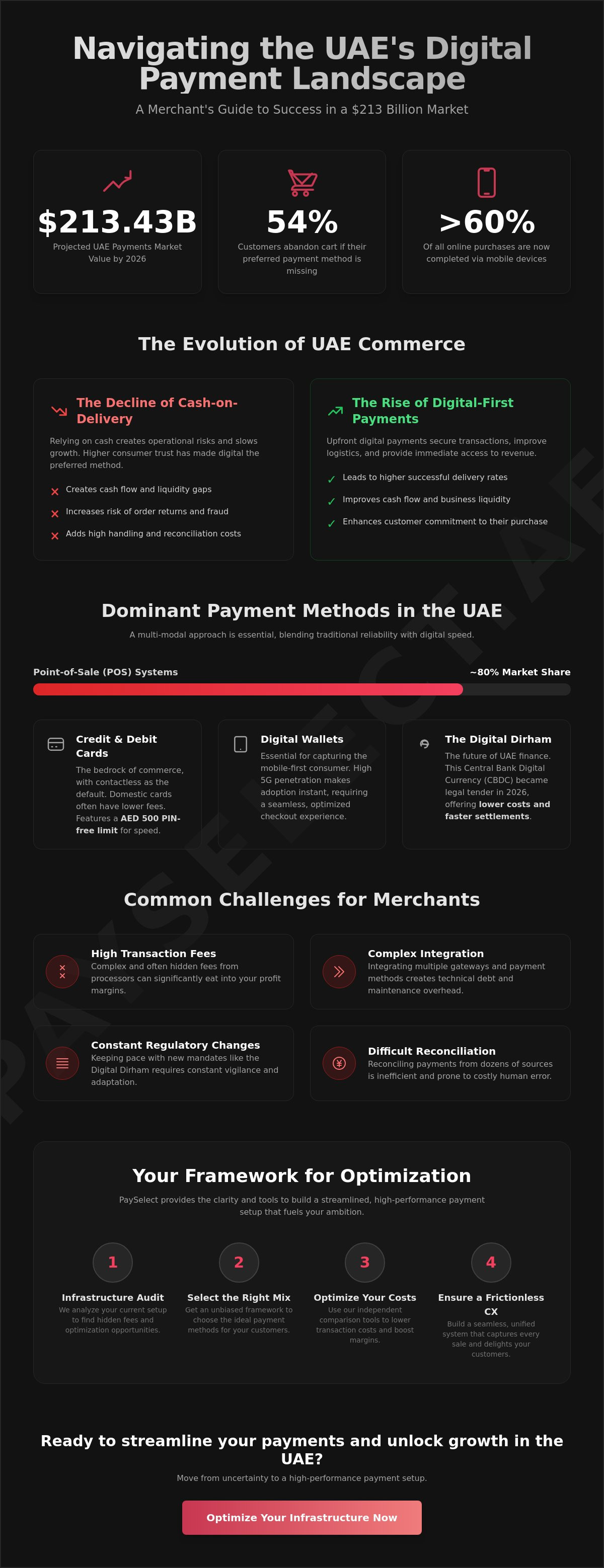
The UAE has moved rapidly from a cash-dependent society to a global leader in digital finance. This shift isn't accidental. It's the result of aggressive government initiatives and a central bank strategy designed to eliminate friction in the Economy of the United Arab Emirates. By 2026, the payments market is projected to reach $213.43 billion. For any merchant entering this space, knowing what payment methods are popular in uae is just the starting point. You need to understand the structural changes driving consumer behavior to stay competitive.
New regulations, such as Federal Decree Law No. 6 of 2025, have expanded the scope of licensed financial activities to include open finance and virtual assets. The mandatory integration of the Digital Dirham across financial institutions in 2026 further signals that the future is non-cash. E-commerce growth now outpaces traditional retail. This trend forces businesses to adopt a unified commerce approach. You must ensure that your online presence and physical storefronts offer a seamless, connected experience that bridges the gap between digital convenience and physical reliability.
The Decline of Cash-on-Delivery
Consumer trust in digital platforms has reached an all-time high. This has significantly reduced the reliance on physical cash for home deliveries. Relying solely on cash-on-delivery (CoD) presents substantial operational risks. It creates liquidity gaps, increases the chance of order returns, and adds high handling costs. Digital-first payments lead to higher successful delivery rates. To see how a specialized grocery platform manages these digital transactions in the UAE, visit Shift 2 Fresh. When customers pay upfront, they're more committed to the transaction. This reduces the logistical burden on your business and improves your cash flow immediately.
Mobile-First Consumer Behaviour
The UAE's high mobile penetration has reshaped the checkout experience. Over 60% of online purchases in the country are now completed via mobile devices. High-speed 5G connectivity allows for instant payment adoption and real-time processing. A mobile-optimized checkout is no longer a luxury. It's a requirement for survival. If your payment infrastructure doesn't support smooth mobile transitions, you'll lose customers to faster competitors. Understanding what payment methods are popular in uae specifically for mobile users is vital for capturing this high-intent traffic.
Setting up this infrastructure can be complex. You might face high transaction fees or difficulty integrating multiple wallets. PaySelect helps you navigate these hurdles. Through our payment infrastructure consulting and cost optimization audits, we help you identify the most efficient ways to process transactions. We provide the clarity needed to choose systems that enhance your performance without adding unnecessary technical debt.
Popular Payment Methods Dominating the UAE Market in 2026
Identifying what payment methods are popular in uae requires a look at both traditional reliability and digital speed. While credit and debit cards remain the bedrock of commerce, the market has shifted toward a multi-modal approach. As of late 2025, point-of-sale (POS) systems accounted for nearly 80% of the payment market. This dominance persists because consumers value the security of global card schemes, but the way they interact with these cards has changed. Contactless payments are now the default, supported by a PIN-free limit of AED 500 that keeps queues moving and transactions fluid.
The evolution of payments in the UAE has been accelerated by the 2026 rollout of the Digital Dirham. This central bank digital currency is now recognized as legal tender, designed to facilitate instant domestic and cross-border settlements. For merchants, this means lower transaction costs and reduced settlement times compared to traditional banking rails. You're no longer just choosing a card processor; you're building a gateway to a digital-first economy.
Card Schemes and Local Usage
Global card brands continue to lead for both local and international transactions. However, savvy merchants are paying closer attention to the origin of the card. Domestic card processing often carries lower merchant discount rates than international transactions, which can significantly impact your margins. Debit cards have also seen a surge in everyday essential spending. They provide a predictable way for consumers to manage their finances without the debt associated with credit lines. Integrating a system that distinguishes between these card types allows for better cost management.
The Rise of Digital Wallets and BNPL
Digital wallets have seen a meteoric rise by offering faster checkout times and enhanced security. Smartphone-native wallets have simplified the POS experience, allowing customers to pay with a tap of their phone or watch. This convenience is matched by the psychological impact of Buy Now, Pay Later (BNPL) services. BNPL has become a critical tool for increasing average order values in retail. By offering flexible, interest-free payment terms, you can reduce cart abandonment and encourage larger purchases without increasing your credit risk.
Managing this variety of options often leads to the complexity of integrating multiple digital wallets or reconciling payments from different sources. If you're unsure which setup fits your volume, you might consider a payment gateway comparison to see how different providers handle these modern methods. Account-to-account (A2A) transfers are also gaining traction, particularly for high-value B2B transactions where traditional card fees would be prohibitive. Choosing the right mix ensures you don't lose the 54% of customers who abandon carts when their preferred method is missing.
Common Challenges for Merchants in the UAE Payment Ecosystem
Knowing what payment methods are popular in uae is only the first step toward commercial success. The real difficulty lies in the execution. Merchants frequently encounter high transaction fees that eat into margins, complex integration processes, and the heavy administrative burden of reconciling disparate data sources. These operational barriers can stall growth and create unnecessary friction in your daily operations. You must also navigate a shifting regulatory environment, including the Central Bank’s Circular No. 5/2026, which requires a compliance gap analysis by October 11, 2026.
The Complexity of Fee Structures
Understanding the fine print of merchant discount rates (MDR) is critical for protecting your bottom line. Some providers favor a flat rate, often around 2.85% plus 1 AED per transaction. Others utilize tiered subscription models where you pay a monthly fee, such as AED 349, to access lower transaction rates for specific volumes. Blended pricing models often appear simple but can mask high costs for high-volume businesses. Auditing your infrastructure is the only way to uncover these inefficiencies. PaySelect provides a detailed payment pricing comparison to help you see the true cost of each provider side-by-side, ensuring you don't overpay for basic connectivity.
Integration and Technical Friction
Technical hurdles often arise when integrating multiple digital wallets. If the integration is poor, it slows down your website and causes failures at the checkout. This is the most critical point in the customer journey. You need a robust payment gateway solution that maintains high uptime while supporting a wide array of payment options. Balancing speed with variety is a common pain point that requires professional oversight. Our payment infrastructure consulting ensures your tech stack is built for performance rather than just basic functionality.
Reconciliation and Compliance
Managing payments across POS systems and online gateways creates a reconciliation nightmare. With POS systems accounting for nearly 80% of the market as of late 2025, bridging the gap between physical and digital sales is essential for accurate accounting. Furthermore, ensuring compliance with local data residency and security regulations is non-negotiable. The 2025 Central Bank Law has expanded the scope of licensed activities, meaning your infrastructure must be both flexible and legally sound. PaySelect acts as an independent bridge, offering a payment cost optimization audit to streamline your operations and ensure every dirham is accounted for without the manual labor.
How to Select the Right Payment Mix for Your Business
Choosing the right infrastructure requires a surgical approach to your specific business model. You shouldn't simply adopt every option available. Instead, you must align your choices with your transaction volume and customer demographics. When businesses ask what payment methods are popular in uae, they often overlook the technical requirements of their specific sector. A high-traffic retail outlet requires different hardware and software capabilities than a professional services firm that relies on recurring billing or large-scale transfers.
For example, specialized platforms like Carwa - UAE Online Car Auctions & Marketplace require a payment setup that can handle secure bidding deposits and high-value vehicle settlements with absolute reliability. This illustrates how your choice of gateway must reflect the unique risks and transaction sizes of your industry.
Transaction volume is your primary guide for pricing models. If you process lower volumes, a flat-rate model offers predictability. However, as your business scales, tiered plans with lower percentage fees and fixed monthly costs often become more economical. Evaluating these differences is essential to prevent operational leakage. You should also audit your hardware needs, ensuring your POS machines support the latest biometric and NFC standards to maintain speed at the point of sale.
Matching Methods to Your Industry
High-frequency retail thrives on digital wallet and NFC adoption. These methods reduce friction and decrease wait times at the counter. Conversely, if you're targeting the wider MENA region, integrating robust cross-border payments is non-negotiable. You must tailor the checkout experience to match your clientele's expectations. Luxury shoppers expect high-limit credit card support and premium security protocols, while budget-conscious consumers may prioritize BNPL options to manage their cash flow. Understanding what payment methods are popular in uae for your specific niche helps you capture every possible sale.
Evaluating Provider Performance
Authorization rates and settlement times are the true metrics of a provider's value. A low fee is irrelevant if your transaction failure rate is high. Local support responsiveness is another critical factor. UAE-based merchants often find that local teams understand the regional regulatory landscape better than global call centers. Before committing to a long-term contract, use an independent comparison to ensure your choice is based on performance data rather than marketing claims. This ensures your payment stack remains a strategic tool for growth rather than a technical burden.
To find the perfect fit for your specific needs, use our Payment Gateway Comparison Tool to analyze providers based on your real-world data.
Optimizing Your Payment Infrastructure with PaySelect
Most information about the UAE market originates from the very companies attempting to sell you their processing services. This creates a clear conflict of interest for merchants. PaySelect eliminates this bias by acting as an independent bridge between complex payment technology and your specific business goals. We don't process payments. Instead, we provide the objective data you need to choose the most efficient infrastructure. Whether you're looking for a payment gateway comparison or a POS system selection tool, our platform delivers absolute clarity.
Understanding what payment methods are popular in uae is only half the battle. You must also navigate the fine print of merchant discount rates and technical integration requirements that often mask true operational costs. Our 'Take the Test' tool simplifies this transition by matching you with providers based on your transaction volume, industry, and specific needs. We provide transparency in a market often clouded by complex fee structures and technical jargon, ensuring your payment setup is a catalyst for growth rather than a technical burden.
The PaySelect Advantage: Independence and Clarity
Our platform remains unbiased by providing data-driven comparisons across all major UAE providers. We remove the technical 'fluff' and deliver benefit-driven insights for CFOs and business owners who value their time. By focusing on the ultimate business outcome, we help you remove the operational barriers that prevent businesses from scaling internationally. This structural clarity ensures that even the most complex technical solutions are presented as simple, manageable, and ready for implementation. We frame technical utility not just as a service, but as a strategic tool for business transformation, focusing on three core pillars: system connectivity, performance enhancement, and cost reduction.
Next Steps for UAE Merchants
Start by conducting a quick audit of your current transaction costs to identify hidden fees or inefficiencies. You can then utilize our selection tools to find a more efficient POS machine or gateway partner. If you operate across regions, our cross-border payment solution matching ensures your international transactions are as fluid as your domestic ones. For businesses requiring deeper insights, expert advisory services are available for enterprise-level audits and cost optimization. Don't let operational friction slow your expansion in a fast-moving digital landscape.
Ready to optimize? Take our payment gateway matching test today.
Future-Proof Your UAE Payment Strategy
The UAE payment landscape is moving fast. Success in 2026 requires a strategic balance between traditional card schemes and the rapid adoption of digital wallets and the Digital Dirham. You've seen how matching your infrastructure to your specific transaction volume and industry needs prevents unnecessary margin erosion. Removing technical barriers at the checkout remains the most effective way to capture every transaction and secure customer loyalty.
Understanding what payment methods are popular in uae gives you the foundation, but independent data gives you the competitive advantage. PaySelect provides the unbiased advisory and custom matching tools necessary to navigate this complex ecosystem. By utilizing expert cost optimization audits, you can identify hidden fees and ensure your technology stack supports your international ambition. Don't let outdated infrastructure or opaque pricing models hold back your expansion. You have the tools to build a fluid, high-performance payment setup that drives real business transformation.
Compare UAE Payment Gateways and Save on Fees
Frequently Asked Questions
What is the most popular payment method for e-commerce in the UAE?
Credit and debit cards remain the most popular foundational methods for e-commerce, though digital wallets are rapidly closing the gap. As of 2026, the market has shifted toward a multi-channel approach where global card schemes coexist with the Digital Dirham. Merchants must offer these diverse options to prevent the 54% abandonment rate reported by customers who don't find their preferred payment method at checkout.
Do I need to accept Apple Pay and Google Pay in the UAE?
Accepting smartphone-native wallets is essential for any business operating in the UAE. With over 60% of online purchases now completed via mobile devices, these wallets provide the frictionless experience that modern consumers expect. Integrating these options ensures your checkout remains competitive and accessible to the high-intent mobile segment, reducing the technical friction that often leads to lost sales during the final payment step.
Are Buy Now, Pay Later (BNPL) services popular among UAE consumers?
BNPL services are increasingly popular as a strategic tool to increase average order values and reduce cart abandonment across the Emirates. These services allow consumers to manage their cash flow through interest-free installments while the merchant receives the full payment amount upfront. This flexibility has become a standard expectation in the retail and electronics sectors, helping businesses capture customers who prefer flexible payment terms.
How much are the typical merchant fees for payment gateways in the UAE?
Typical gateway fees often center around 2.85% plus 1 AED per transaction, though subscription-based models are also available for higher volumes. For example, some entry-level plans offer 0% transaction fees for a monthly subscription of AED 349 for volumes up to AED 20,000. Understanding what payment methods are popular in uae includes analyzing these varied pricing structures to find the most cost-effective fit for your specific transaction volume.
Can I accept international payments with a local UAE payment gateway?
Most local gateways allow you to accept international payments, but you must account for higher processing fees and potential currency conversion costs. Domestic transactions generally carry lower merchant discount rates than international ones. Utilizing a cross-border matching tool helps you identify which providers offer the most efficient rates for your specific international target markets, ensuring your global expansion remains profitable and streamlined.
Is cash-on-delivery still a requirement for businesses in the UAE?
Cash-on-delivery is no longer a requirement and is actively being discouraged due to high operational risks and handling costs. While some segments still utilize it, the rise of digital trust and the Digital Dirham has made upfront digital payments the preferred standard. Moving away from cash reduces your liquidity gaps and significantly lowers order return rates, leading to a more stable and predictable cash flow.
What are the benefits of using an independent comparison tool like PaySelect?
PaySelect provides unbiased, data-driven insights that help you navigate complex fee structures without the influence of payment processors. Our platform offers a payment gateway comparison tool and cost optimization audits to ensure you select the right infrastructure for your unique needs. This transparency helps you lower operational costs and improve performance by matching your business volume and industry to the ideal payment provider.
Disclaimer
This content is for informational purposes only and should not be considered financial, legal, or regulatory advice. Payment provider availability, pricing, and approval processes vary depending on individual business circumstances. PaySelect does not guarantee provider acceptance or specific outcomes. Businesses should conduct their own due diligence before entering into any agreements.
Empowering businesses to achieve greater growth